FEMA Emergency Protective Measures (Category B): Policy and Implementation Briefing
Executive Summary
This document provides a comprehensive synthesis of the Federal Emergency Management Agency (FEMA) Public Assistance Program and Policy Guide (PAPPG) regarding Emergency Protective Measures (Category B). These measures are eligible for funding if they eliminate or lessen immediate threats to lives, public health, or safety, or protect improved property in a cost-effective manner.Critical takeaways include:
- Saving Lives vs. Protecting Property: Eligibility is bifurcated between measures that protect human health (e.g., medical care, evacuations, and sheltering) and those that stabilize improved property (e.g., emergency berms, slope stabilization, and mold remediation).
- Private Property Restrictions: Work on private property is strictly limited to instances of widespread public threat, requiring explicit legal authority and rights-of-entry from the applicant.
- Sheltering Paradigms: The guide distinguishes between congregate sheltering (group facilities) and non-congregate sheltering (hotels/motels), with the latter requiring high levels of justification, data reporting, and often FEMA pre-approval.
- Time and Scope Limitations: Many activities, such as emergency medical care (30 days) and snow-related activities (48 hours), are subject to specific time-limited eligibility windows.
- Documentation Requirements: Applicants must maintain rigorous documentation for increased operating costs, legal authority for private property entry, and data for sheltered individuals to prevent the duplication of benefits with Individual Assistance (IA) programs.
I. Foundational Eligibility and Certification
Emergency protective measures conducted before, during, and after an incident are eligible for FEMA Public Assistance (PA) under Category B if they meet specific criteria.
Primary Eligibility Criteria
- Life and Health: Measures must eliminate or lessen immediate threats to lives, public health, or safety.
- Property Protection: Measures must eliminate or lessen immediate threats of significant additional damage to improved public or private property in a cost-effective manner.
Certification Requirements
FEMA may require certification by federal or state, local, tribal, or territorial (SLTT) officials that a threat exists. This certification must include:
- Identification and evaluation of the specific threat.
- Recommendations for the work necessary to mitigate that threat.
II. Saving Lives and Protecting Public Health and Safety
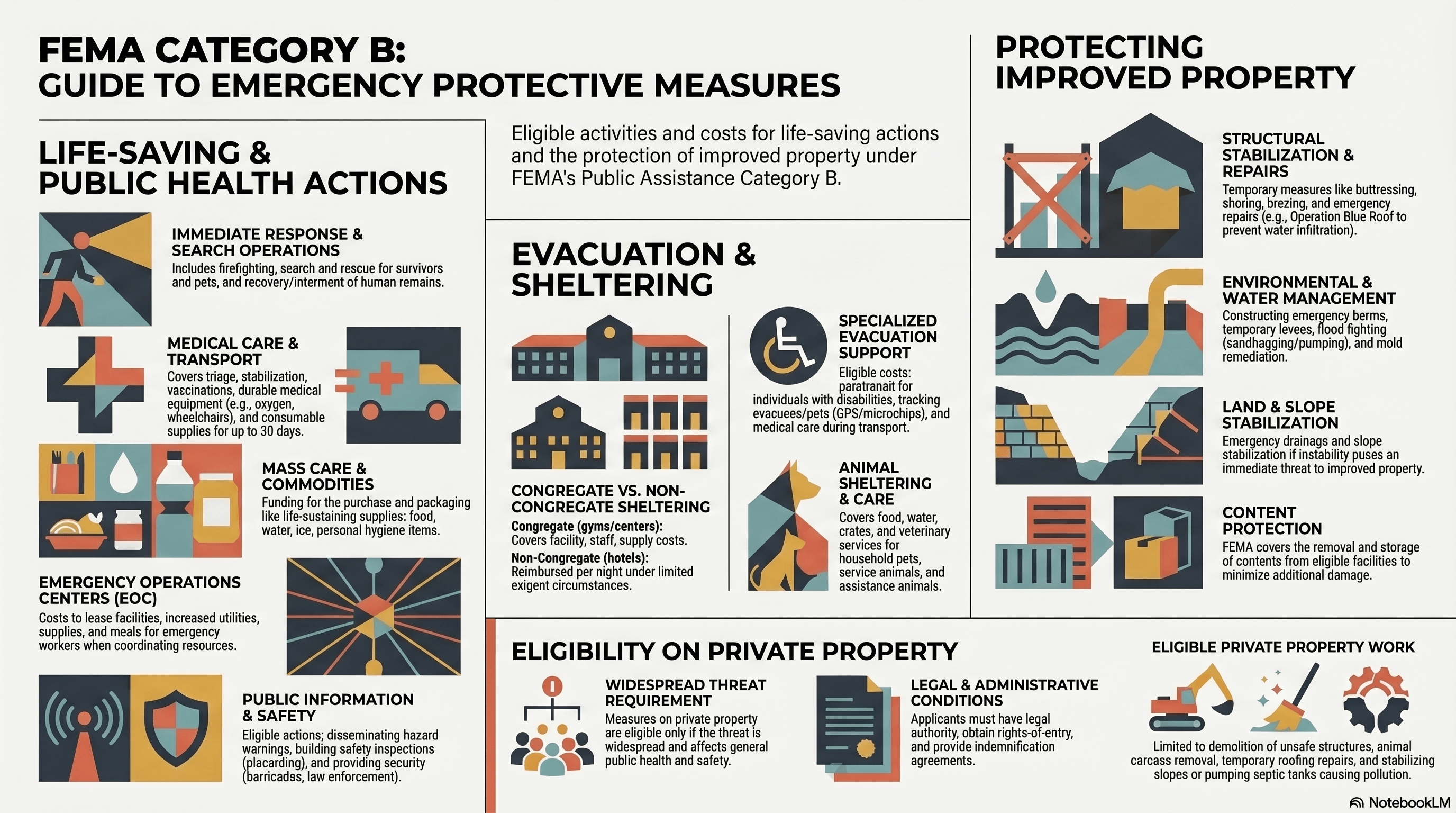
Eligible activities include a broad range of response actions designed to ensure public safety.
Core Eligible Measures
Category,Examples of Eligible Work
Response Logistics,Transporting/pre-positioning equipment; EOC operations; emergency access.
Public Safety,"Search and rescue; firefighting; security (barricades, law enforcement); building safety inspections."
Direct Care,Medical care and transport; evacuation and sheltering; childcare for sheltered populations.
Remains Management,Search/recovery of human remains; storage and interment of unidentified remains; mass mortuary services.
Public Information,"Warnings and guidance regarding health hazards via PSAs, flyers, or newspapers."
Emergency Medical Care
FEMA funds extraordinary costs associated with emergency medical delivery systems that are destroyed or overwhelmed.
- Time Limit: Generally eligible for up to 30 days from the declaration date.
- Eligible Costs: Triage, medically necessary tests, vaccinations for survivors/workers, 30-day prescription supplies for acute conditions, and temporary medical facilities.
- Ineligible Costs: Inpatient care after admission, long-term treatment, and administrative costs.
- Funding Order: FEMA is a secondary payer; applicants must verify that insurance, Medicare, or Medicaid have been pursued and do not exist.
III. Protecting Improved Property
Measures to protect improved property are eligible if they prevent further damage to existing facilities.
- Structural Stabilization: Buttressing, shoring, or bracing facilities to prevent collapse.
- Environmental Mitigation: Mold remediation (including removal of water-damaged materials), extracting water/mud/silt, and emergency slope stabilization.
- Emergency Repairs: Temporary measures such as covering damaged roofs to prevent rainwater infiltration.
- Animal Protection: Actions taken to save the lives of animals that are eligible for replacement.
IV. Sheltering Operations
Sheltering is divided into congregate and non-congregate environments, each with distinct regulatory requirements.
1. Congregate Sheltering
Congregate sheltering provides temporary refuge in group facilities (e.g., gymnasiums).
- Facility Costs: Lease/rent, utilities, minor modifications (ADA compliance), and restoration to pre-disaster condition.
- Staffing: Medical, veterinary, social workers, custodial, and National Guard personnel.
- Supplies: Meals, cots, hygiene kits, and basic communication tools (one TV per 50 people; one computer per 25 people).
- Support Services: Crisis intervention, translation, and care for individuals with disabilities.
2. Non-Congregate Sheltering (NCS)
NCS provides privacy (e.g., hotels, motels) and is only approved in exigent circumstances (e.g., congregate facilities are unavailable or damaged).
- Pre-Approval: Required for non-traditional facilities like RVs, ships, or short-term rentals.
- Funding Structure: Based on a per-night, per-room amount. Ancillary services (room service, movies) are ineligible.
- Eligibility Data: For extensions beyond 30 days, households must be registered with IA, be in a designated county, and have a primary residence determined to be uninhabitable.
- Weekly Reporting: Applicants must report data (IA ID, address, habitability status) to FEMA weekly to prevent duplication of benefits.
3. Animal Sheltering and Evacuation
FEMA distinguishes between types of animals for eligibility:
- Household Pets: Domesticated animals kept for pleasure (dogs, cats, birds, turtles).
- Service Animals: Specifically trained dogs (or miniature horses) that perform tasks for individuals with disabilities.
- Assistance Animals: Animals providing work, assistance, or emotional support for persons with disabilities.
- Ineligible: Reptiles (except turtles), farm animals, and animals kept for racing or commercial purposes.
V. Private Property and PNP Organizations
Eligibility for non-governmental entities is strictly governed to prevent the misuse of public funds.
Private Property Measures
FEMA may determine measures on private property are eligible if the threat is widespread and affects general public health. Required documentation includes:
- Detailed explanation of the applicant’s legal authority to enter private property.
- A basis for the determination of a public threat.
- Signed rights-of-entry and agreements to indemnify the federal government.
Private Nonprofit (PNP) Organizations
PNPs are generally responsible only for protecting their own eligible facilities.
- Emergency Services: Generally the responsibility of SLTT governments. PNPs may be reimbursed only if they provide services at the request of and certified by an SLTT government (e.g., a volunteer fire department with an established agreement).
- Evacuation: PNPs operating medical or custodial care facilities are eligible for direct reimbursement of patient evacuation costs.
VI. Temporary Relocation of Essential Services
If an essential community service facility is unsafe or destroyed, temporary relocation is eligible.
- Eligible Services: Education, emergency services (police/fire), medical care, polling places, and utilities.
- Ineligible Services: Museums, zoos, community centers, and houses of worship.
- Economic Choice: Applicants must choose the most economical option (lease, purchase, or construct) based on a cost analysis of at least three options.
- Time Limit: Emergency work is limited to 6 months. Extensions up to 12 months require FEMA approval; beyond 12 months, the applicant must have begun construction on the permanent facility.
VII. Specialized Protective Measures
Hazardous Materials
Eligible work includes the separation, stabilization, and disposal of pollutants and hazardous substances.
- Regulations: Must comply with RCRA, CERCLA, and CWA.
- Testing: Short-term testing to ensure the elimination of immediate threats is eligible; long-term cleanup testing is not.
Snow-Related Activities
Snow assistance must be specifically authorized in the declaration.
- 48-Hour Rule: Assistance is limited to a continuous 48-hour period designated by the applicant. A 24-hour extension is possible if snowfall exceeds historical records by 50%.
- Eligible Work: De-icing, salting, sanding, and snow removal for critical emergency needs.
Mosquito Abatement
Eligible only when an SLTT health official validates in writing that a mosquito population poses a specific health threat. FEMA calculates reimbursement by deducting the average expenses from the previous three non-disaster years from the current costs.
VIII. Operational Costs and Financial Management
Increased Operating Costs
Additional costs for services specifically related to eligible emergency actions are eligible for a limited timeframe.
- Eligible: Water testing, fuel for increased pump use, and emergency medical care (under specific conditions).
- Ineligible: Routine patient care, administrative activities, school make-up days, and staffing costs for individuals who did not perform eligible emergency work.
Meals for Emergency Workers
FEMA reimburses the cost of meals for employees and volunteers under severe conditions (e.g., extended work hours without time to provide for their own meals).
- Requirement: Meals must be provided in a cost-effective manner (e.g., bulk meals).
- Exclusion: Individual meals or group outings at restaurants are ineligible.
Damage Caused During Performance of Work
Repair of public property damaged during eligible emergency response or debris removal is eligible if the damage was:
- Due to severe conditions resulting from the incident.
- Unavoidable and not due to improper use.
- Note: Replacement of trees, shrubs, or crops is ineligible.
1. Eligibility Criteria
- Measures must address immediate threats to life, health, or safety, or prevent significant additional damage to improved property.
- Certification by appropriate officials may be required to confirm the threat and necessary actions.
2. Types of Eligible Measures
- Saving Lives & Public Health: Includes search and rescue, emergency medical care (up to 30 days), evacuations, sheltering, public information, and remains management.
- Protecting Property: Temporary stabilization (e.g., shoring, mold remediation, emergency repairs) to prevent further damage to public or eligible private property.
- Sheltering Operations:
- Congregate: Group shelters with eligible costs for facilities, staffing, supplies, and support services.
- Non-Congregate: Hotels/motels in special circumstances, requiring pre-approval and strict documentation.
- Animal Sheltering: Limited to household pets and service/assistance animals; farm and commercial animals are ineligible.
- Private Property: Work is only eligible if a widespread public threat exists, withwith strict legal and documentation requirements.
- Temporary Relocation: Essential services (e.g., police,police, fire, medical) may be temporarily relocated if facilities are unsafe, with a 6-month limit (extensions possible).
- Specialized Measures: Includes hazardous materials response, snow removal (48-hour rule), and mosquito abatement (with health official validation).
3. Operational and Financial Requirements
- Increased operating costs are eligible only if directly related to emergency actions and for a limited time.
- Meals for emergency workers are reimbursed only under severe conditions and must be cost-effective.
- Damage to public property during eligible emergency work is reimbursable if unavoidable.
- Rigorous documentation is required for all activities, especially for private property work and non-congregate sheltering, to prevent duplication of benefits.
These measures are designed to ensure rapid, effective response and stabilization during disasters, with strict eligibility, documentation, and cost-effectiveness requirements.