AI Strategy
Define high-impact GPT use cases, workflows, and implementation roadmaps for your team.
Learn moreLaunch intelligent workflows, automated support, and custom AI experiences with services designed for modern teams.
Define high-impact GPT use cases, workflows, and implementation roadmaps for your team.
Learn more
Create branded assistants that answer questions, qualify leads, and guide customers around the clock.
Learn more
Connect GPT to your internal tools to summarize data, draft content, and reduce repetitive tasks.
Learn more
Build scalable content engines for briefs, campaigns, product copy, documentation, and reports.
Learn more
Integrate GPT securely into apps, CRMs, support desks, knowledge bases, and custom platforms.
Learn more
Equip your team with practical prompt frameworks, governance guidance, and AI adoption playbooks.
Learn moreThis document outlines federal procurement and contracting requirements for applicants receiving Public Assistance (PA) funding from FEMA, emphasizing compliance, procedures, and documentation standards across different entity types.
Overview of Procurement and Contracting Requirements FEMA provides PA funding for contract costs based on adherence to federal procurement rules. Requirements vary for state, territorial, Tribal, local governments, and private nonprofits (PNPs). FEMA enforces remedies—denial of costs or partial reimbursement—if applicants do not comply, and may impose non-monetary actions as authorized.
Procurement and Contracting for State, Territorial, and Tribal Entities Applicants must follow federal procurement procedures at 2 C.F.R. § 200.317, which include using their own policies for federal and non-federal funds and complying with EPA guidelines on recovered materials. They must also include specific provisions in all contracts, such as remedies, termination clauses, equal employment opportunity, safety standards, environmental laws, debarment, anti-lobbying, and procurement of recovered materials. FEMA recommends additional provisions like changes clauses, record access, and compliance clauses, with exact language provided in FEMA’s Contract Provisions Guide. Time-and-materials or cost-plus-percentage contracts are permitted only with high oversight and under specific conditions due to their risk of non-compliance.
Procurement and Contracting for Local Governments and PNPs Local and PNP applicants must follow their own procedures, applicable laws, and federal regulations, with the more restrictive rules taking precedence. They should establish or update procurement policies, maintain standards of conduct, and create prequalified contractor lists based on qualifications and past performance. Federal requirements include ensuring full and open competition, promoting small and disadvantaged business participation, and conducting cost or price analyses for procurement above the simplified acquisition threshold. They must document procurement processes, including solicitation methods, evaluation, and selection rationale, and maintain records of contracts and oversight activities.
Procurement Methods and Noncompetitive Procurement Eligible methods include micro-purchase, small purchase, sealed bids, competitive proposals, and sole-source (noncompetitive) procurement. FEMA reimburses costs for noncompetitive contracts only under specific circumstances: item sole source, public exigency or emergency, FEMA or recipient authorization, or inadequate competition after multiple solicitations. Applicants must justify noncompetitive awards with detailed explanations, including the nature of the product or service, necessity, duration, efforts to ensure competition, and conflict of interest considerations. FEMA reviews these justifications and may disallow costs if non-compliance is found.
Contract Types and Oversight FEMA reimburses fixed-price, cost-reimbursement, and limited time-and-materials contracts, with oversight to ensure contractor performance. T&M contracts are only allowed if no other type is suitable, a ceiling price is established, and high oversight is maintained. Cost-plus-percentage contracts are prohibited due to lack of cost control incentives. Pre-positioned contracts, awarded before an incident, are reimbursable if compliant with procurement rules and relevant conditions are met. Cooperative purchasing programs are discouraged due to compliance risks, and piggyback contracts are generally not compliant.
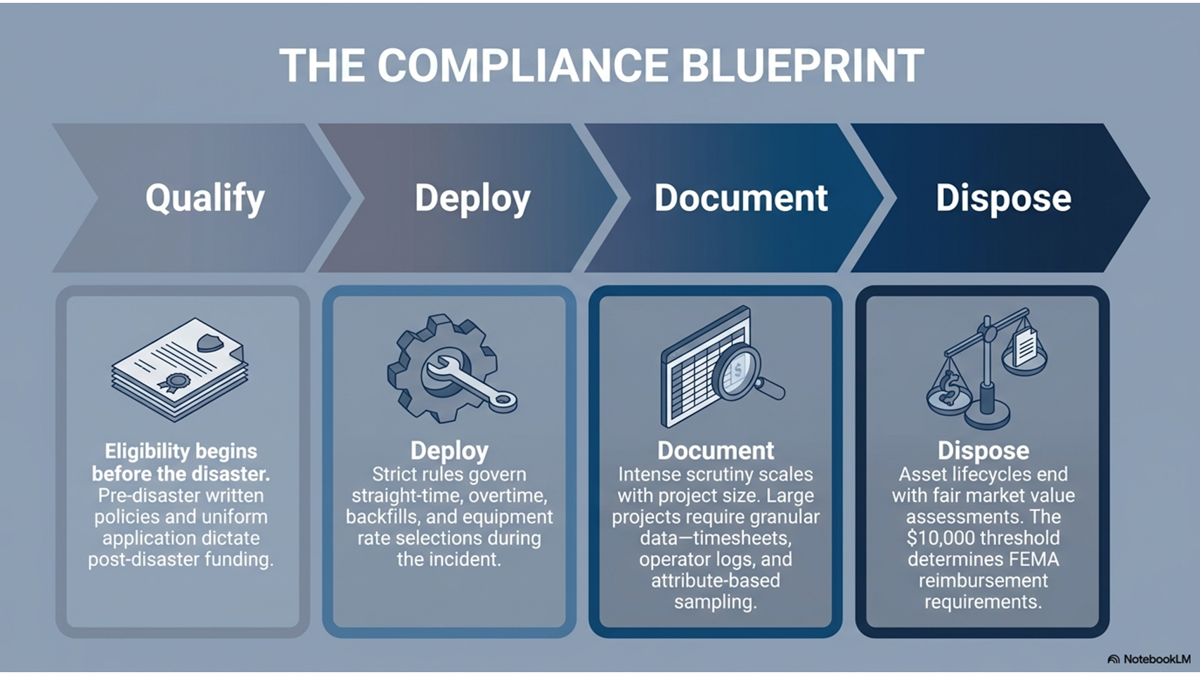
Documentation and Recordkeeping Applicants must provide detailed documentation supporting contract costs, including itemized costs, procurement documents, and oversight records. For small projects, this includes cost summaries, procurement methods, and contract details. Large projects require more extensive documentation, including invoices, selection processes, and oversight records, with FEMA conducting sampling reviews to verify compliance.
Overall, the document emphasizes strict adherence to federal procurement standards, thorough documentation, and justified procurement practices to ensure eligible and reasonable costs for FEMA reimbursement.