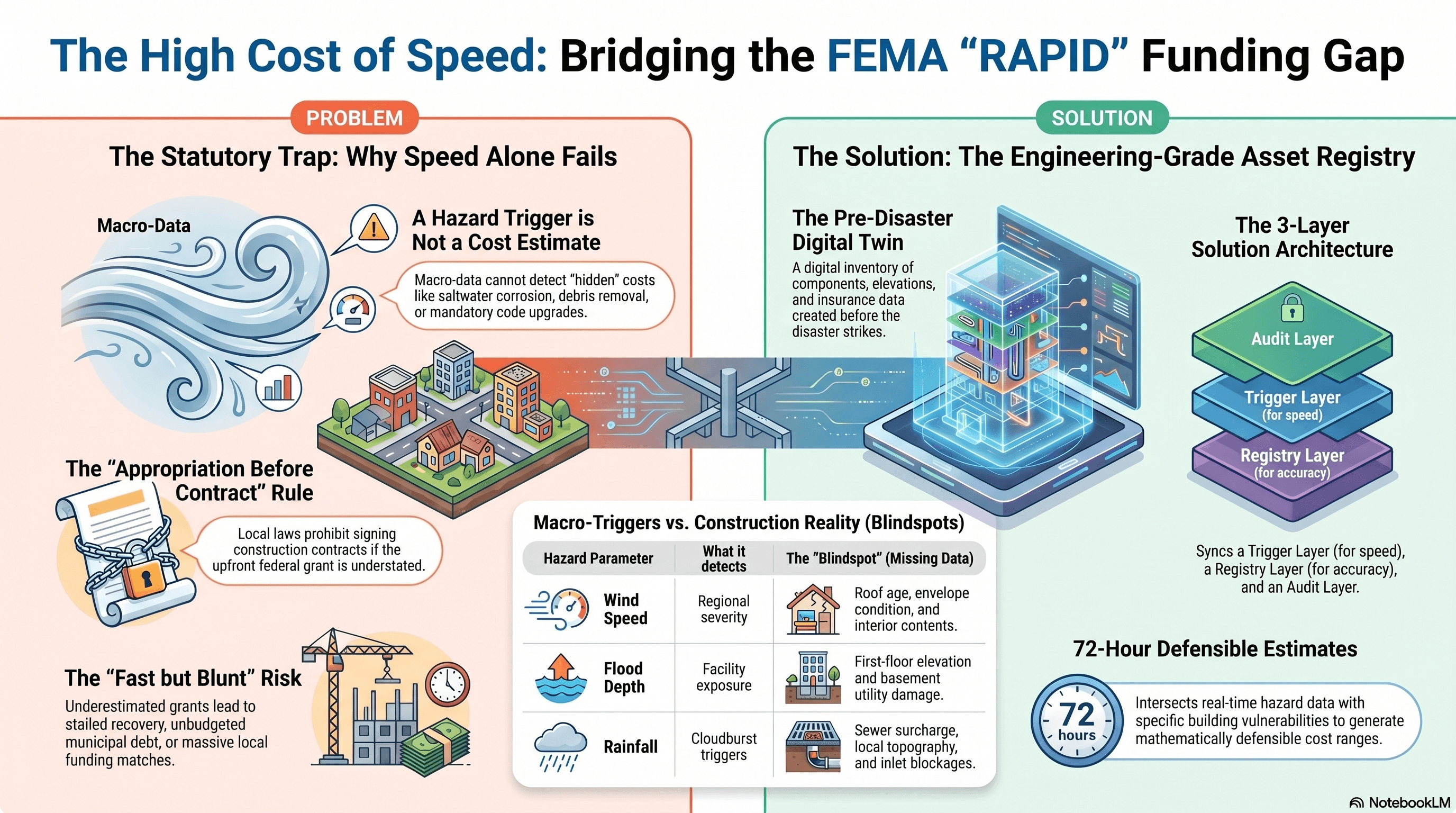
The Tri-Ledger Architecture: A Blueprint for Resilient Disaster Finance
1. Introduction: The High Cost of Speed
In the wake of a catastrophe, the friction of bureaucracy can be as damaging as the event itself. The federal government’s proposed solution is the RAPID model—a shift from slow, forensic reimbursement to upfront liquidity. However, as systems architects, we must recognize a fundamental truth: a disaster trigger is not a construction cost estimate. Moving money in 30 days is a significant achievement, but if that funding is decoupled from engineering reality, we aren't financing a recovery; we are financing a shortfall.Concept Callout: The RAPID Model RAPID (underpinned by legislative frameworks like H.R. 4669) is a funding reform designed to provide immediate liquidity to states and municipalities within 30 days of a disaster declaration. It replaces itemized site inspections with lump-sum formula grants triggered by objective hazard characteristics like wind speed or flood depth.While speed is a virtue in an emergency, accuracy is a legal and structural necessity. To bridge this tension, we utilize a Tri-Ledger Architecture —a system designed to ensure that rapid liquidity is both technically defensible and legally sufficient for a full recovery.
2. Layer 1: The Parametric Trigger (The "Forensic Liquidity" Switch)
Layer 1 acts as the system's "funding switch." It utilizes Parametric Triggers —objective, measurable indices that confirm an event has crossed a severity threshold. This layer provides "Forensic Liquidity," releasing funds based on what the hazard was , rather than what the damage is .However, Layer 1 suffers from "Basis Risk"—the gap between the macro-data of a storm and the micro-reality of a facility. To an architect, a flood trigger sees only a blue plane of water at a certain elevation; it cannot see the vulnerability of the specific components beneath that plane.
The Parametric Blindspot
Hazard Parameter,Utility,Basis-Risk Limitation
Wind Speed,Regional severity and event qualification.,"Does not know roof age, building envelope condition, or contents location."
Flood Depth,Facility exposure and equipment damage proxy.,"Does not know first-floor elevation, basement utilities, duration, or contamination."
Rainfall Intensity,Cloudburst and pluvial-flood triggers.,"Does not map sewer surcharge, local topography, or inlet blockage."
Earthquake PGA,Shaking intensity and structural damage screening.,"Does not know retrofit status, soil amplification, or equipment anchorage."
Key Insight: A parametric trigger is blind to engineering specifics. For example, in a Wastewater Pump Station (Asset ID: P-3056) , a flood elevation of +15.0 ft may be a regional trigger, but the trigger does not know if the SCADA control panels are elevated or if the submersible pump bearings and electrical switchgear have been inundated. If Layer 1 is the "switch," we require a more robust "engine" to determine the actual fuel—the funding—required for the mission.
3. Layer 2: The Asset Registry (The "Infrastructure for Costing")
The second layer is the Engineering-Grade Asset Registry , or the "Digital Twin." This is not merely a list; it is a high-resolution data environment. Legacy insurance "Statements of Values" (SoV) are often simple spreadsheets with addresses and lump-sum values. A reformed Registry, however, provides the granular detail required for defensible estimating:
- Component-Level Data: Tracks specific MEP (Mechanical, Electrical, Plumbing) elevations, roof types, and structural systems.
- Engineering Fields: Includes Lat/Lon footprints, first-floor elevations, and backup power configurations.
- Costing Rigor: Integrates RSMeans equivalent unit-cost assemblies and local demand-surge factors.
- Auditability: Links to pre-event "freeze-event" condition baselines to eliminate disputes over pre-existing damage.
5 Questions the Registry Must Answer within 72 Hours
- What assets were exposed? (Uses geospatial footprints and facility hierarchy).
- How intense was the hazard at each asset? (Intersects hazard grids with specific component elevations).
- Which components are vulnerable? (Identifies locations of SCADA, switchgear, and motors).
- What is the probable repair or replacement cost? (Applies damage ratios and local cost indices).
- What portion is eligible or insured? (Automates Duplication of Benefits (DOB) tracking by pre-linking policy schedules and sublimits).
The Fast-Track Estimating Pipeline
To transform raw hazard data into a facility-specific cost range in days, the Registry follows a six-step workflow:
- Pre-Event Baseline: "Freezes" the inventory and condition data as an auditable pre-loss file.
- Event Hazard Ingestion: Loads authoritative wind/flood/shake data within 24–72 hours.
- Exposure Intersection: Determines which specific assets were hit and at what intensity.
- Damage-to-Cost Engine: Applies vulnerability curves and unit costs (replacement values) to create an initial range.
- Eligibility & Insurance Split: Separates FEMA-eligible costs from insured amounts to prevent DOB violations.
- Field Validation Triage: Prioritizes physical inspections for complex "Lifeline" assets like hospitals or power plants.Even a perfect engine needs a "logbook" to prove to federal auditors that every dollar was spent appropriately under the law.
4. The Local Statutory Trap: Why Accuracy is Mandatory
Without an accurate Asset Registry, the RAPID model isn't just fast—it’s a Financial Risk Transfer from the federal government to the local municipality. Speed is the bait, but the lack of data is the hook.Municipalities operate under rigid legal frameworks that make grant accuracy a prerequisite for action:
- Dillon’s Rule Framework: Many states require a "Certificate of Obligation," where a CFO must certify that funds are actually in the treasury before a contract is executed. Contracts signed without explicit funding are ultra vires (void).
- Home Rule Framework: While more flexible, these charters still mandate strict "appropriation before contract" ordinances.WARNING: The Failure Chain Understated Grant ➔ Local Funding Shortfall ➔ Legal Inability to Contract ➔ Stalled RecoveryIf a fast federal grant is too small because it was based on a "blunt" trigger rather than a Registry, the project stalls. Local taxpayers then become 100% exposed to cost overruns because the federal "safety net" was traded away for speed. Layer 3 is the safety net that prevents this trap from snapping shut.
5. Layer 3: The Audit & Reconciliation Ledger (The "Integrity Layer")
The third ledger validates spending and eligibility after the initial funding release. It ensures that the system can adjust to reality—specifically through Contract-Award Adjustments (Recommendation 4). The bid market is the first reliable test of actual construction cost; Layer 3 allows the grant to be "trued up" when real-world pricing differs from the early digital estimate.
Understanding Estimate Classes
To maintain fiscal integrity, the system classifies estimates by their maturity, preventing early guesses from being treated as final certainties.| Estimate Class | Usage Rules || ------ | ------ || Class R-1: Parametric Advance | Permitted: Immediate liquidity and state cash-flow planning. Prohibited: Use as a final fixed-cost grant. || Class R-2: Registry-Based Initial | Permitted: Allocation and inspection triage. Prohibited: Use for final project closeout. || Class R-3: Engineer-Validated | Permitted: Initial valuation for simpler assets. Prohibited: Final valuation for complex lifeline/SCADA assets. || Class R-4: Contract-Award | Permitted: Refinement of obligations based on bid market. Prohibited: Use to avoid procurement review. || Class R-5: Final Reconciled | Permitted: Audit, closeout, and final DOB check. Prohibited: Reopening the file absent fraud or material error. |
6. Conclusion: Balancing Liquidity and Fiscal Accuracy
The Tri-Ledger Architecture represents the future of resilient recovery. By separating the Trigger (the switch), the Registry (the engine), and the Audit (the logbook), we create a system that respects the immediate need for cash without violating the statutory requirements of municipal finance.We must move beyond the "black box" of formula grants and toward an engineering-grade transparency that protects local taxpayers and federal interests alike.Final Takeaway "Without an enhanced facility and risk-metrics registry, upfront funding risks becoming fast but blunt. With a mature registry, FEMA reform can become a defensible system for rapid cost estimating, insurance integration, local allocation, audit closeout, and long-term resilience."