FEMA Public Assistance Policy: Category A – Debris Removal Operations
I. EXECUTIVE SUMMARY
Category A debris removal operations represent a critical juncture in disaster recovery, serving as both a primary driver for community stabilization and a significant area of fiscal exposure for State, Local, Tribal, and Territorial (SLTT) governments. Efficient debris management is essential for eliminating immediate threats to public health and safety, restoring access to vital infrastructure, and catalyzing the economic recovery of the community. However, the scale and complexity of these operations necessitate a rigorous approach to fiscal stewardship. Because FEMA Public Assistance (PA) funding is contingent upon strict adherence to federal eligibility criteria, administrative precision is as vital as the physical clearance of debris.This document provides a comprehensive overview of the policy framework governing Category A operations. It outlines foundational eligibility mandates—centering on the "public interest" threshold—and details specific requirements for various debris types, including hazardous vegetation, waterway obstructions, and abandoned vehicles. It distinguishes the scope of eligibility for SLTT governments versus Private Non-Profit (PNP) applicants and addresses technical nuances such as the "2-foot rule" for waterways and root-ball exposure thresholds for hazardous trees. Furthermore, it addresses the technical requirements of disposal site management, the legal complexities of Private Property Debris Removal (PPDR), and mandatory monitoring protocols. By synthesizing these operational and regulatory requirements, this guide establishes a clear roadmap for achieving full federal reimbursement while maintaining compliance with environmental and historic preservation standards. Success in these operations begins with a thorough understanding of the specific compliance requirements that dictate FEMA eligibility.
II. KEY TAKEAWAYS FOR ELIGIBILITY AND COMPLIANCE
Navigating the FEMA PA program requires an uncompromising commitment to regulatory detail. Strict adherence to eligibility criteria is the primary safeguard against the de-obligation of federal funds during post-disaster audits. Applicants must ensure that every action taken is documented as necessary and falls within the prescribed legal and geographic boundaries.
A. Core Eligibility Mandates
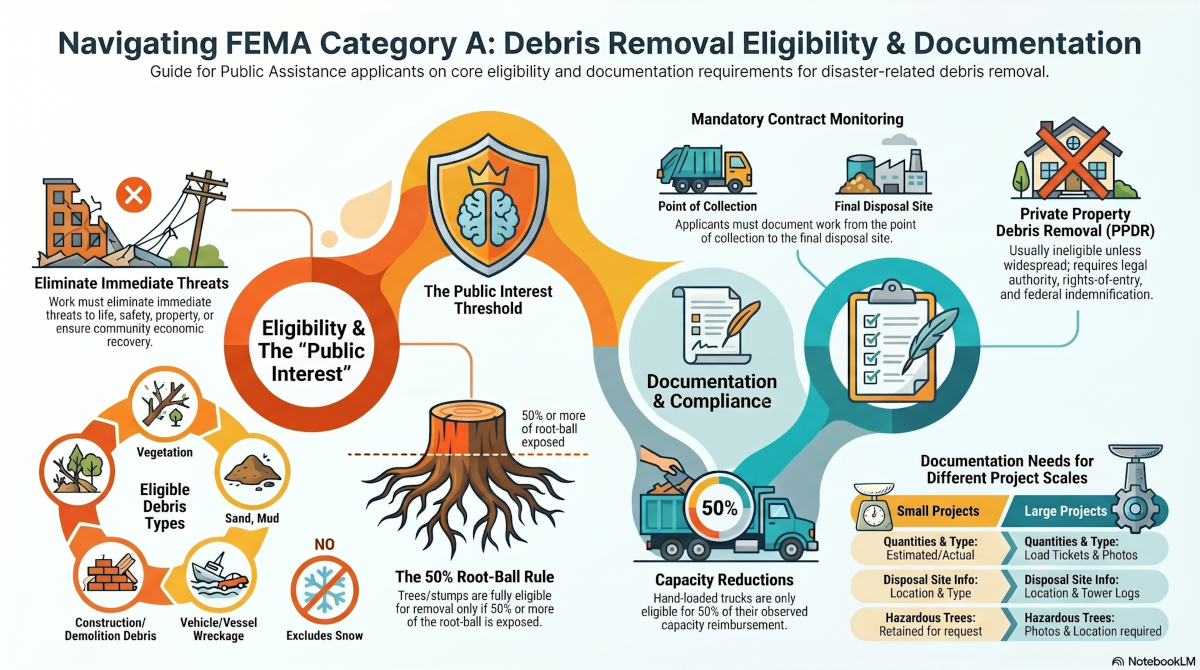
For debris removal to be eligible for PA funding, it must be in the public interest , defined by four specific conditions:
- Eliminate immediate threats to life, public health, and safety.
- Eliminate immediate threats of significant damage to improved public or private property.
- Ensure economic recovery of the affected community (generally restricted to large commercial areas where coordinated removal is vital for community restoration).
- Support Hazard Mitigation Grant Program (HMGP) land management (specifically the removal of structures to convert acquired property to open space, recreation, or wetlands).
B. Critical Exclusions
Certain materials and locations are strictly ineligible for Category A funding:
- Snow: Activities related to snow-clearing are not considered debris operations; snow is not a form of debris.
- Agricultural Land: Debris removal from land used for agriculture is ineligible.
- Unimproved Land: Naturally wooded or unused areas do not qualify.
- Federally Maintained Waterways: Channels under the jurisdiction of the U.S. Coast Guard (USCG) or U.S. Army Corps of Engineers (USACE) are ineligible for FEMA PA funding.
C. PNP Applicant Limitations
For a Private Non-Profit (PNP) applicant, eligible debris removal is strictly limited to that associated with an eligible facility, including debris on the property of that facility.Once the overarching eligibility mandates are confirmed, the applicant must then categorize debris by type to determine the appropriate monitoring and disposal track.
III. DEFINING DEBRIS TYPES AND GEOGRAPHIC SCOPE
Accurate classification of materials is a fundamental requirement for reporting and reimbursement. FEMA distinguishes between various debris types, each carrying unique disposal and documentation requirements.
A. Categorization of Eligible Materials
Eligible materials include, but are not limited to:
- Vegetative Debris: Trees, limbs, and brush.
- Construction and Demolition (C&D): Building materials from damaged structures.
- Earth and Sediment: Sand, mud, silt, gravel, rocks, and boulders.
- Wreckage: "White goods" (appliances) and vehicle or vessel wreckage.
B. Eligible Locations and Rights-of-Way (ROW)
Debris left by the incident on improved public property and public Rights-of-Way (ROW), including federal-aid roads, is eligible.
1. Residential vs. Commercial Debris in ROW
SLTT governments may authorize residents to move incident-related debris from residential, non-commercial properties to public ROWs for collection. However, commercial debris placed on the ROW is strictly ineligible for removal, as commercial businesses are expected to manage debris through private insurance. Additionally, materials from the construction or repair of structures are ineligible.Properly identifying the origin of debris ensures only eligible costs are claimed, particularly when managing the high-volume complexities of hazardous vegetation.
IV. HAZARDOUS VEGETATION: LIMBS, TREES, AND STUMPS
Funding for the removal of vegetative hazards is predicated on the "immediate threat" threshold. Hazards located in natural areas that do not threaten improved property or public-use areas (e.g., sidewalks, playgrounds) are ineligible.
A. Hazardous Limbs and Branches
1. Eligibility Thresholds
Removal of broken limbs or branches is eligible if they pose an immediate threat, such as hanging over improved property or public-use areas. FEMA adheres to a "minimum cut" rule : only the cut necessary to eliminate the threat is funded. Cutting a branch at the trunk is ineligible if the hazard could be mitigated by cutting at the closest main branch junction.
B. Hazardous Tree Removal
1. Root-Ball Exposure Criteria
FEMA applies strict physical standards for tree removal based on root-ball exposure:
- $\ge$ 50% Root-Ball Exposed: Removal of the tree, removal of the root-ball, and filling the resulting hole are eligible. FEMA will not reimburse two separate unit costs for the tree and its root-ball.
- < 50% Root-Ball Exposed: Funding is limited to a flush cut at ground level and disposal of the cut portion. Grinding the residual stump is strictly ineligible.
2. Professional Assessment Requirements
To validate immediate threats, FEMA recognizes assessments from:
- Certified Arborists.
- Individuals with Tree Risk Assessment Qualification (TRAQ).
- Registered Professional Foresters.
C. Hazardous Stump Removal
1. Extraction and Environmental Consultation
Stump extraction ( $\ge$ 50% root-ball exposed) in areas with high potential for archaeological resources requires consultation with the State Historic Preservation Officer (SHPO) or Tribal Historic Preservation Officer (THPO) through FEMA Environmental and Historic Preservation (EHP). Work must stop immediately if resources are discovered.
i. Contracted Stump Removal Costs (Price-Check)
Applicants must ensure that per-stump contract pricing includes extraction, transport, disposal, and filling the root-ball hole . If a price excludes hole-filling, the per-unit cost may be questioned for reasonableness. Stumps not requiring extraction (root-ball < 50%) are funded only by volume or weight as standard debris.While terrestrial debris follows physical markers, debris in aquatic environments introduces complex jurisdictional boundaries.
V. WATERWAY DEBRIS REMOVAL AND JURISDICTIONAL BOUNDARIES
Waterway operations require intense inter-agency coordination to prevent the duplication of benefits, as multiple federal agencies hold statutory authority.
A. Navigable vs. Non-Navigable Waterways
1. Navigable Waterway Depth Limits
For applicants with legal responsibility for a navigable waterway, removal is eligible to a maximum depth of 2 feet below the low-tide draft of the largest vessel that used the waterway pre-incident. Debris below this depth is ineligible unless it is necessary to remove debris extending into the eligible zone.
2. Non-Navigable Waterway Obstructions
Debris removal from natural or constructed channels (including flood control works) is eligible only if it:
- Obstructs or could obstruct intake structures.
- Threatens structures like bridges and culverts.
- Presents a flooding risk to improved property during a 5-year flood event (20% annual chance of occurrence).
B. Identifying Debris Impact Locations
Applicants are responsible for identifying incident-deposited debris. Random surveys to look for debris, including surveys using side-scan sonar, are ineligible. PA funding for side-scan sonar is only eligible if the applicant identifies a specific impact area and demonstrates a need to identify a specific immediate threat.
C. Federal Agency Coordination
Applicants must coordinate with USACE/USCG for navigable channels, the EPA for hazardous materials in inland water areas, and the NRCS for debris under the Emergency Watershed Protection (EWP) program to avoid duplication of benefits.These boundaries extend to the management of private assets, such as vehicles, deposited on public lands.
VI. ABANDONED VEHICLES AND VESSELS ON PUBLIC PROPERTY
Removing private property from public lands requires a specific legal and administrative foundation to ensure the applicant has the right to move the asset and that FEMA is not paying for costs covered by insurance.
A. Conditions for Eligibility
Removal is eligible only if:
- The vehicle/vessel blocks access to a public-use area.
- The asset is abandoned .
- The applicant follows all SLTT ordinances for private property removal.
- The handling is fully documented .
B. Cost Recovery and Insurance
Applicants must attempt to identify owners and pursue insurance for removal and storage costs. Any recovered funds must be credited to FEMA.Effective management of all debris culminates in strategic disposal and site management.
VII. DISPOSAL OPERATIONS AND SITE MANAGEMENT
Strategic disposal focuses on volume reduction to minimize landfill tipping fees and environmental impact.
A. Volume Reduction and Recycling
FEMA encourages mulching, grinding, or burning to reduce volume.
1. Revenue Handling
FEMA reduces PA funding by the amount of any recycling revenue received. Applicants may deduct administrative and marketing costs from the total revenue before the FEMA credit is applied.
B. Temporary Debris Staging and Reduction Sites (TDSRs)
Eligible costs for TDSRs (Temporary Debris Staging and Reduction Sites) include property leasing and eventual land restoration to pre-disaster conditions as required by the lease agreement.
C. Load Compaction and Truck Capacity Reductions
FEMA applies capacity reductions based on loading methods:
- Hand-Loaded: Limited to 50% of the debris monitor's observed capacity for vegetative debris due to lower compaction.
- No Solid Tailgate: Maximum funding is 85% of certified capacity (a 15% reduction).
D. Landfill Tipping Fees
1. Eligible vs. Ineligible Fee Components
- Eligible: Fixed and variable costs directly related to operations, including labor, maintenance, permits, and recycling tax .
- Ineligible: Special taxes for other government services or the "loss of capacity" value of the landfill.Monitoring these operations is the only way to ensure technical reductions and costs are applied accurately.
VIII. MONITORING AND DOCUMENTATION REQUIREMENTS
Documentation is the primary evidence for reimbursement. It is the applicant's responsibility to provide oversight.
A. Debris Monitoring Operations
Monitors must observe the process from collection to final disposal. FEMA considers it unreasonable and not cost-effective to use professional engineers or highly qualified staff for monitoring without justification; such costs may be de-obligated. FEMA provides training for force account monitors upon request.
B. Documentation Matrix by Project Size
The level of documentation scales with project size, but all projects must comply with Environmental and Historic Preservation (EHP) requirements.
- Small Projects: Estimated quantities, disposal locations, and permits. Documentation of coordination with other agencies and Invasive Species Quarantine compliance (Name of area, disposal method, and confirmation of quarantine requirement adherence).
- Large Projects: All Small Project requirements plus Load Tickets , Photographs , Tower Logs , and proof of monitoring. For hazardous vegetation, applicants must retain location data and photos supporting the immediate threat.In exceptional cases, work extends onto private property.
IX. PRIVATE PROPERTY DEBRIS REMOVAL (PPDR) PROTOCOLS
PPDR is generally ineligible because debris on private property is typically the owner's responsibility. To receive PA funding, the applicant must meet a "Public Interest" threshold.
A. PPDR Eligibility Determination
1. Documentation Requirements (Table 22)
Before funding, applicants must provide:
- Legal Authority: Statement certifying the legal authority and responsibility to remove debris, citing specific laws/ordinances.
- Indemnification: Agreement to hold the Federal government harmless for claims.
- Rights-of-Entry (ROE): Permission from property owners.
B. Specialized Property Types
1. Private Roads
Debris removal is eligible if the public has unrestricted access (no gates or guards) and uses the road frequently. Restricted or rarely used private roads require additional justification to meet the public interest determination.
2. Private Commercial Property
Removal is rare and exceptional . It typically requires FEMA Regional Administrator approval and is only considered for critical facilities or where debris is heavily concentrated and insurance is insufficient.
X. COMPLIANCE CHECKLIST FOR PUBLIC ASSISTANCE REIMBURSEMENT
Successful project closeout depends on diligent record-keeping. Grant Managers and CFOs should utilize the following checklist to ensure Category A activities remain eligible.
A. Essential Actions for Compliance
- Verify Root-Ball Exposure: Ensure all uprooted trees and stumps removed meet the 50% exposure threshold for extraction funding; confirm <50% exposure stumps were only flush-cut.
- Confirm Grinding Ineligibility: Ensure no costs are claimed for grinding residual stumps where root-ball exposure was <50%.
- Navigable Waterway Depth: Confirm debris removal in navigable waterways did not exceed 2 feet below the low-tide draft of the largest pre-incident vessel.
- Random Survey Prohibition: Verify that no random side-scan sonar surveys were conducted; ensure any sonar use was tied to a specific, identified threat.
- Monitor Qualification Check: Review monitoring staff qualifications to ensure costs are "reasonable" and not over-qualified (e.g., unnecessary use of professional engineers).
- Apply Load Reductions: Document and apply 50% capacity reduction for hand-loaded trucks and 15% for trucks without solid tailgates.
- Track Recycling/Salvage Revenue: Maintain records of all salvage revenue to correctly offset project costs, minus administrative/marketing expenses.
- Check USACE/USCG Jurisdiction: Verify that debris was not removed from federally maintained channels to avoid duplication of benefits.
- Invasive Species Compliance: If in a quarantine area, document the disposal method and adherence to quarantine requirements.
- Secure Rights-of-Entry: For all PPDR work, obtain signed ROEs and hold-harmless agreements before work begins.
- Stump Extraction Price-Check: Verify that per-stump contract prices include extraction, transport, disposal, and filling the hole .
- Insurance Recovery: Pursue owner insurance for vehicles/vessels and PPDR, ensuring credits are applied to FEMA funding.