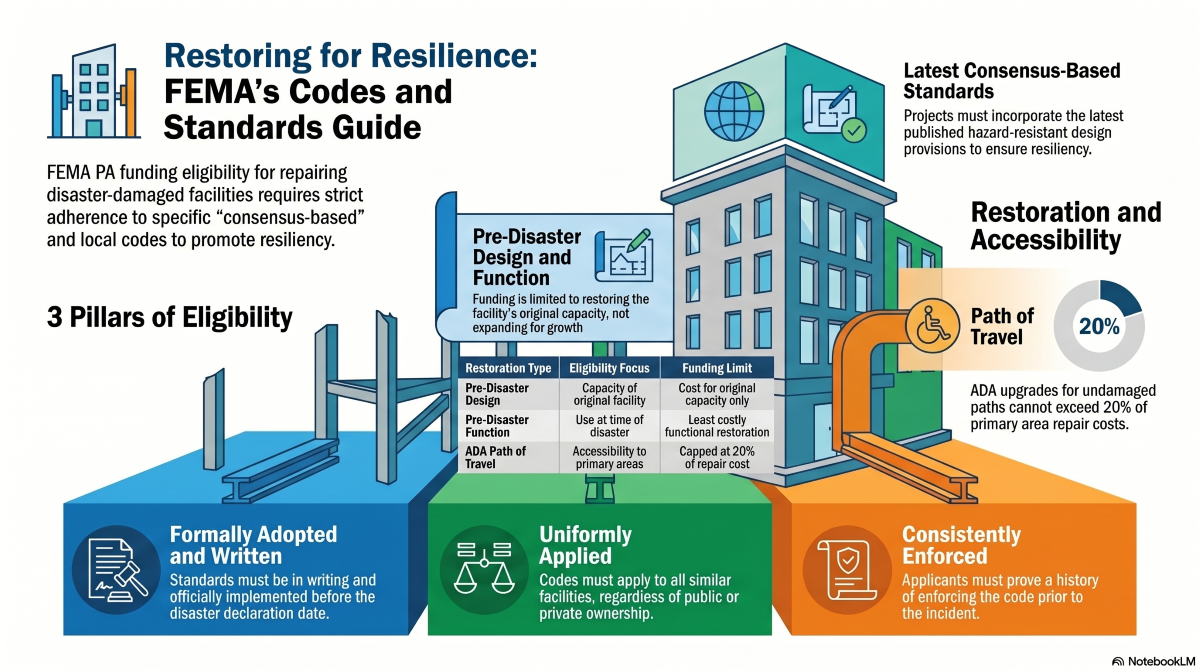
FEMA Public Assistance: Regulatory Framework for Codes and Standards Compliance
I. Executive Summary
Codes and standards serve as the essential foundation for disaster resilience and are the primary determinants of federal funding eligibility within the FEMA Public Assistance (PA) program. By requiring adherence to established design and construction benchmarks, FEMA ensures that restoration projects do not merely return facilities to their pre-disaster state but proactively reduce future risk through hazard-resistant provisions. The strategic funding landscape is governed by a dual framework: mandatory consensus-based codes for critical infrastructure (pursuant to Section 1235(b)) and locally adopted regulations that must pass a rigorous federal eligibility test. Navigating this environment requires a precise understanding of the intersection between a facility's pre-disaster design, the specific regulatory triggers that necessitate upgrades, and specialized constraints—most notably the 20% funding limitation on Americans with Disabilities Act (ADA) "path-of-travel" improvements. Ultimately, while codes can expand project scope, the baseline for restoration is tethered to the least costly method of restoring pre-disaster function, and failure to document compliance meticulously can lead to the total deobligation of grant funds.
II. Fundamental Principles of Restoration: Design vs. Function
Distinguishing between "Design" and "Function" is the critical first step in determining the "cap" or ceiling for eligible funding. These principles ensure that FEMA funds the restoration of a facility’s actual utility rather than aspirational or unused capacity.
A. Restoring to Pre-Disaster Design
Funding for the replacement or repair of a facility is strictly limited to the capacity for which it was originally designed. For example, if a school designed for a capacity of 100 students is damaged beyond repair, the eligible funding for a replacement facility is limited to what is necessary for 100 students. This remains true even if the school’s actual attendance exceeded 100 students prior to the disaster; the original design capacity, not the actual population, dictates the funding limit.
B. Restoring to Pre-Disaster Function
Eligibility is also dictated by how the facility was actually being used at the time of the incident. If an applicant is using an office building as a storage facility at the time of the disaster, and it is less costly to restore the facility as a storage facility than as an office, only the repairs necessary to restore the storage function are eligible.The baseline for federal assistance is always the least costly restoration to the actual pre-disaster function. These fundamental limits serve as the funding ceiling, which may only be legally expanded when specific, eligible codes and standards are triggered.
III. Consensus-Based Codes, Specifications, and Standards
Pursuant to Section 1235(b), FEMA utilizes a strategic framework of consensus-based requirements to promote resiliency and achieve risk reduction. These standards provide a mandatory benchmark for disaster-resistant design in the execution of permanent work.
A. Application and Scope
FEMA’s consensus-based codes apply to permanent work projects for the following facility types:
- Buildings
- Electric power facilities
- Roads and bridges
- Potable water and wastewater facilitiesStrategic Impact: These standards represent the minimum design criteria. Their application is mandatory for all eligible repair, replacement, or new construction projects—including improved and alternate projects. If an applicant elects to change the function of a facility (an improved project), the consensus-based codes apply to the new function or capacity of that facility. Adherence is essential for the long-term viability of the grant; failure to incorporate these provisions will result in the denial or deobligation of funding.
B. Identification and Documentation Requirements
Applicants must identify which codes apply to each damaged component and provide a compliance description including:
- Affected Elements: Identification of specific components and how the code applies.
- Damage Inventory: Inclusion of specific damage inventory line item numbers.
- Dimensions and Quantities: Precise measurements for all restoration components.
- Direct Relationship: A description of how the disaster damage necessitates the upgrade, particularly for any upgrades to undamaged elements.
C. Verification, Waivers, and Funding Consequences
Compliance must be validated by the applicant and verified by FEMA. Proof of compliance typically requires a written certification from a registered engineer or design professional.Waiver Conditions: While these codes are mandatory, the Regional Administrator may approve a waiver if:
- The jurisdiction has adopted codes with hazard-resistant elements equal to or greater than FEMA’s requirements.
- Implementation is technically infeasible.
- Implementation would create an extraordinary burden on the applicant.
- The upgrade would adversely affect a historic property (National Register of Historic Places).
IV. Eligibility Criteria for Codes and Standards
For any code or standard (federal or SLTT) to be eligible for PA funding under 44 C.F.R. § 206.226(d), it must pass a five-part test.
A. Application to Restoration Type and Pre-Disaster Use
The code must specifically apply to the type of restoration (repair vs. replacement). For example, a zoning requirement for a new parking garage is ineligible if the garage has no direct relationship to the disaster-related repairs of an existing building. Regarding use, FEMA funds the least costly of the following:
- Restoration to pre-disaster use (if serving its original design function).
- Restoration to alternate use (if serving an alternate function at the time of the incident, such as a warehouse used as a classroom).
B. Technical Defensibility and Reasonableness
FEMA evaluates whether the "trigger" for a code-required upgrade is reasonable based on the extent of the damage.So What? To prevent "gold-plating," FEMA determines if an upgrade is "technically defensible" from an engineering perspective. A massive upgrade triggered by negligible damage may be deemed unreasonable and ineligible.
C. Formal Adoption, Uniformity, and Enforcement
A code must be in writing and formally adopted on or before the disaster declaration date. Additionally, the code must meet three tests for Uniform Application :
- Uniform Accountability: It must provide for the same accountability for noncompliance across all sectors.
- No Discretionary Enforcement: Building officials cannot have the discretion to waive the code for some and enforce it for others.
- No Selective Application: The code must be applied regardless of the cause of damage (e.g., it also applies to private renovations) and regardless of the source of funding.
V. Specialized Compliance: Structural Damage and Accessibility
Specific "triggers" often necessitate upgrades that extend beyond the immediate disaster-damaged elements.
A. Substantial Structural Damage (IEBC Criteria)
Under the International Existing Building Code (IEBC), "Substantial Structural Damage" (SSD) is a critical threshold defined by capacity loss in gravity load-carrying elements. If SSD is reached, it triggers a requirement to evaluate and potentially upgrade the facility’s lateral-force-resisting elements (seismic/wind bracing).Critical Requirement: Only an evaluation by a licensed professional in compliance with IEBC criteria can determine SSD. This evaluation is the only mechanism to unlock funding for undamaged lateral elements.
B. Accessibility (ADA) and Path of Travel
The ADA and Architectural Barriers Act (ABA) require that repairs affecting a facility's usability comply with accessibility standards. This often triggers "Path of Travel" requirements.
- Path of Travel Elements: As illustrated in SOURCE_IMAGE_1 , this includes a continuous pedestrian passage to the Primary Function Area , encompassing:
- Entrances, sidewalks, and streets.
- Accessible parking and public transit drop points.
- Service facilities (restrooms, water fountains, and public telephones).The 20% Funding Cap: While compliance is mandatory, PA funding for "Path of Travel" upgrades is capped at 20% of the total cost to restore the Primary Function Area. For calculation purposes, the "total cost" of the Primary Function Area includes the restoration of the roof, HVAC systems, mechanical rooms, janitorial closets, locker rooms, and private offices directly associated with that area. If costs exceed 20%, the applicant must prioritize elements providing the greatest degree of access.
VI. Key Takeaways for Compliance
For Government CFOs and Grant Managers, maintaining compliance is a matter of administrative discipline and rigorous documentation.
- Eliminate Discretion: Discretionary decisions by local officials (e.g., a permit officer recommending a bridge instead of a culvert) are generally ineligible. Funding is only available for mandatory, written, and formally adopted standards.
- The Uniformity Rule: If a code is only enforced when federal money is available, or if it is not applied to private renovations, it fails the uniformity test and the entire upgrade becomes ineligible.
- No "Gold-Plating": Every upgrade to an undamaged component must have a documented direct relationship to the disaster damage or a specific, non-discretionary code trigger.
VII. Compliance Checklist: Essential Actions
This checklist serves as a roadmap for project development and audit-readiness.
- Code Adoption and Prior Enforcement
- Confirm the code was formally adopted in writing before the disaster declaration date.
- Verify a history of previous enforcement (Applicants cited for ADA violations prior to the disaster are ineligible for those specific upgrade funds).
- Professional Certification and Evaluation
- Obtain written certification from a registered design professional (e.g., PE) for code compliance.
- For structural claims, ensure a licensed professional has performed an IEBC-compliant SSD evaluation to trigger lateral-force upgrades.
- Uniformity and Implementation Audit
- Document that the code is applied regardless of the source of funding.
- Verify the code is applied to private sector renovations/improvements.
- Accessibility and Capping Analysis
- Define the "Primary Function Area" and identify all "Path of Travel" elements.
- Calculate the 20% cap including the cost of associated HVAC, roof, and locker room repairs.
- Document the prioritization of accessibility elements if costs exceed the 20% threshold.
- Detailed Documentation of "Direct Relationship"
- Link every code-required upgrade to a specific damage inventory line item.
- Provide design drawings, dimensions, and quantities for all upgrades to undamaged elements.Action Item: Applicants lacking internal expertise should utilize Technical Assistance (A&E) funding . FEMA may approve PA funding for architectural and engineering design to ensure all required codes and standards are correctly implemented, preventing the risk of future deobligation.