FEMA Public Assistance: Facility and Work Eligibility Regulatory Analysis
I. Summary
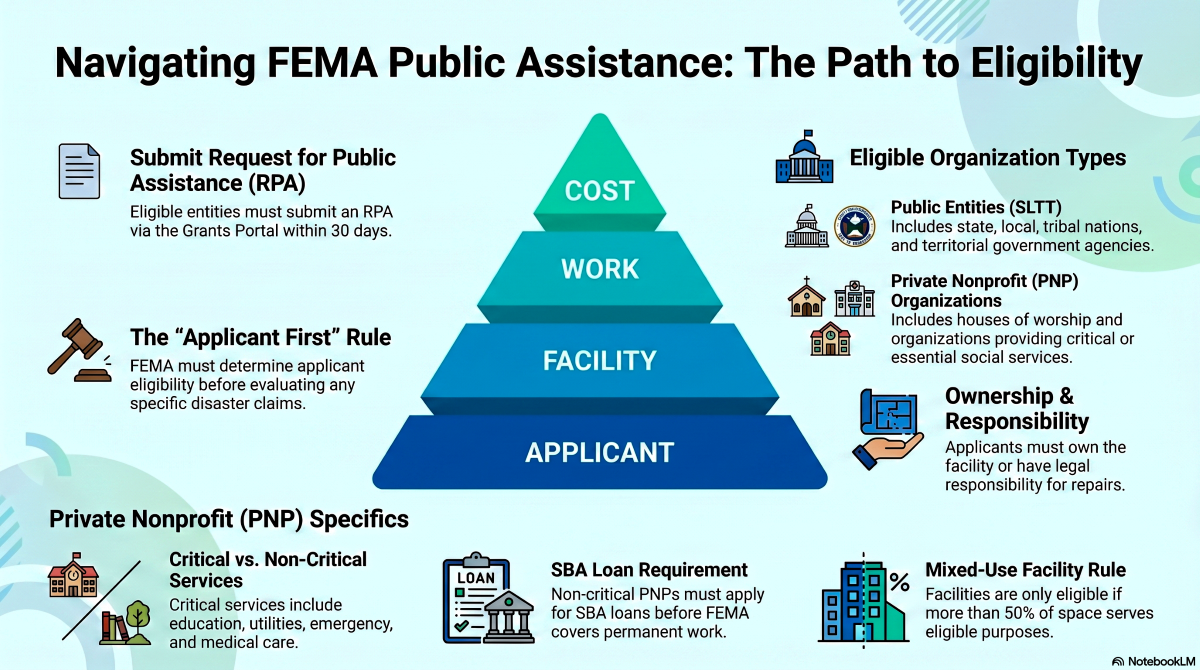
Securing federal disaster funding through the FEMA Public Assistance (PA) Program necessitates a mastery of the eligibility "pyramid"—a sequential hierarchy comprising the Applicant, Facility, Work, and Cost. This framework serves as the strategic gatekeeper for all federal obligations; failure to validate a lower tier, such as the jurisdictional nexus of a facility, immediately precludes the eligibility of subsequent work and costs. For State, Local, Tribal, and Territorial (SLTT) governments, understanding this pyramid is essential for protecting treasury resources and ensuring that restoration efforts meet stringent federal standards.This regulatory analysis provides a comprehensive roadmap for navigating these requirements. It defines the scope of eligible public facilities, including specialized criteria for natural features and the financial implications of proration for partially inactive structures. The analysis further bifurcates work into Emergency and Permanent categories, detailing the mandatory triggers of direct causality, geographic designation, and legal responsibility. By integrating these regulatory foundations with the operational mandates of impact listing and strategic project grouping, this document establishes the compliance baseline required to survive federal audits and maximize reimbursement.These high-level summaries translate into specific regulatory compliance requirements that dictate how applicants must document, report, and group disaster-related impacts to ensure successful grant obligation and retention.
II. Key Takeaways for Compliance
Strict adherence to FEMA eligibility criteria is non-negotiable for FEMA Grant Managers and Chief Financial Officers. As the PA Program operates on a reimbursement model, any deviation from 44 C.F.R. or PAPPG policy creates significant audit risk. Failure to demonstrate compliance typically results in the de-obligation of funds, shifting the massive financial burden of disaster recovery back onto the subrecipient.The three most critical eligibility requirements are:
- Result of the Declared Incident: All damage and impacts must be bifurcated from pre-existing conditions and proven to have occurred directly because of the declared event within the designated incident period.
- The "So What?": Costs associated with deterioration or deferred maintenance are ineligible. If FEMA determines that a lack of maintenance was a significant contributing factor to a facility’s failure, the entire claim may be disqualified.
- Located in the Designated Area: Facilities must be situated within the geographically defined boundaries of the presidential declaration.
- The "So What?": Work performed on facilities outside the designated area is ineligible, even if the applicant possesses legal responsibility. The only exceptions are limited to sheltering, evacuation, and Emergency Operations Center (EOC) activities.
- Legal Responsibility: The applicant must demonstrate a clear jurisdictional nexus, proving they had the legal authority or ownership to perform the work at the time of the incident.
- The "So What?": If a facility is under a construction contract where the contractor bears the risk of loss, or a lease agreement assigns repair responsibility to a tenant, FEMA will disallow the claim to prevent "duplication of benefits" or the assumption of third-party liability.Establishing the facility as the jurisdictional gatekeeper is the prerequisite for all work eligibility.
III. Facility Eligibility Analysis
At the "Facility" level of the eligibility pyramid, work eligibility is generally contingent upon the facility itself being eligible. While certain emergency protective measures are exceptions, Permanent Work and restoration cannot be funded unless the underlying structure or system meets FEMA’s regulatory definition of a public facility.
A. Public Facility Definition
An eligible public facility is any system or structure that an SLTT government owns or has legal responsibility for maintaining.
- Eligible Systems and Structures:
- Infrastructure Systems: Flood control, navigation, irrigation, reclamation, public power, sewage treatment/collection, water supply/distribution, and watershed development.
- Buildings & Ancillary Structures: Maintenance sheds, restrooms, outbuildings, and public buildings used for education, recreation, or culture.
- Transportation: Non-federal-aid streets, roads, highways, bridges, ramps, and airports (including runways).
- Parks & Recreational: Docks, piers, trails, benches, picnic tables, swimming pools, and ball fields.
- Other Public Facilities: Pumping stations, communication towers/antennas, contents, supplies, equipment, and vehicles , fences, signage, lighting, and drainage structures (gutters, ditches, catch basins).
- Natural Feature Eligibility: A natural feature (e.g., a channel, slope, or hillside) is only eligible if it is "improved and maintained." It must meet three mandatory conditions:
- Designed Improvement: It must have a designed and constructed improvement to its natural characteristics (e.g., a realigned channel or terraced slope).
- Enhanced Function: The constructed improvement must enhance the function of the unimproved natural feature.
- Regular Maintenance: The applicant must maintain the improvement on a regular schedule to ensure it performs as designed.i. Detailed Requirements: Eligibility is strictly limited to the specific section of the natural feature meeting these criteria. Maintenance records are the primary differentiator between an eligible "improved facility" and ineligible "unimproved property."
B. Inactive or Partially Inactive Facilities
A facility must have been in active use at the start of the incident period. Inactive facilities are ineligible unless they were temporarily closed for repairs, or future use was established in an approved budget or formal plan.
- The Proration Rule: For facilities partially occupied at the start of the incident, FEMA assistance is prorated based on the percentage of the facility in active use . For example, if a building’s roof is destroyed but only 50% of the building was in active use, FEMA will only reimburse 50% of the roof replacement cost.
- PNP Requirement: Private nonprofit (PNP) mixed-use facilities must have had more than 50% of the facility in active use for an eligible purpose to qualify for any assistance.
C. Facilities Scheduled for Repair/Replacement
Facilities scheduled for non-federally funded repair or replacement remain eligible if they are not yet under contract. FEMA will meticulously review procurement and contract documents to ensure the claimed damage was not pre-existing.
IV. General Work Eligibility Framework
FEMA categorizes work into specific streams, dictated by the nature of the threat and the required restoration.
A. Categories of Work
- Emergency Work (Immediate Threat): Addressing immediate threats to life, health, and safety.
- Category A: Debris Removal.
- Category B: Emergency Protective Measures.
- Permanent Work (Restoration): Restoring facilities to pre-disaster state.
- Category C: Roads and Bridges.
- Category D: Water Control Facilities.
- Category E: Buildings and Equipment.
- Category F: Utilities.
- Category G: Parks, Recreational, and Other Facilities.
- Category I: Building Code and Floodplain Management (Administration/Enforcement).
B. Minimum Eligibility Criteria
Per 44 C.F.R. § 206.223(a), work must result from the incident, be in the designated area, and be the applicant's legal responsibility.
- Result of Declared Incident: i. Documentation Mandates:
- Small Projects: Applicants may certify that damage was incident-caused and not due to lack of maintenance.
- Large Projects: FEMA may require pre-incident photos, maintenance logs, or inspection reports.
- Hard Documentation Mandate: Regardless of project size or how "evident" the damage appears, restoration of natural features and beaches always mandates the submission of maintenance records and photographs.Deterioration and deferred maintenance exclude costs from reimbursement. If a facility was functional pre-disaster, it remains eligible only if pre-disaster condition was not a "significant contributing factor" in the failure.
V. Legal Responsibility and Special Contexts
A. Establishing Legal Responsibility
- Contractual Review: For facilities under construction, FEMA reviews contracts to determine if the owner or contractor bears the risk of loss. A Force Majeure provision is critical here; it may relieve a contractor of responsibility for "Acts of God," thereby returning the legal responsibility for disaster repairs to the applicant.
- Leased Facilities: Responsibility is determined by the lease terms. If the lease is silent, the owner is typically deemed responsible.
B. Tribal Nations and Sensitive Locations
FEMA’s relationship with Tribal Nations is grounded in the Federal Indian Trust Responsibility , a legal obligation to protect tribal sovereignty and lands.
- Sacred Sites: Site inspections by non-tribal FEMA staff are prohibited at sacred locations. FEMA will accept a Tribal Nation’s certified damage assessment as a valid alternative.
- Artifact Protection: To prevent looting or desecration, FEMA waives the requirement for photos, site maps, or GPS coordinates for locations containing sensitive artifacts or human remains.
C. Geographic Designation
While most applicants must stay within defined boundaries, Tribal declarations do not usually define specific geographical areas (e.g., counties). For Tribal Nations, FEMA determines eligibility based primarily on the jurisdictional nexus of legal responsibility and direct causality.
VI. Impact Listing and Project Formulation
The Impact List is the foundational inventory for the grant application.
A. Impact List Requirements
Each site must include GPS coordinates, facility type, damage description, and cost estimates.
- Submission Deadlines: Applicants have a 60-day window following the recovery scoping meeting to identify and report all impacts. Late reporting typically results in ineligibility.
B. Logical Grouping of Projects
- Infrastructure Groupings: Impacts are initially organized into 11 categories (Transportation, Energy, Water/Wastewater, Natural/Cultural Resources, etc.).
- Final Grouping Logic: FEMA will separate sites to streamline the process if they:
- Involve complex Environmental and Historic Preservation (EHP) reviews.
- Are located in a Special Flood Hazard Area (SFHA).
- PNP Requirements: PNP applicants must separate critical service facilities from non-critical service facilities to prevent funding delays pending SBA loan determinations.Strategic grouping prevents the specialized technical needs of complex facilities from bottlenecking the reimbursement of simple repair sites.
VII. Compliance Checklist
FEMA Grant Managers must execute the following actions to safeguard funding:
- Verify Active Use: Document that the facility was active at the incident start or calculate the proration percentage for partially active structures.
- Audit Legal Nexus: Review deeds, leases, and construction contracts—specifically identifying Force Majeure clauses—to confirm legal responsibility for restoration.
- Secure Natural Feature Records: Ensure pre-disaster maintenance logs and design plans are on file for all "improved" natural features; these are mandatory for eligibility.
- Bifurcate Damage: Utilize pre-disaster photos and inspection reports to clearly separate incident damage from pre-existing deterioration or deferred maintenance.
- PNP Separation: Ensure PNP project formulations separate critical from non-critical services to avoid SBA-related delays.
- Tribal Protocol Coordination: Apply alternative assessment protocols for sacred sites under the Federal Indian Trust Responsibility to protect sensitive coordinates.
- 60-Day Review: Confirm all impacts are entered into the system within the 60-day regulatory window.Call to Action: Applicants should immediately conduct a Pre-Disaster Maintenance Audit of all natural features, leased assets, and critical infrastructure to ensure that maintenance logs and photographs are sufficient to support future claims.