COMPREHENSIVE POLICY ANALYSIS: FEMA CATEGORY B EMERGENCY PROTECTIVE MEASURES
I. ABSTRACT SUMMARY OF EMERGENCY PROTECTIVE MEASURES
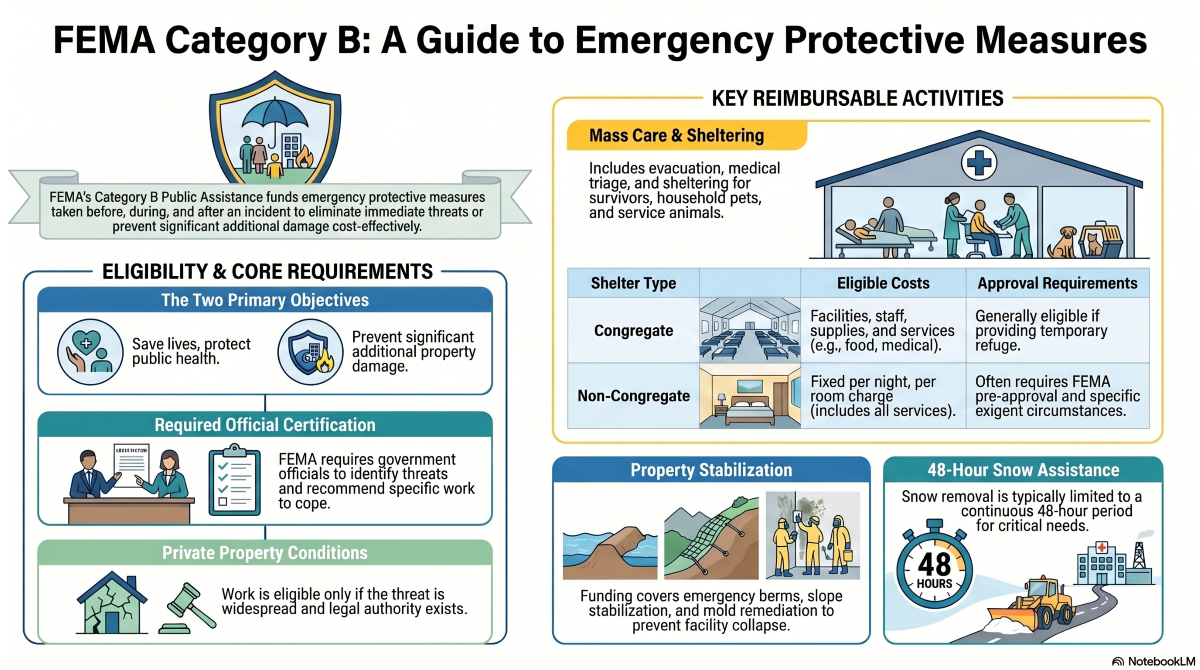
FEMA Category B Public Assistance (PA) funding serves as a critical strategic mechanism for immediate threat reduction and the preservation of community stability following a disaster. Under the authority of 44 C.F.R. § 206.225 and Sections 403 and 502 of the Stafford Act, these measures are authorized when essential to saving lives, protecting public health and safety, or preventing significant additional damage to Improved Property in a cost-effective manner. This framework provides State, Local, Tribal, and Territorial (SLTT) governments with the resources to implement rapid interventions during the exigency of a disaster.The PA framework for emergency work is structured upon three foundational pillars:
- Core Eligibility Criteria: Measures must address immediate threats. Work that merely restores a facility to its pre-disaster condition is generally classified as permanent work. Under 44 C.F.R. § 206.225(a)(3), the "least costly option" must be prioritized for property protection.
- Operational Scope: Eligibility encompasses a broad spectrum of activities, from Emergency Operations Center (EOC) coordination and search and rescue to emergency medical care, mass mortuary services, and the provision of essential life-sustaining commodities.
- Documentation and Certification Standards: Transparency and legal sufficiency are paramount. FEMA requires formal certification by federal or SLTT officials to identify specific threats and validate work recommendations.The following narrative provides a detailed hierarchy of eligible work, transitioning from life-safety mandates to the protection of physical infrastructure and legal compliance.
II. SAVING LIVES AND PROTECTING PUBLIC HEALTH AND SAFETY
In FEMA’s hierarchy of assistance, life-safety measures take absolute precedence. Because the window for life preservation is extremely narrow, the framework incentivizes rapid deployment by providing broad eligibility for activities that mitigate immediate hazards to human life.
A. Immediate Response Operations
Eligible activities include 15+ core operations such as Search and Rescue (SAR), firefighting, EOC operations, security (barricades/fencing), and building safety inspections. SAR specifically covers the location of survivors, household pets, and service animals.Administrative Necessity: It is vital to distinguish between animal categories. Household pets are domesticated animals (dogs, cats, birds, rabbits, rodents, and turtles) traditionally kept for pleasure. Under the Americans with Disabilities Act (ADA), Service Animals are limited to dogs or miniature horses trained for specific tasks. Assistance Animals provide emotional support. Evacuation of exhibition or agricultural animals is ineligible.
B. Emergency Medical Care and Transport
FEMA provides funding for extraordinary costs when the medical delivery system is compromised.
- Eligibility Window: Costs are generally limited to 30 days from the declaration date. Any extension requires a high-level justification and analysis of options, with final approval authority retained by the Assistant Administrator for the Recovery Directorate .
- Eligible Services: Triage, medically necessary testing, first aid, and a one-time 30-day supply of prescriptions for acute conditions.
- Equipment Definitions:
- Durable Medical Equipment (DME): Reusable items like wheelchairs, hospital beds, and oxygen equipment.
- Consumable Medical Supplies (CMS): One-time use items like bandages, medications (including Naloxone), and diapers.Compliance Alert: FEMA determines cost reasonableness based on Medicare’s cost-to-charge ratio. Under Stafford Act § 312, FEMA is prohibited from duplicating benefits. Applicants must maintain patient-by-patient verification that private insurance, Medicare, or Medicaid coverage does not exist for the claimed costs.
C. Evacuation and Sheltering Frameworks
Eligible costs cover the transportation of survivors and the operation of shelters.
- Congregate Sheltering: Funding covers Facility costs (lease/utilities/ADA mods), Staff (medical/social workers), Supplies (meals/linens), and Services (management/security).
- Non-Congregate Sheltering (NCS): Sheltering in hotels or motels is eligible under exigent circumstances. Audit Risk: To extend NCS beyond 30 days, every household must meet five criteria: (1) be in an area designated for both IA and PA; (2) be registered with FEMA IA; (3) have not withdrawn IA registration; (4) document pre-disaster status as an owner or renter of a primary residence; and (5) have a primary residence determined to be uninhabitable or inaccessible.Beyond the immediate preservation of life, the framework extends to the stabilization of physical infrastructure.
III. PROTECTION OF IMPROVED PROPERTY AND INFRASTRUCTURE
FEMA defines "Improved Property" as property built or modified to serve a specific purpose. Category B funding supports preventative actions to minimize economic and structural disaster impacts.
A. Structural Stabilization and Repair
Protective measures focus on preventing collapse or further deterioration.
- Immediate Interventions: Buttressing, shoring, bracing, and emergency roof coverings.
- Slope Stabilization: Eligible only if a landslide poses an immediate threat to Improved Property. Compliance Alert: FEMA only funds the "least costly option" necessary to alleviate the threat and limits stabilization to the area of the immediate threat, not the entire slope.
B. Environmental Remediation: Mold and Hazmat
- Mold Remediation: Eligible only if the mold resulted from the incident and not poor maintenance. Conflict of Interest Alert: FEMA only provides funding for mold sampling performed by an indoor environmental professional (e.g., Certified Industrial Hygienist) who must not be employed by the remediation company.
- Hazardous Materials: Eligibility covers the separation, specialized handling, and disposal of pollutants. Short-term testing to eliminate immediate threats is eligible, but long-term cleanup testing is not.
C. Flood Fighting and Coastal Protection
- Emergency Berms: Construction is eligible if erosion increases the risk to Improved Property from a 5-year storm (20% annual chance). Audit Threshold: Sand placement is limited to 6 cubic yards per linear foot above the 5-year Still Water Level (SWL) or the pre-incident profile, whichever is less.
- Flood Fighting: Sandbagging and dewatering behind levees are eligible. Dewatering natural or agricultural areas is ineligible.Administrative Necessity: Project approval relies on technical documentation, including SWL/TWL elevations or certified hygienist reports, which serve as the evidentiary basis for project approval.
IV. LEGAL AUTHORITY AND PRIVATE PROPERTY CONSIDERATIONS
Public work on private land involves complex jurisdictional boundaries. To maintain eligibility, applicants must satisfy a rigorous three-prong test: (1) the threat must be widespread; (2) the applicant must have legal authority; and (3) the applicant must obtain Rights-of-Entry (ROE) and Indemnification agreements.
A. Access and Demolition
These requirements apply to unsafe structure demolition, septic pumping causing pollution threats, and emergency access repairs. Compliance Alert: Applicants must provide a citation of the specific law, ordinance, or code used to exercise emergency powers. General "emergency power" claims are insufficient for audit defense.
B. Emergency Demolition Protocols
- Non-Commercial: Eligible if ROEs are secured and a qualified individual (licensed engineer/architect) determines collapse is imminent.
- Commercial: Generally ineligible as commercial entities are expected to carry insurance. Risk Management: If a structure was condemned prior to the incident , emergency protective measures are categorically ineligible .Failure to demonstrate "Public Interest" or secure ROEs exposes the applicant to legal liability and de-obligation of grant funds.
V. OPERATIONAL COSTS, SUPPLIES, AND ENTITY-SPECIFIC RULES
A. Increased Operating Costs
FEMA distinguishes between routine expenses and disaster-necessitated "increased" costs.
- Eligible: Water testing, fuel for emergency pumps, and meals for emergency workers (if severity prevents them from providing their own or labor policies require it).
- Ineligible: Administrative activities, school make-up days, and patient care beyond 30 days.
B. Private Nonprofit (PNP) Eligibility
The "Legally Responsible" rule dictates that PNPs are generally not responsible for emergency services. However, Compliance Exceptions exist for PNPs requested by an SLTT government to provide fire/rescue, and for essential components like emergency rooms of PNP hospitals or PNP sewage/water treatment plants. PNP volunteer fire departments are eligible if they have an established agreement with an SLTT government.Audit Defense: Meticulous cost-tracking and separate ledgers for "increased" vs. "routine" costs are mandatory. Without this granularity, auditors may classify costs as standard operations, leading to clawbacks.
VI. SPECIALIZED INCIDENTS AND POST-ACTIVITY COMPLIANCE
A. Snow-Related and Infectious Disease Response
- Snow Assistance: Limited to a continuous 48-hour period designated by the applicant. Once the 48-hour period is approved, it cannot be changed. Extensions are only granted if snowfall exceeds historical records by at least 50%.
- Infectious Disease: FEMA coordinates with the CDC. Reimbursement is strictly guided by disaster-specific guidance (DSG).
- Mosquito Abatement: Requires a written validation from a health official. Eligible costs are calculated using a 3-year average deduction formula , subtracting the average expenses from the most recent three non-disaster years.
B. Damage Caused During Work
Repairs to public property damaged during emergency work (e.g., equipment damaged during debris removal) are eligible only if the damage was due to severe conditions, was unavoidable, and was not due to improper use. Compliance Alert: Applicants must produce pre-incident maintenance records to prove equipment was in good operational order before the claim.
VII. KEY TAKEAWAYS FOR COMPLIANCE
- 44 C.F.R. § 206.225: Mandates that all work must eliminate immediate threats to life or protect Improved Property.
- Time Limitations: Adhere to the 30-day medical care limit and the 48-hour snow period.
- Least Costly Option: Mandatory for slope stabilization and beach protection (6 cy/lf sand limit).
- Hygienist Independence: No employment ties between the hygienist and the remediation firm.
VIII. COMPLIANCE CHECKLIST FOR FEMA GRANT MANAGERS
- Rights-of-Entry (ROE): Secure signed ROE and Indemnification agreements for all private property work.
- Legal Authority: Document the specific citation (ordinance or code) for the exercise of emergency powers.
- Medical Verification: Maintain patient-by-patient logs verifying that Medicare, Medicaid, and private insurance do not exist before claiming costs.
- NCS Reporting: Submit weekly data reporting to the FEMA Data Sharing Support Box (fema-recovery-rad-data-sharing-support@fema.dhs.gov).
- Habitability: For NCS >30 days, document the pre-disaster status and habitability assessment for each household.
- Mosquito Formula: Document the 3-year average of abatement costs to justify "increased cost" claims.
- Equipment Readiness: Maintain pre-incident maintenance records to support claims for damage caused during the performance of work.
- Health Certification: Secure written validation from health officials for carcass removal and mosquito abatement.