RETURN TO PREVIOUS PAGE

FEMA's Section 428 fixed-cost grants approach

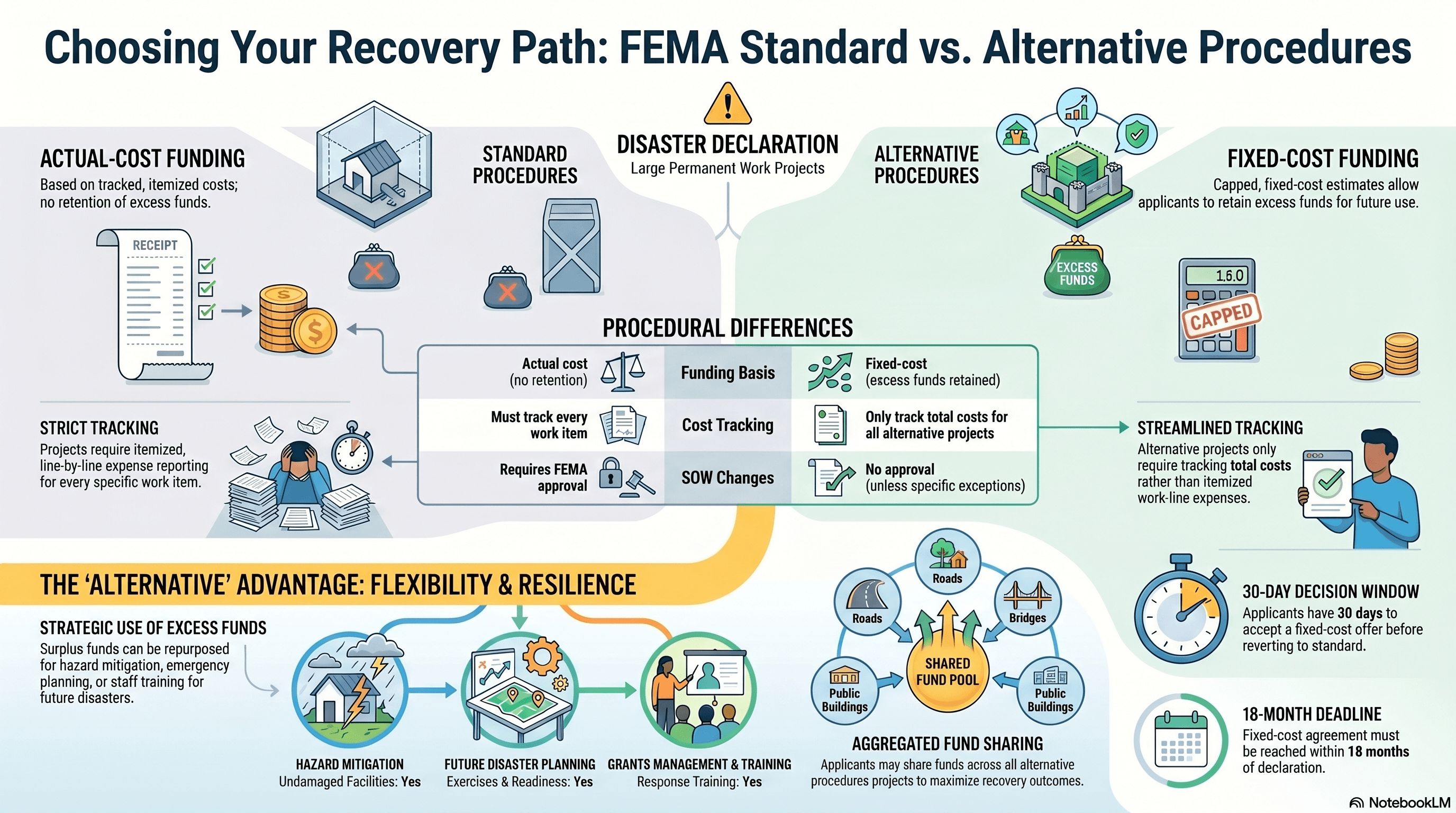
Section 428 fixed-cost grants can speed recovery, but they also transfer major cost-overrun risk to applicants. This Govstar resource compares NYC’s stronger Section 428 experience with Puerto Rico’s inflation, procurement, supply-chain, and scope challenges to show why fixed grants require mature estimates before lock-in. Topics include Sandy Recovery Improvement Act authority, DDD/SOW development, FEMA validation, expert panels, underfunding risk, local market factors, H.R. 4669, parametric funding, basis risk, adjustment rights, small-grantee protections, and reform guardrails for future FEMA funding models.

This document analyzes the benefits and risks of FEMA's Section 428 fixed-cost grants approach, highlighting lessons from NYC's successful use and Puerto Rico's challenges during disaster recovery.Overview of FEMA Fixed Grants and Reform LessonsThe document analyzes the effectiveness, risks, and lessons learned from FEMA's use of fixed-cost grants under Section 428, highlighting implications for future reform models like H.R. 4669 and the Review Council’s parametric approach.Section 428: Purpose and FunctionalityFixed-cost grants under Section 428 allow FEMA to fund permanent work projects based on pre-agreed estimates instead of actual costs, enabling faster obligation, applicant flexibility, and project consolidation.Authorized by the Sandy Recovery Improvement Act.FEMA can fund projects based on fixed estimates, with the recipient responsible for overruns.Benefits include quicker obligation, applicant flexibility, and excess funds for other eligible uses.Risks involve underfunding if estimates are inaccurate or market conditions change.

The model relies on damage description, scope, repair methods, hazard mitigation, insurance, and environmental reviews.Cost-Estimating Protocols and ChallengesPuerto Rico’s experience with Section 428 highlights the importance of damage assessment, independent review, and local market factors in developing reliable estimates.Damage Description and Dimensions (DDD) and Scope of Work (SOW) are foundational.Either FEMA or the applicant can develop estimates; FEMA validates if applicant-developed.Estimates may be prepared before final design, risking inaccuracies.Independent expert panels review large projects ($25M+), but do not decide eligibility.Once accepted, estimates are rarely adjusted, risking underfunding if costs rise.Puerto Rico faced inflation, supply chain issues, procurement delays, and capacity constraints, leading to significant cost overruns.RAND estimates Puerto Rico could face $5B to $15.9B in inflation-driven shortfalls depending on recovery pace.Lessons from Puerto Rico and NYCNYC’s sophisticated capacity enabled effective use of Section 428, while Puerto Rico’s experience revealed risks of fixed grants in long-duration, system-wide projects.NYC had large asset portfolios, professional staff, strong documentation, and capacity to manage overruns.Puerto Rico’s challenges included inflation, supply chain delays, procurement issues, and evolving scopes.USVI’s concerns about remote and island-specific costs emphasize the need for local cost factors.Fixed grants work best for owners with strong planning, estimating, and negotiation capacity.Risks and Failure Modes of Fixed EstimatesKey failure modes include immature scope, inaccurate local market data, inflation, portfolio complexity, narrow adjustment rights, and review capacity bottlenecks.

Fixed estimates before final design risk latent damage and scope changes.Local market factors and supply chain issues can cause cost increases.Inflation can erode fixed grants, especially with slow disbursement.Large portfolios can offset overruns internally; small projects cannot.Post-acceptance adjustments are limited, increasing underfunding risk.Review capacity may limit scaling, risking inadequate validation.Comparison of FEMA Reform ModelsDifferent models—Section 428, H.R. 4669, and the Review Council—vary in timing, funding basis, and risk.Section 428 ties funding to detailed damage and scope, with moderate speed and risk.H.R. 4669 proposes engineer-certified estimates with a 90-day FEMA review, offering faster funding but higher estimate risk.

The Review Council’s parametric model offers rapid disbursement within 30 days but with high basis risk and less project-level validation.The core difference is the timing of funding relative to project maturity and estimate reliability.Lessons for Future FEMA Reform GuardrailsRecommendations include treating parametric funding as an advance, requiring estimate maturity disclosure, local market factors, transparency in future price assumptions, independent review for large estimates, multiple adjustment triggers, protections for small/sub-capacity grantees, and dispute rights before lock-in.Use parametric funding as liquidity, not final.Disclose estimate maturity levels.Require local cost factors for remote and high-cost areas.Make future price assumptions transparent.Expand independent review beyond 90 days.Allow multiple triggers for adjustments, including inflation and scope changes.Support small and low-capacity subgrantees with technical assistance.Ensure dispute pathways before finalizing fixed estimates.Key Policy Insights and ConclusionsSection 428 demonstrates fixed grants can improve recovery with strong estimates and capacity but risk underfunding when market, inflation, or scope risks are high.Fixed grants work for sophisticated owners with capacity.They can underfund long-term, system-wide projects in volatile markets.Reliable, update-protected, market-adjusted estimates are essential before fixing funding.Future reforms must address the core cost-estimating challenge to prevent underfunding and ensure equitable recovery.