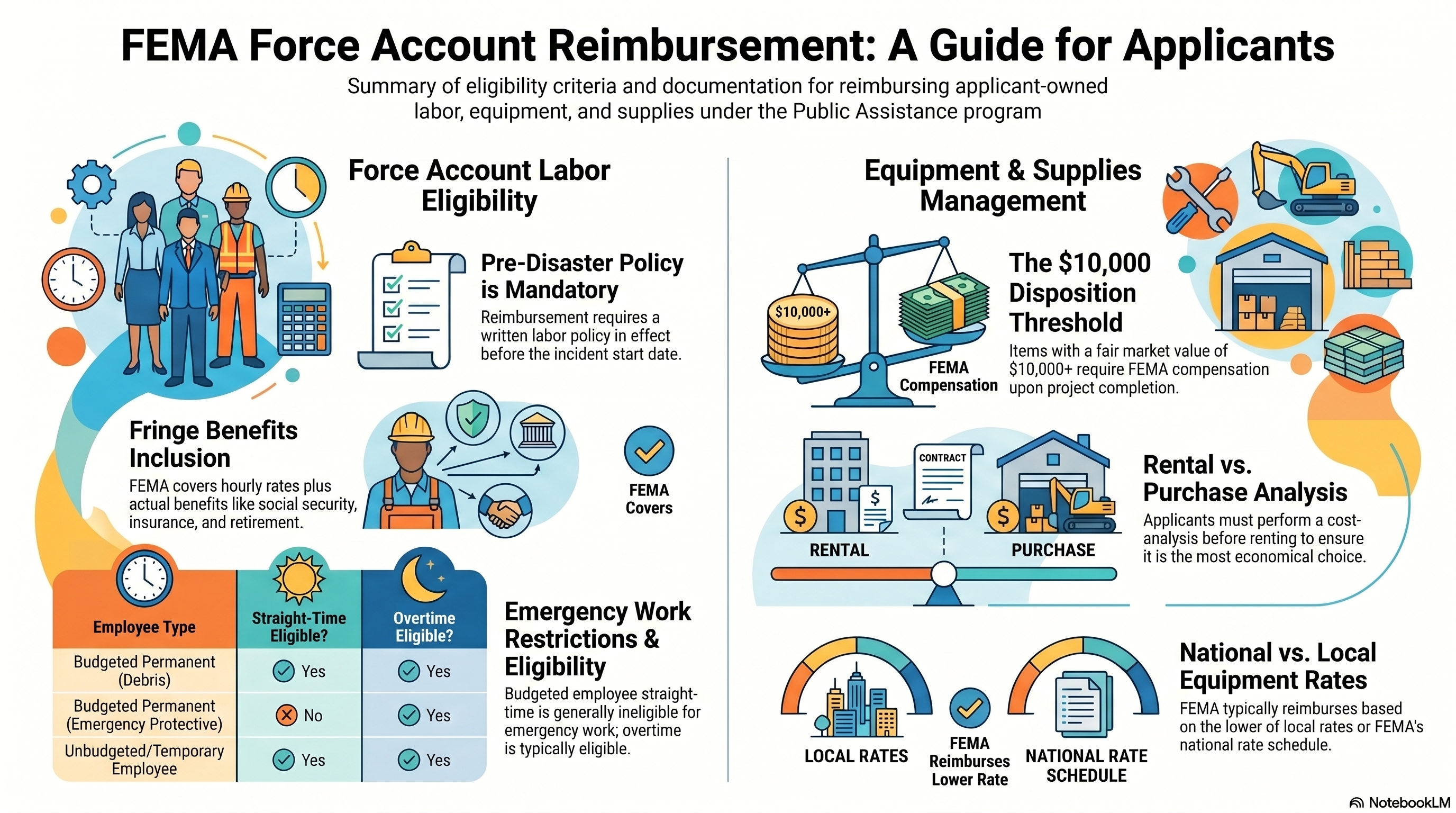
Force account claims can be won or lost before the disaster begins. This Govstar resource explains how FEMA PA applicants can protect reimbursement for their own labor, equipment, materials, and supplies through compliant pre-disaster policies and strong documentation. Topics include labor policy requirements, straight-time vs. overtime eligibility, budgeted and unbudgeted staff, Categories A–G, management costs, fringe benefits, timesheets, backfill, reassigned personnel, standby rules, equipment rate hierarchies, leased equipment, materials from stock, disposition rules, and audit risks.
Operational Compliance Manual: Force Account Labor and Equipment Reimbursement Standards
1. Regulatory Foundation: Pre-Disaster Policy Requirements
The success of a Public Assistance (PA) reimbursement claim depends entirely on the strength of the applicant’s existing administrative framework. A pre-disaster labor policy is the non-negotiable baseline for all personnel claims; it serves as the legal foundation upon which all costs are evaluated. Without a formal policy that precedes the incident start date, applicants risk significant funding de-obligations. FEMA does not allow for the retroactive creation of pay policies to accommodate disaster expenses; rather, the agency audits existing standards to ensure they meet federal requirements.The Three Pillars of Policy Eligibility To be recognized by FEMA, a labor policy must satisfy three mandatory criteria:
- Non-contingency: The policy must not state that payment is contingent upon the receipt of federal funding.
- Uniform Application: The policy must be applied consistently regardless of whether a presidential disaster declaration is in effect.
- Non-discretionary Criteria: The policy must contain established rules for when the applicant activates various pay types (e.g., overtime, hazard pay).Strategic Vehicle for Employee Classification Beyond pay rates, the pre-disaster policy is the regulatory vehicle for defining "Full-time" and "Part-time" status based on the normal number of hours worked per pay period. Critically, the policy must distinguish between Exempt and Non-exempt status under the Fair Labor Standards Act. Without these clear internal definitions, FEMA cannot validate overtime eligibility or the reasonableness of hours worked.Analyze the Impact of Policy Failure If these criteria are not met, FEMA defaults to funding only the applicant’s non-discretionary, uniformly applied pay rates. This often results in the disqualification of "extraordinary" pay types that the applicant may have already disbursed, creating a significant unfunded liability."Pre-Disaster" Chronology "Pre-disaster" is strictly defined as the period prior to the incident start date identified in the approved presidential disaster declaration. Any policy updates made after this date cannot be applied to that incident’s claims.Understanding these foundational requirements is the first step toward accurately categorizing labor costs and determining their eligibility.
2. Labor Eligibility Framework: Categorization and Pay Types
FEMA differentiates between work categories and employee types to determine reimbursement. The primary driver of financial recovery is the distinction between "Budgeted" and "Unbudgeted" labor. Budgeted employees are those whose salaries are in the normal operating budget, while unbudgeted employees (temporary hires or reassigned staff) represent an extraordinary disaster-related cost.Work Category Eligibility
- Permanent Work (Categories C-G): Straight-time and overtime pay are eligible for both budgeted and unbudgeted employees.
- Emergency Work (Categories A-B): For budgeted employees, straight-time is generally ineligible (except for Category A Debris Removal under alternative procedures), while overtime is eligible. For unbudgeted employees, both straight-time and overtime are eligible.
- Management Costs (Category I): Straight-time is strictly limited to extra hires . Overtime is eligible for all staff.Emergency Work Labor Eligibility Matrix| Labor Classification | Type of Employee | Eligible Overtime? | Eligible Straight-Time? || ------ | ------ | ------ | ------ || Budgeted (Debris Removal) | Permanent | Yes | Yes || Budgeted (Emergency Measures) | Permanent | Yes | No || Budgeted (Emergency Measures) | Part-time/seasonal (normal hours) | Yes | No || Unbudgeted (All Emergency) | Reassigned (externally funded) | Yes | Yes || Unbudgeted (All Emergency) | Essential (called back from furlough) | Yes | Yes || Unbudgeted (All Emergency) | Temporary hire | Yes | Yes || Unbudgeted (All Emergency) | Part-time/seasonal (outside normal hours) | Yes | Yes |
Ineligible Labor Costs and the Fringe Paradox Certain costs are strictly excluded, though nuance exists regarding benefits:
- Leave Taken: Salary/benefits for employees on sick, vacation, or holiday leave during the incident are ineligible as direct labor.
- Administrative Leave: Costs for employees sent home due to emergency conditions are ineligible.
- Discretionary Pay: Performance bonuses and incentive pay are ineligible.
- Compliance Note (Accrued vs. Taken): While leave taken is an ineligible direct cost, leave accrued (sick, vacation, holiday) is an eligible component of the fringe benefit package .While general eligibility defines what can be claimed, the project size dictates the evidentiary burden required to survive a federal audit.
3. Evidentiary Standards: Small vs. Large Project Documentation
Applicants must navigate a documentation "Step-Up" between project sizes. While Small Projects use simplified reporting, Large Projects require granular data.Contrast Documentation Requirements
- Small Projects: Requires an itemized cost summary including number of employees, total hours, and average pay rates (inclusive of fringe).
- Compliance Warning: "Average rates" are only permissible for employees in similar pay grades and the same category (e.g., permanent vs. temporary), as per Source Footnote 147.
- Large Projects: Requires names, job titles, employee types (Full-time exempt, non-exempt, etc.), timesheets, daily logs/activity reports, and specific fringe benefit calculations for every individual.The Sampling Protocol FEMA utilizes an attribute-based sampling approach following the GAO Financial Audit Manual. For Large Projects, FEMA may select a representative sample of records. If errors are identified in the sample, it can jeopardize the entire claim.Fringe Benefit Requirements FEMA reimburses actual hourly rates plus the cost of actual fringe benefits. The fringe package may include:
- Social Security & Medicare matching
- Unemployment insurance & Workers' compensation
- Retirement contributions
- Health, life, and disability insurance
- Accrued leave (holiday, sick, vacation)Because health insurance and other fixed costs are not dependent on hours worked, the fringe percentage for overtime is typically lower than for straight-time.
4. Specialized Labor Scenarios: Reassignment, Backfilling, and Supervision
Operational necessity often requires reassigning or backfilling staff, creating "extraordinary" costs that require specific substantiation.Reassigned Personnel and External Funding Personnel performing non-normal functions are reimbursed at their normal pay rate. If an employee is funded by an external source (e.g., a federal grant), their straight-time is only eligible if they are reassigned to work the external source does not fund, ensuring no "Duplication of Benefits."Backfill Eligibility Constraints Backfill eligibility is tied strictly to replacing an employee who is unable to perform normal duties because they are performing eligible emergency work . It is not eligible for employees who are on leave or furloughed.
- Budgeted Staff as Backfill: Only overtime is eligible.
- Unbudgeted/Contracted Backfill: Both straight-time and overtime are eligible.
- Exigency: Costs are only eligible for a limited time based on the urgency of circumstances.Extraordinary Labor Costs FEMA may fund extraordinary costs such as call-back pay, night-time/weekend differential, and hazardous duty pay if these are paid in accordance with the pre-disaster written labor policy.Supervision and Standby Rules
- Supervisors: Second-level supervisors (Chiefs, Directors) are generally exempt and ineligible for overtime unless they meet a three-prong test: direct project involvement, normal practice of charging time to projects, and a compliant labor policy.
- Standby Time (Personnel): Limited to life-saving actions (e.g., SAR, medical care). Must meet five criteria including necessity and the employee actively conducting the action. Firefighter portal-to-portal rest periods are limited to 14 days.
- Standby Time (Equipment): The "Intermittent Rule" states equipment standby is only eligible if the operator uses the equipment for more than 50% of the working hours that day.
5. Equipment Usage and Rate Substantiation
FEMA follows an "Ownership and Operation" model to recover actual usage costs.NDAA Compliance Warning Applicants are prohibited from using FEMA funds to procure or obtain telecommunications or video surveillance equipment/services produced by entities controlled by covered foreign countries (e.g., certain Chinese telecommunications firms). This is a high-risk audit area.The Three-Tier Rate Hierarchy
- FEMA Rates: Cover depreciation, fuel, and maintenance. Because these are included, mechanic labor and fuel receipts are ineligible.
- SLTT Rates: FEMA reimburses these up to $75/hour. Rates above $75 require proof that components are comparable to market prices.
- Local Rates: FEMA pays the lower of the local or FEMA rate.
- Rate Logic: If no SLTT rate exists, FEMA defaults to the FEMA rate. Custom rates submitted for approval cannot be based on rental rates, as those include ineligible profit margins.Rented and Leased Equipment Requires a "purchase vs. lease" cost analysis. FEMA only reimburses rental costs up to the cost of purchasing and maintaining the equipment, unless the applicant can prove the decision was prudent under incident exigencies.
6. Materials, Supplies, and Asset Disposition
The final compliance stage involves managing residual value. "Equipment" is defined as tangible property with a useful life of >1 year and a value of ≥$10,000 (or the applicant's capitalization threshold). All other items are "Supplies."Documenting Materials
- Purchased: Requires receipts and justification for any unused items.
- From Stock: Requires inventory withdrawal records and original invoices for historical cost.Disposition and Fair Market Value (FMV) Disposition rules vary significantly by applicant type:
- State, Territorial, and Tribal (STT) Governments: STTs dispose of equipment according to their own laws . They may not be required to compensate FEMA for its share of the purchase.
- Local Governments and PNPs: For equipment with an FMV of $10,000 or more , the applicant must compensate FEMA for its share of the original purchase. If FMV is under $10,000, no reduction is taken.
- Supplies (All Applicants): If the aggregate total of residual supplies exceeds $10,000, the applicant must compensate FEMA.Small Project Exception For Small Projects, no reduction is taken for the disposition of supplies, as it is assumed the aggregate unused supplies do not exceed the $10,000 threshold.Continuous, meticulous documentation from day one is the only way to ensure the full recovery of these mechanical and human resource costs.