From Statement of Values to Smart Asset Registry: Preparing FEMA PA Applicants for Cost-Estimate-Driven Disaster Funding
The insurance Statement of Values is no longer enough for disaster finance. This Govstar resource explains how governments can convert SOV data into a FEMA-ready Smart Asset Registry that supports upfront funding, cost estimates, parametric triggers, insurance recovery, and audit-ready closeout. Topics include COPE data, FEMA PA eligibility, legal responsibility, pre-disaster condition, replacement cost, hazard exposure, mitigation fields, damage-to-cost formulas, basis risk, settlement protocols, DOB controls, dashboards, and a phased roadmap from SOV cleanup to parametric-enabled recovery planning.
From Statement of Values to Smart Asset Registry: Preparing FEMA PA Applicants for Cost-Estimate-Driven Disaster Funding
How governments can transform insurance Statements of Values into Smart Asset Registries for FEMA PA cost estimates, upfront funding, disaster recovery, and parametric triggers.
Important Status Note: HR4669 and the FEMA Review Council recommendations referenced throughout this article should be treated as proposed reform concepts unless enacted, adopted, funded, and implemented through binding law, regulation, or FEMA policy. Current FEMA PA eligibility still turns on existing Stafford Act, 44 CFR Part 206, and FEMA policy requirements. Under current 44 CFR § 206.223, eligible PA work must be required as the result of the disaster, located in the designated area, and be the legal responsibility of an eligible applicant.
The Big Shift: Why the Insurance SOV Is No Longer Enough
For decades, public entities have maintained a Statement of Values, or SOV, primarily as an insurance underwriting tool. The SOV tells insurers what assets exist, where they are located, and what they are worth. It supports property insurance placement, catastrophe modeling, sublimits, deductibles, total insurable value, and insurance-to-value analysis.
But the future FEMA Public Assistance environment may require something more powerful.
The SOV has served as the "census" of a policyholder's assets — capturing location ID, physical address, latitude and longitude, building value, business personal property, business interruption/extra expense, inventory, ISO construction class, year built, square footage, number of stories, occupancy, sprinkler status, public protection class, alarms, roof data, opening protection, basement/pit information, and other primary and secondary COPE fields.
That is a strong insurance start. But it is not enough for the next generation of disaster finance.
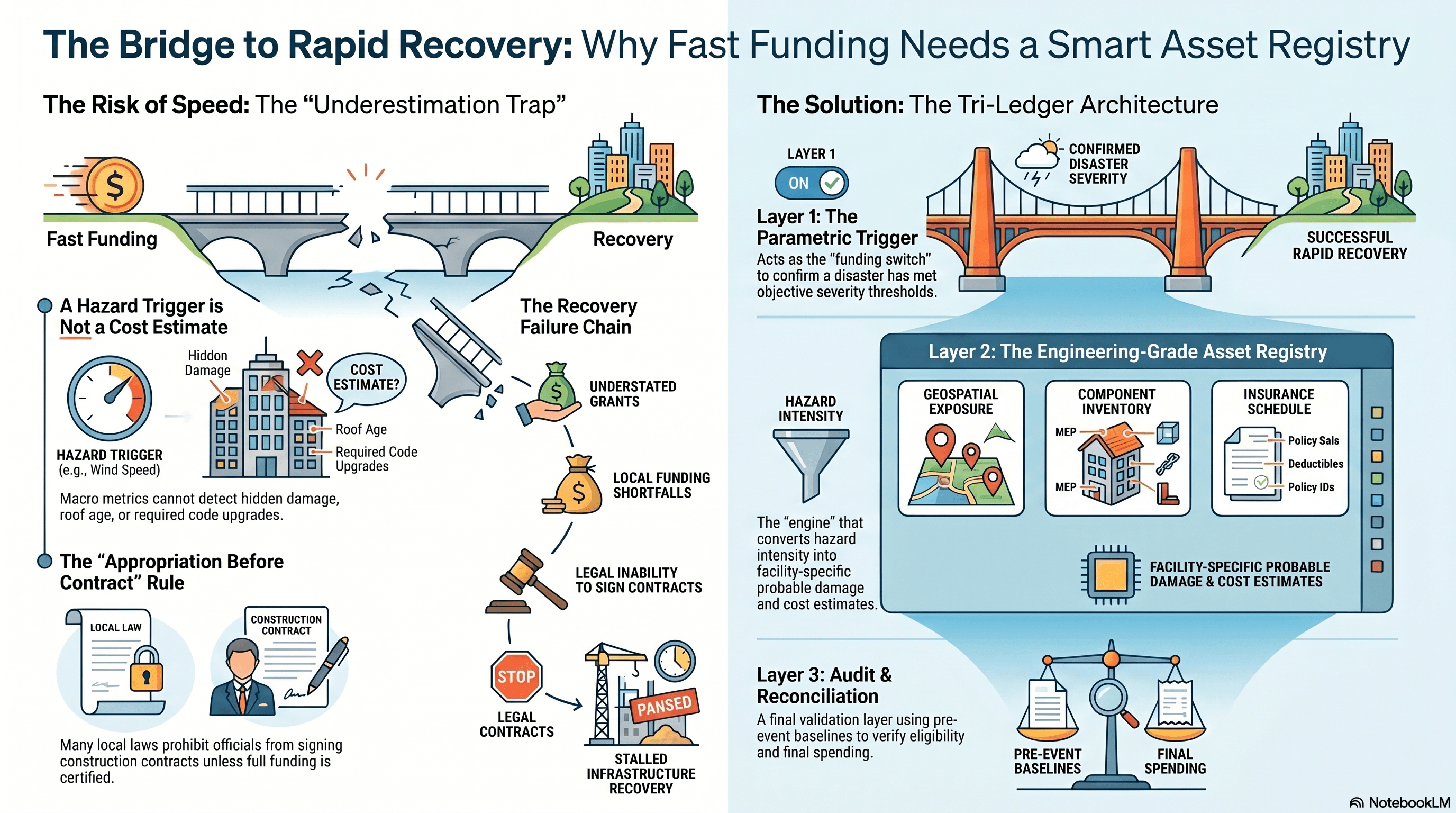
That difference matters because HR4669's proposed Public Assistance reforms would move the center of gravity toward professional cost estimates, faster review, upfront grant availability, mitigation-informed repair, and resilience incentives. The proposed §409 model is not merely an administrative shortcut — it is a new way to think about the disaster recovery data stack. If grant amounts are based on cost estimates, the quality of the applicant's pre-disaster asset data becomes central.
The best-positioned applicants will not be those who begin collecting facility data after landfall, fire, flood, or earthquake. The best-positioned applicants will already have an asset registry capable of generating defensible initial cost estimates.
What a Traditional Statement of Values Does Well
The traditional SOV is still essential. It should not be discarded — it should be upgraded. The SOV typically provides five core functions:
1. Location Identification. Each site should have a unique location number, physical address, city, state, ZIP code, county, and latitude/longitude. Accurate geocoding is critical for catastrophe modeling, especially for wind, flood, earthquake, and high-hazard areas.
2. Total Insurable Values. These include building value, business personal property, business interruption/extra expense, inventory, and other valued exposures. These values support insurance-to-value analysis, capacity placement, deductibles, sublimits, and catastrophe modeling.
3. Primary COPE Data. COPE stands for Construction, Occupancy, Protection, and Exposure — the underwriting basics: construction class, occupancy description, year built, square footage, number of stories, and basic fire protection.
4. Protection and Engineering Information. For public-sector portfolios, this may include sprinkler type, water supply, public protection class, monitored alarms, generator protection, backup power, and essential service continuity features.
5. Secondary COPE Fields. Increasingly important for catastrophe modeling, these include roof geometry and material, year of major roof/HVAC/electrical/plumbing updates, opening protection, basement/pit details, and flood vulnerability indicators. Absent secondary COPE data, catastrophe models may default to conservative or worst-case assumptions.
For insurance underwriting, these data points are useful. For FEMA Public Assistance, they are only the beginning.
A FEMA-ready Smart Asset Registry must extend the SOV in at least six ways:
Document pre-disaster condition
Support facility eligibility and legal responsibility
Classify assets by FEMA PA category and facility type
Support rapid damage-to-cost conversion
Identify codes, standards, mitigation, and resilience gaps
Connect physical asset data to insurance, parametric triggers, and recovery funding sources
Under current PA regulations (44 CFR § 206.223), the work must be required by the disaster, located in the designated area, and be the legal responsibility of an eligible applicant. A Smart Asset Registry should therefore help prove not just value, but eligibility, location, ownership/legal responsibility, pre-disaster condition, and disaster-caused scope.
What Makes an Asset Registry "Smart"?
A Smart Asset Registry is not simply a bigger spreadsheet. It is a disaster finance database. It combines insurance underwriting data, engineering data, FEMA eligibility data, cost-estimating data, hazard exposure data, mitigation data, and parametric-trigger data into one structured asset record.
Consider the difference:
Traditional SOV Entry: Fire Station 12 — $8.5 million building value — 21,000 square feet — masonry construction.
Smart Asset Registry Entry: Fire Station 12 is a legally owned public safety facility, Category E building and equipment asset, located at verified latitude/longitude coordinates, with ISO Class 4 masonry non-combustible construction, a replacement cost new of $8.5 million, roof replaced in 2021, emergency generator elevated above base flood elevation, electrical switchgear located in the basement, flood depth vulnerability at 18 inches above first-floor elevation, pre-disaster condition photos updated annually, insured under property policy schedule location 12, and mapped to a wind parametric grid cell and flood gauge trigger zone.
The second record is far more useful after a disaster. It can support:
Insurance claim validation
FEMA damage inventory
Preliminary damage assessment
Cost estimating
Mitigation scoping
Parametric payout calculations
Capital planning
Bond disclosure
Grant closeout
Audit defense
This additional "DNA" is the difference between a passive insurance list and an active recovery tool.
The HR4669 Connection: Why Initial Cost Estimates Change the Data Requirement
The proposed HR4669 §409 model is the reason this matters now.
Under the proposed language, grant amounts would be determined based on the estimated cost to repair, restore, reconstruct, or replace a damaged public or private nonprofit facility to applicable building codes. The estimate must be developed by an appropriately licensed professional and must include:
Mitigation measures
Labor costs
Management costs
Materials
Other repair/restoration/reconstruction/replacement costs
The cost of developing the estimate
The same bill excerpt proposes a 90-day review period after submission of the estimate, a 30-day deadline for making funds available after approval, a one-time adjustment within two years for market changes, and finality protections absent criminal fraud.
That structure radically increases the value of pre-disaster asset data.
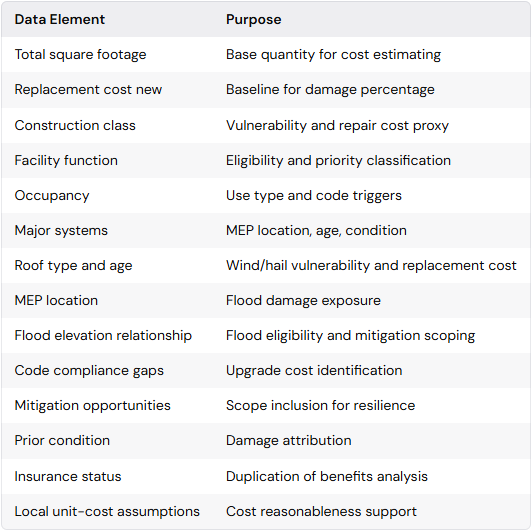
If the applicant has poor data, the estimate process becomes slow and reactive. Engineers must locate drawings, confirm dimensions, investigate construction type, determine roof age, identify MEP location, obtain photos, determine code triggers, and reconstruct pre-disaster condition — all after the event.
If the applicant has a Smart Asset Registry, much of that work is already structured. The registry becomes the pre-disaster baseline for:
FEMA already recognizes cost estimating as part of PA administration through its Cost Estimating Format (CEF), described as a uniform methodology for determining costs of eligible permanent work for large construction projects. The proposed HR4669 model would make this even more critical because the cost estimate itself becomes the gateway to upfront funding.
Smart Asset Registry Data Model: The Core Data Fields
A FEMA-ready Smart Asset Registry should be designed as a flat file at the base level — one row per location or one row per asset component, with no merged cells, consistent units, and clean alpha-numeric headers. The following data model serves as comprehensive guidance.
1. Identity and Geospatial Fields
Every asset should include:
Asset ID
Location ID
Facility name
Facility type
Department/agency owner
Legal owner
Operator
Street address
City
State
ZIP code
County
Jurisdiction
Latitude/Longitude
Congressional district
FEMA region
Tribal/non-tribal indicator
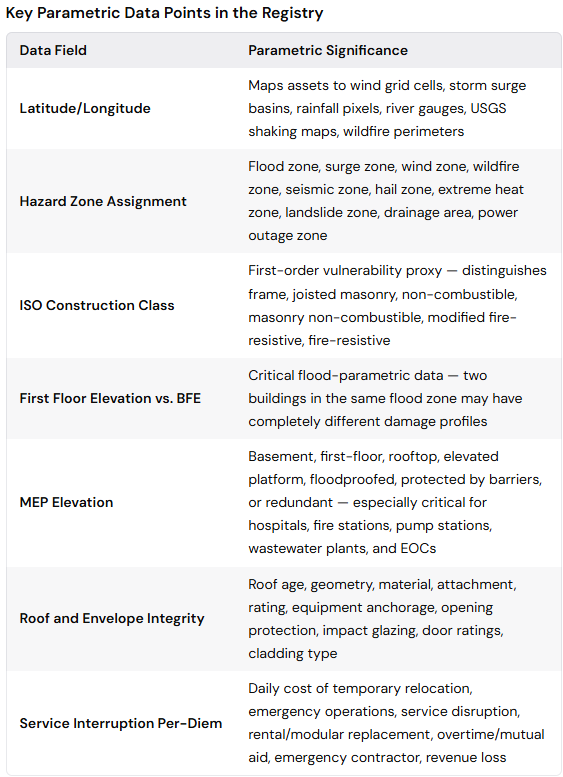
Why it matters: Precise geocoding maps assets to hazard grids, wind cells, surge basins, and flood zones. Without coordinates, parametric triggers and damage attribution are unreliable.
2. FEMA Eligibility and Classification Fields
Every asset should include:
Applicant legal responsibility
FEMA PA category (A through G)
Facility type
Critical service flag
Essential governmental service flag
Pre-disaster use description
Ownership documentation link
Insurance schedule link
Pre-disaster condition evidence link
Prior disaster damage record
Why it matters: Current PA eligibility requires the work to be disaster-related, in the designated area, and the legal responsibility of an eligible applicant. The registry should help prove those elements quickly.
3. Value and Cost Fields
Every asset should include:
Building value
Contents/equipment value
Business interruption or service interruption value
Replacement cost new
Replacement cost per square foot
Date of valuation
Escalation index
Local cost adjustment factor
Demolition cost factor
Debris removal factor
Soft cost factor
Design/engineering factor
Permitting factor
Construction contingency
Management cost factor
Why it matters: Proposed §409 estimates must include associated expenses such as labor, management costs, materials, and other costs to repair, restore, reconstruct, or replace the impacted facility.
4. COPE and Engineering Fields
Every asset should include:
ISO construction class
Structural system
Year built
Renovation years
Number of stories
Square footage
Basement flag
Basement area
First floor elevation
Base flood elevation
MEP location (basement, first floor, rooftop, elevated platform, floodproofed)
MEP elevation
Floodproofing status
Roof age
Roof geometry
Roof material
Roof attachment type
Roof rating
Roof equipment anchorage
Opening protection
Impact glazing
Door ratings
Cladding type
Sprinkler status
Sprinkler type
Alarm type
Public protection class
Utility dependencies
Generator capacity
Backup power type
Essential service continuity features
5. Hazard and Mitigation Fields
Every asset should include:
Flood zone (FEMA designated)
Surge zone
Wind zone
Wildfire zone
Seismic zone
Hail zone
Extreme heat zone
Landslide zone
Drainage/watershed area
Power outage zone
Base flood elevation
First floor elevation
MEP elevation relative to BFE
Floodproofing status
Backup power type and capacity
Mitigation opportunities identified
Code upgrade factor
Nature-based protection if applicable
Retrofit status
6. Parametric Trigger Fields
Every asset should include:
Trigger zone assignment
Trigger data source (e.g., wind grid cell, river gauge, rainfall pixel)
Trigger threshold
Vulnerability coefficient or fragility curve assignment by hazard
Payout tier
TIV used for payout calculation
Service interruption per-diem
Business interruption daily cost if applicable
Daily cost of temporary relocation
Daily cost of emergency operations
Daily cost of service disruption
Daily rental/modular replacement cost
Daily overtime/mutual aid cost
Daily emergency contractor cost
Calculation agent
Settlement protocol
Basis risk notes
7. Documentation and Evidence Fields
Every asset should include links or references to:
Ownership/lease documents
Insurance policy schedules
NFIP policies
Self-insurance documentation
Pre-disaster condition photos
Inspection reports
Maintenance logs
Roof age records
Equipment inventories
Asset condition records
Drawings and specifications
Prior comparable project cost data
Mutual aid agreements
Operating agreements
Service responsibility records
How the Smart Asset Registry Supports FEMA Upfront Funding
If a future FEMA PA model moves toward upfront funding based on initial estimates, the Smart Asset Registry becomes the applicant's evidence engine.
Pre-Disaster Data: Questions the Registry Answers Before Any Event
What was the facility before the disaster?
Who owned it?
Who had legal responsibility?
What was its use?
What was its pre-disaster condition?
What was its replacement cost?
What construction system was used?
What systems were in the basement?
What systems were elevated?
What codes and standards may be triggered?
What mitigation measures are appropriate?
What insurance applies?
What local cost data should be used?
What prior damage or deferred maintenance existed?
Post-Disaster Data: Questions the Registry Answers Immediately After an Event
What hazard intensity reached the asset?
What components are likely damaged?
What is the estimated percent damage?
What is the initial base cost?
What soft costs apply?
What mitigation costs should be included?
What insurance proceeds or parametric payouts may duplicate or complement the funding?
What scope can be submitted for upfront grant funding?
This is especially important because current PA cost eligibility depends on more than damage. FEMA PA requires eligibility of the applicant, facility, work, and costs. A Smart Asset Registry does not guarantee FEMA eligibility — it makes the eligibility and estimate process faster, cleaner, and more defensible.
The Parametric Trigger Layer: Turning the Registry into a Liquidity Engine
Parametric insurance pays based on an agreed event index, not a traditional loss adjustment. The trigger might be wind speed, flood depth, rainfall total, storm surge height, earthquake shaking, heat index, wildfire footprint, or river gauge height.
The parametric-registry link consists of three components:
Index — A verifiable data point such as wind speed, peak ground acceleration, or gauge height
Threshold — The intensity at which payout activates
Payout Function — The pre-agreed percentage of TIV or other value measure paid when the trigger is met
A traditional SOV can support a crude parametric product because it provides TIV by location. But a Smart Asset Registry supports a better parametric product because it explains how different assets respond to the same hazard.
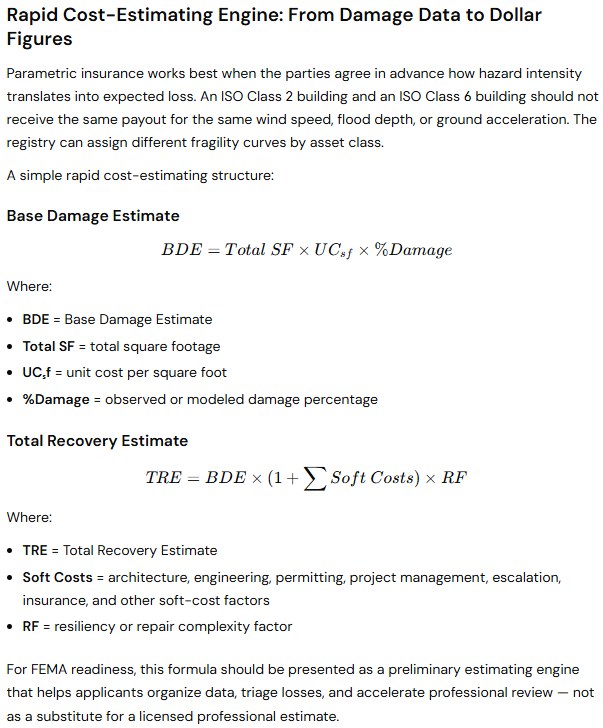
Example: A Class 1 wood-frame public works garage may suffer severe wind damage at a lower wind speed than a Class 6 fire-resistive building — even if both have the same TIV. The same flood depth that causes 200,000 in damage to a building with elevated MEP may cause \2 million in damage to an identical building with basement MEP.
Settlement Protocol: How the Smart Registry Shortens Time to Cash
A traditional indemnity claim asks: What damage occurred, what does the policy cover, what is excluded, what is the actual repair cost, and what proof supports the claim?
A parametric settlement protocol asks: Did the agreed event occur at the agreed intensity, at the agreed location, according to the agreed data source, and what payout does the schedule require?
Municipal Parametric Settlement Workflow
Step 1 — Event Occurs. A hurricane, flood, earthquake, or wildfire impacts the jurisdiction.
Step 2 — Index Confirmed. An independent data source (e.g., NOAA, USGS, third-party weather station network) confirms wind speeds, flood depths, rainfall totals, or ground shaking intensity at the asset's coordinates.
Step 3 — Registry Cross-Reference. The Smart Asset Registry cross-references the event data against each asset's trigger zone, vulnerability coefficient, and payout assignment.
Step 5 — Settlement Verification. Payout is verified and pre-agreed settlement protocol is executed.
Step 6 — Liquidity Injection. Funds are deployed for emergency work, temporary facilities, debris removal, pumps, generators, shelters, professional estimates, engineering, or non-federal match strategy.
This is where the Smart Asset Registry aligns with FEMA readiness. It does not replace FEMA — it supplies rapid liquidity while FEMA eligibility, cost estimating, environmental review, insurance review, and grant processing proceed in parallel.
Basis Risk: The Central Technical Problem
Parametric insurance has one unavoidable challenge: basis risk — the mismatch between the payout and actual loss. A policy may pay when damage is lower than expected, or fail to pay enough when damage is higher than expected.
The more granular the registry — especially with secondary COPE data — the lower the basis risk. Municipalities may use a parametric-first layer for immediate liquidity followed by a traditional indemnity layer for the tail of the loss.
Five Ways a Smart Asset Registry Reduces Basis Risk
1. Better Geocoding. Precise coordinates prevent the wrong hazard intensity from being assigned to the wrong asset.
2. Better Vulnerability Classification. ISO class, roof type, MEP elevation, opening protection, floodproofing, and retrofit status help differentiate assets rather than treating them uniformly.
3. Better Trigger Zoning. Assets can be grouped into rational zones: coastal surge, inland rainfall, riverine flood, wind grid, wildfire interface, seismic basin, or drainage catchment.
4. Better Payout Curves. Instead of one flat payout for all buildings, payout curves can vary by facility class, construction type, hazard, and criticality.
5. Better Hybrid Design. A public entity can use parametric insurance for immediate liquidity and traditional insurance, FEMA PA, reserves, or bond proceeds for longer-tail reconstruction.
The key is not to make parametric insurance pretend to be indemnity insurance. The key is to design parametric coverage for what it does best: speed, liquidity, transparency, and pre-agreed settlement.
Smart Asset Registry and FEMA Compliance: Avoiding the Wrong Message
The Smart Asset Registry should not be marketed as a way to bypass FEMA rules. It should be marketed as a way to prepare better FEMA submissions.
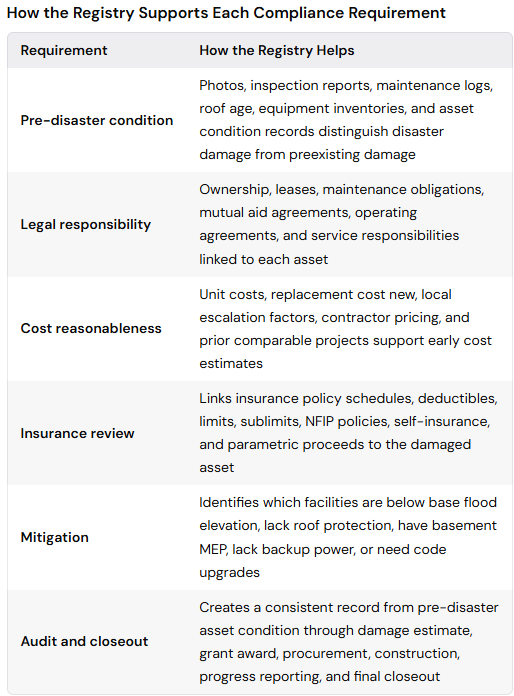
Current FEMA PA eligibility still requires disaster causation, designated-area location, and legal responsibility (44 CFR § 206.223). FEMA also evaluates facility eligibility, work eligibility, cost reasonableness, insurance, environmental and historic compliance, procurement, and documentation.
A Smart Asset Registry helps with those requirements by organizing evidence before the disaster.
Under proposed §409, annual progress reports would include funded projects, permitted and commenced projects, completed projects, and remaining project status, with reports made publicly available. A Smart Asset Registry can become the backbone of that reporting system.
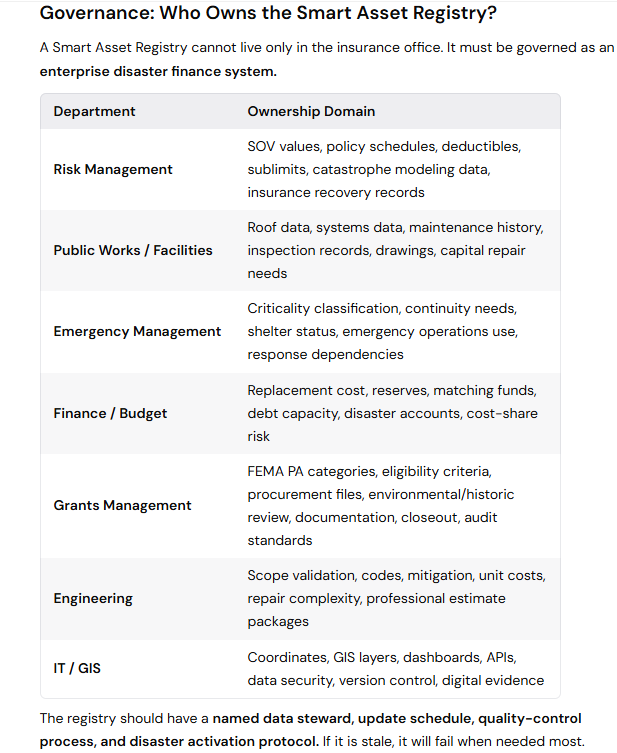
The registry should have a named data steward, update schedule, quality-control process, and disaster activation protocol. If it is stale, it will fail when needed most.
Implementation Roadmap: From SOV to Smart Asset Registry
A practical transition can be staged in seven phases. Each phase builds on the previous one, allowing organizations to start with minimal investment and grow toward full capability.
Phase 1 — Clean the Existing SOV
Start with what exists:
Remove merged cells
Create one row per location
Standardize location IDs
Add latitude/longitude
Validate addresses
Standardize building values
Separate building, contents, equipment, and service interruption values
Add county and jurisdiction fields
Add facility owner and operator
Phase 2 — Add FEMA Eligibility Fields
Applicant legal responsibility
FEMA PA category (A–G)
Facility type
Critical service flag
Essential governmental service flag
Pre-disaster use
Ownership documentation link
Insurance schedule link
Pre-disaster condition evidence link
Phase 3 — Add Engineering and COPE Fields
ISO construction class
Structural system
Year built
Renovation years
Roof age/type/geometry
Number of stories
Basement flag
MEP location
Sprinkler status
Alarm type
Public protection class
Opening protection
Utility dependencies
Phase 4 — Add Hazard and Mitigation Fields
Flood zone
Base flood elevation
First floor elevation
MEP elevation
Wind zone
Seismic zone
Wildfire zone
Floodproofing status
Backup power
Mitigation opportunities
Code upgrade factor
Nature-based protection if applicable
Phase 5 — Add Cost Estimating Fields
Replacement cost new
Unit cost per square foot
Local cost factor
Escalation factor
Demolition factor
Debris factor
Soft cost factor
Management cost factor
Design/engineering factor
Contingency
Damage percentage assumptions
Rapid estimate formula output
Phase 6 — Add Parametric Fields
Trigger zone
Trigger data source
Trigger threshold
Payout tier
Vulnerability curve
Vulnerability coefficient
TIV used for payout
Service interruption per-diem
Calculation agent
Settlement protocol
Basis risk notes
Phase 7 — Build Dashboards
Create dashboards for:
Highest TIV assets
Most critical assets
Highest flood exposure
Basement MEP risk
Roof age risk
Uninsured/underinsured assets
Parametric trigger exposure
FEMA PA estimate readiness
Mitigation priority
Cost-share resilience evidence
The New Disaster Finance Standard
The Statement of Values is not obsolete. It is incomplete.
For insurance placement, the SOV remains the starting point. But for the future of FEMA Public Assistance — upfront funding, cost-estimate-driven recovery, parametric liquidity, and fiscal resilience — applicants need a smarter structure.
A Smart Asset Registry turns the SOV into a recovery operating system.
It connects:
Insurance values
FEMA eligibility
Pre-disaster condition
Engineering data
Hazard exposure
Replacement cost
Mitigation
Parametric triggers
Cash-flow planning
Audit-ready closeout
If HR4669's proposed §409 model or similar FEMA Review Council concepts move forward, the applicants that succeed will be those that can rapidly submit credible initial cost estimates backed by professional data. The proposed §409 text places cost estimates, licensed professionals, mitigation, labor, materials, management costs, review deadlines, funding availability, and annual reporting at the center of the new model.
That makes the Smart Asset Registry one of the most important disaster finance tools a state, local government, tribal government, public authority, school district, utility, transportation agency, or eligible nonprofit can build before the next disaster.
Final Message
The future FEMA PA applicant will not win by having a spreadsheet of insured values.
The future applicant will win by having a verified, geocoded, engineered, cost-ready, insurance-linked, parametric-enabled Smart Asset Registry that can convert damage into defensible funding requests within days — not years.