Navigating the Statutory Wall: A Comparative Guide to Local Power and Disaster Recovery
1. Introduction: The High-Stakes Conflict of Recovery
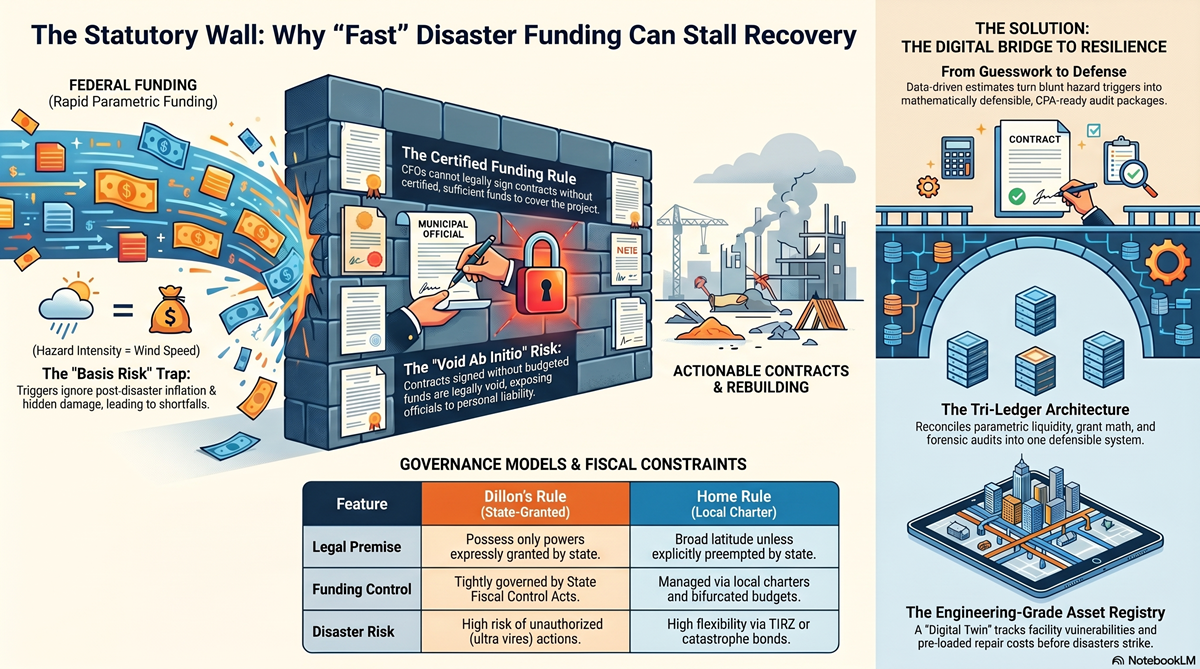
In the immediate aftermath of a catastrophe, the political and social pressure for rapid reconstruction is absolute. This urgency has prompted a significant paradigm shift in federal recovery policy, moving away from slow, itemized reimbursement models toward the "RAPID" funding model (as seen in H.R. 4669). This model promises upfront, formula-driven grants within 30 days based on "parametric triggers" like peak wind speeds or flood depths.However, for the municipal leader, this "immediate liquidity" can represent a dangerous Statutory Trap . The conflict arises when federal speed meets Statutory Reality : local budget laws strictly prohibit officials from committing to projects without certified, sufficient funds. When speed results in an understated grant, the recovery process hits a wall that no amount of political will can bypass."The core tension lies in the fact that a macro-level hazard trigger is not a construction cost estimate. When federal speed results in an understated grant, it hits the 'statutory wall' of local budget laws that prohibit officials from committing to projects without certified, sufficient funds."Municipal leaders must recognize that navigating this crisis requires an audit of their city’s "legal DNA," which defines the boundaries of their fiscal authority.
2. Comparing the Legal Architectures: Dillon’s Rule vs. Home Rule
The capacity of a local official to legally authorize rebuilding depends entirely on the framework governing municipal power in their state.| Feature | Dillon’s Rule (General State Laws) | Home Rule (Charter Framework) || ------ | ------ | ------ || Legal Premise | Municipalities possess only those powers expressly granted by the state legislature. | Cities manage local affairs unless explicitly preempted by state law. || Funding Control | Tightly governed by Uniform Municipal Budget Laws and Local Government Fiscal Control Acts. | Managed via local charters; requires a strict bifurcated budget (Operating vs. Capital). || Flexibility in Disaster Financing | Static statutory pathways; alternative risk financing is often prohibited without state enabling acts. | High flexibility; can utilize "fiscal stacks" including TIRZ , 4B taxes , or catastrophe bonds. |
Consultant’s Take: The "So What?"
For Dillon’s Rule Jurisdictions: Officials face a severe risk of ultra vires actions—acting beyond legal authority. If an official signs a contract for an unbudgeted project, the contract is considered void ab initio (void from the beginning). This is not a mere procedural error; it exposes the official to significant personal and professional liability .For Home Rule Jurisdictions: While these cities can leverage complex "fiscal stacks" (mixing insurance, local taxes, and grants), they are bound by strict appropriation ordinances . These ordinances require a project to be fully funded before it can move from a Capital Improvement Plan (CIP) to an actionable, legally binding contract.Regardless of the model, both frameworks eventually hit the same uncompromising fiscal gatekeeper.
3. The "Statutory Wall": Why Funding Isn't Always "Spending Power"
In municipal finance, a promise of federal money is not synonymous with the power to spend it. This is dictated by the Certified Funding Rule (the "Appropriation Before Contract" rule). Under this rule, the Chief Financial Officer (CFO) serves as the statutory gatekeeper. A CFO cannot legally execute a construction contract based on an "initial allocation" or a formula-based promise.To satisfy auditors and comply with federal Stafford Act mandates, two distinct types of funding must be established to avoid a Duplication of Benefits (DOB) :
- Committed Funding (The Legal Minimum): The legislative body must pass an ordinance authorizing a specific, legally binding revenue pathway. This requires an executed federal grant agreement that complies with 2 CFR § 200 (Uniform Administrative Requirements) before any work begins.
- Dedicated Funding: These are "ring-fenced" revenue streams, such as Enterprise Funds for water/sewer utilities or 4B sales taxes . These funds are legally restricted to capital infrastructure and cannot be diverted to cover general operating shortfalls.If a grant is understated, the CFO is statutorily barred from certifying the contract, turning a procedural check into a total mathematical collapse of the recovery.
4. The Anatomy of Failure: How Speed Leads to Stalled Recovery
The "RAPID" model’s reliance on blunt hazard data often triggers a step-by-step collapse of the recovery effort due to Basis Risk —the gap between a parametric payout and actual construction costs. Macro-sensors cannot detect facility-specific realities like electrical corrosion in switchgear or foundation erosion ( scour ).The Failure Chain follows four predictable steps:
- The Understated Grant: Formulaic triggers fail to account for "demand surge" (post-disaster inflation) and hidden variables such as selective demolition or hazardous debris removal .
- The Local Shortfall: By accepting a fixed RAPID grant, the local government waives its cost-reimbursement protection . Local taxpayers become responsible for 100% of any overrun risk , including costs for mandatory ADA and building code upgrades .
- The Legal Wall: Because the budget is now out of balance, the City Council cannot legally appropriate the missing millions. The CFO, fearing personal liability, cannot certify the contract.
- Stalled Infrastructure: Reconstruction stops. The community remains in ruin because the "speedy" funding was mathematically and legally insufficient to trigger a contract.To break this chain, local officials must move beyond macro-hazard data and adopt a technical bridge that reconciles legal risk with engineering reality.
5. The Solution: Pre-Disaster Asset Registries as a Legal Shield
To reconcile the need for speed with the requirement for legal accuracy, municipalities must implement an Engineering-Grade Asset Registry (a "Digital Twin"). This allows officials to intersect real-time hazard data with component-level vulnerabilities before a shortfall occurs.
The Five Questions the Registry Must Answer
Question,Required Data Capability
1. What was exposed?,Geospatial footprints and facility hierarchy.
2. How intense was the hazard?,"Intersection with high-water marks, wind swaths, or ShakeMaps ."
3. Which components are vulnerable?,"Component-level data (e.g., location of MEP systems, scour potential, roof age)."
4. What is the repair cost?,"Pre-loaded unit costs and ""damage-to-cost"" formulas."
5. What portion is insured?,Integration with insurance policy schedules and deductibles.
The Statutory Tri-Ledger Architecture
To satisfy the most stringent auditors, this data must be managed through a Tri-Ledger Architecture that provides immutable evidence :
- Parametric/Liquidity Ledger (The Switch): Confirms the disaster threshold and releases initial emergency cash flow.
- Capital/Grant Ledger (The Registry): Converts hazard intensity into a mathematically defensible, facility-specific cost estimate.
- Forensic/Insurance Ledger (The Audit): Validates spending, prevents Duplication of Benefits, and produces CPA-ready audit packages to defend the municipality against future federal clawbacks.
6. Final Summary: Key Takeaways for Municipal Leaders
Accuracy Over Speed
A disaster trigger (hazard data) is not a cost estimate (engineering data). Releasing funds based on triggers alone—without component-level accuracy—inevitably transfers 100% of the financial risk to the local government.
Statutory Compliance
The law does not recognize "good intentions" or "disaster urgency." Without certified, appropriated funds that meet the strict requirements of Local Government Fiscal Control Acts, officials are legally powerless to sign contracts and begin rebuilding.
The Digital Imperative
A pre-disaster Asset Registry is the only way to reconcile the speed of modern federal funding with the accuracy required by law. It serves as the essential technical bridge that makes upfront funding legally defensible and sufficient to complete the mission of reconstruction.