RETURN TO PREVIOUS PAGE

RAPID UPFRONT FUNDING - COST ESIMATING GUARDRAILS

RAPID can accelerate disaster liquidity, but only if Congress prevents fast payments from becoming premature fixed grants. This Govstar resource explains why parametric triggers, early estimates, and fixed-cost Public Assistance grants need statutory guardrails before communities accept long-term cost risk. Topics include RAPID advances, asset registries, estimate maturity, confidence bands, contract-award adjustments, final reconciliation, tri-ledger controls, insurance offsets, Puerto Rico fixed-grant lessons, critical infrastructure timelines, audit safeguards, and legislative language to balance speed with fiscal integrity.

This document outlines recommended statutory guardrails and reforms for FEMA’s RAPID disaster funding model and fixed-cost Public Assistance grants, emphasizing the need for clear legal protections to ensure accurate cost estimation, accountability, and effective reconstruction.

Overview of Core Principles

  • RAPID aims to accelerate disaster liquidity by providing upfront funding based on objective parametric indicators, but early estimates are not final costs.
  • The model must distinguish between parametric triggers (funding switches), asset registries (cost estimation infrastructure), and audit reconciliation (federal integrity control).
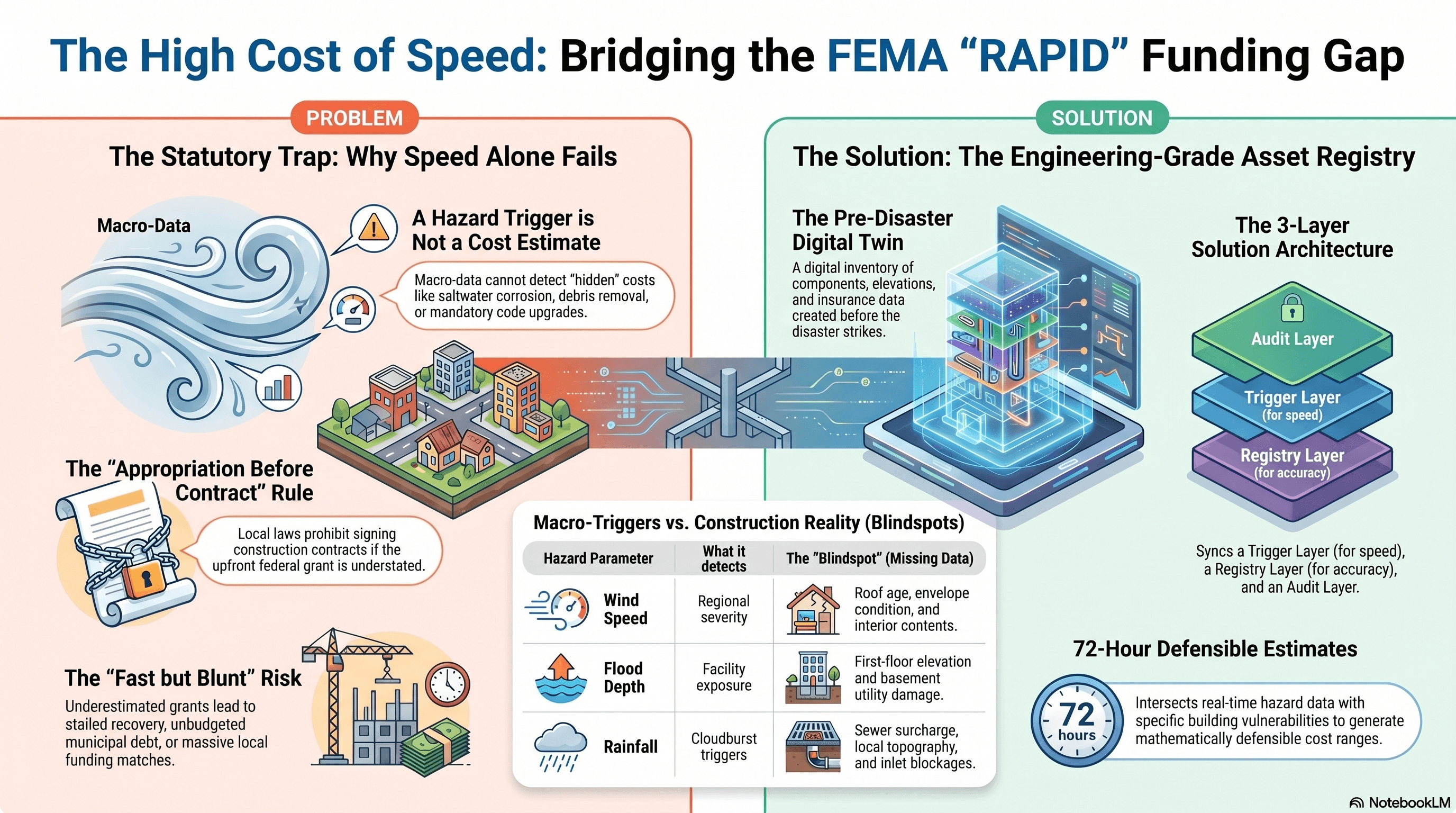
  • Speed without statutory guardrails risks converting preliminary estimates into fixed grants prematurely, leading to cost overruns, funding gaps, and reconstruction delays.

Key Technical Findings

  • Parametric triggers (e.g., wind speed, flood depth) only indicate disaster severity, not actual costs; they cannot replace detailed cost estimates.
  • Certified estimates improve accountability but remain uncertain due to hidden damage, demand surge, insurance disputes, and evolving scope.
  • Relying solely on early estimates without staged validation and statutory protections risks fixed obligations based on incomplete or inaccurate data.
  • Past examples like Puerto Rico’s Hurricane Maria recovery demonstrate how fixed estimates fixed too early can cause significant funding shortfalls due to inflation, scope changes, or hidden damage.

Implications for Local Governments

  • Local agencies cannot legally award major contracts without assured funding; underestimations can cause delays, shortfalls, or legal issues.
  • Without statutory adjustment rights, early fixed grants may not cover actual costs, burdening local taxpayers and delaying recovery.

Recommended Statutory Guardrails

  • Clarify that RAPID funds are advances, not final grants, until estimates reach a defined maturity.
  • Mandate pre-disaster, engineering-grade asset registries with detailed data on assets, hazard exposure, costs, insurance, and audit evidence.
  • Establish asset-class-specific certification timelines, recognizing that different infrastructure types require varying validation periods before final valuation.
  • Require a contract-award adjustment within 18 months to account for market and scope changes, based on actual bid prices.
  • Implement a final reconciliation at project completion or after eight years to adjust for actual costs, scope changes, insurance recoveries, and federal offsets.
  • Enforce a tri-ledger system linking asset exposure, insurance claims, and federal eligibility to prevent over- or under-offsetting insurance proceeds.
  • Classify estimates by maturity and confidence bands, avoiding reliance on single-point early estimates as final.
  • Prohibit FEMA guidance from defining core legal protections, reserving such determinations for statute.

Proposed Legislative Language

  • Payments within 30 days are initial advances, not final grants, until statutory criteria are met.
  • Asset registries must include geospatial, ownership, hazard, cost, insurance, and audit data.
  • Estimate classifications and validation timelines are mandated, with longer periods for complex or critical assets.
  • Contract adjustments are required within 18 months for projects with material cost differences.
  • Final reconciliation occurs at project end or after eight years, accounting for all relevant costs and recoveries.
  • Recipients must maintain linked ledgers for hazard exposure, insurance, and federal costs.
  • Critical infrastructure must have longer certification periods and special protections.

Conclusion

  • RAPID can improve liquidity but must be protected by explicit statutory guardrails to prevent premature fixed obligations and ensure realistic, accountable reconstruction.
  • The legislation should codify staged estimates, asset standards, certification timelines, adjustment rights, reconciliation procedures, and audit controls.
  • Without these protections, RAPID risks becoming a fast but blunt tool; with them, it can serve as a reliable, efficient disaster finance platform that balances speed with fiscal and technical integrity.