RETURN TO PREVIOUS PAGE

Section 428 Alternative Procedures for Infrastructure Restoration

Section 428 can give FEMA PA applicants major flexibility—but only if they understand the fixed-cost risk before accepting. This Govstar guide explains how Alternative Procedures shift recovery from actual-cost reimbursement to capped fixed-cost grants, allowing fund sharing, excess-fund retention, faster project delivery, and resilience investments. Topics include Standard vs. Alternative Procedures, Fixed Cost Offers, expert panel review, 18-month and 30-day deadlines, excess funds, mitigation SOW rules, O&M insurance, procurement, closeout, OIG audit risk, and the no-appeals rule after acceptance.

Strategic Recovery Guide: Evaluating Section 428 Alternative Procedures for Infrastructure Restoration

1. The Strategic Landscape of Federal Disaster Assistance

In the wake of major disasters, municipal recovery efforts often struggle to move beyond reactive rebuilding. Traditionally, the Stafford Act has functioned on a reimbursement basis, prioritizing the restoration of facilities to their exact pre-disaster state. However, Section 428 Alternative Procedures represent a strategic pivot toward proactive, resilient infrastructure management. By decoupling recovery from rigid, itemized reimbursements, these procedures allow applicants to treat disaster funding as a catalyst for long-term community stability and hazard risk reduction.The fundamental mechanism driving this shift is the move from "actual-cost" reimbursement to "fixed-cost" grants. In the standard model, FEMA pays for the final documented cost of a project, which limits the applicant’s risk but also eliminates any incentive for efficiency. Under Section 428, the grant is capped based on an agreed-upon estimate. While this transfer of risk allows the applicant to retain and repurpose excess funds, it also creates an absolute fiscal liability. If costs exceed the cap, the municipality is solely responsible for the deficit. Consequently, leadership must perform a rigorous internal "Gap Analysis" prior to accepting any offer to ensure the organization can manage potential overruns. Choosing the correct pathway early in the disaster lifecycle is not just a technical requirement; it is a critical governance decision that dictates the municipality's financial trajectory for years.

2. Comparative Analysis: Standard vs. Alternative Procedures

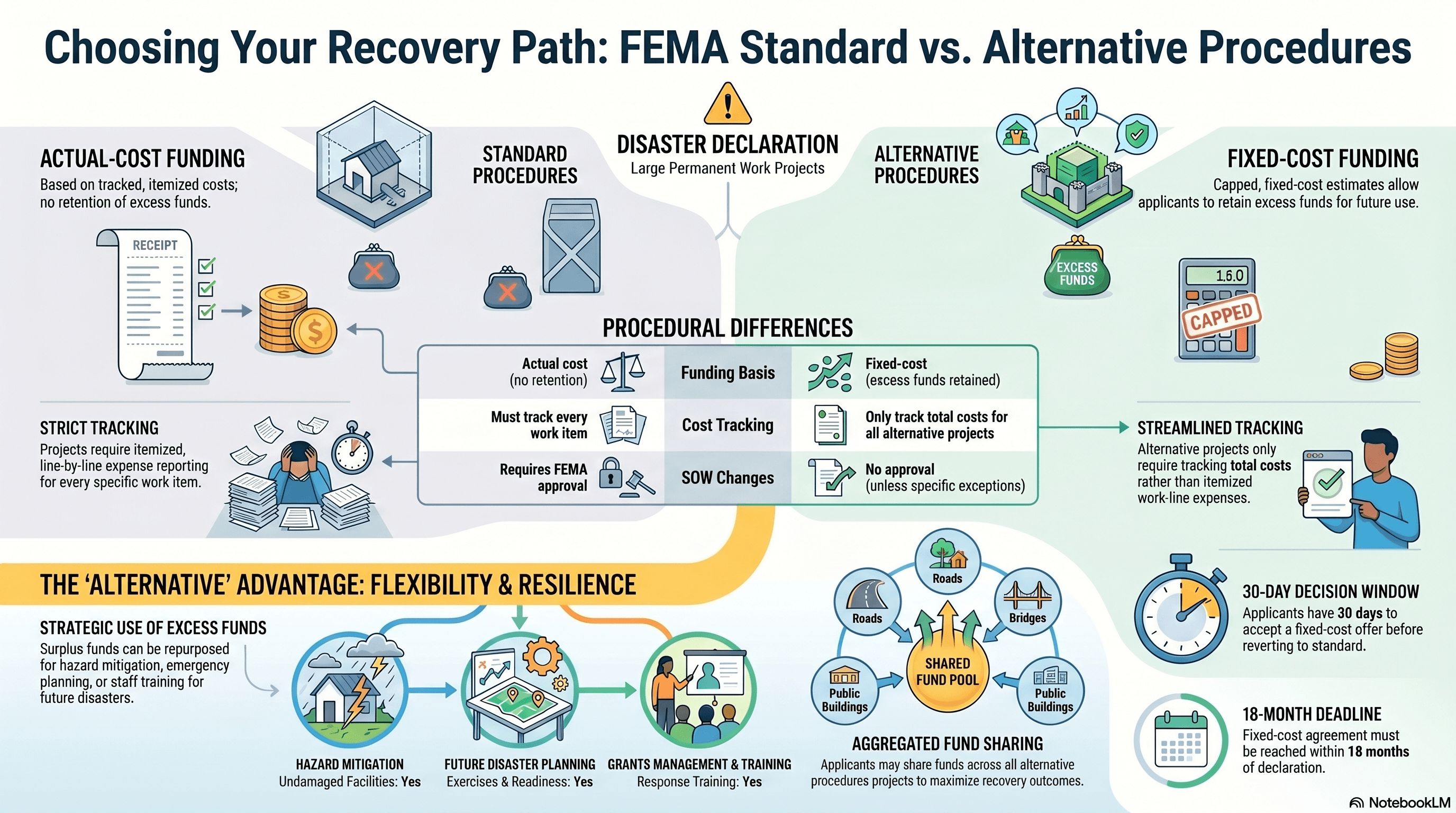
For municipal leadership, the choice between Standard and Alternative procedures is a decision regarding long-term fiscal health and administrative autonomy. Understanding the trade-offs in tracking, flexibility, and oversight is essential for determining which pathway aligns with the complexity of the restoration effort.| Consideration | Standard Procedures | Alternative Procedures || ------ | ------ | ------ || Funding Basis | Actual cost project; no retention of excess. | Fixed-cost project; allows use of excess funds. || Fund Retention | Funds must be returned if not spent on the specific project. | Excess funds may be retained for specific eligible uses. || Fund Flexibility | Restricted to the specific work in each project. | Shared across all alternative procedures projects. || Cost Tracking | Itemized tracking per work item within each project. | Aggregate total cost tracking; no per-work-item tracking. || SOW Amendment | FEMA approval required for all changes. | Approval required only for specific triggers (e.g., age, water). |

The "So What?" of Programmatic Differences

The administrative shifts listed above have direct impacts on project execution:

  • Reduced Administrative Overhead:  The shift to aggregate cost tracking (the "What") means staff can focus on high-level project delivery and engineering quality rather than granular, itemized bookkeeping (the "So What").
  • Strategic Portfolio Management:  The ability to share funds across all alternative projects allows a municipality to treat its recovery as a single portfolio, moving money to where it is most needed without individual project-level roadblocks.
  • Operational Speed:  By removing the requirement for FEMA approval on changes that "substantially conform" to the Scope of Work (SOW), project managers can make real-time adjustments on-site, avoiding the months-long delays inherent in the standard federal amendment process.This flexibility is predicated on the successful establishment of a Fixed Cost Offer (FCO), which serves as the final financial foundation for the recovery portfolio.

3. The Fixed Cost Offer (FCO) Mechanism

The Fixed Cost Offer (FCO) is the "point of no return" in the Section 428 process. Because the funding is capped, the precision of the initial development phase is paramount. Once an applicant accepts the FCO, the project is officially governed by alternative procedures and cannot revert to the standard actual-cost model.

FCO Development Sequence
  1. Foundational Requirements:  Before an estimate is generated, FEMA, the recipient, and the applicant must reach a tripartite agreement on the Damage Description and Dimensions (DDD), the SOW, and specific resilience initiatives.
  2. Allowable Cost Components:  The FCO includes Architectural and Engineering (A&E) fees, environmental design, project management, permitting, and compliance with consensus-based codes and standards. Under the Bipartisan Budget Act, this includes modern standards such as the 2018 or 2021 International Codes (I-Codes), which often provide higher funding levels than pre-disaster standards.
  3. The Expert Panel Layer:  For projects with an estimated Federal share of at least $5 million, an applicant may request a review by an independent third-party panel of experts. This acts as a risk-mitigation tool by validating cost elements, ensuring the estimate is sufficient to execute the SOW before the cap is finalized.
Critical Deadlines and Finality

The timeline for establishing an FCO is rigorous.  Agreement must be reached within 18 months of the disaster declaration date.  Once FEMA transmits the FCO, the applicant and recipient have a  combined total of 30 days to accept.  Failure to act within this window defaults the project to Standard Procedures. Leadership must recognize that  obligation constitutes finality;  once accepted, the fixed cost will not be adjusted for cost overruns or hidden damage, making aggressive technical reconciliation during the 18-month window the only defense against future fiscal shortfalls.

4. Strategic Resource Management: Fund Sharing and Excess Funds

Section 428 offers the strategic advantage of "Aggregate Funding." The total award for all alternative projects becomes a flexible pool of resources for the municipality, rather than a series of isolated funding silos.

Strategic Use of Excess Funds

If restoration is completed under budget, "Excess Funds" can be transitioned into a broader set of eligible activities. This creates a unique opportunity to build a  cost-neutral, permanent recovery department.  Strategic uses include:

  • Administrative Capacity:  Using excess funds for PA or emergency management staff salaries allows the city to maintain a permanent recovery office without drawing from the general fund.
  • Future Resilience:  Hazard mitigation for undamaged facilities and updating debris management or pre-disaster recovery plans.
  • Insurance Sustainability:  Covering future insurance premiums to meet "Obtain and Maintain" (O&M) requirements.
Tactical Compliance Deadlines

To retain these funds, the applicant must navigate a strict post-project timeline. The applicant  must submit a proposed SOW for the use of excess funds within 90 days  of completing the last alternative procedures project. The recipient then has until  180 days  after project completion to forward this request to FEMA. Missing these windows is a high-risk failure point that results in the forfeiture of all cost savings.

5. Prioritizing Long-Term Resilience and Hazard Mitigation

Section 428 is the preferred vehicle for applicants aiming to "Build Back Better." While standard procedures focus on simple restoration, alternative procedures are designed to facilitate long-term risk reduction.

Nuanced SOW Management

Strategic management of mitigation funds requires a dual-track approach to compliance:

  • Repair Flexibility:  For standard repairs, applicants enjoy "Substantial Conformity," allowing changes like material substitutions (e.g., steel vs. concrete) or interior reconfigurations without FEMA approval—unless the structure is 45+ years old, requires ground disturbance, or is near water.
  • Mitigation Rigidity:  Unlike repair SOWs, any changes to the  Hazard Mitigation SOW  must be formally approved by FEMA within the original 18-month agreement window. Failure to complete the approved mitigation work as specified will result in a dollar-for-dollar reduction of the fixed cost amount.

6. Governance, Compliance, and Closeout

Despite the flexibility of Section 428, rigorous documentation remains mandatory to satisfy Office of the Inspector General (OIG) audits. The OIG maintains authority to investigate fraud, waste, and abuse across all projects.

Closeout Requirements Checklist

To retain excess funds, the following must be certified within 180 days of the final project completion:

  •  Work Completion:  All SOW items finished by the approved deadline.
  •  Cost Certification:  Documentation of total actual costs (aggregate, not itemized).
  •  EHP & Civil Rights:  Full compliance with environmental, historic, and civil rights laws.
  •  Insurance (O&M):  Proof of "Obtain and Maintain" compliance for all funded facilities.
  •  Procurement:  Adherence to federal procurement standards.
  •  Credits:  Reporting of all actual insurance proceeds and salvage values received.
The Strategic "So What?" of the No-Appeals Rule

A critical strategic consideration is that  FEMA does not grant appeals  on Alternative Procedures projects regarding damage, SOW, or costs once the FCO is accepted. This places the burden of due diligence entirely on the pre-obligation phase. Any technical or cost disputes must be resolved with absolute finality before acceptance. From a leadership perspective, a post-obligation realization of a budget shortfall is a  governance failure.  C-suite level oversight is required during the 18-month development window to ensure all engineering and cost variables are locked.

Conclusion

The choice between recovery pathways is a choice between certainty and flexibility.  Standard Procedures  are best for low-risk, predictable projects where the applicant prefers FEMA to bear the risk of cost fluctuations.  Alternative Procedures  are the superior choice for complex, high-value infrastructure where the municipality seeks the autonomy to innovate and the opportunity to fund a permanent recovery infrastructure through realized efficiencies.