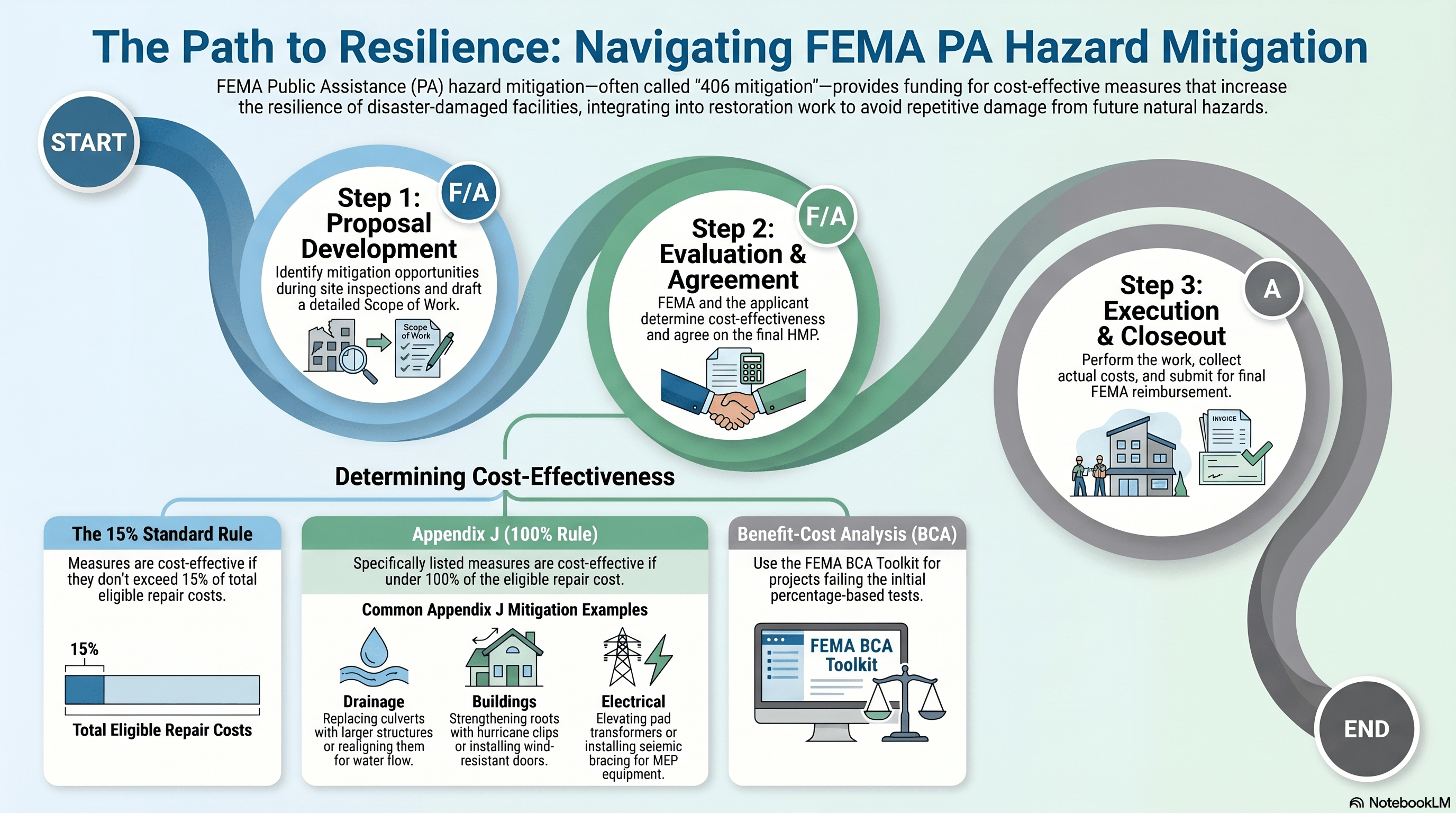
Section 406 Hazard Mitigation helps FEMA PA applicants turn disaster repairs into long-term resilience projects. This Govstar resource explains how to use 406 funding to harden damaged infrastructure, protect functionally interdependent systems, and avoid repetitive loss. Topics include Categories C–G eligibility, damaged-portion nexus, PA 406 vs. HMGP stacking, Appendix J, the 15% and 100% cost-effectiveness rules, BCA strategy, floodwalls, drainage, safe rooms, MEP elevation, generator quick-connects, bridge and marine hardening, EHP compliance, HMP workflow, historic assets, and snow declaration rules.
For local government executives, the aftermath of a disaster is more than a crisis—it is a high-stakes strategic window to secure the future of municipal infrastructure. Traditional recovery often focuses on "return to status quo," but true resilience requires leveraging the FEMA Public Assistance (PA) Program’s Section 406 Hazard Mitigation. This framework serves as your primary mechanism for transitioning from simple restoration to the proactive hardening of assets against increasing climate severity. By funding the gap between "minimum repair" and "future-proofed design," Section 406 allows you to break the cycle of repetitive loss and stabilize long-term maintenance budgets.Per PAPPG v5 guidelines, Hazard Mitigation consists of cost-effective measures that reduce the potential for future damage to a facility. Unlike "Codes and Standards" work, which only covers what is legally required, Section 406 mitigation allows for work that goes above and beyond minimum requirements to provide long-term resilience solutions.To maximize federal obligation, you must ground every project proposal in the specific legal mandates that govern federal participation.
Navigating the regulatory landscape is not a bureaucratic exercise; it is a financial defense strategy. Failure to align engineering designs with federal eligibility from the outset leads to the deobligation of funds during final audits.
To qualify for Section 406 funding, a project must meet these non-negotiable criteria:
While FEMA generally only funds work on damaged components, the concept of Functional Interdependence is your primary lever to secure funding for undamaged assets . If an entire system (e.g., a pump station and its control building) is jeopardized by the failure of a single component, FEMA may fund the protection of both. Use this logic to protect interdependent systems that would otherwise be left vulnerable.
If a project fails PA 406 eligibility (e.g., it only protects an undamaged portion of a facility), immediately pivot to the Hazard Mitigation Grant Program (HMGP). You can strategically "stack" these funds: use PA 406 for the damaged components and HMGP for the undamaged portions of the same facility, provided the work is not duplicative.
FEMA recognizes that certain assets require external structures for protection. Use these examples to justify separate construction:| Mitigation Measure | Strategic Function (Wildfire/Flood/Erosion) || ------ | ------ || Floodwalls/Vegetated Swales | Prevention of inundation for low-lying critical assets. || New Drainage Structures | Installation of culverts or permeable pavements for road stability. || Defensible Space | Removing flammable vegetation/hardscaping to mitigate wildfire risk. || Nature-Based Solutions | Using live fascines or root wads to stabilize banks and control scour. |
Once eligibility is confirmed, the project’s design must be engineered to meet specific financial thresholds.
Cost-effectiveness is the ultimate hurdle. Your engineering team should not design in a vacuum; they must target specific financial thresholds to fast-track obligation and avoid the complexities of a full Benefit-Cost Analysis (BCA).
A successful BCA captures hidden social and environmental values. Ensure your team documents:
Appendix J is your "menu of pre-approved resilience." Select these measures to fast-track funding and bypass secondary reviews.
The Hazard Mitigation Proposal (HMP) is a collaborative lifecycle. The Site Inspection is your "make-or-break" moment; this is where you must identify mitigation opportunities before repairs are locked in.| Step | Responsible Party | Strategic Action || ------ | ------ | ------ || 1. Request PA | Applicant | Formally trigger the funding process. || 2. Inventory Damage | Applicant | Comprehensive cataloging of all impacts. || 3. Site Inspection | FEMA & Applicant | Critical: Verify damage and scout mitigation potential. || 4. Identify Opportunities | FEMA & Applicant | Strategic brainstorming based on the damage nexus. || 5. Develop SOW | FEMA & Applicant | Drafting the technical resilience plan. || 6. Calculate Costs | FEMA & Applicant | Establishing the HMP budget. || 7. Determine Cost-Effectiveness | FEMA | Validating the 15%/100%/BCA threshold. || 8. Agreement on HMP | FEMA & Applicant | Finalizing the funding obligation. |
Post-Repair Warning: If you expedite repairs before an HMP is approved, you risk losing funding for any duplicative work (e.g., tearing out new pavement to install a culvert). Always attempt to integrate mitigation during the primary repair phase.
Complex assets and extraordinary declarations require specialized regulatory navigation.
Snow removal is only eligible under Major Disaster Declarations (not Emergency Declarations) and is classified as an Emergency Protective Measure.