The Guide to Federal Tasking: Understanding Mission Assignments and Direct Federal Assistance
I. Executive Summary: The Strategic Framework of Federal Intervention
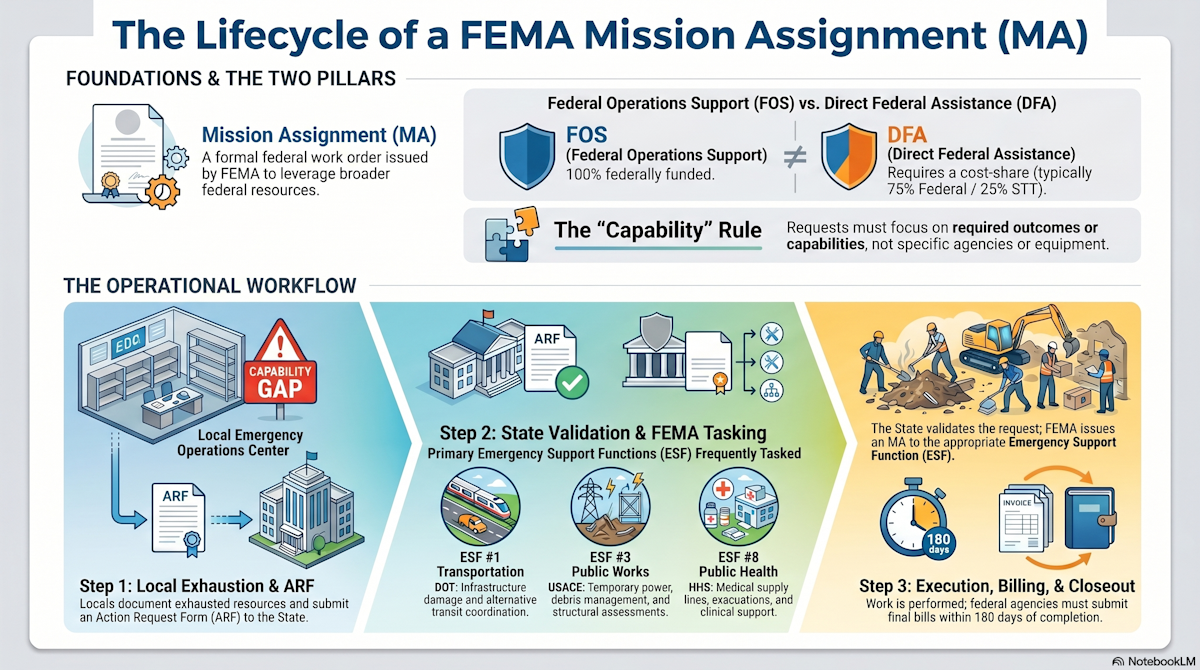
Under the Robert T. Stafford Disaster Relief and Emergency Assistance Act , federal intervention is not a default response but a highly structured support mechanism activated only when the scale of a catastrophe exhausts the organic capabilities of state, tribal, or territorial (STT) governments. The primary instrument for this coordination is the Mission Assignment (MA) . As a formal work order, the MA allows FEMA to "task" other federal agencies (OFAs) to leverage specialized expertise and assets, bridging the gap between local exhaustion and federal capability. For the emergency management professional, understanding this mechanism is the difference between a synchronized response and an uncoordinated logistical failure.The following strategic pillars govern the federal tasking lifecycle:
- Bifurcated Support Pillars: Federal assistance is strictly divided into Federal Operations Support (FOS) and Direct Federal Assistance (DFA).
- The 75/25 Cost-Share: While FOS is 100% federally funded, DFA typically requires a 25% STT cost-share, ensuring local "skin in the game."
- Emergency Support Functions (ESFs): Resources are organized into 15 functional categories, grouping agencies by skill sets such as engineering, public health, or transportation.
- Financial Accountability: Strict temporal guardrails, including the "one-year IAA rule" and the "180-day billing backstop," protect the Disaster Relief Fund (DRF) from mismanagement.Because these missions are legally grounded in the Stafford Act, we must first establish the regulatory foundations that empower federal tasking.
II. Foundations and Definitions: The Stafford Act and the MA Instrument
The Stafford Act serves as the legal "permission slip" for federal intervention. Authority flows from the President through the Secretary of Homeland Security to the FEMA Administrator, who delegates the power to task OFAs. This delegated authority ensures that the full weight of the federal government can be applied to STT needs without overstepping constitutional boundaries.A Mission Assignment (MA) is a federal work order issued by FEMA that directs another federal agency to utilize its authorities and resources to support disaster assistance efforts.
Key Officials and the Governance Hierarchy
The obligation and monitoring of federal funds are managed by specific officials. Understanding these roles is critical for navigating the "insider" bureaucracy of a Joint Field Office (JFO):
- Federal Approving Official (FAO): This is a collateral duty responsibility , not a certifiable position within the FEMA Qualification System (FQS). The FAO holds the sole delegated authority to sign MAs and obligate funds. In "urgent life-saving" scenarios, the FAO is the only official authorized to issue verbal MAs.
- FEMA Project Manager (PM): The PM owns the entire lifecycle of the MA. They are responsible for fiscal monitoring, ensuring the work remains within the Statement of Work (SOW) and that the performing agency adheres to the Period of Performance (POP).
- OFA Action Officer (AO): The primary contact for the performing agency (e.g., USACE or HHS). The AO manages their agency’s tactical resources and coordinates daily operations with the FEMA PM.
- STT Approving Official: For DFA missions, this official must sign the MA to acknowledge the SOW and formally bind the STT government to the cost-sharing requirements.These legal foundations bifurcate into two distinct operational pillars that dictate the budget, the recipient, and the long-term financial liability.
III. The Two Pillars of Support: FOS vs. DFA
The distinction between Federal Operations Support (FOS) and Direct Federal Assistance (DFA) is the most consequential decision in the tasking lifecycle. Choosing the wrong pillar can lead to significant budgetary friction and legal ineligibility.| Feature | Federal Operations Support (FOS) | Direct Federal Assistance (DFA) || ------ | ------ | ------ || Primary Purpose | Federal-to-federal support to coordinate the response. | Goods/services provided because an STT lacks capacity. || Target Recipient | FEMA or other federal agencies. | State, Tribal, or Territorial (STT) governments. || Cost-Share Requirement | 100% Federal. | Minimum 75% Federal / 25% STT share. || Pre-Declaration | Authorized if a declaration is imminent. | Prohibited prior to a formal Presidential declaration. |
The "So What?" Layer: Strategic Implications
The cost-share is a partnership mechanism. Because DFA involves the federal government performing work that is technically a state or local responsibility (e.g., clearing municipal roads), the law requires the STT to contribute a match. In contrast, FOS is 100% federal because it supports the internal machinery of the federal response itself.Critical Exclusion: A common operational pitfall is attempting to use MAs for Fire Management Assistance Grants (FMAG) . Per policy, neither FOS nor DFA Mission Assignments are authorized for FMAG declarations.This structural choice leads directly into the narrative journey of how a mission moves from a local failure to a federal execution.
IV. Student’s Narrative Guide: The Journey from Local Need to Federal Execution
The lifecycle of an MA begins with local exhaustion. For the student, the process is a chronological workflow of validation designed to ensure federal aid is the last resort, not the first.
1. The Action Request Form (ARF) and the "Golden Rule"
When a local Applicant (city or county) exhausts its resources, it submits an Action Request Form (ARF) to the State Emergency Operations Center (SEOC).
- The State Logistics Check: The SEOC first reviews National Guard, state DOT, and Emergency Management Assistance Compact (EMAC) assets. If mutual aid cannot solve the problem, they "pull the federal trigger."
- The Golden Rule of ARFs: Requests must focus on capability or outcome , not specific equipment. An ARF should state "Need immediate debris clearance," not "Send USACE with 20 dump trucks."
2. Validation and the SOW Flexibility Rule
The request moves to the JFO, where it is validated under 44 CFR § 206.208 . To accelerate response, FEMA often utilizes Pre-Scripted Mission Assignments (PSMAs) —templates for common needs like heavy-lift aviation.
- Operational Flexibility Nuance: When drafting the Statement of Work (SOW), the FEMA PM must not include specific dates or quantifiable numbers. This intentional lack of specificity preserves the "operational flexibility" required to adapt to a fluid disaster environment without requiring constant legal amendments.
3. The Lifecycle Checklist
- Request: STT requests aid via ARF; FEMA validates the MA tool.
- Creation: FAO, PM, and AO define the SOW.
- Approval: FAO and STT sign; the "IFMIS" initials are applied, signifying financial activation.
- Execution: OFA performs work; Mission Assignment Task Orders (MATOs) provide specific site directions without obligating new funds.
- Inspection: For DFA, a Final Inspection Report is signed by the OFA and STT to confirm completion.
- Billing: OFA submits a "FINAL" bill within 180 days.
- Closeout: FEMA verifies payment and de-obligates excess funds.Execution at this scale requires specialized powerhouse partners, primarily organized through the ESF framework.
V. Powerhouse Partners: ESF Framework and the Role of USACE
The federal government groups its capabilities into 15 Emergency Support Functions (ESFs) to ensure FEMA knows exactly which agency to task for a specific crisis.| ESF Category | Focus Area | Primary Agency / Purpose || ------ | ------ | ------ || ESF #1 | Transportation | DOT: Infrastructure monitoring and alternative transit. || ESF #3 | Public Works | USACE: Engineering, power, water, and debris. || ESF #8 | Public Health | HHS: Patient evacuation and medical supply chains. || ESF #10 | HazMat | EPA / Coast Guard: Environmental stabilization. |
The Unique Scale of USACE
The U.S. Army Corps of Engineers (USACE) is the indispensable partner for ESF #3, providing technical scale that local governments simply cannot replicate. Their core missions include:
- Temporary Power ("Task Force Power"): Installing industrial generators at critical lifelines.
- Debris Management: Logistical oversight of millions of cubic yards of waste.
- "Operation Blue Roof": Installing reinforced plastic sheeting to protect damaged homes.
- Critical Infrastructure Assessment: Engineering evaluations of bridges, dams, and levees to prevent secondary catastrophic failures.High-powered execution, however, must be tempered by the rigorous financial guardrails that prevent post-disaster audits from becoming a second catastrophe.
VI. Financial Guardrails: Risks, Responsibilities, and Accountability
Safeguarding the Disaster Relief Fund (DRF) requires strict fiscal controls. As an analyst, you must warn Applicants that MAs are not "free money"; they are work orders billed at actual final costs .
75/25 Cost-Share Mechanics
The Recipient (State) manages the award, while the Applicant (Local) executes the work. Applicants are prohibited from "double-dipping"—they cannot use other federal grants to pay for their 25% match (with rare exceptions like HUD’s CDBG-DR).
Temporal Backstops and the "Audit Warning"
- The One-Year IAA Conversion Rule: If a mission is expected to extend beyond one year , policy requires it be converted from an MA into an Interagency Agreement (IAA) .
- The $100 De-obligation Buffer: OFAs must submit a "FINAL" bill within 180 days. If they miss this deadline, FEMA will de-obligate all funds down to a ****$ 100 buffer , potentially leaving the OFA (or the STT) with unpaid liabilities.
- 60-Day DFA Limit: DFA is generally limited to 60 days; extensions are reserved for urgent life-safety needs.
- 3-Year Expenditure Backstop: Absolute deadline for all reimbursement and final expenditure reporting.
Prohibited Actions
- No Self-Deployment: No reimbursement for work started without prior FAO approval.
- No Statutory Authority Reimbursement: FEMA cannot pay an agency to perform tasks already mandated by that agency's own independent legal authority.
- No Category Switching: Once a mission is designated FOS or DFA, it cannot switch categories during transitions between different types of disaster declarations.
VII. Analysis of Deployment Trends: Geography and Logistical Friction
DFA deployment patterns serve as a primary indicator of "infrastructure-breaking" catastrophes. These trends are driven by two factors: geography and logistical friction.
Top Tier Locations for DFA
- Isolated Territories (Puerto Rico & USVI): These are "Top Tier" triggers because Mutual Aid (EMAC) friction is absolute. Islands cannot "truck in" help from neighboring states, forcing a total reliance on federal logistics and microgrid construction.
- Large Coastal States (Texas & Florida): The sheer scale of debris and utility failure in these states swamps even the most robust state-level networks.
- Gulf/Atlantic Coast (LA, MS, NC): Frequent exposure exhausts local public works departments within the first 14 days, necessitating federal intervention.
Dominant Drivers of DFA Requests
- Hurricanes: The undisputed leader in DFA due to massive debris blockages and total grid collapses.
- Flooding: Focuses on temporary water-pumping and potable water supplies.
- Biological Anomalies: Events like COVID-19 represent an extreme anomaly, triggering DFA across all 50 states for vaccination and testing infrastructure.Ultimately, federal tasking transforms the chaos of disaster into a manageable, professional framework. By adhering to the legal lifecycle and financial backstops, emergency managers ensure that federal intervention remains a precise, accountable, and effective tool for recovery.