Reason 01
Hidden or Latent Damage
Structural, electrical, mechanical, underground, utility, or contamination conditions may not be visible during initial inspection.


Welcome to the operational deep dive into the FEMA Force Account Playbook. As a Senior Disaster Recovery Compliance Expert, I cannot overstress the importance of the Public Assistance Program and Policy Guide (PAPPG) version 5 framework. The "Force Account" represents an applicant’s own internal resources—labor, equipment, and supplies. This playbook isn't just a guide; it is a defensive operational blueprint. In the world of federal recovery, the difference between a fully funded project and a massive de-obligation often comes down to how well an organization navigates these rigorous reimbursement standards before the first person is even deployed.
.PNG)
The "Force Account" concept is the bedrock of self-performed disaster work. Under PAPPG v5, FEMA requires a structured "Operational Blueprint" to distinguish disaster-specific costs from normal, day-to-day operational expenses.
This reference matrix ensures that internal assets—the very people, machines, and consumables you rely on—are tracked with the level of precision required for federal reimbursement. Every hour logged and every gallon of fuel used must be grounded in an audit trail that proves the resource was necessary, used specifically for the declared incident, and priced according to validated standards.
The "So What?" Layer: FEMA does not reimburse based on "good faith" or the intensity of your response; they reimburse based on the audit-readiness of your documentation. Without a structured playbook, applicants often find that their internal record-keeping fails to meet federal thresholds. If you cannot provide a clear, pre-existing policy or an itemized audit trail, FEMA’s default position is to deny the claim. Failing to institutionalize these standards early results in a permanent loss of funding that no amount of retroactive paperwork can fix.Connective Tissue: To protect your recovery funding, we must move beyond a reactive stance and master the four-stage lifecycle of compliance, which we call the Compliance Blueprint.
The Compliance Blueprint defines the lifecycle of a disaster project through four distinct phases: Qualify, Deploy, Document, and Dispose. From a compliance perspective, the "Qualify" stage is the most critical because it occurs before the disaster. If your pre-disaster policies are not the bedrock of your operation, the entire funding structure for the remaining stages will collapse under federal scrutiny.
.PNG)
Eligibility is won or lost in the Qualify stage. This is where your written pay policies and uniform application rules are established; these dictate all post-disaster funding. During the
Deploy stage, we activate the strict rules governing straight-time, overtime, and equipment rate selections. As work matures, the Document stage takes over, where intense scrutiny scales with project size—large projects require granular data like individual timesheets and operator logs.
Finally, the Dispose stage marks the end of an asset’s lifecycle, where we use fair market value assessments to determine if funds must be returned to the federal government.The "So What?" Layer: The $10,000 threshold mentioned in the "Dispose" phase is a high-stakes pivot point for scrutiny. If an unused supply or a piece of equipment maintains a fair market value over $10,000, FEMA requires compensation. More importantly, if your "Document" phase fails the "attribute-based sampling" used by auditors, the entire project’s funding is at risk. Policies must be in effect before the incident; without them, FEMA defaults to the most restrictive possible reimbursement rates.Connective Tissue: While the lifecycle provides the timeline, the complexity begins with our most expensive and scrutinized resource: Force Account Labor.
Labor is frequently the largest line item in a Public Assistance claim, making it the primary target for OIG audits. To ensure these costs are eligible, they must rest on three compliance pillars: No Federal Contingency, Uniform Application, and Non-Discretionary Criteria. These pillars exist to ensure applicants aren't creating "pay-for-funding" schemes that only exist when federal money is on the table.
.PNG)
First, No Federal Contingency means pay cannot be subject to the availability of federal funds.
Second, Uniform Application requires that your pay rules apply consistently across the board, regardless of whether a presidential declaration is in place.
Third, Non-Discretionary Criteria requires clear, set triggers for when pay types like overtime are activated. Critically, all policies must be "written and in effect prior to the incident start date." This is a non-negotiable requirement for eligibility.
The "So What?" Layer: The source provides a definitive "Warning": if these requirements are not met, FEMA will ignore your actual payroll costs. Instead, they will limit Public Assistance funding to your "strictly non-discretionary, uniformly applied pay rates." This often results in the total de-obligation of disaster premiums, hazard pay, or specialized overtime rates that weren't codified before the storm.Connective Tissue: Once the policy pillars are in place, we apply them to the personnel in the field using the Labor Eligibility Matrix.
FEMA’s reimbursement logic for labor is binary: it depends on whether an employee is "Budgeted" or "Unbudgeted" and the category of work they are performing. Understanding the "Red X" on this matrix is essential for any finance officer trying to avoid a million-dollar mistake.
.PNG)
For Budgeted Employees (permanent staff), overtime is eligible across both Emergency (Cat A-B) and Permanent (Cat C-G) work. However, for Emergency Work, there is a critical "Red X": Straight-Time is INELIGIBLE . The only exception is for Category A debris removal performed under specific alternative procedures. For Permanent Work (Cat C-G), both straight-time and overtime are fully eligible.
Conversely, for Unbudgeted Employees (temporary or disaster-specific hires), both straight-time and overtime are eligible across all work categories.The "So What?" Layer: We must also address the "Fringe Benefits Note." Fringe benefits are reimbursed as a percentage of actual wages, but the percentages for straight-time and overtime differ . This is because "fixed benefits," such as health insurance, do not scale with additional hours worked. Failing to account for this distinction or incorrectly billing straight-time for budgeted staff during emergency response will lead to immediate "clawbacks" during the closeout phase.
Connective Tissue: Standard hours are just the beginning; the real compliance traps lie in the special deployment profiles of your team.
Disasters force employees into non-standard roles, from backfilling positions to 24-hour standby shifts. Each profile has a specific "Trigger" that dictates eligibility. As a consultant, I've seen more funding lost to mismanaged standby time than almost any other labor category.
.PNG)
Backfill employees replace those deployed to the disaster; their straight-time is only eligible if they are temps, contractors, or permanent staff called in on a day off.
Reassigned employees performing work outside their normal functions must be paid at their normal pay rate, not the rate of the new task.
Standby Time (for evacuation or rescue) must be intermittent, necessary, and policy-backed, with a strict cap of 14 calendar days from incident start for portal-to-portal shifts.
Finally, Supervisors (2nd level and up) in FLSA-exempt roles find their overtime ineligible unless they are directly involved in a specific project and backed by a compliant policy.
The "So What?" Layer: The financial risk here is absolute. If you exceed the 14-day standby cap "from incident start," or if you pay a reassigned employee a higher "hazard rate" without a pre-disaster policy, FEMA will de-obligate those costs. Furthermore, for supervisors like Mayors or Chiefs, failing to track their time regardless of federal funding availability can invalidate the entire claim for their hours.Connective Tissue: Proving these complex scenarios requires a documentation strategy that scales with the size and risk of the project.
Documentation is not a "one size fits all" endeavor. FEMA’s requirements scale significantly between Small and Large projects. For Large Projects, the administrative burden is immense because FEMA applies the "GAO Sampling Rule," which tests your records for specific "attributes" of compliance.
.PNG)
Small Projects require high-level summaries: the number of employees, total hours, and average pay rates including fringes. However, Large Projects require exhaustive granularity: individual names, job functions, exact dates/hours per person, specific pay and fringe rates, complete timesheets, and daily activity logs.
Most importantly, FEMA utilizes an "attribute-based sampling approach" following the GAO Financial Audit Manual. They will pull a representative sample of your records to rigorously verify that the supporting documentation—down to the signature—matches your written pay policies.
The "So What?" Layer: In a Large Project, "averages" are an invitation for an audit finding. If a sampled record is missing a "mathematical fringe calculation" or a "daily log description," it is flagged as an exception. Too many exceptions in a sample can lead auditors to declare the entire labor claim "unverifiable," potentially resulting in the de-obligation of millions of dollars.Connective Tissue: Once the human element is secured, we must apply a similarly rigorous standard to our mechanical resources: Force Account Equipment.
FEMA categorizes equipment into three buckets: Applicant-Owned, Purchased, and Rented/Leased. While the reimbursement methods differ, all categories are now governed by a critical security mandate: the NDAA Telecom Ban under 2 C.F.R. § 200.216.
.PNG)
Applicant-Owned equipment, which explicitly includes "permanently mounted generators," is reimbursed via hourly rates or mileage.
Purchased equipment is funded at the purchase price plus either hourly usage or actual fuel/maintenance. Rented/Leased equipment is based on agreement terms and a strict cost-analysis. However, the NDAA Telecom Ban is a non-negotiable prohibition on foreign-covered telecommunications or surveillance equipment. Public Assistance funds cannot be used for such equipment if it is a "substantial, essential, or critical component" of any system.
The "So What?" Layer: The "So What?" for the NDAA ban is catastrophic: the "substantial, essential, or critical component" clause means that an entire communication tower or security system could be de-obligated because of a single banned $500 camera or switch. There is no partial eligibility here; if the banned component is central to the system, the whole project's funding is rendered ineligible.Connective Tissue: For equipment that passes the security check, the next hurdle is determining the "correct" billable rate through the Decision Tree.
Selecting an equipment rate is a logic-driven hierarchy. You cannot simply pick the highest rate; you must follow a path that prioritizes local standards, then state standards, and finally the FEMA National Schedule.
.PNG)
The tree starts with your local rate for day-to-day operations. If it exists and is lower than FEMA's, you use it (unless you certify it doesn't cover costs). If your local rate is higher than FEMA's, you must document the basis and get explicit FEMA approval. If no local rate exists, move to the State/Tribal/Territorial (STT) rate .
STT rates are automatically approved up to $75/hr; anything above that requires market price justification. If no other rate exists, you default to the FEMA national rate .
The "So What?" Layer: There is a "double-dipping" trap here: FEMA national rates inherently include fuel, maintenance, and mechanics’ labor . If you use a FEMA hourly rate and then try to bill separately for a mechanic's time or a fuel invoice, FEMA will de-obligate the separate costs during the audit. This is a common and easily avoided "administrative error" that costs applicants thousands.Connective Tissue: While this logic applies to owned assets, rented or leased equipment introduces the "Prudence Rule" and the requirement for a cost-analysis.
Renting or leasing equipment during a disaster might feel like the only option, but FEMA evaluates these decisions through the lens of "The Prudence Rule." You must prove that renting was a more fiscally responsible choice than purchasing the equipment outright.
.PNG)
FEMA requires a rigorous cost-analysis comparing renting vs. purchasing. The "Threshold" is clear: total rental or leasing costs must not exceed the cost of purchasing and maintaining that equipment over the life of the eligible project. Furthermore, if an agreement is "Rent-to-Own" and ownership transfers during the project, the reimbursement model shifts immediately from rental fees to hourly equipment rates.
The "So What?" Layer: If your rental costs exceed the purchase price, FEMA evaluates "FEMA’s Recourse." They will determine if you acted with "prudence under the circumstances." If they find you were wasteful or failed to conduct the required cost-analysis, they will limit your reimbursement to the estimated purchase price, leaving your organization to cover the excess rental costs out of pocket.Connective Tissue: Proving this prudence requires a specialized set of documents that move beyond simple invoices.
Documentation for equipment on Large Projects is a technical exercise. FEMA auditors don't just want to see that a machine was used; they want the mechanical specifications to verify that the correct rate was applied.
.PNG)
Small Projects require total usage hours and total cost per equipment type. Large Projects, however, demand: make, model, size, capacity, and horsepower and wattage specs . You must also provide specific site locations, exact dates/hours used, operator names for each day, and signed lease agreements. If you are not using FEMA rates, you must also provide detailed fuel usage logs.
The "So What?" Layer: The "So What?" here is $0.00. Without specific horsepower or wattage specs, FEMA cannot assign a rate from the National Schedule. This means your reimbursement defaults to zero until that data is produced. Furthermore, missing "operator names" or "site-specific locations" makes it impossible to prove the equipment was actually working on the disaster-site rather than performing routine municipal maintenance.Connective Tissue: With labor and equipment documented, we move to our final resource category: the "Supplies" or consumables that fuel the recovery.
Supplies range from PPE to sandbags, and the "Core Rule" is that they must be "justifiably needed" for the incident. The complexity lies in the valuation of "Taken from Stock" items versus "Newly Purchased" items.
.PNG)
For items Taken From Stock , you must track them with inventory withdrawal and usage records. Pricing is based on invoices if available; otherwise, you must use an established inventory pricing method, historical data, or area vendor prices.
Newly Purchased items are simpler, based "entirely on original invoices and receipts." In the event of a complex valuation dispute, FEMA will consult the DHS Office of Inspector General (OIG) Emergency Management Oversight Team .
The "So What?" Layer: Receipt retention is the single most important operational task for supplies. Because newly purchased items are based entirely on invoices, a lost receipt is a lost reimbursement. For stock items, the lack of a pre-disaster inventory pricing method can lead to a protracted dispute with the DHS OIG that delays funding for the entire project.Connective Tissue: Documentation logic is useless if you've classified the resource in the wrong category to begin with. We must distinguish between an "Asset" and a "Supply."
The documentation for supplies scales with project size, but it includes a unique financial trap: "The Unused Supply Rule." This rule requires a formal accounting of everything you bought but didn't consume.
.PNG)
Small Projects require an itemized cost summary of type, quantity, and cost. Large Projects require original invoices, "strict inventory withdrawal logs," and exact quantities used at specific deployment locations. If you have purchased supplies that were ultimately not used on a Large Project, you must provide a formal justification explaining why they were purchased and why they remain unused.
The "So What?" Layer: The "Unused Supply Rule" is a trigger for funding reduction. If the aggregate total of all unused residual supplies across all your projects exceeds $10,000, FEMA will reduce your funding. Formal justification is your only defense, but even then, exceeding that $10,000 threshold invites a secondary review of your project's overall scale and necessity.Connective Tissue: To navigate these thresholds, you must first apply the Classification Matrix to determine if an item is an asset or a supply.
Misclassifying an item is a major compliance risk that leads to the application of the wrong documentation standards and disposition rules. The Classification Matrix uses two primary criteria: useful life and acquisition cost.
.PNG)
Detailed Narrative: Equipment (Capital Assets) are tangible property with a useful life of more than one year and an acquisition cost that exceeds $10,000 (or your lower internal threshold). FEMA examples include ventilators, freezers, hospital beds, refrigerator trucks , and IT systems.
Supplies are any tangible personal property that doesn't meet the equipment definition. This includes PPE (N95s, masks, gloves, face shields), sharps containers, iPads/Laptops, and dry ice .
The "So What?" Layer: Treating a $12,000 ventilator as a "supply" means you'll miss the required capital asset disposition rules, leading to an audit failure. Conversely, treating a "sharps container" as equipment creates an unnecessary administrative burden of tracking "useful life" for an item meant to be consumed. Precision here saves hundreds of hours of administrative correction later.Connective Tissue: Once classified, we enter the final financial reconciliation of the project: The Disposition Financial Workflow.
Disposition is the process of answering the question: "Do we owe FEMA money back?" The rules differ significantly depending on whether you are a Local/PNP applicant or a State/Tribal/Territorial (STT) government.
.PNG)
For Local/PNPs , the Equipment Workflow triggers if an individual item has a Current Fair Market Value (FMV) of $10,000 or more; if so, you must compensate FEMA. However, STT governments follow their own distinct laws for equipment .
For Supplies , the $10,000 threshold applies to all applicants and is based on the AGGREGATE total of all unused residual supplies across all projects. Note the Small Projects Exception : for these, FMV depreciation and supply caps are estimated and handled upfront during project formulation, not post-incident.
The "So What?" Layer: The "So What?" for supplies is the word "Aggregate." You cannot hide unused stock by spreading it across multiple small projects to keep each under $10,000. FEMA’s aggregate check is designed specifically to capture the value of large-scale leftover stockpiles. Failing to calculate FMV correctly results in a surprise funding reduction during final closeout.Connective Tissue: We conclude this playbook with your ultimate defense tool: The Master Checklist.
The PA Force Account Master Checklist distills hundreds of pages of PAPPG policy into five critical "Go/No-Go" checks. As a consultant, I recommend this be the first and last thing reviewed by your project managers to ensure total audit-readiness.
.PNG)
Detailed Narrative: The checklist requires verification of:
This presentation serves as your strategic visual guide for navigating the FEMA Public Assistance (PA) program, specifically focusing on Categories C-G (Permanent Work) and Category I (Administrative Support). As recovery strategists, we must move beyond the narrow view of "replacing what was lost." Instead, we view these categories as civic levers to achieve the specific policy goal of "Building Back Better." This isn't just a catchphrase; it is a deliberate effort to reduce future federal liability and community risk. Our goal is to transition from immediate stability to a long-term resilience framework, navigating the technical nuances of the PA program to maximize funding and future-proof critical infrastructure. Before we can leverage these opportunities, we must first master the fundamental eligibility hierarchy that governs every federal dollar.
Establishing the "Baseline" is the most critical hurdle in a FEMA claim, as it sets the financial floor and the legal ceiling for all restoration work. Eligibility is a strict pyramid: the Applicant must be eligible, the Facility must be eligible, the Work must be required due to the disaster, and the Cost must be reasonable. Within this framework, we distinguish between "Pre-Disaster Design"—the size and capacity as originally constructed—and "Pre-Disaster Function"—the specific purpose the facility was designed to serve. Be wary of the "Alternate Function" rule: if a facility was being used for a purpose other than its original design at the time of the incident, FEMA only funds the less costly restoration option. Accurate documentation of the original design is paramount to protecting the ceiling of your grant. From this baseline of "what was," we can then determine the requirements for "what must be" and the possibilities for "what could be."
Strategic recovery requires a clear distinction between mandatory code compliance and optional hazard mitigation. One is a requirement; the other is an opportunity.| Feature | Codes & Standards (Upgrades) | Hazard Mitigation (Section 406) || ------ | ------ | ------ || The Trigger | Automatic; based on the type of repair/restoration required. | Optional; requires an applicant-initiated proposal to prevent future damage. || Application | Applies only to damaged elements; must be uniformly enforced or FEMA-consensus based. | Must directly reduce future risk to the damaged portion of the facility. || Financial Limit | Included within the baseline repair estimate. | Must pass cost-effectiveness tests (15% Rule, 100% Appendix J, or BCA). |
While codes are defensive and reactive to modern standards, Section 406 Mitigation is proactive. It is the primary mechanism for work that exceeds code requirements to build true long-term resilience. However, securing this funding requires navigating a technical procedural loop.
Section 406 is a procedural gauntlet requiring technical precision to secure optional funding. The workflow moves from the Request for PA through site inspections to the development of a formal Hazard Mitigation Proposal (HMP). To be eligible, the HMP must prove cost-effectiveness through one of three tests: the 15% Rule (cost is ≤ 15% of total repair), the 100% Appendix J Rule (for specific pre-approved measures), or a formal Benefit-Cost Analysis (BCA). The BCA is the most rigorous path, requiring specialized software and data to prove that benefits—like reduced loss of function or fewer casualties—outweigh the costs. Note the "Crucial Rule": Section 406 only protects the damaged portion of a facility. Mitigation for undamaged areas must be funded through the Hazard Mitigation Grant Program (HMGP). Failure to separate these scopes can disqualify your entire claim.
FEMA provides three pathways to match an applicant's long-term goals, but each carries different financial risks.
The 50% Rule is the "tipping point" that determines if a facility is repaired or completely replaced with a modern, code-compliant structure. A facility is eligible for replacement if: Repair Cost Estimate (disaster damage + codes for damaged elements) / Replacement Cost Estimate (pre-disaster design & function + codes) > 50%. Inclusion of "Function" in the denominator is vital; if a facility’s function requires modern high-tech standards, the replacement cost rises, making the 50% threshold easier to hit. You must strip "Excluded Costs" (Demolition, Soft Costs, Contents, Mitigation, and Emergency Work) from both sides of the equation. Including these items can artificially inflate the ratio, leading to a "replacement" designation that will likely be clawed back during a federal audit if the math is found flawed.
The Americans with Disabilities Act (ADA) creates a strategic opportunity to fund maintenance backlogs in undamaged areas. If a "Primary Function Area" (e.g., a meeting room) is damaged, FEMA will fund ADA upgrades for the undamaged Path of Travel—including entrances, parking, and restrooms—to ensure accessibility. This is a chance to address long-standing compliance issues using disaster funding. However, these upgrades are capped at 20% of the cost to restore the Primary Function Area. If costs exceed this 20%, the applicant must use "Prioritization," documenting which specific elements provide the greatest access to remain within the funding limit.
Utility restoration is high-stakes, where specific thresholds can turn a minor repair into a massive "reconductoring" project. A line section is eligible for complete replacement if one of these conditions is met:
FEMA requires physical proof for road damage; projections are insufficient. Submerged roads must show visible, quantifiable surface damage (washouts or collapses) once waters recede. Do not waste resources on core sampling or ground-penetrating radar to find hidden damage, as core sampling and radar costs are not reimbursed. "Projected loss of useful life" and subsurface deterioration are strictly ineligible. Beware of "Premature Reopening": surface rutting caused by opening a saturated road too early is considered negligence and is ineligible for funding unless it was a documented necessity for emergency response. For closed basins that cannot drain, permanent grade raises are eligible for critical routes projected to face long-term loss of use.
In FEMA’s eyes, sand is only infrastructure if it is part of a highly managed "engineered" beach. To be eligible, the beach must not be under USACE authority, must have been originally constructed with imported sand to a specific profile (elevation, width, slope), and must have a documented maintenance program of periodic renourishment. Funding is strictly limited to sand lost directly to the disaster. To substantiate the claim, you must provide pre- and post-incident profiles extending seaward to the "Depth of Closure," which can be 1,500 feet or more offshore. Without this seaward data, your claim for sand replacement will likely be denied.
The "Floodplain Gauntlet" consists of regulatory hurdles that must be managed sequentially to avoid grant reduction.
FEMA funding is a "one-time opportunity" per facility. To receive PA funds for buildings, contents, equipment, or vehicles, applicants must "Obtain and Maintain" insurance for the specific hazard that caused the damage. This requirement is only waived if eligible costs are below $5,000. The stakes are high: a "failure to maintain" this coverage makes the facility permanently ineligible for any future PA funding in subsequent disasters. This creates a massive long-term liability for the local government that far exceeds the cost of annual premiums.
Category I provides a temporary "resource surge" to help local governments enforce the very codes and ordinances FEMA requires. Eligible work begins on day one of the incident and lasts for a maximum of 180 days following the disaster declaration. This funding covers processing permits, hiring/training temporary staff, field inspections, and determining substantial damage. Crucially, Category I work is eligible even if the facility being inspected is not. This allows for community-wide compliance and inspection activities without the burden of individual facility eligibility hurdles, ensuring the administrative burden of recovery doesn't bankrupt the local government.
This blueprint is your roadmap for "Building Back Better," transforming Public Assistance from a replacement program into a tool for civic improvement. To secure your community's future, follow this five-step checklist:
SLIDE #1Context & Strategic Importance: Welcome to the operational deep-dive of the FEMA Force Account Playbook. As a Senior Disaster Recovery Compliance Architect, I cannot overstress the importance of the Public Assistance Program and Policy Guide (PAPPG) version 5 framework. The "Force Account" represents an applicant’s own internal resources—labor, equipment, and supplies. This playbook isn't just a guide; it is a defensive operational blueprint. In the world of federal recovery, the difference between a fully funded project and a massive de-obligation often comes down to how well an organization navigates these rigorous reimbursement standards before the first person is even deployed.Detailed Narrative: The "Force Account" concept is the bedrock of self-performed disaster work. Under PAPPG v5, FEMA requires a structured "Operational Blueprint" to distinguish disaster-specific costs from normal, day-to-day operational expenses. This reference matrix ensures that internal assets—the very people, machines, and consumables you rely on—are tracked with the level of precision required for federal reimbursement. Every hour logged and every gallon of fuel used must be grounded in an audit trail that proves the resource was necessary, used specifically for the declared incident, and priced according to validated standards.The "So What?" Layer: FEMA does not reimburse based on "good faith" or the intensity of your response; they reimburse based on the audit-readiness of your documentation. Without a structured playbook, applicants often find that their internal record-keeping fails to meet federal thresholds. If you cannot provide a clear, pre-existing policy or an itemized audit trail, FEMA’s default position is to deny the claim. Failing to institutionalize these standards early results in a permanent loss of funding that no amount of retroactive paperwork can fix.Connective Tissue: To protect your recovery funding, we must move beyond a reactive stance and master the four-stage lifecycle of compliance, which we call the Compliance Blueprint.SLIDE #2Context & Strategic Importance: The Compliance Blueprint defines the lifecycle of a disaster project through four distinct phases: Qualify, Deploy, Document, and Dispose. From a compliance perspective, the "Qualify" stage is the most critical because it occurs before the disaster. If your pre-disaster policies are not the bedrock of your operation, the entire funding structure for the remaining stages will collapse under federal scrutiny.Detailed Narrative: Eligibility is won or lost in the Qualify stage. This is where your written pay policies and uniform application rules are established; these dictate all post-disaster funding. During the Deploy stage, we activate the strict rules governing straight-time, overtime, and equipment rate selections. As work matures, the Document stage takes over, where intense scrutiny scales with project size—large projects require granular data like individual timesheets and operator logs. Finally, the Dispose stage marks the end of an asset’s lifecycle, where we use fair market value assessments to determine if funds must be returned to the federal government.The "So What?" Layer: The $10,000 threshold mentioned in the "Dispose" phase is a high-stakes pivot point for scrutiny. If an unused supply or a piece of equipment maintains a fair market value over $10,000, FEMA requires compensation. More importantly, if your "Document" phase fails the "attribute-based sampling" used by auditors, the entire project’s funding is at risk. Policies must be in effect before the incident; without them, FEMA defaults to the most restrictive possible reimbursement rates.Connective Tissue: While the lifecycle provides the timeline, the complexity begins with our most expensive and scrutinized resource: Force Account Labor.SLIDE #3Context & Strategic Importance: Labor is frequently the largest line item in a Public Assistance claim, making it the primary target for OIG audits. To ensure these costs are eligible, they must rest on three compliance pillars: No Federal Contingency, Uniform Application, and Non-Discretionary Criteria. These pillars exist to ensure applicants aren't creating "pay-for-funding" schemes that only exist when federal money is on the table.Detailed Narrative: First, No Federal Contingency means pay cannot be subject to the availability of federal funds. Second, Uniform Application requires that your pay rules apply consistently across the board, regardless of whether a presidential declaration is in place. Third, Non-Discretionary Criteria requires clear, set triggers for when pay types like overtime are activated. Critically, all policies must be "written and in effect prior to the incident start date." This is a non-negotiable requirement for eligibility.The "So What?" Layer: The source provides a definitive "Warning": if these requirements are not met, FEMA will ignore your actual payroll costs. Instead, they will limit Public Assistance funding to your "strictly non-discretionary, uniformly applied pay rates." This often results in the total de-obligation of disaster premiums, hazard pay, or specialized overtime rates that weren't codified before the storm.Connective Tissue: Once the policy pillars are in place, we apply them to the personnel in the field using the Labor Eligibility Matrix.SLIDE #4Context & Strategic Importance: FEMA’s reimbursement logic for labor is binary: it depends on whether an employee is "Budgeted" or "Unbudgeted" and the category of work they are performing. Understanding the "Red X" on this matrix is essential for any finance officer trying to avoid a million-dollar mistake.Detailed Narrative: For Budgeted Employees (permanent staff), overtime is eligible across both Emergency (Cat A-B) and Permanent (Cat C-G) work. However, for Emergency Work, there is a critical "Red X": Straight-Time is INELIGIBLE . The only exception is for Category A debris removal performed under specific alternative procedures. For Permanent Work (Cat C-G), both straight-time and overtime are fully eligible. Conversely, for Unbudgeted Employees (temporary or disaster-specific hires), both straight-time and overtime are eligible across all work categories.The "So What?" Layer: We must also address the "Fringe Benefits Note." Fringe benefits are reimbursed as a percentage of actual wages, but the percentages for straight-time and overtime differ . This is because "fixed benefits," such as health insurance, do not scale with additional hours worked. Failing to account for this distinction or incorrectly billing straight-time for budgeted staff during emergency response will lead to immediate "clawbacks" during the closeout phase.Connective Tissue: Standard hours are just the beginning; the real compliance traps lie in the special deployment profiles of your team.SLIDE #5Context & Strategic Importance: Disasters force employees into non-standard roles, from backfilling positions to 24-hour standby shifts. Each profile has a specific "Trigger" that dictates eligibility. As a consultant, I've seen more funding lost to mismanaged standby time than almost any other labor category.Detailed Narrative: Backfill employees replace those deployed to the disaster; their straight-time is only eligible if they are temps, contractors, or permanent staff called in on a day off. Reassigned employees performing work outside their normal functions must be paid at their normal pay rate, not the rate of the new task. Standby Time (for evacuation or rescue) must be intermittent, necessary, and policy-backed, with a strict cap of 14 calendar days from incident start for portal-to-portal shifts. Finally, Supervisors (2nd level and up) in FLSA-exempt roles find their overtime ineligible unless they are directly involved in a specific project and backed by a compliant policy.The "So What?" Layer: The financial risk here is absolute. If you exceed the 14-day standby cap "from incident start," or if you pay a reassigned employee a higher "hazard rate" without a pre-disaster policy, FEMA will de-obligate those costs. Furthermore, for supervisors like Mayors or Chiefs, failing to track their time regardless of federal funding availability can invalidate the entire claim for their hours.Connective Tissue: Proving these complex scenarios requires a documentation strategy that scales with the size and risk of the project.SLIDE #6Context & Strategic Importance: Documentation is not a "one size fits all" endeavor. FEMA’s requirements scale significantly between Small and Large projects. For Large Projects, the administrative burden is immense because FEMA applies the "GAO Sampling Rule," which tests your records for specific "attributes" of compliance.Detailed Narrative: Small Projects require high-level summaries: the number of employees, total hours, and average pay rates including fringes. However, Large Projects require exhaustive granularity: individual names, job functions, exact dates/hours per person, specific pay and fringe rates, complete timesheets, and daily activity logs. Most importantly, FEMA utilizes an "attribute-based sampling approach" following the GAO Financial Audit Manual. They will pull a representative sample of your records to rigorously verify that the supporting documentation—down to the signature—matches your written pay policies.The "So What?" Layer: In a Large Project, "averages" are an invitation for an audit finding. If a sampled record is missing a "mathematical fringe calculation" or a "daily log description," it is flagged as an exception. Too many exceptions in a sample can lead auditors to declare the entire labor claim "unverifiable," potentially resulting in the de-obligation of millions of dollars.Connective Tissue: Once the human element is secured, we must apply a similarly rigorous standard to our mechanical resources: Force Account Equipment.SLIDE #7Context & Strategic Importance: FEMA categorizes equipment into three buckets: Applicant-Owned, Purchased, and Rented/Leased. While the reimbursement methods differ, all categories are now governed by a critical security mandate: the NDAA Telecom Ban under 2 C.F.R. § 200.216.Detailed Narrative: Applicant-Owned equipment, which explicitly includes "permanently mounted generators," is reimbursed via hourly rates or mileage. Purchased equipment is funded at the purchase price plus either hourly usage or actual fuel/maintenance. Rented/Leased equipment is based on agreement terms and a strict cost-analysis. However, the NDAA Telecom Ban is a non-negotiable prohibition on foreign-covered telecommunications or surveillance equipment. Public Assistance funds cannot be used for such equipment if it is a "substantial, essential, or critical component" of any system.The "So What?" Layer: The "So What?" for the NDAA ban is catastrophic: the "substantial, essential, or critical component" clause means that an entire communication tower or security system could be de-obligated because of a single banned $500 camera or switch. There is no partial eligibility here; if the banned component is central to the system, the whole project's funding is rendered ineligible.Connective Tissue: For equipment that passes the security check, the next hurdle is determining the "correct" billable rate through the Decision Tree.SLIDE #8Context & Strategic Importance: Selecting an equipment rate is a logic-driven hierarchy. You cannot simply pick the highest rate; you must follow a path that prioritizes local standards, then state standards, and finally the FEMA National Schedule.Detailed Narrative: The tree starts with your local rate for day-to-day operations. If it exists and is lower than FEMA's, you use it (unless you certify it doesn't cover costs). If your local rate is higher than FEMA's, you must document the basis and get explicit FEMA approval. If no local rate exists, move to the State/Tribal/Territorial (STT) rate . STT rates are automatically approved up to $75/hr; anything above that requires market price justification. If no other rate exists, you default to the FEMA national rate .The "So What?" Layer: There is a "double-dipping" trap here: FEMA national rates inherently include fuel, maintenance, and mechanics’ labor . If you use a FEMA hourly rate and then try to bill separately for a mechanic's time or a fuel invoice, FEMA will de-obligate the separate costs during the audit. This is a common and easily avoided "administrative error" that costs applicants thousands.Connective Tissue: While this logic applies to owned assets, rented or leased equipment introduces the "Prudence Rule" and the requirement for a cost-analysis.SLIDE #9Context & Strategic Importance: Renting or leasing equipment during a disaster might feel like the only option, but FEMA evaluates these decisions through the lens of "The Prudence Rule." You must prove that renting was a more fiscally responsible choice than purchasing the equipment outright.Detailed Narrative: FEMA requires a rigorous cost-analysis comparing renting vs. purchasing. The "Threshold" is clear: total rental or leasing costs must not exceed the cost of purchasing and maintaining that equipment over the life of the eligible project. Furthermore, if an agreement is "Rent-to-Own" and ownership transfers during the project, the reimbursement model shifts immediately from rental fees to hourly equipment rates.The "So What?" Layer: If your rental costs exceed the purchase price, FEMA evaluates "FEMA’s Recourse." They will determine if you acted with "prudence under the circumstances." If they find you were wasteful or failed to conduct the required cost-analysis, they will limit your reimbursement to the estimated purchase price, leaving your organization to cover the excess rental costs out of pocket.Connective Tissue: Proving this prudence requires a specialized set of documents that move beyond simple invoices.SLIDE #10Context & Strategic Importance: Documentation for equipment on Large Projects is a technical exercise. FEMA auditors don't just want to see that a machine was used; they want the mechanical specifications to verify that the correct rate was applied.Detailed Narrative: Small Projects require total usage hours and total cost per equipment type. Large Projects, however, demand: make, model, size, capacity, and horsepower and wattage specs . You must also provide specific site locations, exact dates/hours used, operator names for each day, and signed lease agreements. If you are not using FEMA rates, you must also provide detailed fuel usage logs.The "So What?" Layer: The "So What?" here is $0.00. Without specific horsepower or wattage specs, FEMA cannot assign a rate from the National Schedule. This means your reimbursement defaults to zero until that data is produced. Furthermore, missing "operator names" or "site-specific locations" makes it impossible to prove the equipment was actually working on the disaster-site rather than performing routine municipal maintenance.Connective Tissue: With labor and equipment documented, we move to our final resource category: the "Supplies" or consumables that fuel the recovery.SLIDE #11Context & Strategic Importance: Supplies range from PPE to sandbags, and the "Core Rule" is that they must be "justifiably needed" for the incident. The complexity lies in the valuation of "Taken from Stock" items versus "Newly Purchased" items.Detailed Narrative: For items Taken From Stock , you must track them with inventory withdrawal and usage records. Pricing is based on invoices if available; otherwise, you must use an established inventory pricing method, historical data, or area vendor prices. Newly Purchased items are simpler, based "entirely on original invoices and receipts." In the event of a complex valuation dispute, FEMA will consult the DHS Office of Inspector General (OIG) Emergency Management Oversight Team .The "So What?" Layer: Receipt retention is the single most important operational task for supplies. Because newly purchased items are based entirely on invoices, a lost receipt is a lost reimbursement. For stock items, the lack of a pre-disaster inventory pricing method can lead to a protracted dispute with the DHS OIG that delays funding for the entire project.Connective Tissue: Documentation logic is useless if you've classified the resource in the wrong category to begin with. We must distinguish between an "Asset" and a "Supply."SLIDE #12Context & Strategic Importance: The documentation for supplies scales with project size, but it includes a unique financial trap: "The Unused Supply Rule." This rule requires a formal accounting of everything you bought but didn't consume.Detailed Narrative: Small Projects require an itemized cost summary of type, quantity, and cost. Large Projects require original invoices, "strict inventory withdrawal logs," and exact quantities used at specific deployment locations. If you have purchased supplies that were ultimately not used on a Large Project, you must provide a formal justification explaining why they were purchased and why they remain unused.The "So What?" Layer: The "Unused Supply Rule" is a trigger for funding reduction. If the aggregate total of all unused residual supplies across all your projects exceeds $10,000, FEMA will reduce your funding. Formal justification is your only defense, but even then, exceeding that $10,000 threshold invites a secondary review of your project's overall scale and necessity.Connective Tissue: To navigate these thresholds, you must first apply the Classification Matrix to determine if an item is an asset or a supply.SLIDE #13Context & Strategic Importance: Misclassifying an item is a major compliance risk that leads to the application of the wrong documentation standards and disposition rules. The Classification Matrix uses two primary criteria: useful life and acquisition cost.Detailed Narrative: Equipment (Capital Assets) are tangible property with a useful life of more than one year and an acquisition cost that exceeds $10,000 (or your lower internal threshold). FEMA examples include ventilators, freezers, hospital beds, refrigerator trucks , and IT systems. Supplies are any tangible personal property that doesn't meet the equipment definition. This includes PPE (N95s, masks, gloves, face shields), sharps containers, iPads/Laptops, and dry ice .The "So What?" Layer: Treating a $12,000 ventilator as a "supply" means you'll miss the required capital asset disposition rules, leading to an audit failure. Conversely, treating a "sharps container" as equipment creates an unnecessary administrative burden of tracking "useful life" for an item meant to be consumed. Precision here saves hundreds of hours of administrative correction later.Connective Tissue: Once classified, we enter the final financial reconciliation of the project: The Disposition Financial Workflow.SLIDE #14Context & Strategic Importance: Disposition is the process of answering the question: "Do we owe FEMA money back?" The rules differ significantly depending on whether you are a Local/PNP applicant or a State/Tribal/Territorial (STT) government.Detailed Narrative: For Local/PNPs , the Equipment Workflow triggers if an individual item has a Current Fair Market Value (FMV) of $10,000 or more; if so, you must compensate FEMA. However, STT governments follow their own distinct laws for equipment . For Supplies , the $10,000 threshold applies to all applicants and is based on the AGGREGATE total of all unused residual supplies across all projects. Note the Small Projects Exception : for these, FMV depreciation and supply caps are estimated and handled upfront during project formulation, not post-incident.The "So What?" Layer: The "So What?" for supplies is the word "Aggregate." You cannot hide unused stock by spreading it across multiple small projects to keep each under $10,000. FEMA’s aggregate check is designed specifically to capture the value of large-scale leftover stockpiles. Failing to calculate FMV correctly results in a surprise funding reduction during final closeout.Connective Tissue: We conclude this playbook with your ultimate defense tool: The Master Checklist.SLIDE #15Context & Strategic Importance: The PA Force Account Master Checklist distills hundreds of pages of PAPPG policy into five critical "Go/No-Go" checks. As a consultant, I recommend this be the first and last thing reviewed by your project managers to ensure total audit-readiness.Detailed Narrative: The checklist requires verification of:
The "FEMA Public Assistance Compliance Blueprint" is a rigorous diagnostic playbook engineered for State, Local, Tribal, and Territorial (SLTT) governments and Private Non-Profit (PNP) organizations. Its strategic intent is to provide a defensible roadmap through the regulatory complexities of disaster recovery. By establishing a formalized framework for managing Force Account Labor, Equipment, and Supplies, this blueprint serves as an applicant’s primary defense against federal de-obligations.The core mission of this document is the maximization of federal reimbursement through an uncompromising adherence to FEMA’s eligibility criteria. In the professional world of disaster recovery, documentation is not merely administrative—it is a financial asset. This playbook aims to shift the applicant’s posture from a reactive, crisis-driven response to a proactive compliance management model. By engineering eligibility into the process at the onset of an incident, applicants protect their long-term fiscal health. This proactive management begins with a comprehensive understanding of the entire lifecycle of every asset deployed.
Adopting a "lifecycle" view of FEMA reimbursement is critical for identifying and mitigating audit risks before they manifest. Eligibility is not a one-time event; it is a continuous chain of compliance. A failure in Node 1 creates an irrecoverable compliance gap that invalidates all subsequent claims. Applicants must maintain the integrity of each node to survive a post-disaster audit:
FEMA strictly enforces the "Pre-Disaster Status" requirement. All labor and pay policies must be established and in writing prior to the incident start date. Policies amended after a disaster begins are generally considered "contingent" and will be rejected. Warning: If these three requirements are not met, FEMA will ignore the applicant’s disaster rates and limit Public Assistance (PA) funding strictly to the applicant’s baseline, non-discretionary pay rates.
FEMA distinguishes between Emergency Work (Cat A–B) and Permanent Work (Cat C–G). This distinction is the primary driver for federal cost-sharing of straight-time and overtime.| Labor Classification | Eligible Straight-Time? | Eligible Overtime? || ------ | ------ | ------ || Permanent Work (Cat C-G) | | || Budgeted Employees | Eligible | Eligible || Unbudgeted Employees | Eligible | Eligible || Emergency Work (Cat A-B) | | || Budgeted Employees | Ineligible* | Eligible || Unbudgeted Employees | Eligible | Eligible |
*Category A Exception: Straight-time for budgeted employees is eligible under alternative procedures for debris removal (Category A). Note that leave time and administrative leave for employees "sent home" are universally ineligible.Operational complexities often require moving staff away from their primary roles, necessitating a specific logic for reassignment and backfill.
When operational demands force the movement of staff, applicants must follow a two-path decision logic to ensure costs remain reimbursable.
Standby time and supervisory overtime represent significant audit risks. Without precise adherence to the following parameters, these costs are frequently disallowed.
FEMA applies the Firefighter Portal-to-Portal Rule for life-saving assets. To be eligible, time must be categorized as follows:
Under FLSA, overtime for exempt supervisors is "inherently locked" (ineligible). To "unlock" these costs, the applicant must meet all three criteria:
To prevent "profit-making" on federal grants, FEMA uses a strict rate hierarchy. Reimbursable costs are limited to the actual cost of operation.The Rate Hierarchy:
Equipment procurement must meet the "Reasonableness and Prudence" standard. This requires a documented Rent vs. Purchase Analysis .Compliance Checklist:
Inventory control is essential to prove that supplies were used specifically for the disaster.Supply Pricing Hierarchy:
The "Fair Market Value" (FMV) concept governs the residual value of assets. If an item retains significant value, the applicant must compensate FEMA for the federal share.Measurement Differences:
Small Project Exception: For small projects, equipment depreciation is calculated during formulation; no reduction is taken for unused supplies.
Organization is the applicant’s best defense. FEMA auditors utilize an "Attribute-Based Sampling" approach (GAO Financial Audit Manual). Applicants are advised to pre-audit their own files using this same sampling logic before submitting to FEMA.| Category | Small Projects (Estimates & Summaries) | Large Projects (Granular Actuals) || ------ | ------ | ------ || Labor | Employee count, total hours, average pay/fringe. | Names, titles, pay policies, daily logs, timesheets, fringe calculations. || Equipment | Total usage hours, total cost. | Make/model/specs, operator names, specific locations, invoices, lease agreements. || Supplies | Type, quantity, total cost. | Original invoices, inventory withdrawal records, justification for unused items. |
By following this blueprint, SLTT and PNP organizations can ensure that every action taken during the recovery is backed by the granularity required to withstand federal audit and secure long-term recovery funding.
The transition from reactive reimbursement to an "engineered" methodology represents a fundamental shift in large-scale disaster recovery. FEMA’s Cost Estimating Format (CEF) 2.1 is far more than a financial spreadsheet; it serves as a structural guide designed to ensure high-level financial accountability in an era of increasing disaster complexity.This presentation serves as a guide to CEF 2.1 specifically for "Large Projects" (Category C–G permanent work). We use the core metaphor of a bridge to define this system. Just as a bridge connects two distinct landmasses, the CEF connects initial damage assessments to final project funding, providing a stable, predictable path through the recovery process. Branding this as an "architecture" signals FEMA’s move toward precision and defensibility in federal grant management. However, this architectural precision is only effective if built upon a solid foundation; before a project can be "engineered" via the CEF, the underlying claim must first survive the scrutiny of basic eligibility.
Before applying the CEF, every claimed cost must clear a rigorous eligibility hierarchy. As a policy advisor, I cannot overstress that cost is the most scrutinized layer of a FEMA claim. If the base layers of the pyramid—the Applicant, the Facility, or the Work—fail to meet federal standards, the cost layer is rendered moot, regardless of how technically accurate the CEF estimate may be.
To clear the bar for federal funding, a cost must sit atop a stable four-tier pyramid:
The Prudent Person Standard is a mechanism for weighing the extreme realities of a disaster against standard business operations. A cost is only deemed reasonable if it does not exceed what a "prudent person" would incur under the exact circumstances prevailing at the time of the expenditure.| Project Complexities (Disaster Realities) | Sound Business Practices (Standard Operations) || ------ | ------ || Labor and equipment shortages | Arm's-length bargaining || Extreme severity or exigent circumstances | Historical cost data analysis || Remote access and mobilization challenges | Adherence to established internal policies || Unique environmental or historic preservation compliance | Full and open competitive procurement |
The Strategic Consequence: If costs are found to be unreasonable—meaning they fail to balance these competing interests—FEMA will adjust eligible funding down to the "least-cost alternative" or "industry-standard estimates." This protects the taxpayer from price gouging while ensuring the recovery remains grounded in the historical evolution of funding models.
The CEF 2.1 was designed to solve the chronic delays and budget uncertainties inherent in traditional reimbursement models. From a strategic financial standpoint, the most significant advancement in CEF 2.1 is the timing of funding.| Feature | The Traditional Method | Grant Acceleration Program (GAP) | CEF Version 2.1 || ------ | ------ | ------ | ------ || Funding Timing | Post-project reconciliation. | Upfront fixed sum. | Upfront obligation of total estimate. || Flexibility | High, but chaotic. | None (no appeals or overruns). | Controlled (modular factors; closeout overruns). || Non-Construction Costs | Reimbursed only after actuals. | Flat RSMeans markup. | Modular, 8-part layered system. || Result | Massive budget uncertainty; Applicant carries debt. | Fast funding, but punishing if actuals exceed markup. | Superior cash-flow; mirrors construction hierarchies. |
The "So What?" Layer: For subgrantees, the "Upfront obligation" of the total estimate provides a massive cash-flow advantage. Unlike the Traditional Method, where Applicants had to carry millions in debt until post-project reconciliation, CEF 2.1 provides the liquidity needed to manage large-scale construction. This mirrors real-world construction hierarchies by layering "soft costs" onto the baseline construction budget.
The modular design of CEF 2.1 mimics the financial relationships between subgrantees, general contractors, and subcontractors. By stacking these costs, the system ensures that every dollar is attributed to the correct level of project execution.
Part A is the foundational level. Any inaccuracy here is amplified exponentially by the subsequent multipliers. Therefore, not all cost data is treated equally; FEMA utilizes a strict hierarchy to prioritize data that reflects the actual economic conditions of the disaster area.
Parts B and C manage the environment-driven costs and the risks inherent in engineering. CEF 2.1 has tightened these variables to ensure consistent, defensible estimating across all disasters.
Mathematically, CEF 2.1 represents a massive leap over its predecessor by replacing "Step Functions" with "Continuous Curve Functions."In CEF 2.0, rigid steps created "artificial penalty zones." For example, at a project size of $2.95M, a contractor was allowed a 7% profit. If the project scope increased slightly to $3.15M, the profit rate dropped to 5.5%, resulting in a $ 33,000 penalty for a project that actually became more complex. CEF 2.1 uses a curve function to provide smooth, logical scaling. This eliminates the incentive for Applicants to artificially "shrink" projects to stay under profit cliffs, ensuring that contractor compensation scales fairly with project size.
Because large recovery projects often span years, the CEF must protect the budget against inflation and the administrative burden of the prime contractor.
The Application Matrix acts as the regulatory gatekeeper of the CEF. Its primary purpose is to prevent the "fraudulent duplication of costs."| Data Type | Part B | Part C | Part D | Part E | Part F | Part G | Part H || ------ | ------ | ------ | ------ | ------ | ------ | ------ | ------ || RSMeans Data | ✔ | ✔ | ✔ | ✔ | ✔ | ✔ | ✔ || Local Cost Data | | | | ✔ | ✔ | ✔ | ✔ || Bid Tab | | | | | ✔ | ✔ | ✔ || Completed Work | | | | | | | ✔ |
The Inverse Relationship: As data specificity moves from general averages (RSMeans) to actuals (Completed Work), the allowed CEF Parts decrease . This is because more costs become "actuals" rather than "estimates." Why RSMeans allows the full stack: RSMeans is the only data type that allows Part B (Job Site) and Part D (Home Office), because national average unit prices lack site-specific general conditions and contractor-specific overhead. If a cost is already in a "Bid Tab," applying a CEF factor for it would result in double-billing.
Under Section 205(d) of the Disaster Mitigation Act of 2000, the CEF estimate is more than just a budget; it is a risk-sharing agreement .
The "day of reckoning" occurs at project closeout, where the final financial outcome is determined by where actual costs land relative to the 10% thresholds.
When an Applicant deviates from the original "repair-in-kind" scope, the CEF estimate acts as a strict funding cap, and the 10% threshold rules are suspended.
The Cost Estimating Format transforms recovery from a chaotic, reactive process into a predictable, engineered methodology. By aligning with industry standards, the system ensures that funds flow faster, smarter, and with built-in incentives for resilience.The Three Pillars of the System:
In the modern landscape of escalating disaster frequency, the RAPID Asset Registry is the essential bridge required to connect event-based parametric triggers with immediate, upfront liquidity for public infrastructure. This framework provides the technical defensibility required to bypass the bureaucratic inertia of the Stafford Act, transforming federal aid from a years-long reimbursement cycle into a proactive fiscal tool. By establishing a pre-disaster digital twin of critical assets, we replace administrative friction with an automated engine of recovery.Visualizing this shift requires a move from the "Physical Facility" to a "Digital Twin Model." Taking a water treatment plant as an example, the physical components—filtration units, sedimentation tanks, and intake pump stations—are mirrored by a digital infrastructure. Crucially, the digital twin is not a static map; it integrates digital meters, sensor arrays, and data aggregation points. This allows for real-time condition monitoring, where the Decision Support System can validate the operational status of an asset against pre-event baselines. This pre-disaster architecture transforms recovery funding from a reactive, manual exercise into an automated allocation flowchart. By having this infrastructure in place before the disaster strikes, we replace months of subjective damage assessment with objective data, shifting the conversation from conceptual reform to a practical, policy-driven reality.
Achieving a 30-day funding goal necessitates a complete departure from legacy administrative sequences. Speed is the primary driver for this new architecture, as traditional project-by-project reimbursement processes often leave municipalities in a state of prolonged fiscal instability. To solve for this, we must compress the federal Public Assistance (PA) timeline through a fundamental structural shift.| Feature | Legacy PA Sequence | RAPID Reform Solution || ------ | ------ | ------ || Pace | Months/Years | Within 30 days || Mechanism | Project-by-project reimbursement | Upfront lump-sum formula grants || Process | Damage identified after the event | Requires a pre-event inventory || Evidence | Site inspections create scope | Priority queues with modeled damage || Estimation | Developed site-by-site | Component-level cost engines || Insurance | Reconciliation post-claim | Pre-linked insurance schedules |
The strategic impact of this shift is found in moving site inspections from a post-event bottleneck to a pre-event inventory requirement. By deploying component-level cost engines, we eliminate the need for manual, site-by-site estimates that traditionally delay funding. This pre-existing digital twin of public infrastructure exposure serves as the mandatory prerequisite for federal fund triggering, providing the high-fidelity data needed for immediate sizing and allocation.
A successful RAPID implementation depends on the strategic separation of the "When" (the Trigger) from the "How Much" (the Estimate). This separation ensures that the speed of the funding does not sacrifice the accuracy of the allocation.The Parametric Trigger serves as the "funding switch." It is fast, objective, and externally verifiable, confirming that a hazard event has reached a specific severity threshold, such as a defined wind speed or seismic intensity. While the trigger releases the funds, the Asset Registry acts as the "cost-estimating infrastructure." It converts the recorded hazard intensity into facility-specific probable damage, calculating the specific requirements for code-compliant repairs, debris removal, and mitigation. An objective, externally verifiable trigger is a blunt instrument without this facility-specific calibration; together, they ensure funds are directed where they are most needed. However, while triggers provide speed, they are inherently limited by the problem of "Basis Risk."
In the context of disaster finance, "Basis Risk" is the fiscal gap between a parametric payout and the actual cost of restoration. For state and local governments, failing to address this risk can be catastrophic; it leads to massive underfunding of critical services or wasteful overfunding that fails audit scrutiny. Parametric triggers alone are often "blind" to the engineering nuances that dictate actual loss.Based on technical limitations, standard triggers are blind to the following:
To resolve the conflict between speed and accountability, the RAPID framework utilizes a tiered architecture designed to function as a defensible engine for upfront funding.
The Reformed Asset Registry is not a static database; it is a pre-disaster, engineering-grade, and insurance-linked inventory. It is designed to answer five central questions immediately following an event:
Interoperability across agencies requires a standardized data structure. This "Data Genome" ensures that every data point serves the ultimate goal of auditability and rapid funding.The five pillars of this genome include:
For upfront funding to survive a federal audit, cost estimation must be automated, formulaic, and grounded in verifiable data sources. The engine operates on the following mathematical logic:Component Quantity x Damage Ratio x Unit Replacement Cost x Local Cost Index + Emergency Work + Debris + Soft Costs + Code Allowances + Contingency + Escalation - Insurance Recoverable = Initial Facility Cost EstimateEvery variable in this formula is pulled from an authoritative source: quantities originate from GIS geometry ; damage ratios are derived from the intersection of hazard intensity and vulnerability curves ; emergency work is modeled from incident logs and land-use factors ; and insurance recoverables are pulled directly from the policy schedule and sublimits . By integrating these diverse data streams into a unified mathematical engine, we ensure the resulting estimate is accurate enough for immediate release while maintaining a transparent confidence range for financial planning.
The workflow transitions from a pre-event baseline to a funded recovery through a six-step progression:
Strategic alignment with private risk markets allows governments to leverage private capital for public recovery. This integration occurs where exposure definition, trigger calibration, and basis-risk reduction intersect.By utilizing the Registry’s granular data, we can move beyond blunt regional triggers to citywide triggers focused on specific vulnerabilities, such as sewershed asset exposure, bridge access, or MEP elevations. This allows for the weighting of payout curves by critical asset exposure and modeled damage bands. This precision aligns payout curves with actual replacement costs and deductibles, reducing the cost of coverage for governments while giving insurers the transparent data they need to price risk accurately.
An Asset Registry must be hazard-specific because the engineering requirements of a hurricane differ fundamentally from those of a seismic event.| Hazard Type | Focus Area | Specific Engineering Requirements || ------ | ------ | ------ || Coastal Hurricane | Wind + Surge + Rain | Roof uplift design, envelope type, salt-water corrosion lead times. || Urban Cloudburst | Pluvial Flooding | Catchment/sewershed mapping, basement utility locations, inlet blockage history. || Earthquake | Component Fragility | Structural systems, code era, retrofit status, nonstructural equipment anchorage. || Wildfire | Heat & Burn | WUI exposure, defensible space, material class, smoke-sensitive HVAC. |
Critically, "code era" and "material class" are not just descriptive data; they are the primary drivers of cost under the FEMA Policy Guide (PAPPG). The "code era" determines whether FEMA pays for a simple repair or a full, code-required upgrade—a distinction that can represent a 400% difference in the final cost of a project.
The "Registry Output Server" acts as the "Liquidity and Audit Protection" hub, providing tailored evidence packages for every stakeholder:
Integrity is the bedrock of the RAPID framework. Rigorous "Data," "Engineering," and "Insurance" governance ensure the registry is trusted by federal auditors.
The transition to RAPID is a phased journey that allows agencies to build data foundations before going live.
The RAPID Asset Registry is a unified platform that solves the structural friction of disaster recovery. Its value proposition is clear for every stakeholder:
Context and Strategic Importance In the landscape of federal disaster recovery, a "Defensible Estimate" is not merely a financial projection; it is a critical regulatory compliance document. The "Anatomy" of the FEMA Cost Estimating Format (CEF) represents a systematic methodology designed to ensure that federal disaster recovery funds are applied with absolute precision. For the Senior FEMA Specialist, this format serves as the primary regulatory shield against audit findings, ensuring that every dollar obligated can withstand the rigorous scrutiny of federal oversight.Discussion Content Direct the audience's attention to the blueprint visual in SOURCE_IMAGE_1. A "Defensible Estimate" must be viewed as a structure built deliberately upon the CEF methodology. Just as an architectural blueprint dictates the physical integrity of a building, the CEF provides the structural integrity for the financial claim. It is the framework that allows us to move from the chaos of disaster damage to a structured, justifiable funding request.The "So What?" Layer Adopting this defensible approach fundamentally shifts the burden of proof. It moves the applicant away from subjective claims and toward a standard of objective, data-driven evidence. When an estimate follows the CEF, its validity is built into its DNA, significantly reducing the likelihood of federal cost-share reductions during later reviews.Connective Tissue A defensible estimate is not a singular data point; it is a structure built from the ground up, resting upon three core pillars.
Context and Strategic Importance The CEF is an additive process. Estimators must understand that missing or miscalculating any single component—the Foundation, Framing, or Finishes—compromises the entire financial structure. A flaw in any one pillar does not just weaken the estimate; it creates a vulnerability that often leads to a total loss of federal cost share during a post-award audit.Discussion Content Using SOURCE_IMAGE_2, we break the methodology into three distinct phases:
Context and Strategic Importance The "Risk Zone" defines the operational tolerance for estimate accuracy. As policy advisors, we emphasize that staying within these boundaries is the primary mechanism for applicant protection. Variance outside these limits shifts financial responsibility from the federal government back to the applicant.Discussion Content Analysis of SOURCE_IMAGE_3 shows the 100% CEF Estimate Baseline . Critically, this baseline represents the funds used for cost-effective activities to reduce risk . Around this target, we observe a +/- 10% tolerance:
Context and Strategic Importance A foundational requirement of Public Assistance policy is the clear distinction between "Documented" and "Projected" costs. Different evidentiary standards apply to each, and mistaking one for the other can lead to immediate eligibility challenges.Discussion Content Based on SOURCE_IMAGE_4, we define the two categories:
Context and Strategic Importance The site inspection is the "Ground Truth" of the CEF process. As specialists, we argue that "front-loading" effort here is the only way to prevent systemic failures. An estimate can only be as accurate as the physical data that feeds it.Discussion Content SOURCE_IMAGE_5 outlines the mandatory workflow:
Context and Strategic Importance FEMA utilizes the CSI MasterFormat to establish a "common language" between disaster recovery and the construction industry. This standardization is what allows federal estimates to be compared against commercial bids with transparency and consistency.Discussion Content Referencing SOURCE_IMAGE_6, the project is categorized into four primary quadrants:
Context and Strategic Importance Not all data is equal. FEMA policy enforces a strict hierarchy of preference for cost data to ensure estimates reflect actual market conditions rather than theoretical averages.Discussion Content SOURCE_IMAGE_7 outlines the three options in order of FEMA preference:
Context and Strategic Importance Strategic Validation is the key to efficiency. In complex recovery projects, the bulk of the financial weight is always concentrated in a minority of the tasks.Discussion Content According to the actionable directive in SOURCE_IMAGE_8, 80% of a project's eligible costs are typically found in just 20% of the line items . The estimator's primary duty is to isolate and rigorously validate these specific "heavy hitters."The "So What?" Layer Do not get "lost in the micro-details" of minor line items. If the 20% of items representing the bulk of the financial weight are incorrect, the entire estimate is a failure. Rigorous verification of the major cost drivers is the only way to ensure the estimate remains defensible.Connective Tissue Once those major cost drivers are identified, the base data must be adjusted to account for the unique realities of the disaster environment.
Context and Strategic Importance "Base Unit Costs" represent raw, generic data. To become "Localized Project Costs" that FEMA can actually obligate, this data must be filtered through project-specific realities.Discussion Content As shown in SOURCE_IMAGE_9, the Factor Filter takes the Input (Base Unit Costs) and processes them through three screens:
Context and Strategic Importance The CEF is cumulative. Base costs are merely the beginning. The Mark-Up Staircase provides a holistic calculation of what it actually costs to execute work in a post-disaster environment.Discussion Content Following the steps in SOURCE_IMAGE_10, the estimate is built sequentially:
Context and Strategic Importance Accuracy is not a single event; it is the result of an iterative process. As more information is discovered during recovery, the estimate must be refined to stay aligned with the "Ground Truth."Discussion Content SOURCE_IMAGE_11 details the 4-step iterative process:
Context and Strategic Importance The CEF methodology is designed to eliminate guesswork. It provides a structured path for moving from disaster-induced chaos to a Meticulously Constructed Financial Blueprint .Discussion Content The final synthesis in SOURCE_IMAGE_12 reviews the three-layered structure:
Developing a "defensible" estimate is not a clerical exercise; it is the fundamental engineering blueprint for a community’s financial recovery. In the high-stakes environment of FEMA Public Assistance, a defensible estimate moves beyond mere guesswork, replacing it with a rigorous, audit-ready methodology. By mastering the "Anatomy of the FEMA Cost Estimating Format (CEF)," we shift the perspective of estimation from a simple administrative task to a complex engineering feat. This structural rigor is our primary defense against Office of Inspector General (OIG) findings and ensures the financial framework can withstand the most intense federal oversight.This presentation establishes the strategic vision for that blueprint, ensuring every dollar requested is backed by a logical, documented, and standardized structure. We begin by examining the three primary structural components required to build this estimate from the ground up.
A defensible estimate is built upon three distinct layers. Each layer serves a specific role in maintaining financial integrity, ensuring that the final request is justifiable, compliant, and resistant to federal scrutiny.| Pillar | Component | Strategic Role || ------ | ------ | ------ || The Foundation | Eligible Scope of Work (SOW) | Establishing accurate damage dimensions and repair requirements. || The Framing | Accurate Cost Data | Utilizing local actual costs or vetted industry standards to ensure price realism. || The Finishes | Standardized Markups (CEF Parts B-H) | Applying contextual project realities, professional services, and specific risk factors. |
The "So What?" When these three pillars are correctly aligned, the project achieves three critical outcomes:
For Applicants, accuracy is not a suggestion—it is a regulatory mandate. FEMA operates within a financial "Goldilocks zone" centered on the 100% CEF Estimate Baseline . This baseline is the critical level where funds are used for cost-effective activities to reduce overall risk. Falling outside the +/- 10% range carries severe penalties.
The regulatory environment demands absolute price reasonableness. Whether a project uses documented actuals or projected estimates, the standard for compliance remains "demanding."
FEMA regulations state that an independent estimate is strictly required prior to receiving any bids or proposals. Furthermore, a formal cost analysis is required for every procurement action , including minor contract modifications. Any procurement action taken without this analysis is a primary non-compliance trigger for fund de-obligation.| Actual Costs (Documented) | Estimated Costs (Projected) || ------ | ------ || Condition: Applied to work already completed. | Condition: Applied to future work to be completed. || Requirement: Must establish price reasonableness through competitive bidding. | Condition: Used for incomplete work lacking competitive pricing or sole-source procurement scenarios. |
These administrative requirements find their physical starting point during the site visit, where data integrity is established.
The quality of a financial recovery document is irrevocably tied to the quality of the physical site inspection. An incomplete or poorly defined SOW virtually guarantees an inaccurate estimate.The estimation process follows a direct flow-down effect:
To ensure a "common language" between FEMA, the Applicant, and the construction industry, work must be organized into the CSI MasterFormat.
FEMA maintains a strict hierarchy of preference for cost data, prioritizing the reality of the local market over generic national averages.
In complex disasters, efficiency is a component of accuracy. The 80/20 Rule of Estimating dictates that 80% of a project's eligible costs are found in just 20% of the line items.Actionable Directive: Isolate and rigorously check the "Major Drivers"—typically high-volume debris removal, structural steel, or complex MEP (Mechanical, Electrical, Plumbing) systems. Do not lose time in the micro-details of minor items until these high-weight drivers are verified. These base costs are then processed through the localized "Factor Filter."
A generic unit cost must be transformed into a project-specific cost through the following variables:
The "Base Cost" is merely the starting point. The true holistic cost includes compounding layers of markups.
Accuracy is not a milestone; it is an iterative process of continuous validation.The 4-Step Iterative Process:
A defensible estimate is a meticulously constructed financial blueprint composed of:
In high-stakes disaster recovery, data standardization is the tactical prerequisite for financial insulation. When managing multi-million dollar asset failures, we cannot rely on fragmented data sets that vary by vendor or region. We leverage the ASTM UNIFORMAT II (E1557) framework to establish a rigorous, common denominator that scales from the initial site inspection to the final Board of Directors’ approval. This framework ensures that technical damage determinations are instantly convertible into defensible financial data, protecting the recovery from the volatility of post-disaster market conditions.Speaker’s Notes: Establishing the Paradigm Shift
The immediate aftermath of a catastrophe is a period of data scarcity. Traditional "Component-Based" estimating (MasterFormat) requires finalized architectural plans and granular material counts—data that simply does not exist in the first 30 days of a recovery. Relying on this approach creates a bottleneck, delaying the formulation of a baseline budget and stalling critical recovery decisions.Comparative Analysis: Standardizing the Approach| Estimating Approach | Methodology | Operational Impact || ------ | ------ | ------ || The Component Approach (MasterFormat) | Relies on distinct, raw components (lumber, fasteners, concrete bags). | High Friction: Granular data is unsuited for rapid, conceptual-stage estimating. It stalls early-stage funding. || The Assembly Approach (UNIFORMAT II) | Organizes a facility into functional, systems-based assemblies. | Lubricant for Recovery: Built for rapid damage valuation. It allows for defensible budgeting before plans are finalized. |
The Philosophy: Prioritizing Function Over Material We view the physical structure as a compilation of functional systems. This performance-based viewing remains consistent entirely regardless of the granular material composition. Consider three different wall types:
A standardized taxonomy is the only way to ensure data remains "audit-safe" as it travels from a field engineer to a financial auditor. Without this rigid structure, recovery projects often suffer from "line-item padding" and unverified cost escalations.The UNIFORMAT II Hierarchy (Major Categories A–G):
A major recovery is often paralyzed because adjusters and engineers operate in silos. UNIFORMAT II provides the "mutual technical vocabulary" needed to span the gap between an adjuster’s policy interpretation and an engineer’s structural reality.Diagnostic Perspectives: Aligning the Objectives| Adjuster Perspective (Financial Recovery) | Engineer Perspective (Structural Reality) || ------ | ------ || Functional Matching: Assessing systemic kitchen losses (E1030) against policy sub-limits, bypassing the need to count hundreds of individual appliances. | Load Path Analysis: Isolating A10 Foundations to model how a storm-surge failure affected the B10 Superstructure. || Depreciation Valuation: Assessing useful life on a total system basis (e.g., B3010 Roof Coverings) rather than individual shingles. | Root Cause Mapping: Determining if water intrusion is an Enclosure failure (B2010) or a Roofing failure (B3010). |
The Rosetta Stone Pricing Workflow: This alignment is not just for communication—it is the foundation of the price tag.
To survive a forensic audit, recovery budgets must be built on a defensible, parametric foundation. This prevents arbitrary line-item padding and ensures the budget is "audit-safe" even before the final design is finished.The Four-Step Defensible Budgeting Process:
In the immediate wake of disaster recovery, the reliance on subjective, trade-specific "guesses" creates a significant risk profile for municipal sub-recipients. These decentralized, spreadsheet-based estimates are non-defensible because they depend on material-specific guessing rather than a unified data hierarchy. To stabilize recovery, we must enforce a strategic shift toward a standardized, audit-ready framework. This transition moves the valuation process from fragmented trade data to a forensic "engine" that provides the mathematical consistency required for municipal capital budgets, FEMA Project Worksheets (PWs), and complex NFIP/Commercial insurance claims reconciliation.Discussion Directives for Slide 1:
During the chaotic forensic assessment phase following a disaster, traditional unit-price frameworks are functionally obsolete. They require a level of granular detail—specific product selections and material counts—that is impossible to verify in the context of undocumented loss. A functional, systems-based approach is superior because it values the performance requirements of a building system (e.g., the thermal and structural performance of an exterior closure) rather than a list of raw materials that may no longer exist to be inventoried.Discussion Directives for Slide 3:
A forensic cost estimator must go beyond "bare costs" to capture the "True Replacement" value of an asset. Public-sector reconstruction carries a "Macro Public Execution" burden—including mobilization, strict safety protocols, and administrative oversight—that commercial insurance adjusters often ignore. Failure to account for these multipliers results in a permanent funding gap between the insurance settlement and the actual cost of restoration.Discussion Directives for Slide 5:
The Integrated Cost Engineering (ICE) methodology is the mechanism used to translate theoretical national averages into street-level realities that can withstand the scrutiny of a federal audit.Discussion Directives for Slide 9:
There is a fundamental legal friction between the Stafford Act and commercial insurance policies. Navigating this "Funding Friction Zone" requires a deep understanding of the regulatory drivers that dictate how money moves from different sources.Discussion Directives for Slide 12:
The role of the technical specialist is to "de-conflict" the funding stack. We must maximize recovery dollars while strictly adhering to Section 312 of the Stafford Act, which legally bars the "Duplication of Benefits."Discussion Directives for Slide 15:
Formula: $\Delta \text{Cost} = ((\text{Actual LF} - \text{Model LF}) / 100) \times \text{Perimeter Factor}$ | | Story Height | Exceeding standard height (e.g., 14' vs 12') requires a vertical expansion factor for framing, skin, and MEP risers. | * Phase 4: Geographic Localization: Using the City Cost Index (CCI) to adjust for local labor burdens and shipping. The CCI tracks 970+ zip-code-mapped locations , ensuring the estimate reflects "street-level" local reality. --------------------------------------------------------------------------------
##### 6. The Funding Stack: Harmonizing FEMA and Insurance Even a perfect estimate must survive the "Funding Friction Zone"—the gap between insurance mandates and FEMA grant requirements. UNIFORMAT II is the bridge that connects these divergent worlds. SOURCE_IMAGE_12 SOURCE_IMAGE_13 SOURCE_IMAGE_14 SOURCE_IMAGE_15 | Operational Vector | FEMA Public Works (Stafford Act) | Insurance Adjusters (Commercial/NFIP) | | ------ | ------ | ------ | | Primary Directive | Restore to pre-disaster design + federal compliance. | Indemnify physical loss based on policy limits (ACV/RCV). | | Regulatory Drivers | 44 CFR Part 206 , 2 CFR Part 200 , and Stafford Act Section 406. | Policy language, exclusions, and local civil tort parameters. | | Eligible Cost Scope | Includes macro-project costs: prevailing wages, environmental mitigation, and site constraints. | Strictly "inside-the-fence" physical structure; excludes regional overhead. | | Code Upgrades | Mandated if active prior to the disaster. | Capped via "Law and Ordinance" (typically 10%). | The Eligibility Gap FEMA is barred by Stafford Act Section 312 from duplicating insurance benefits. To bridge the gap, technical teams use UNIFORMAT II to isolate costs insurance adjusters omit: 1. Davis-Bacon Act Wage Premiums: Federal projects exceeding $2,000 must use prevailing wages, which can be 15–30% higher than the open-market rates used by insurance adjusters. 2. Section 406 Hazard Mitigation: Forward-looking upgrades (e.g., structural shear systems) that did not exist pre-disaster. > Pro-Tip: Mastering the Stack Don't use RSMeans to fight an insurance adjuster's unit pricing. Use it to mathematically isolate the "unclaimed" public-sector costs—like Davis-Bacon premiums—to justify the remaining eligibility gap to FEMA. The Final Equation: Total Project Budget = Base Insurance Commitment + Section 406 Mitigation + Davis-Bacon Wage Premiums + Complex Overhead Gaps
In the immediate aftermath of a disaster, initial damage assessments must be conducted before specific architectural plans or material product selections are finalized. Standard MasterFormat construction drafting relies on distinct, raw components (e.g., concrete mixes, specific drywall thicknesses, or framing hardware). This granular approach is unsuited for rapid, conceptual-stage estimating.
The ASTM UNIFORMAT II Classification for Building Elements (E1557) resolves this constraint by organizing a building into functional, systems-based assemblies. This report establishes how the UNIFORMAT II hierarchical framework optimizes early-stage disaster data modeling, facilitates collaboration between insurance adjusters and forensic engineers, and produces defensible capital project budgets for public infrastructure recovery.
Unlike product-based standards, UNIFORMAT II views a facility as a compilation of functional systems that perform specific tasks regardless of their material composition. The system uses a strict alphanumeric hierarchical structure divided into three primary levels.
Level 1: Major Group Elements
Level 2: Group Elements
Level 3: Individual Elements (Examples)
A. Substructure
A10 Foundations
A20 Basement Construction
A1010 Standard Foundations
A2020 Basement Walls
B. Shell
B10 Superstructure
B20 Exterior Enclosure
B30 Roofing
B1010 Floor Construction
B2010 Exterior Walls
B3010 Roof Coverings
C. Interiors
C10 Interior Construction
C20 Staircases
C30 Interior Finishes
C1010 Partitions
C2010 Stair Construction
C3020 Floor Finishes
D. Services
D10 Conveying
D20 Plumbing
D30 HVAC
D40 Fire Protection
D50 Electrical
D1010 Elevators & Escalators
D3020 Heat Generating Systems
D5020 Lighting and Power
E. Equipment & Furnishings
E10 Equipment
E20 Furnishings
E1020 Institutional Equipment
E2010 Fixed Furnishings
F. Special Construction & Demolition
F10 Special Construction
F20 Selective Building Demolition
F1010 Special Structures
F2010 Building Elements Demolition
G. Building Sitework
G10 Site Preparation
G20 Site Improvements
G30-G90 Site Utilities & Services
G1030 Site Earthwork
G2030 Pedestrian Paving
G3010 Water Supply Systems
During major project evaluations, insurance adjusters and forensic engineers approach recovery from distinct professional perspectives. UNIFORMAT II provides a mutual technical vocabulary that bridges the gap between policy interpretation and structural reality.
Adjusters require a system-based framework to reconcile field damage with policy sub-limits, exclusions, and Scheduled Values.
Engineers utilize UNIFORMAT II to evaluate structural integrity and performance failures across interconnected systems.
By utilizing UNIFORMAT II, both disciplines can cross-reference their data:
[Forensic Engineer: Pinpoints failure in Element B2010 (Exterior Walls)]
│
▼
[ASTM UNIFORMAT II: Provides standard functional assembly framework]
│
▼
[Insurance Adjuster: Applies coverage to Element B2010 based on structural report]
This alignment minimizes disputes during damage scoping, as the engineer's structural findings directly map to the adjuster's line-item budgeting categories.
When specific product selections are not yet finalized, UNIFORMAT II enables the creation of defensible, audit-safe capital project budgets using assembly-based parametric estimating.
Rather than counting linear feet of 2x4 studs or square feet of drywall, estimators define the total square footage of the complete functional assembly (e.g., total surface area of Element C1010: Partitions).
Estimators apply composite cost factors derived from regional historical databases (e.g., RSMeans Assembly Data). For example, a square-foot cost is applied to a complete standard interior wall assembly, which inherently factors in studs, insulation, drywall, tape, floating, and primer.
Because the budget is organized by major systems, estimators can apply targeted contingencies for code compliance upgrades (e.g., ADA accessibility or local building code variances) directly to the affected elements:
This structured approach creates an explicit audit trail. As the project advances from initial assessment to final architectural design, the conceptual UNIFORMAT II system budgets can be smoothly mapped into detailed CSI MasterFormat specifications for procurement, ensuring that the final construction expenditures align directly back to the original disaster damage determinations.
TO: FEMA Public Assistance (PA) Delivery Managers, Infrastructure Assessment Teams, and Insurance Specialist Cohorts
FROM: Senior Disaster Recovery Technical Advisory Group
DATE: June 5, 2026
SUBJECT: Operationalizing the RSMeans Square Foot Cost Model for Initial Building Damage Estimations, Budget Planning, and Insurance Reconciliation
In the immediate aftermath of a presidentially declared disaster, establishing rapid, legally defensible, and highly accurate initial building damage cost estimates is critical for stabilizing municipal capital budgets, formulating FEMA Public Assistance (PA) Project Worksheets (PWs), and reconciling claims with National Flood Insurance Program (NFIP) or commercial underwriters.
This technical report delineates the structural mechanics, cost component hierarchy, and mathematical frameworks driving the RSMeans Square Foot Cost Model, specifically tailored to public and institutional buildings (e.g., municipal offices, schools, police stations, and public works facilities).
By transitioning away from decentralized, ad-hoc estimations and adopting the ASTM UNIFORMAT II Elemental Classification system embedded in RSMeans, engineering firms, government public works departments, and insurance adjusters can communicate using a standardized, audit-ready data framework. This report breaks down the hierarchical architecture of square foot modeling, isolates the five most critical cost-driving elements under an 80/20 distribution rule, profiles the methodology employed by engineering firms to establish baseline municipal planning budgets, and analyzes the distinct use cases and harmonization pathways required for FEMA Grant Programs and Insurance Adjusters.
Unlike traditional unit-price estimating frameworks (such as MasterFormat, which categorizes costs by specific material trades and work results), the RSMeans Square Foot Cost Model is structurally anchored to the ASTM UNIFORMAT II Classification for Building Elements (E1557). This system organizes a building into functional, systems-based assemblies rather than distinct raw components, matching the conceptual stage of initial damage assessments where specific product selections are not yet finalized.
The RSMeans Square Foot model maps costs across a rigid four-tier hierarchical matrix that rolls up individual labor, material, and equipment variables into unified square foot rates.
This represents the macro-structural and functional divisions of the asset. The primary classifications evaluated within public building models include:
Level 1 categories are subdivided into distinct operational sub-assemblies. For instance, B (Shell) is systematically bifurcated into:
This tier isolates structural performance components. B20 (Exterior Closure) further deconstructs into:
The operational base layer where RSMeans engineers assign real-time labor, material, and equipment data. For B2010 (Exterior Walls), this layer lists specific assemblies like:
“Brick veneer on 6” metal studs with R-19 batt insulation, drywall interior finish, including scaffolding, mortar, ties, and joint treatments.”
The base square foot cost model calculates the Bare Costs (Direct Material, Labor, and Equipment). To establish a true public-sector replacement or repair baseline, RSMeans applies a standardized compounding multiplier layer to the aggregate direct cost:
$$\text{Total Square Foot Cost} = (\text{Direct Elemental Assemblies} \times \text{Location Factor}) \times (1 + \text{General Requirements \%}) \times (1 + \text{Contractor O\&P \%})$$
In public and institutional building construction and heavy disaster restoration, approximately 80% of structural costs are captured within less than 20% of the UNIFORMAT II system components. When evaluating a damaged facility or planning an initial mitigation budget, technical teams must focus their engineering scrutinies on these five critical cost elements, which routinely dictate the final square foot valuation.
+-------------------------------------------------------------------------+
| TYPICAL PUBLIC BUILDING COST DRIVERS |
+-------------------------------------------------------------------------+
| [██████████████████] D50 Electrical & D30 HVAC (30-40%) |
| [████████████] B20 Exterior Closure / Envelope (15-25%) |
| [██████████] B10 Superstructure / Framing (10-15%) |
| [████████] C30 Interior Finishes & Specialty Walls (10-15%) |
| [████] A10 Foundations & Substructure (5-10%) |
+-------------------------------------------------------------------------+
Engineering and architectural firms are routinely retained by local, state, and federal government entities to develop independent cost estimates (ICE) for capital project budgeting and post-disaster rebuilding frameworks. To execute these tasks using the RSMeans Square Foot methodology, firms operate under a standardized four-phase engineering framework:
The firm evaluates the proposed or damaged structure against the RSMeans database of over 45 predefined commercial, institutional, and public building models (e.g., “2-Story Fire Station,” “3-Story Elementary School,” “1-Story Public Works Warehouse”). The closest structural match is established as the baseline matrix.
Firms establish three principal geometric metrics from schematic plans or physical field measurements:
RSMeans baselines assume a fixed, standardized footprint geometry. Because actual structures deviate from these idealized assumptions, engineering firms apply systematic interpolation and adjustment formulas to correct the base rate:
The final adjusted national average baseline is localized utilizing the RSMeans City Cost Index (CCI). The CCI updates quarterly and isolates specific local labor burdens, equipment rental rates, and material shipping indexes across more than 970 zip-code-mapped locations in the United States and Canada. The localized cost is expressed as:
$$\text{Localized Project Estimate} = \text{Adjusted Base Model Cost} \times \left( \frac{\text{Local CCI}}{100} \right)$$
While both FEMA technical specialists and private/commercial insurance adjusters utilize RSMeans as an industry-standard benchmark, their regulatory mandates, cost capture boundaries, and audit trail expectations diverge sharply. Misunderstanding these differences frequently results in severe funding gaps and protracted legal or administrative appeals.
Operational Vector
FEMA Public Works / Grant Compliance (Stafford Act)
Insurance Adjusters (Commercial / NFIP Underwriting)
Primary Directive
Restore public assets to their pre-disaster design, function, and capacity, while enforcing federal public-sector compliance.
Indentify and indemnify the specific physical loss based on policy limits, actual cash value (ACV), or replacement cost value (RCV).
Eligible Cost Scope
Captures macro-level public project execution costs, including federal prevailing wages (Davis-Bacon Act), environmental mitigations, and site constraints.
Focuses strictly on the immediate "inside-the-fence" physical structure; excludes regional programmatic overheads and indirect project delivery fees.
Regulatory Drivers
Driven by 44 CFR Part 206, 2 CFR Part 200 (Uniform Guidance), and Stafford Act Section 406.
Driven by specific insurance contract language, policy exclusions, endorsement caps, and local civil tort parameters.
Code Upgrades & Compliance
Mandates funding for eligible building code upgrades if they are formally adopted, uniform, and active prior to the disaster declaration.
Restricts code compliance funding to specific "Law and Ordinance" policy endorsements, which are frequently capped at a fixed percentage of the structural limit (e.g., 10%).
Pricing Software Integration
Heavily relies on RSMeans Square Foot / Assemblies data models to build defensible Independent Cost Estimates (ICE).
Heavily relies on Xactimate or Symbility, utilizing unit-price market data that must be carefully cross-referenced with RSMeans assemblies.
FEMA-funded public works projects exceeding $2,000 must incorporate localized prevailing wage determinations under the Davis-Bacon Act. Standard RSMeans commercial data incorporates national union labor averages, while the RSMeans Open Shop data reflects non-union labor.
FEMA estimators must ensure they utilize the appropriate labor rate dataset (typically RSMeans Commercial/Union or customized local labor rate adjustments) to mirror the mandatory federal labor pricing floor. Commercial insurance adjusters, conversely, default to localized open-market rates, which can understate labor costs on public works project sites by 15% to 30%.
Under the Stafford Act, FEMA can inject funds for forward-looking Section 406 Hazard Mitigation upgrades (e.g., modifying a standard concrete masonry unit wall assembly to an insulated, high-velocity wind-rated structural shear system during repair). This introduces cost assemblies that do not exist in the pre-disaster building profile.
An insurance adjuster will view these upgrades as non-reimbursable "betterments" and strip them from the RCV calculation. FEMA specialists must maintain distinct, segregated accounting codes in their estimates to track repair costs separately from mitigation costs:
$$\text{Total Public Works Project Budget} = \text{RSMeans Baseline Repair Cost (Eligible Insurance Base)} + \text{Section 406 Mitigation Assemblies} + \text{Davis-Bacon Wage Premiums}$$
Per Stafford Act Section 312, FEMA is legally barred from duplicating benefits provided by commercial insurance policies. When a public building is damaged, the insurance adjuster's detailed line-item valuation represents the primary funding layer.
FEMA technical specialists use the RSMeans Square Foot and Assemblies model to build an independent baseline. They then deduct the insurance settlement or line-item commitments from that baseline.
If the insurance adjuster omitted complex public works requirements (such as mandatory temporary traffic control, specialized municipal security infrastructure, or engineering oversight fees), the FEMA specialist can leverage the comprehensive system assemblies found within the RSMeans framework to justify funding the remaining eligibility gap.
The 80/20 Rule of Public Building Valuation states that in heavy disaster restoration, approximately 80% of structural costs are captured within less than 20% of UNIFORMAT II components. This core principle demonstrates that a small number of complex building systems drive the vast majority of replacement and repair costs.
The costs are categorized into primary and secondary drivers:
Primary Cost Drivers (The "80%" Focus) These components form the most expensive core of the building's valuation and are highly vulnerable to catastrophic loss:
Secondary Cost Drivers (The "20%" Focus) The remaining valuation is spread across foundational, structural, and interior elements:
Understanding this uneven distribution allows estimators and recovery teams to prioritize their focus on mechanical services and exterior closures, as these systems exert the most financial weight on the overall recovery budget
The Cost Estimating Format (CEF) is the mandatory, standardized methodology for developing and reviewing cost estimates for "Large Projects" under federal grant programs. The strategic importance of this framework cannot be overstated; it ensures that repair and replacement activities, as well as Section 406 Hazard Mitigation measures, are cost-effective and technically sound. By utilizing this Excel-based methodology, estimators maintain fiscal accountability between the Applicant and federal providers, ensuring that funding is "identifiable" and "reasonable" from the outset.
The CEF methodology is governed by a strict ±10% financial tolerance range. Adherence to these thresholds is non-negotiable for project eligibility and audit resilience.| Threshold Category | Financial Impact | Description || ------ | ------ | ------ || Ceiling (+10%) | Applicant Absorbs Costs | If actual costs exceed the estimate by >10%, the Applicant is responsible for the overage. || CEF Estimate (100%) | Baseline Funding | The core project funding based on the validated, reproducible estimate. || Floor (-10%) | Applicant Reimburses FEMA | If actual costs fall >10% below the estimate, the Applicant must return the excess funds. |
Estimators must first establish a defensible base using the foundational structural components. These must be sufficiently detailed to support the subsequent non-construction factors:
A professional estimate must stand on these four pillars to withstand federal scrutiny:
Part E addresses the temporal nature of construction costs, serving as a strategic buffer against inflationary pressures. Because construction often occurs months or years after an initial disaster, escalation is required to maintain the project's purchasing power.
Escalation accounts for economic changes between the Date of Estimate (the required starting point for all calculations) and the anticipated midpoint of construction. Failure to document the Date of Estimate as the baseline for escalation exposes the project to significant audit risk and potential funding shortfalls.
Detailed, professional notes in Part E are mandatory. The estimator must provide a clear trail of professional judgment that allows an independent third party to reach the same cost conclusion without verbal explanation. These notes must specify the economic assumptions used, including the specific indices and the calculated midpoint of construction.
Documented escalation factors act as a primary defense during federal audits. By providing a transparent record of the economic forecasts used, the estimator ensures that the funding reflects a professional calculation rather than an arbitrary percentage, protecting the Applicant's grant eligibility.
Contingencies are strategic tools used to manage uncertainty. They must be scaled precisely based on the project's complexity and the current maturity of the Architect/Engineer (A/E) process.
Part F applies to the uncertainty inherent in the design process. This factor is strictly reserved for projects with less than 100% design completion .
Part G addresses unforeseen site conditions or scope changes occurring during active construction .
Contingencies are not automatic. Every percentage applied must be legitimately documented with site-specific risks or complexities. If project costs cannot be brought within the 10% tolerance threshold through standard reconciliation, the estimator is mandated to develop an independent estimate to justify and validate the variance.
Part H captures non-direct costs essential for project recovery. These include the site-related overhead and management expenses required to oversee a Large Project.
To ensure reproducibility, estimators must identify specific site-related needs using standard CSI Division 01 codes . Mandatory inclusions typically include:
The "Floor and Ceiling" logic applies strictly here. Under-estimating Part H costs requires the Applicant to absorb management expenses, while over-estimating by more than 10% creates a reimbursement liability to the federal government.
Every management factor applied must be reproducible. Estimators must provide a corresponding note for every Part H entry explaining the "why" (necessity) and the "how" (calculation method). A professional estimate is only valid if a third-party reviewer can achieve the same results using the provided data.
Documentation is the estimator’s primary shield. An estimate is only as strong as its ability to withstand independent, rigorous scrutiny.
The absolute standard for a professional estimate is reproducibility . The same cost results must be achievable by a different person using the same data.
Before final submission, every CEF estimate must meet the following criteria:
Estimators have a duty to maintain transparency through consistent formatting and the use of industry-standard software. Adhering to these CEF standards is the only way to ensure project eligibility and provide a defensible framework that protects the Applicant's long-term funding.
Projects must be completed within the Regulatory deadlines. Applicants may submit a request in writing to the Recipient for consideration of a time extension.
FEMA works with the Recipient to assess Applicant capacity and complexity, as well as impacts and damage, and define operational staffing and resource needs.
FEMA works with the Recipient to engage and educate potential Applicants, prioritizing engagements with Applicants having complex projects or located in underserved communities. As soon as possible following the President’s declaration, the Recipient conducts Applicant briefings, where Applicants receive program orientation and learn about the online grants management system (Grants Portal). Applicants register for PA Grants Portal access and submit Requests for Public Assistance (RPA), which are then reviewed by the Recipient and FEMA for eligibility.
Once an RPA is approved, FEMA assigns the Applicant a Program Delivery Manager (PDMG) or supports the Applicant through the Direct Application process. The PDMG schedules a Recovery Scoping Meeting (RSM) to help the Applicant identify disaster impacts, recovery needs, and provides information about deadlines and next steps.
Applicants have 60 days from the Recovery Scoping Meeting to identify and report all disaster-related impacts to FEMA.
FEMA then works with the Applicant to finalize the list of impacts; logically group the impacts and associated damage and work into project applications; conduct site inspections to develop a detailed description of the incident-related damage and dimensions; and collect additional project information and documentation.
FEMA develops the damage description and dimensions (for work completed/fully documented projects only), scopes of work (if not provided by the Applicant), including hazard mitigation proposals, and costs for each project.
FEMA reviews and validates all documentation to ensure document integrity, quality assurance, and compliance with all laws and regulations including for duplication-of-benefits from insurance or other Federal Agencies.
FEMA reviews the project application to ensure completeness, eligibility, and compliance with all applicable laws, regulations, and policies on items such as contracting and FEMA Environmental and Historic Preservation (EHP).
Once FEMA approves the project, the Recipient reviews the project to ensure the Applicant has properly addressed all incident-related impacts, repair methods, and costs.
The Applicant then reviews the subgrant conditions included in the project application and signs in agreement to the funding terms, including requirements for reporting on project work progress and completion.
FEMA obligates funds to the Recipient based on the eligible total of an approved project. The Recipient then disburses funding to the Applicant.
The Applicant coordinates with the Recipient to provide FEMA with quarterly updates on the status of its projects.
The Applicant may submit an amendment request to change the scope of work or costs of a project or request additional time to complete the project. FEMA reviews all amendment and time extension requests for eligibility and compliance with EHP regulations.
The Applicant coordinates with the Recipient to formally close projects upon completion of work.
Once all Applicant projects are closed, the Recipient requests closeout for the Applicant. Once all Applicants are closed, FEMA and the Recipient work together to close the PA award for the entire disaster.
The strategic necessity of this Standard Operating Procedure (SOP) lies in the absolute protection of the community’s financial recovery under the authority of the Stafford Act § 407 and 44 C.F.R. § 206.224. In the aftermath of a disaster, Category A debris removal is the most scrutinized expenditure. Adherence to these protocols is the primary mechanism for ensuring every dollar spent is eligible for Federal units. Any deviation from these regulatory standards creates a "footprint for disallowance" during federal audits. Rigorous field monitoring is not an administrative burden; it is the community’s shield against the permanent loss of recovery funds.Debris removal is deemed "in the public interest" and eligible for Public Assistance (PA) funding only when the work is necessary to achieve one of the following four conditions:
The selection and training of debris monitors constitute the first line of defense against "unreasonable" cost determinations. FEMA frequently disallows costs associated with over-qualified staff performing routine tasks. Cease the use of Professional Engineers (P.E.s) for load-site monitoring unless a specific, documented engineering hazard is present; failure to do so will result in cost disallowance.Monitoring may be performed using force account resources (including temporary hires), contractors, or a combination of both. To maximize cost-effectiveness, the applicant should take advantage of federal resources: FEMA provides training to an applicant’s force account debris monitors upon request. This strategic "win" ensures monitors are trained directly to federal standards at no additional training cost to the applicant.All monitors must master the following competencies before deployment:
FEMA utilizes an "attribute-based sampling" approach (GAO Financial Audit Manual) for verifying supporting documentation. Under this protocol, FEMA may select a representative sample of records for review. A single error in a sampled ticket can jeopardize the reimbursement of the entire project body. Therefore, 100% accuracy is the only acceptable standard.
Documentation Requirement,Small Projects,Large Projects
Debris Quantities (by type),Estimated or Actual,Estimated or Actual
Site Locations (TDSR/Final),Required,Required
Permits/Authorizations,Required,Required
Load Tickets & Tower Logs,Retain for request,Required for submission
Photos of Debris Impacts,Retain for request,Required for submission
Coordination/Threat Docs,Required,Required
Invasive Species Compliance,Quarantine name/Disposal method,Quarantine name/Disposal method
Note: In Invasive Species Quarantine Areas, monitors must document the specific quarantine name and provide confirmation that disposal followed all mandated compliance requirements.
Monitors must record comprehensive data from the point of collection to final disposal:
Monitors must apply mandatory reductions to the certified capacity of vehicles that do not allow for standard mechanical compaction.| Vehicle/Loading Condition | Mandatory Reduction | Funded Capacity || ------ | ------ | ------ || Hand-Loaded (Vegetative Only) | 50% Reduction | 50% of observed capacity || Non-Solid Tailgate Vehicles | 15% Reduction | 85% of certified capacity |
While these protocols cover general debris, specialized hazards such as standing trees require more intensive documentation.
Standing hazards receive heightened scrutiny. Eligibility is restricted to items posing an "immediate threat" to life, safety, or improved property. Hazards in natural, unimproved areas (e.g., deep woods) are ineligible.
Eligibility is determined by the exposure of the root system:
For every individual hazard removed, monitors must provide GPS locations, photos/video of the threat, and the source/quantity of fill material used.Archaeological Resource Protocol: If potential archaeological resources are discovered during stump extraction (especially in sensitive areas like cemeteries or Tribal lands), the applicant must immediately stop work and notify FEMA to avoid EHP violations.
Assessments must be performed by a "qualified individual" (e.g., Certified Arborist or TRAQ professional). They must determine if a tree can be saved through bracing (Category B) or must be removed (Category A). The authority having jurisdiction makes the final determination on which individuals are recognized as qualified.This terrestrial focus extends to specialized debris found in waterways, which involves complex jurisdictional layers.
Waterway debris removal requires coordination with multiple federal agencies to avoid a duplication of benefits.
Agency,Role / Authority
USCG,"Coastal waters, navigable lakes/rivers (hazmat/obstructions)."
USACE,Federally maintained navigable channels; Nationwide permits.
EPA,Inland water areas (hazardous materials/pollutants).
NRCS,Non-navigable streams; Emergency Watershed Protection.
NMFS / USFWS,ESA Section 7 compliance (Endangered Species).
Removal from public property is eligible if the item blocks access, is clearly abandoned, and local laws are followed. Monitors must immediately flag VIN or hull ID numbers. If an owner is identified, the applicant must work to recover storage and removal costs from the owner and credit the federal share back to FEMA.
Debris removal from private property is standardly ineligible . It is only funded in "Exceptional Circumstances" where debris is so widespread (as exemplified in Figure 11 of the PAPPG) that it threatens the community's health or economic recovery.
Required Documentation,Description
Legal Certification,Statement citing legal authority (law/code) to enter property.
Indemnification,Agreement to hold the Federal government harmless.
Rights-of-Entry (ROE),Signed permission from every property owner.
Context Photos,Photos showing widespread density/magnitude of the threat.
FEMA evaluates "Public Interest" based on community density, Fire Hazard Severity Zone (FHSZ) ratings, and immediate health risks (e.g., rodent infestation). Commercial debris must not be moved to the ROW ; doing so renders it ineligible. PPDR on commercial sites is extremely rare and requires written pre-approval from the FEMA Regional Administrator.Once debris is collected, it must be managed through strictly controlled disposal and reduction sites.
Efficient management prioritizes volume reduction (mulching/burning) to conserve landfill capacity.
Revenue from recycling (e.g., scrap metal or mulch sales) must be credited to FEMA. Applicants may deduct actual costs of administering and marketing these materials from the fair market value before the credit is applied.
Temporary Debris Staging and Reduction Sites (TDSRs) require formal lease agreements. If a lease mandates the restoration of the land to pre-disaster conditions, those restoration costs are eligible.The goal of this SOP is to ensure that every field record and financial transaction forms a cohesive, compliant narrative that protects the community's long-term financial recovery.
In the wake of a declared incident, Category A recovery activities focus on the clearance, removal, and disposal of disaster-generated debris. For the purposes of FEMA Public Assistance (PA) funding, "debris" is defined as the scattered remains of items broken or destroyed by the event.Eligible materials include:
To be eligible for PA funding, debris removal must be in the "public interest." Recovery specialists must document that the work is necessary to:
Debris management strategies are designed to balance rapid clearance with the conservation of landfill space and environmental compliance.| Debris Category | Typical Treatment | Key Recovery Goal || ------ | ------ | ------ || Vegetative | Volume reduction (mulching, grinding, burning) | Conserve landfill space and reduce bulk || Construction & Demolition (C&D) | Separation for recycling or landfilling | Conserve landfill space through material reuse || Sand, Mud, & Silt | Redistribution (e.g., beach disposal) or landfilling | Restore capacity of engineered facilities || White Goods | Recycling and hazardous material extraction | Safe disposal of refrigerants and metal recovery |
The location of the debris at the time of collection is a primary factor in funding eligibility.
Vegetative debris is eligible for individual removal only if it poses an "immediate threat" to improved property or public-use areas like sidewalks and parks.
Funding thresholds are based on the degree of root-ball exposure:| Condition | Funding Eligibility || ------ | ------ || 50% or more root-ball exposed | Removal of the tree/stump and filling the hole are eligible. || Less than 50% root-ball exposed | Only eligible for a "flush cut" at ground level. Grinding the residual stump is generally ineligible . |
Specialist Notes:
Waterway debris removal is restricted by depth and the specific authority of various federal agencies.
Agency,Primary Authority / Coordination Role
EPA,Hazardous materials in most inland water areas.
USCG,Hazardous materials in coastal waters and navigable rivers.
USACE,Sunken vessels/obstructions in federally maintained navigable channels.
NRCS,Oversight of flood control works and Emergency Watershed Protection (EWP).
NMFS / USFWS,Ensuring compliance with the Endangered Species Act (Section 7).
While natural materials are complex, man-made objects like vehicles and commercial waste require specific legal handling and proof of catastrophic impact.
Privately-owned items on public property require strict legal adherence before public funds can be utilized.
Removal from public property is eligible only if:
Debris removal from private or commercial property is typically the responsibility of the owner and is ineligible . For FEMA to consider PPDR, the applicant must prove the debris is in the "Public Interest." This requires demonstrating that debris is "widespread and catastrophic"—a threshold exemplified by Figure 11 , which depicts a landscape where debris is so high and concentrated that structures are buried and normal community function is impossible.Pro-Tip: Duplication of Benefits Applicants are legally required to pursue insurance proceeds from private property owners for any debris work performed on their behalf. Any insurance money received for debris removal must be credited back to the PA funding to prevent a "Duplication of Benefits."With the "what" and "where" established, recovery moves into the final stages of the debris lifecycle: disposal and strict monitoring.
The lifecycle of disaster debris concludes at disposal, where reduction strategies and meticulous documentation ensure fiscal accountability.
While volume reduction (mulching/grinding) is encouraged to save costs, final disposal often involves tipping fees. Funding is limited to costs directly related to landfill operations.| Eligible Tipping Fee Components | Ineligible Tipping Fee Components || ------ | ------ || Labor, supplies, utilities, and permits | Special taxes for unrelated government services || Equipment, landfill closure, and post-closure | Fees for unrelated public infrastructure || Recycling taxes and facility amortization | Value of the loss of landfill capacity |
FEMA applies strict capacity adjustments for loading methods to ensure accurate reimbursement:
Monitoring is mandatory for all contracted work. It is not necessary to hire professional engineers for these roles; FEMA considers the use of over-qualified staff an unreasonable cost.Core Documentation Responsibilities:
In the wake of a catastrophe, the friction of bureaucracy can be as damaging as the event itself. The federal government’s proposed solution is the RAPID model—a shift from slow, forensic reimbursement to upfront liquidity. However, as systems architects, we must recognize a fundamental truth: a disaster trigger is not a construction cost estimate. Moving money in 30 days is a significant achievement, but if that funding is decoupled from engineering reality, we aren't financing a recovery; we are financing a shortfall.Concept Callout: The RAPID Model RAPID (underpinned by legislative frameworks like H.R. 4669) is a funding reform designed to provide immediate liquidity to states and municipalities within 30 days of a disaster declaration. It replaces itemized site inspections with lump-sum formula grants triggered by objective hazard characteristics like wind speed or flood depth.While speed is a virtue in an emergency, accuracy is a legal and structural necessity. To bridge this tension, we utilize a Tri-Ledger Architecture —a system designed to ensure that rapid liquidity is both technically defensible and legally sufficient for a full recovery.
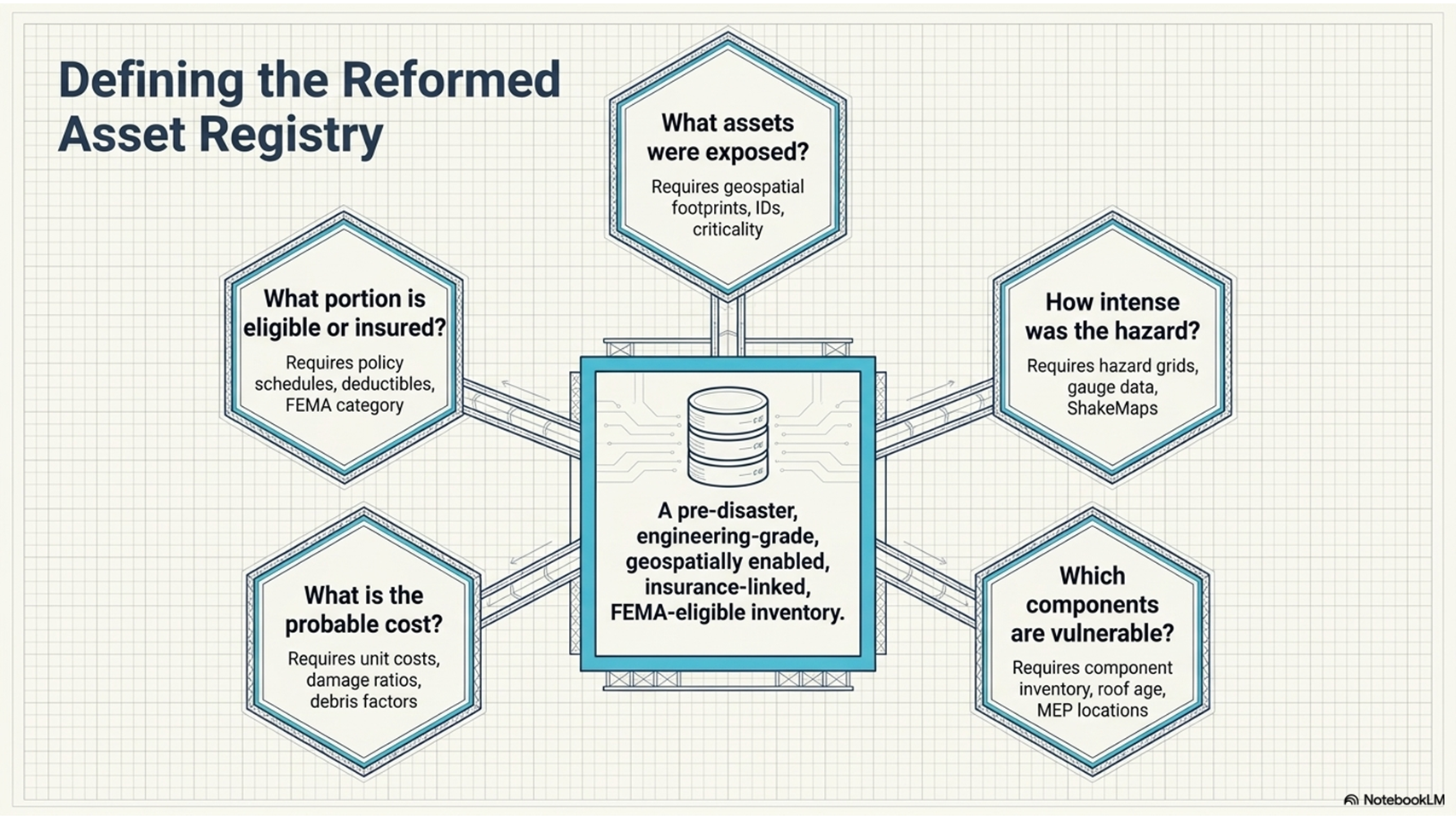
Layer 1 acts as the system's "funding switch." It utilizes Parametric Triggers —objective, measurable indices that confirm an event has crossed a severity threshold. This layer provides "Forensic Liquidity," releasing funds based on what the hazard was , rather than what the damage is .However, Layer 1 suffers from "Basis Risk"—the gap between the macro-data of a storm and the micro-reality of a facility. To an architect, a flood trigger sees only a blue plane of water at a certain elevation; it cannot see the vulnerability of the specific components beneath that plane.
Hazard Parameter,Utility,Basis-Risk Limitation
Wind Speed,Regional severity and event qualification.,"Does not know roof age, building envelope condition, or contents location."
Flood Depth,Facility exposure and equipment damage proxy.,"Does not know first-floor elevation, basement utilities, duration, or contamination."
Rainfall Intensity,Cloudburst and pluvial-flood triggers.,"Does not map sewer surcharge, local topography, or inlet blockage."
Earthquake PGA,Shaking intensity and structural damage screening.,"Does not know retrofit status, soil amplification, or equipment anchorage."
Key Insight: A parametric trigger is blind to engineering specifics. For example, in a Wastewater Pump Station (Asset ID: P-3056) , a flood elevation of +15.0 ft may be a regional trigger, but the trigger does not know if the SCADA control panels are elevated or if the submersible pump bearings and electrical switchgear have been inundated. If Layer 1 is the "switch," we require a more robust "engine" to determine the actual fuel—the funding—required for the mission.
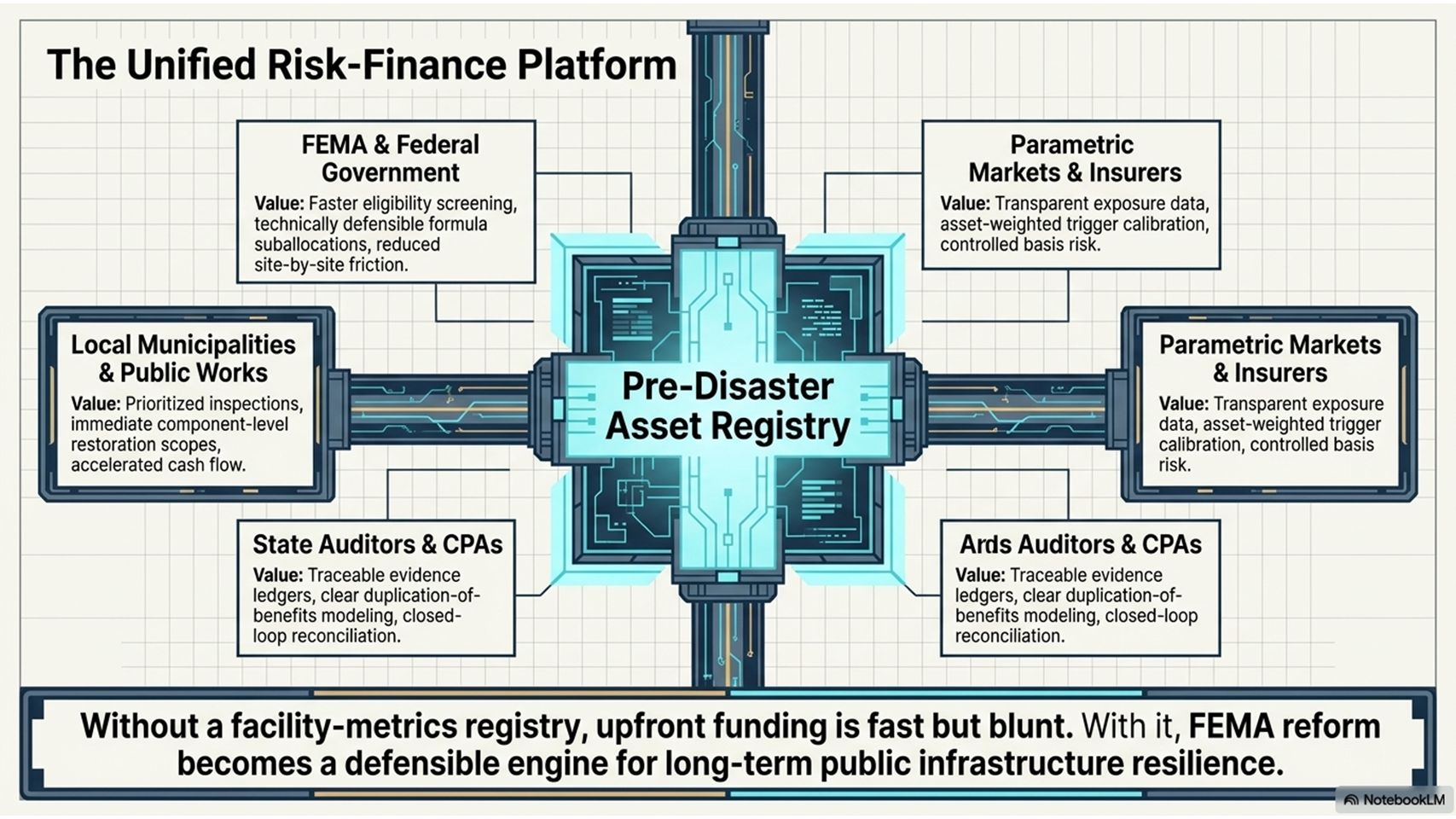
The second layer is the Engineering-Grade Asset Registry , or the "Digital Twin." This is not merely a list; it is a high-resolution data environment. Legacy insurance "Statements of Values" (SoV) are often simple spreadsheets with addresses and lump-sum values. A reformed Registry, however, provides the granular detail required for defensible estimating:
To transform raw hazard data into a facility-specific cost range in days, the Registry follows a six-step workflow:
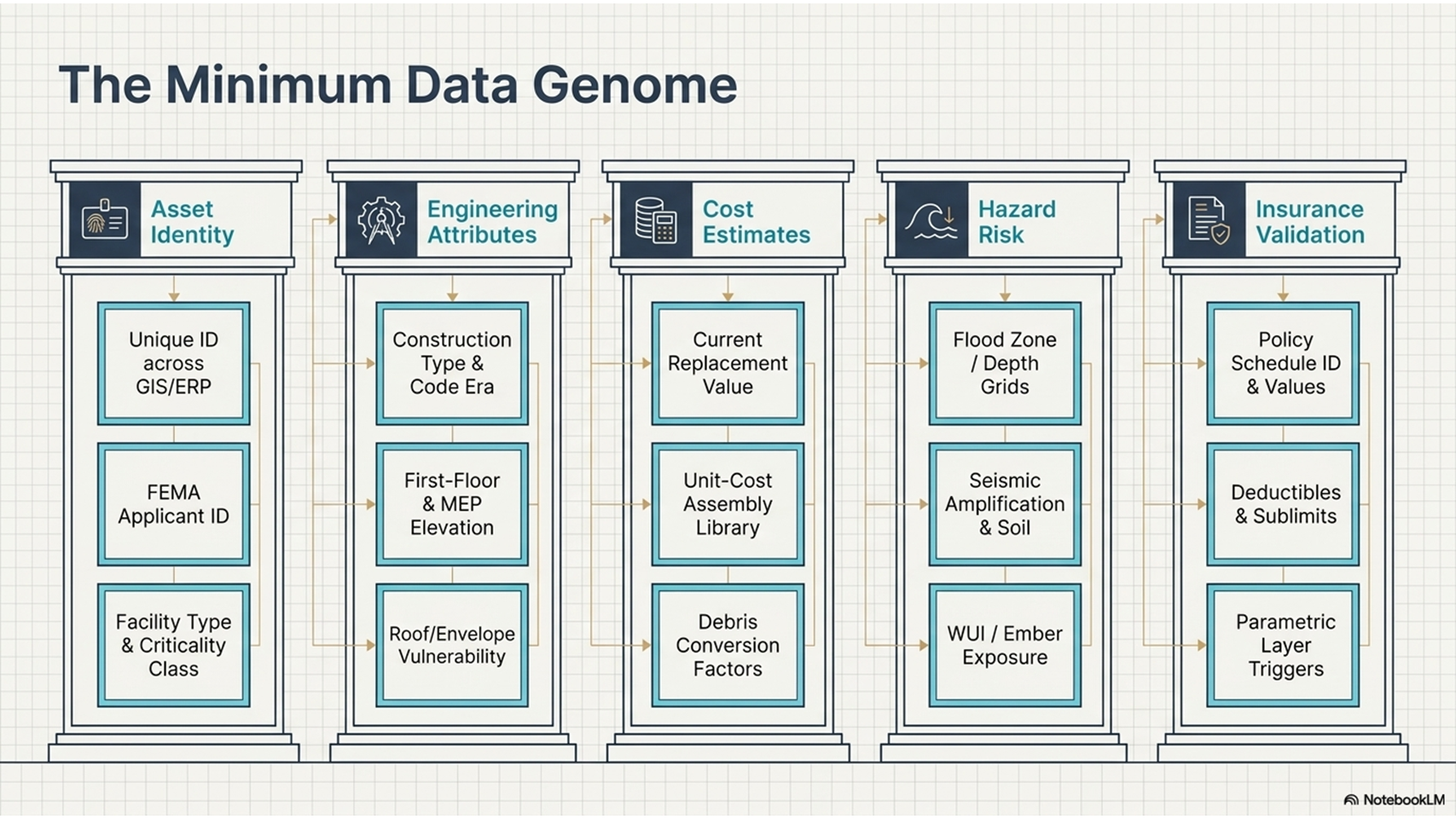
Without an accurate Asset Registry, the RAPID model isn't just fast—it’s a Financial Risk Transfer from the federal government to the local municipality. Speed is the bait, but the lack of data is the hook.Municipalities operate under rigid legal frameworks that make grant accuracy a prerequisite for action:
The third ledger validates spending and eligibility after the initial funding release. It ensures that the system can adjust to reality—specifically through Contract-Award Adjustments (Recommendation 4). The bid market is the first reliable test of actual construction cost; Layer 3 allows the grant to be "trued up" when real-world pricing differs from the early digital estimate.
To maintain fiscal integrity, the system classifies estimates by their maturity, preventing early guesses from being treated as final certainties.| Estimate Class | Usage Rules || ------ | ------ || Class R-1: Parametric Advance | Permitted: Immediate liquidity and state cash-flow planning. Prohibited: Use as a final fixed-cost grant. || Class R-2: Registry-Based Initial | Permitted: Allocation and inspection triage. Prohibited: Use for final project closeout. || Class R-3: Engineer-Validated | Permitted: Initial valuation for simpler assets. Prohibited: Final valuation for complex lifeline/SCADA assets. || Class R-4: Contract-Award | Permitted: Refinement of obligations based on bid market. Prohibited: Use to avoid procurement review. || Class R-5: Final Reconciled | Permitted: Audit, closeout, and final DOB check. Prohibited: Reopening the file absent fraud or material error. |
The Tri-Ledger Architecture represents the future of resilient recovery. By separating the Trigger (the switch), the Registry (the engine), and the Audit (the logbook), we create a system that respects the immediate need for cash without violating the statutory requirements of municipal finance.We must move beyond the "black box" of formula grants and toward an engineering-grade transparency that protects local taxpayers and federal interests alike.Final Takeaway "Without an enhanced facility and risk-metrics registry, upfront funding risks becoming fast but blunt. With a mature registry, FEMA reform can become a defensible system for rapid cost estimating, insurance integration, local allocation, audit closeout, and long-term resilience."
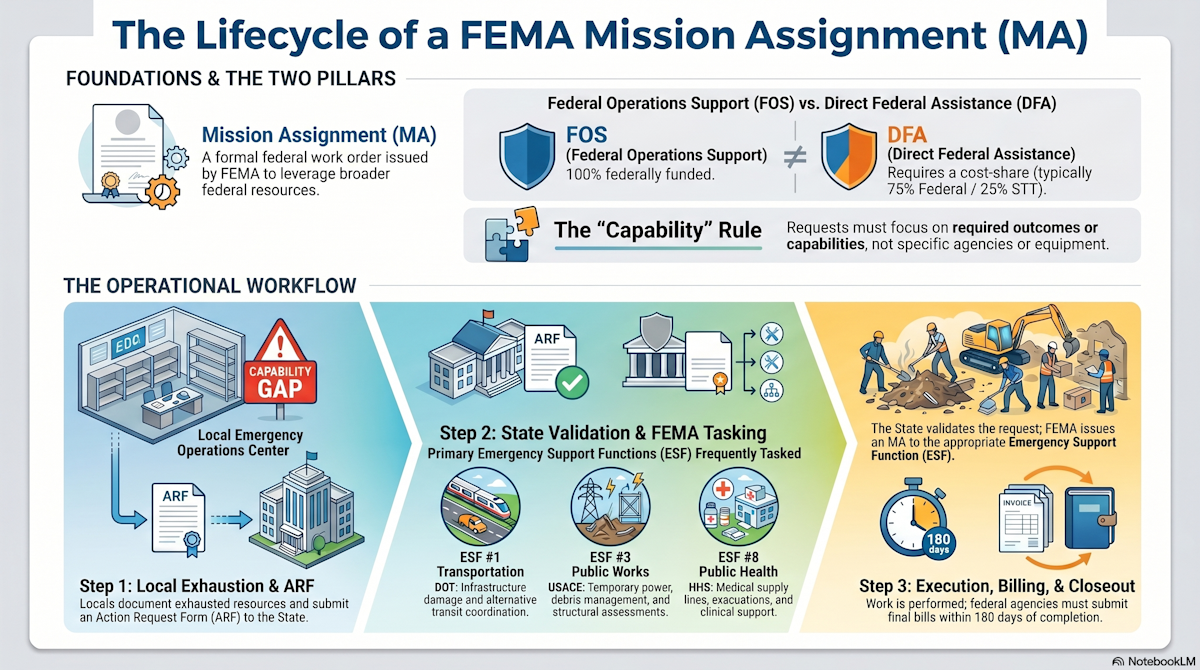
Under the Robert T. Stafford Disaster Relief and Emergency Assistance Act , federal intervention is not a default response but a highly structured support mechanism activated only when the scale of a catastrophe exhausts the organic capabilities of state, tribal, or territorial (STT) governments. The primary instrument for this coordination is the Mission Assignment (MA) . As a formal work order, the MA allows FEMA to "task" other federal agencies (OFAs) to leverage specialized expertise and assets, bridging the gap between local exhaustion and federal capability. For the emergency management professional, understanding this mechanism is the difference between a synchronized response and an uncoordinated logistical failure.The following strategic pillars govern the federal tasking lifecycle:
The Stafford Act serves as the legal "permission slip" for federal intervention. Authority flows from the President through the Secretary of Homeland Security to the FEMA Administrator, who delegates the power to task OFAs. This delegated authority ensures that the full weight of the federal government can be applied to STT needs without overstepping constitutional boundaries.A Mission Assignment (MA) is a federal work order issued by FEMA that directs another federal agency to utilize its authorities and resources to support disaster assistance efforts.
The obligation and monitoring of federal funds are managed by specific officials. Understanding these roles is critical for navigating the "insider" bureaucracy of a Joint Field Office (JFO):
The distinction between Federal Operations Support (FOS) and Direct Federal Assistance (DFA) is the most consequential decision in the tasking lifecycle. Choosing the wrong pillar can lead to significant budgetary friction and legal ineligibility.| Feature | Federal Operations Support (FOS) | Direct Federal Assistance (DFA) || ------ | ------ | ------ || Primary Purpose | Federal-to-federal support to coordinate the response. | Goods/services provided because an STT lacks capacity. || Target Recipient | FEMA or other federal agencies. | State, Tribal, or Territorial (STT) governments. || Cost-Share Requirement | 100% Federal. | Minimum 75% Federal / 25% STT share. || Pre-Declaration | Authorized if a declaration is imminent. | Prohibited prior to a formal Presidential declaration. |
The cost-share is a partnership mechanism. Because DFA involves the federal government performing work that is technically a state or local responsibility (e.g., clearing municipal roads), the law requires the STT to contribute a match. In contrast, FOS is 100% federal because it supports the internal machinery of the federal response itself.Critical Exclusion: A common operational pitfall is attempting to use MAs for Fire Management Assistance Grants (FMAG) . Per policy, neither FOS nor DFA Mission Assignments are authorized for FMAG declarations.This structural choice leads directly into the narrative journey of how a mission moves from a local failure to a federal execution.
The lifecycle of an MA begins with local exhaustion. For the student, the process is a chronological workflow of validation designed to ensure federal aid is the last resort, not the first.
When a local Applicant (city or county) exhausts its resources, it submits an Action Request Form (ARF) to the State Emergency Operations Center (SEOC).
The request moves to the JFO, where it is validated under 44 CFR § 206.208 . To accelerate response, FEMA often utilizes Pre-Scripted Mission Assignments (PSMAs) —templates for common needs like heavy-lift aviation.
The federal government groups its capabilities into 15 Emergency Support Functions (ESFs) to ensure FEMA knows exactly which agency to task for a specific crisis.| ESF Category | Focus Area | Primary Agency / Purpose || ------ | ------ | ------ || ESF #1 | Transportation | DOT: Infrastructure monitoring and alternative transit. || ESF #3 | Public Works | USACE: Engineering, power, water, and debris. || ESF #8 | Public Health | HHS: Patient evacuation and medical supply chains. || ESF #10 | HazMat | EPA / Coast Guard: Environmental stabilization. |
The U.S. Army Corps of Engineers (USACE) is the indispensable partner for ESF #3, providing technical scale that local governments simply cannot replicate. Their core missions include:
Safeguarding the Disaster Relief Fund (DRF) requires strict fiscal controls. As an analyst, you must warn Applicants that MAs are not "free money"; they are work orders billed at actual final costs .
The Recipient (State) manages the award, while the Applicant (Local) executes the work. Applicants are prohibited from "double-dipping"—they cannot use other federal grants to pay for their 25% match (with rare exceptions like HUD’s CDBG-DR).
DFA deployment patterns serve as a primary indicator of "infrastructure-breaking" catastrophes. These trends are driven by two factors: geography and logistical friction.
APPLICANTREADINESS
Cost-EstimateReadiness Plan: How Applicants Prepare Before the Next Disaster
If FEMA funding moves toward direct awards, parametric triggers, block grants, fixed-costgrants, or 90-day approval processes, applicants must be ready to producestronger initial cost estimates under extreme time pressure. Initial costestimates are difficult because they are prepared when the applicant knows theleast. Damage may still be hidden. Insurance may be unresolved. Design may notexist. Procurement may not have started. Market prices may be unstable.
Yet underreform proposals, early estimates may influence or determine the federalfunding amount. Local applicants should prepare before the next disaster bybuilding a cost-estimate readiness system.
Page Purpose: This page converts FEMA cost-estimate risk into an applicant readiness plan. It is the practical preparation page for counties, cities, school districts, utilities, transit agencies, hospitals, ports, housing authorities, and eligible nonprofits with complex facilities.
INITIAL COSTESTIMATE READINESS
Faster fundingwill reward applicants that can quickly produce credible, documented, locallygrounded, and audit-ready cost estimates. Readiness begins before thedeclaration. Applicants need records, cost libraries, estimating protocols,technical support, and FEMA-ready documentation templates in place beforedamage occurs.
01
Build Asset Inventories
Facility location, function, replacement value, insurance, elevation, age, condition, criticality, systems, and major equipment.
02
Create Local Cost Libraries
Bid tabs, unit prices, contractor rates, equipment rates, debris costs, utility repair costs, RSMeans adjustments, DOT prices, and escalation assumptions.
03
Pre-Position Estimating Support
Engineers, architects, cost estimators, construction managers, insurance claim consultants, grant specialists, procurement advisors, and legal support.
04
Map Parametric Basis Risk
Identify where rainfall, wind, surge, flood, seismic, or other indices may fail to match actual local facility losses.
05
Create Estimate-Class Rules
Distinguish conceptual, preliminary, funding-grade, bid-based, and closeout estimates so the maturity of each estimate is clear.
06
Preserve Adjustment Evidence
Track design changes, code requirements, procurement results, insurance updates, market escalation, hidden damage, and scope revisions.
ACTION 01
A strongreadiness plan starts with asset-level data. Applicants should maintainfacility profiles that connect physical assets to probable repair andreplacement costs. A facility inventory should not merely list buildings. Itshould support rapid scoping, estimating, insurance review, mitigationplanning, and federal grant documentation.
Each asset cost profile should include:
· Facility name, location, ownership, and eligible applicant relationship
· Predisaster function and service criticality
· Construction type, age, elevation, condition, and known vulnerabilities
· Major systems, utility connections, equipment, and critical components
· Replacement value, repair history, and prior project cost data
· Insurance coverage, deductibles, exclusions, NFIP status, and obtain-and-maintain issues
· Floodplain, seismic, coastal, wind, wildfire, or other hazard exposure
· Access constraints, staging issues, continuity requirements, and emergency operating considerations
Readiness Value: Asset cost profiles reduce the time needed to connect damage, facility function, replacement value, insurance, and probable recovery cost after the event.
ACTION 02
National costbooks can be useful, but FEMA recovery estimates need local cost evidence.Applicants should maintain a local cost library before the disaster so they arenot forced to rely only on generic pricing during an emergency.
Local Bid Tabs
Recent public works bids, utility contracts, transportation projects, school construction, facility repairs, and debris contracts.
Contractor and Equipment Rates
Labor rates, equipment rates, subcontractor pricing, emergency response rates, specialty contractor rates, and mobilization assumptions.
Debris and Emergency Work Costs
Debris removal rates, haul distances, tipping fees, monitoring costs, emergency protective measures, temporary work, and access costs.
Escalation and Surge Factors
Price date, midpoint of construction, seasonal constraints, fuel cost, material volatility, contractor availability, and post-disaster surge pricing.
Benchmark Adjustments
RSMeans location factors, state DOT unit prices, utility repair costs, job-order-contract pricing, and local market validation.
Owner Cost History
Prior repair costs, prior FEMA projects, capital projects, maintenance records, insurance claims, change orders, and closeout data.
Control Point: The cost library should support price reasonableness, not replace engineering judgment, quantity takeoff, or disaster-specific scope development.
ACTION 03
Applicantsshould not try to assemble a technical cost-estimating team after a majordisaster. Standby contracts, prequalified pools, cooperative purchasingoptions, and emergency procurement protocols should be established in advance.
Pre-position support for:
· Engineering damage inspections
· Architectural and building system assessments
· Cost estimating and quantity takeoff
· Construction management and schedule review
· Insurance claim documentation and duplication-of-benefits coordination
· Grant eligibility, FEMA Public Assistance documentation, and appeal risk
· Procurement compliance and contract packaging
· Environmental and historic preservation coordination
· Finance, legal, public works, executive leadership, and board-level decision support
Best Practice: Create a rapid internal review team before the disaster. Include public works, finance, legal, grants, insurance, engineering, procurement, and executive leadership.
ACTION 04
Applicantsshould label estimates by maturity. A conceptual disaster estimate should notbe treated the same as a funding-grade estimate, bid-based estimate, orcloseout estimate. Estimate class discipline helps reviewers understandconfidence level, assumptions, contingency, adjustment risk, and the evidenceneeded to support later updates.
Conceptual Estimate
Early range based on facility type, asset value, broad damage indicators, or parametric screening. Useful for planning, but not sufficient for a binding funding amount.
Preliminary Estimate
Uses initial inspections, early scope assumptions, rough quantities, benchmark costs, and known exclusions. Requires clear uncertainty and risk disclosure.
Funding-Grade Estimate
Includes documented damage, eligible scope, quantity backup, cost workbook, schedule assumptions, insurance review, risk register, and certification.
Bid-Based Estimate
Uses procurement results, contractor bids, market pricing, construction sequencing, and refined design assumptions.
Closeout Estimate / Actual Cost Record
Reconciles approved scope, actual contracts, change orders, insurance proceeds, eligible costs, and final grant documentation.
Governance Rule: Every estimate should state its class, price date, confidence level, excluded costs, contingency rationale, adjustment triggers, and version history.
INITIALESTIMATE DOCUMENTATION PACKAGE
A stronginitial funding package should be built like a combined engineering estimate,insurance claim file, and federal grant record. The goal is not simply tosubmit a number. The goal is to submit a documented, traceable, update-readyestimate that can be reviewed quickly without losing audit integrity.
01
Executive Cost Summary
Total project cost, eligible cost, federal share, estimate class, confidence level, price date, cost basis, contingency, and major assumptions.
02
Damage and Scope Narrative
Facility description, predisaster function, event damage, repair or replacement scope, eligibility explanation, and connection to disaster impact.
03
Quantity Backup
Measurements, photos, sketches, GIS information, inspection notes, drawings, engineering observations, and quantity takeoff support.
04
Cost Workbook
Line items, unit prices, labor, material, equipment, contractor markups, soft costs, escalation, contingency, source references, and pricing assumptions.
05
Schedule Assumptions
Design period, procurement period, construction duration, midpoint of construction, seasonal constraints, phasing, long-lead items, and continuity needs.
06
Insurance and DOB Summary
Known coverage, deductibles, exclusions, anticipated proceeds, pending claims, NFIP issues, commercial insurance issues, and duplication-of-benefits assumptions.
07
Risk Register
Unresolved scope, latent damage, code issues, market uncertainty, procurement risk, environmental conditions, insurance uncertainty, and adjustment triggers.
Design Note: This section can be displayed in Webflow as a checklist, accordion, or card grid. The same content can also support a downloadable readiness checklist.
APPLICANTPROTECTION
Applicantsshould assume that early estimates will be imperfect. The goal is not to makethe first estimate final. The goal is to make the first estimate disciplined,transparent, and update-ready.
Use Estimate Classes
Label the estimate so reviewers know whether it is conceptual, preliminary, funding-grade, bid-based, or closeout-level.
Preserve Assumptions
Document what is known, unknown, excluded, estimated, assumed, and subject to later validation.
Track Version Changes
Maintain version control so every update can be tied to new facts, revised quantities, procurement results, insurance updates, or design changes.
Use Independent Review
Have qualified engineers, estimators, finance, insurance, procurement, and grant specialists review major submissions before acceptance.
Protect Adjustment Rights
Identify the events, evidence, deadlines, and approval steps needed to support future changes.
Do Not Accept Finality Too Early
A fast award should not be treated as full project certainty unless scope, code, insurance, market, and procurement facts are mature.
NEXT STEP
Rapid approvalreadiness starts with asset records, local cost libraries, estimatingprotocols, technical support, FEMA-ready templates, and update evidencesystems. The next step is to build the technical estimate update protocol thatallows applicants to defend revised costs as facts develop.
Continue to the Technical Page
Develop the estimate update protocol and hybrid estimating framework needed to support updated costs, audit review, and fixed-funding risk management.
Go to Estimate Update Protocol →
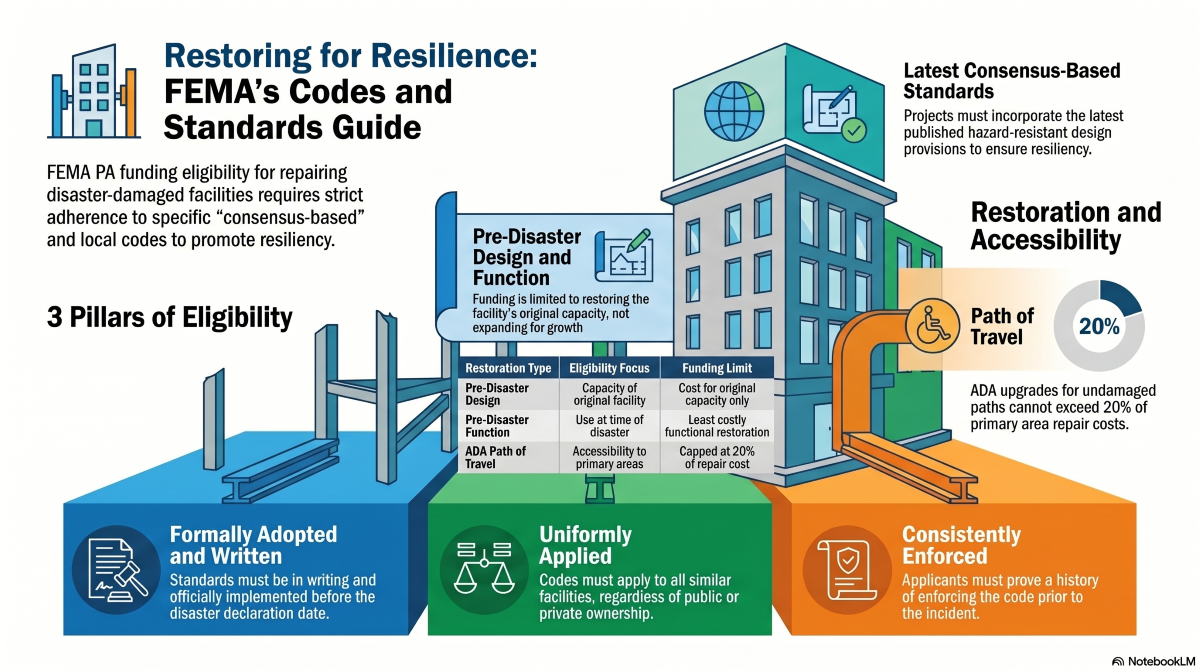
Codes and standards serve as the essential foundation for disaster resilience and are the primary determinants of federal funding eligibility within the FEMA Public Assistance (PA) program. By requiring adherence to established design and construction benchmarks, FEMA ensures that restoration projects do not merely return facilities to their pre-disaster state but proactively reduce future risk through hazard-resistant provisions. The strategic funding landscape is governed by a dual framework: mandatory consensus-based codes for critical infrastructure (pursuant to Section 1235(b)) and locally adopted regulations that must pass a rigorous federal eligibility test. Navigating this environment requires a precise understanding of the intersection between a facility's pre-disaster design, the specific regulatory triggers that necessitate upgrades, and specialized constraints—most notably the 20% funding limitation on Americans with Disabilities Act (ADA) "path-of-travel" improvements. Ultimately, while codes can expand project scope, the baseline for restoration is tethered to the least costly method of restoring pre-disaster function, and failure to document compliance meticulously can lead to the total deobligation of grant funds.
Distinguishing between "Design" and "Function" is the critical first step in determining the "cap" or ceiling for eligible funding. These principles ensure that FEMA funds the restoration of a facility’s actual utility rather than aspirational or unused capacity.
Funding for the replacement or repair of a facility is strictly limited to the capacity for which it was originally designed. For example, if a school designed for a capacity of 100 students is damaged beyond repair, the eligible funding for a replacement facility is limited to what is necessary for 100 students. This remains true even if the school’s actual attendance exceeded 100 students prior to the disaster; the original design capacity, not the actual population, dictates the funding limit.
Eligibility is also dictated by how the facility was actually being used at the time of the incident. If an applicant is using an office building as a storage facility at the time of the disaster, and it is less costly to restore the facility as a storage facility than as an office, only the repairs necessary to restore the storage function are eligible.The baseline for federal assistance is always the least costly restoration to the actual pre-disaster function. These fundamental limits serve as the funding ceiling, which may only be legally expanded when specific, eligible codes and standards are triggered.
Pursuant to Section 1235(b), FEMA utilizes a strategic framework of consensus-based requirements to promote resiliency and achieve risk reduction. These standards provide a mandatory benchmark for disaster-resistant design in the execution of permanent work.
FEMA’s consensus-based codes apply to permanent work projects for the following facility types:
Applicants must identify which codes apply to each damaged component and provide a compliance description including:
Compliance must be validated by the applicant and verified by FEMA. Proof of compliance typically requires a written certification from a registered engineer or design professional.Waiver Conditions: While these codes are mandatory, the Regional Administrator may approve a waiver if:
For any code or standard (federal or SLTT) to be eligible for PA funding under 44 C.F.R. § 206.226(d), it must pass a five-part test.
The code must specifically apply to the type of restoration (repair vs. replacement). For example, a zoning requirement for a new parking garage is ineligible if the garage has no direct relationship to the disaster-related repairs of an existing building. Regarding use, FEMA funds the least costly of the following:
FEMA evaluates whether the "trigger" for a code-required upgrade is reasonable based on the extent of the damage.So What? To prevent "gold-plating," FEMA determines if an upgrade is "technically defensible" from an engineering perspective. A massive upgrade triggered by negligible damage may be deemed unreasonable and ineligible.
A code must be in writing and formally adopted on or before the disaster declaration date. Additionally, the code must meet three tests for Uniform Application :
Specific "triggers" often necessitate upgrades that extend beyond the immediate disaster-damaged elements.
Under the International Existing Building Code (IEBC), "Substantial Structural Damage" (SSD) is a critical threshold defined by capacity loss in gravity load-carrying elements. If SSD is reached, it triggers a requirement to evaluate and potentially upgrade the facility’s lateral-force-resisting elements (seismic/wind bracing).Critical Requirement: Only an evaluation by a licensed professional in compliance with IEBC criteria can determine SSD. This evaluation is the only mechanism to unlock funding for undamaged lateral elements.
The ADA and Architectural Barriers Act (ABA) require that repairs affecting a facility's usability comply with accessibility standards. This often triggers "Path of Travel" requirements.
VI. Key Takeaways for Compliance
For Government CFOs and Grant Managers, maintaining compliance is a matter of administrative discipline and rigorous documentation.
This checklist serves as a roadmap for project development and audit-readiness.
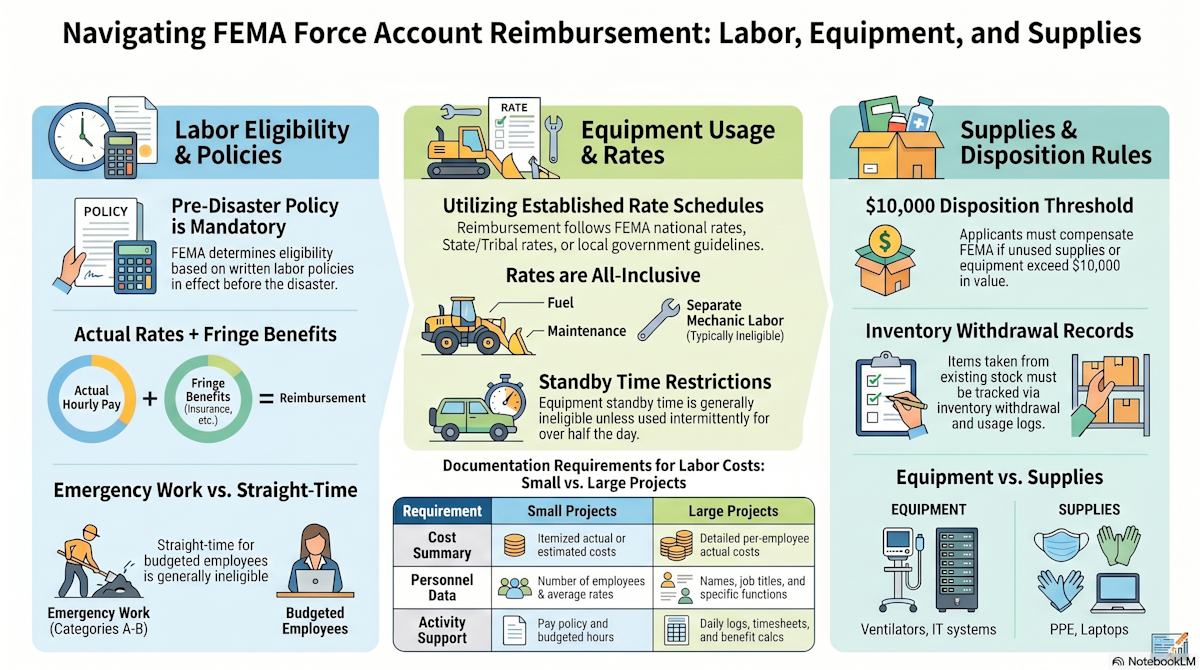
The Impact List is the fundamental administrative tool for defining the scope of a disaster declaration. Per 44 C.F.R. § 206.201(l), this list serves as the strategic baseline for all subsequent recovery efforts. Its primary purpose is not to provide exhaustive engineering specifications, but to establish a transparent and accurate record of incident-related damage. Adherence to precision during this initial phase is non-negotiable for maintaining audit readiness and preventing future eligibility disputes.
To ensure a standardized and compliant submission, every entry on the Impact List must include the following data points:
The submission process is governed by strict regulatory windows defined in 44 C.F.R. § 206.202.
Project formulation is the process of synthesizing the Impact List into manageable project applications. This is a formal regulatory mechanism—defined by logical grouping under 44 C.F.R. § 206.201(k)—intended to streamline funding, environmental reviews, and compliance.
Strategic grouping requires the immediate exclusion of facilities under the authority of other federal agencies. Furthermore, "Inactive or Partially Inactive" facilities—those not in use at the time of the incident—are ineligible and must be removed from the list to avoid delays. Grouping must never be based on project dollar size or general administrative convenience; it must be driven by the nature of the facility and the work required.
Standardized initial groupings allow FEMA to apply uniform cost-analysis and compliance checks across similar disaster response activities.
A critical distinction must be maintained between general response and private property measures:
To ensure a comprehensive recovery, permanent work is organized into 11 distinct infrastructure categories:
Under the "Primary Facility" rule, FEMA groups administrative and support facilities (e.g., parking lots, sheds, signage, lighting, fencing) with the primary facility they serve. While these must be listed as separate impacts initially, they are formulated together to provide a holistic project view. Note that Private Non-Profit (PNP) applicants face unique eligibility restrictions for support facilities that require independent evaluation.
The refinement phase separates complex sites from initial groups to protect the funding timeline. By isolating high-complexity sites, "cleaner" projects can be obligated and funded without being delayed by lengthy technical or environmental hurdles.
The Disaster Recovery Reform Act (DRRA) established specialized groupings for administrative and enforcement costs:
This framework optimizes Public Assistance data through three distinct phases:
The strategic management of force account resources—an applicant’s own personnel, equipment, and inventory—is the primary determinant of success in a FEMA Public Assistance (PA) grant audit. For Grant Managers and CFOs, accurate force account accounting is not merely a bookkeeping exercise but a high-stakes compliance requirement to secure and retain federal funding. This guide details the rigorous standards for Force Account Labor , including the necessity of pre-disaster policies; Equipment usage, where rates and maintenance exclusions must be precisely managed; Materials and Supplies acquisition; and the often-overlooked Disposition requirements for high-value assets. By adhering to these granular criteria, applicants can navigate the complexities of "budgeted vs. unbudgeted" costs and avoid the de-obligation of funds during federal oversight reviews.The following sections provide the technical framework necessary to meet the standards of the PAPPG v5 and successfully survive an attribute-based sampling audit.
Personnel costs are frequently the most scrutinized component of disaster recovery. FEMA classifies an applicant’s own employees as "force account," and the eligibility of these costs hinges almost entirely on pre-disaster written policies. In the absence of a compliant policy, FEMA defaults to the most restrictive reimbursement limits, often leaving applicants to absorb significant unbudgeted expenses.
Reimbursement for labor is based on actual hourly rates plus the cost of the employee’s actual fringe benefits. FEMA calculates fringe as a percentage of the hourly pay rate. Because certain benefits (e.g., health insurance) are fixed and do not increase with extra hours, the fringe percentage for overtime (OT) is typically different than the percentage for straight-time (ST).Eligible Fringe Benefits include:
FEMA utilizes an attribute-based sampling approach for verification. If a project is selected for review, the documentation must be flawless.
Applicants must provide an itemized cost summary including:
Large projects require granular, employee-level data:
To be recognized by FEMA, a labor policy must be in writing and meet three mandatory criteria prior to the incident start date:
FEMA reimburses the use of force account equipment based on hourly rates. Strategic Grant Auditors prioritize the verification of usage logs and the exclusion of duplicate costs built into those rates.
Logs must include the year, make, model, size, capacity, horsepower, and wattage, alongside the operator’s name and specific site locations.Intermittent Standby Rule: While general standby (time on hold) is ineligible, intermittent standby is eligible if the operator uses the equipment for more than half of the working hours in a given day.NDAA Restrictions: Under the National Defense Authorization Act, applicants are prohibited from using FEMA funds for telecommunications or video surveillance equipment from covered foreign entities (e.g., certain Chinese manufacturers).
FEMA requires applicants to act with "prudence" when choosing to rent rather than purchase equipment.
Applicants must perform a cost-benefit analysis (lease vs. purchase). FEMA limits reimbursement to the cost of purchasing and maintaining the equipment for the project's life. If lease costs exceed the purchase price, FEMA will audit the "prudence" of the decision at the time the agreement was signed.
If an applicant obtains ownership via a rent-to-own agreement during the project, reimbursement shifts from the lease cost to the standard hourly equipment rates the moment ownership is transferred.
Supplies are eligible whether purchased for the disaster or taken from existing stock.
Items taken from stock must be tracked with inventory withdrawal and usage records. Funding is based on invoices; if unavailable for stock, FEMA uses the applicant's established pricing method or historical vendor data.
For Large Projects, applicants must provide original invoices, inventory records, quantities used, and specific site locations. If purchased supplies were not used, a justification for the over-purchase is required.
When equipment or supplies are no longer needed, federal "disposition" rules trigger a potential reduction in funding.
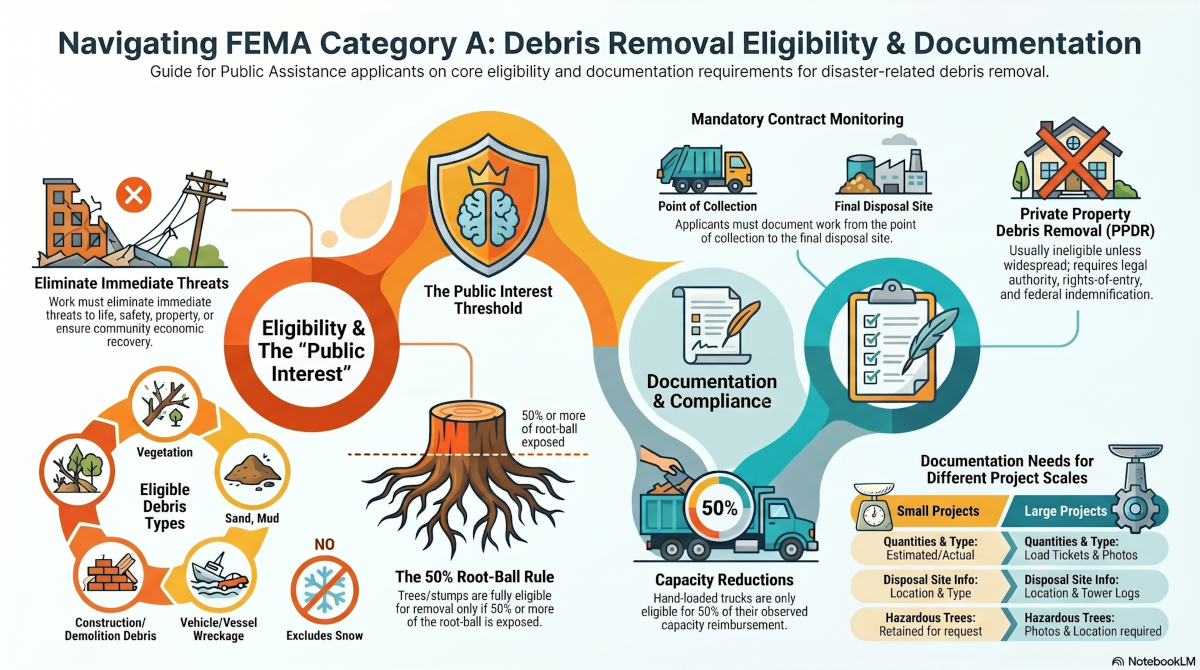
Category A debris removal operations represent a critical juncture in disaster recovery, serving as both a primary driver for community stabilization and a significant area of fiscal exposure for State, Local, Tribal, and Territorial (SLTT) governments. Efficient debris management is essential for eliminating immediate threats to public health and safety, restoring access to vital infrastructure, and catalyzing the economic recovery of the community. However, the scale and complexity of these operations necessitate a rigorous approach to fiscal stewardship. Because FEMA Public Assistance (PA) funding is contingent upon strict adherence to federal eligibility criteria, administrative precision is as vital as the physical clearance of debris.This document provides a comprehensive overview of the policy framework governing Category A operations. It outlines foundational eligibility mandates—centering on the "public interest" threshold—and details specific requirements for various debris types, including hazardous vegetation, waterway obstructions, and abandoned vehicles. It distinguishes the scope of eligibility for SLTT governments versus Private Non-Profit (PNP) applicants and addresses technical nuances such as the "2-foot rule" for waterways and root-ball exposure thresholds for hazardous trees. Furthermore, it addresses the technical requirements of disposal site management, the legal complexities of Private Property Debris Removal (PPDR), and mandatory monitoring protocols. By synthesizing these operational and regulatory requirements, this guide establishes a clear roadmap for achieving full federal reimbursement while maintaining compliance with environmental and historic preservation standards. Success in these operations begins with a thorough understanding of the specific compliance requirements that dictate FEMA eligibility.
Navigating the FEMA PA program requires an uncompromising commitment to regulatory detail. Strict adherence to eligibility criteria is the primary safeguard against the de-obligation of federal funds during post-disaster audits. Applicants must ensure that every action taken is documented as necessary and falls within the prescribed legal and geographic boundaries.
For debris removal to be eligible for PA funding, it must be in the public interest , defined by four specific conditions:
Certain materials and locations are strictly ineligible for Category A funding:
For a Private Non-Profit (PNP) applicant, eligible debris removal is strictly limited to that associated with an eligible facility, including debris on the property of that facility.Once the overarching eligibility mandates are confirmed, the applicant must then categorize debris by type to determine the appropriate monitoring and disposal track.
Accurate classification of materials is a fundamental requirement for reporting and reimbursement. FEMA distinguishes between various debris types, each carrying unique disposal and documentation requirements.
Eligible materials include, but are not limited to:
Debris left by the incident on improved public property and public Rights-of-Way (ROW), including federal-aid roads, is eligible.
SLTT governments may authorize residents to move incident-related debris from residential, non-commercial properties to public ROWs for collection. However, commercial debris placed on the ROW is strictly ineligible for removal, as commercial businesses are expected to manage debris through private insurance. Additionally, materials from the construction or repair of structures are ineligible.Properly identifying the origin of debris ensures only eligible costs are claimed, particularly when managing the high-volume complexities of hazardous vegetation.
Funding for the removal of vegetative hazards is predicated on the "immediate threat" threshold. Hazards located in natural areas that do not threaten improved property or public-use areas (e.g., sidewalks, playgrounds) are ineligible.
Removal of broken limbs or branches is eligible if they pose an immediate threat, such as hanging over improved property or public-use areas. FEMA adheres to a "minimum cut" rule : only the cut necessary to eliminate the threat is funded. Cutting a branch at the trunk is ineligible if the hazard could be mitigated by cutting at the closest main branch junction.
FEMA applies strict physical standards for tree removal based on root-ball exposure:
To validate immediate threats, FEMA recognizes assessments from:
Stump extraction ( $\ge$ 50% root-ball exposed) in areas with high potential for archaeological resources requires consultation with the State Historic Preservation Officer (SHPO) or Tribal Historic Preservation Officer (THPO) through FEMA Environmental and Historic Preservation (EHP). Work must stop immediately if resources are discovered.
Applicants must ensure that per-stump contract pricing includes extraction, transport, disposal, and filling the root-ball hole . If a price excludes hole-filling, the per-unit cost may be questioned for reasonableness. Stumps not requiring extraction (root-ball < 50%) are funded only by volume or weight as standard debris.While terrestrial debris follows physical markers, debris in aquatic environments introduces complex jurisdictional boundaries.
Waterway operations require intense inter-agency coordination to prevent the duplication of benefits, as multiple federal agencies hold statutory authority.
For applicants with legal responsibility for a navigable waterway, removal is eligible to a maximum depth of 2 feet below the low-tide draft of the largest vessel that used the waterway pre-incident. Debris below this depth is ineligible unless it is necessary to remove debris extending into the eligible zone.
Debris removal from natural or constructed channels (including flood control works) is eligible only if it:
Applicants are responsible for identifying incident-deposited debris. Random surveys to look for debris, including surveys using side-scan sonar, are ineligible. PA funding for side-scan sonar is only eligible if the applicant identifies a specific impact area and demonstrates a need to identify a specific immediate threat.
Applicants must coordinate with USACE/USCG for navigable channels, the EPA for hazardous materials in inland water areas, and the NRCS for debris under the Emergency Watershed Protection (EWP) program to avoid duplication of benefits.These boundaries extend to the management of private assets, such as vehicles, deposited on public lands.
Removing private property from public lands requires a specific legal and administrative foundation to ensure the applicant has the right to move the asset and that FEMA is not paying for costs covered by insurance.
Removal is eligible only if:
Applicants must attempt to identify owners and pursue insurance for removal and storage costs. Any recovered funds must be credited to FEMA.Effective management of all debris culminates in strategic disposal and site management.
Strategic disposal focuses on volume reduction to minimize landfill tipping fees and environmental impact.
FEMA encourages mulching, grinding, or burning to reduce volume.
FEMA reduces PA funding by the amount of any recycling revenue received. Applicants may deduct administrative and marketing costs from the total revenue before the FEMA credit is applied.
Eligible costs for TDSRs (Temporary Debris Staging and Reduction Sites) include property leasing and eventual land restoration to pre-disaster conditions as required by the lease agreement.
FEMA applies capacity reductions based on loading methods:
Documentation is the primary evidence for reimbursement. It is the applicant's responsibility to provide oversight.
Monitors must observe the process from collection to final disposal. FEMA considers it unreasonable and not cost-effective to use professional engineers or highly qualified staff for monitoring without justification; such costs may be de-obligated. FEMA provides training for force account monitors upon request.
The level of documentation scales with project size, but all projects must comply with Environmental and Historic Preservation (EHP) requirements.
PPDR is generally ineligible because debris on private property is typically the owner's responsibility. To receive PA funding, the applicant must meet a "Public Interest" threshold.
Before funding, applicants must provide:
Debris removal is eligible if the public has unrestricted access (no gates or guards) and uses the road frequently. Restricted or rarely used private roads require additional justification to meet the public interest determination.
Removal is rare and exceptional . It typically requires FEMA Regional Administrator approval and is only considered for critical facilities or where debris is heavily concentrated and insurance is insufficient.
Successful project closeout depends on diligent record-keeping. Grant Managers and CFOs should utilize the following checklist to ensure Category A activities remain eligible.
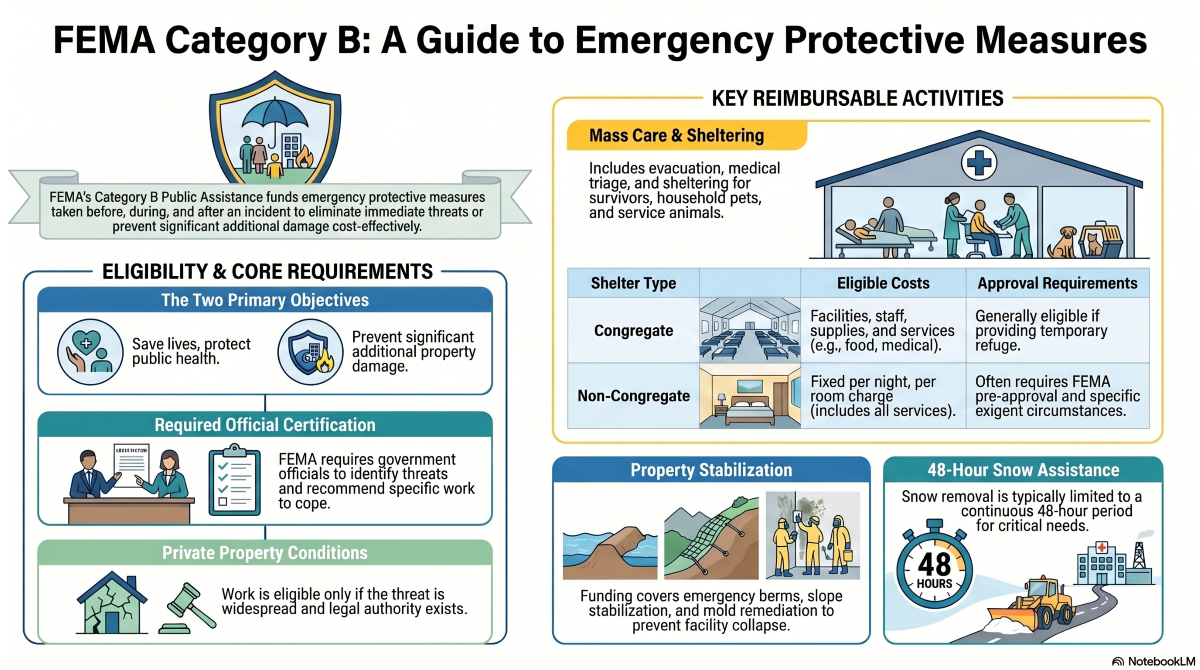
FEMA Category B Public Assistance (PA) funding serves as a critical strategic mechanism for immediate threat reduction and the preservation of community stability following a disaster. Under the authority of 44 C.F.R. § 206.225 and Sections 403 and 502 of the Stafford Act, these measures are authorized when essential to saving lives, protecting public health and safety, or preventing significant additional damage to Improved Property in a cost-effective manner. This framework provides State, Local, Tribal, and Territorial (SLTT) governments with the resources to implement rapid interventions during the exigency of a disaster.The PA framework for emergency work is structured upon three foundational pillars:
In FEMA’s hierarchy of assistance, life-safety measures take absolute precedence. Because the window for life preservation is extremely narrow, the framework incentivizes rapid deployment by providing broad eligibility for activities that mitigate immediate hazards to human life.
Eligible activities include 15+ core operations such as Search and Rescue (SAR), firefighting, EOC operations, security (barricades/fencing), and building safety inspections. SAR specifically covers the location of survivors, household pets, and service animals.Administrative Necessity: It is vital to distinguish between animal categories. Household pets are domesticated animals (dogs, cats, birds, rabbits, rodents, and turtles) traditionally kept for pleasure. Under the Americans with Disabilities Act (ADA), Service Animals are limited to dogs or miniature horses trained for specific tasks. Assistance Animals provide emotional support. Evacuation of exhibition or agricultural animals is ineligible.
FEMA provides funding for extraordinary costs when the medical delivery system is compromised.
Eligible costs cover the transportation of survivors and the operation of shelters.
FEMA defines "Improved Property" as property built or modified to serve a specific purpose. Category B funding supports preventative actions to minimize economic and structural disaster impacts.
Protective measures focus on preventing collapse or further deterioration.
Public work on private land involves complex jurisdictional boundaries. To maintain eligibility, applicants must satisfy a rigorous three-prong test: (1) the threat must be widespread; (2) the applicant must have legal authority; and (3) the applicant must obtain Rights-of-Entry (ROE) and Indemnification agreements.
These requirements apply to unsafe structure demolition, septic pumping causing pollution threats, and emergency access repairs. Compliance Alert: Applicants must provide a citation of the specific law, ordinance, or code used to exercise emergency powers. General "emergency power" claims are insufficient for audit defense.
FEMA distinguishes between routine expenses and disaster-necessitated "increased" costs.
The "Legally Responsible" rule dictates that PNPs are generally not responsible for emergency services. However, Compliance Exceptions exist for PNPs requested by an SLTT government to provide fire/rescue, and for essential components like emergency rooms of PNP hospitals or PNP sewage/water treatment plants. PNP volunteer fire departments are eligible if they have an established agreement with an SLTT government.Audit Defense: Meticulous cost-tracking and separate ledgers for "increased" vs. "routine" costs are mandatory. Without this granularity, auditors may classify costs as standard operations, leading to clawbacks.
Repairs to public property damaged during emergency work (e.g., equipment damaged during debris removal) are eligible only if the damage was due to severe conditions, was unavoidable, and was not due to improper use. Compliance Alert: Applicants must produce pre-incident maintenance records to prove equipment was in good operational order before the claim.
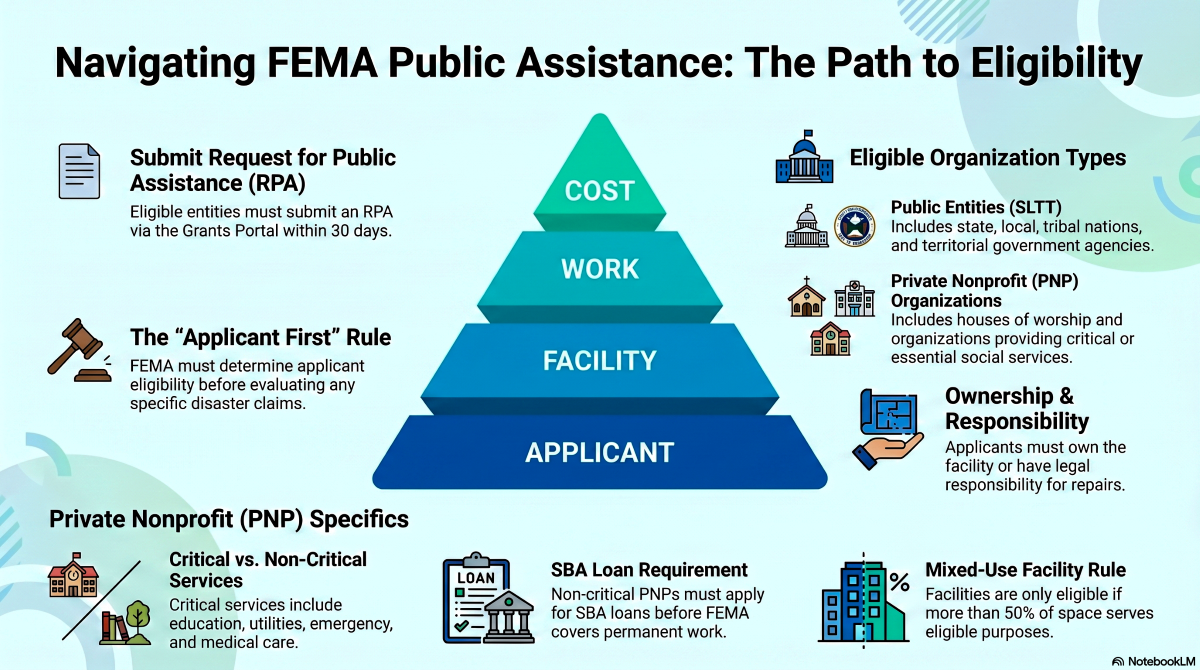
Securing federal disaster funding through the FEMA Public Assistance (PA) Program necessitates a mastery of the eligibility "pyramid"—a sequential hierarchy comprising the Applicant, Facility, Work, and Cost. This framework serves as the strategic gatekeeper for all federal obligations; failure to validate a lower tier, such as the jurisdictional nexus of a facility, immediately precludes the eligibility of subsequent work and costs. For State, Local, Tribal, and Territorial (SLTT) governments, understanding this pyramid is essential for protecting treasury resources and ensuring that restoration efforts meet stringent federal standards.This regulatory analysis provides a comprehensive roadmap for navigating these requirements. It defines the scope of eligible public facilities, including specialized criteria for natural features and the financial implications of proration for partially inactive structures. The analysis further bifurcates work into Emergency and Permanent categories, detailing the mandatory triggers of direct causality, geographic designation, and legal responsibility. By integrating these regulatory foundations with the operational mandates of impact listing and strategic project grouping, this document establishes the compliance baseline required to survive federal audits and maximize reimbursement.These high-level summaries translate into specific regulatory compliance requirements that dictate how applicants must document, report, and group disaster-related impacts to ensure successful grant obligation and retention.
II. Key Takeaways for Compliance
Strict adherence to FEMA eligibility criteria is non-negotiable for FEMA Grant Managers and Chief Financial Officers. As the PA Program operates on a reimbursement model, any deviation from 44 C.F.R. or PAPPG policy creates significant audit risk. Failure to demonstrate compliance typically results in the de-obligation of funds, shifting the massive financial burden of disaster recovery back onto the subrecipient.The three most critical eligibility requirements are:
At the "Facility" level of the eligibility pyramid, work eligibility is generally contingent upon the facility itself being eligible. While certain emergency protective measures are exceptions, Permanent Work and restoration cannot be funded unless the underlying structure or system meets FEMA’s regulatory definition of a public facility.
An eligible public facility is any system or structure that an SLTT government owns or has legal responsibility for maintaining.
A facility must have been in active use at the start of the incident period. Inactive facilities are ineligible unless they were temporarily closed for repairs, or future use was established in an approved budget or formal plan.
Facilities scheduled for non-federally funded repair or replacement remain eligible if they are not yet under contract. FEMA will meticulously review procurement and contract documents to ensure the claimed damage was not pre-existing.
FEMA categorizes work into specific streams, dictated by the nature of the threat and the required restoration.
Per 44 C.F.R. § 206.223(a), work must result from the incident, be in the designated area, and be the applicant's legal responsibility.
FEMA’s relationship with Tribal Nations is grounded in the Federal Indian Trust Responsibility , a legal obligation to protect tribal sovereignty and lands.
While most applicants must stay within defined boundaries, Tribal declarations do not usually define specific geographical areas (e.g., counties). For Tribal Nations, FEMA determines eligibility based primarily on the jurisdictional nexus of legal responsibility and direct causality.
VI. Impact Listing and Project Formulation
The Impact List is the foundational inventory for the grant application.
Each site must include GPS coordinates, facility type, damage description, and cost estimates.
VII. Compliance Checklist
FEMA Grant Managers must execute the following actions to safeguard funding:
FEMA Public Assistance (PA) eligibility is not determined in a single step; it is a tiered, hierarchical screening process. FEMA evaluates the foundation of a claim—the Applicant—before ever considering the details of a specific project or cost. This structure acts as a critical filter for federal resources: if an entity fails to meet the criteria at a lower level, the evaluation stops immediately, rendering all subsequent damage and costs irrelevant.The progression follows this mandatory logical flow:Applicant $\rightarrow$ Facility $\rightarrow$ Work $\rightarrow$ CostBy adhering to this sequence, FEMA ensures that administrative efforts are not wasted auditing receipts for entities or assets that have no legal standing to receive federal disaster reimbursement. Once the Applicant is validated as an eligible organization, the focus moves to the physical assets they own or operate.
The first gate is the determination of whether an organization is a legal entity authorized by the Stafford Act to receive Public Assistance.| Entity Type | Key Defining Characteristics || ------ | ------ || SLTT Entities | State, Local, Tribal, and Territorial governments. This includes state agencies, federally recognized Tribal Nations, and local political subdivisions such as counties, cities, and school districts. || Private Nonprofits (PNP) | Organizations that provide certain services and possess a 501(c), (d), or (e) tax exemption or state-level nonprofit substantiation. This includes houses of worship and faith-based organizations. |
To initiate the PA process, an entity must submit a Request for Public Assistance (RPA) . This document serves as the formal entry into the program and must be submitted via the FEMA Grants Portal within 30 days of an area being designated in a presidential declaration. This deadline is strictly enforced because the RPA triggers the formal administrative relationship between the Recipient (the State or Territory) and the Subrecipient (the Applicant).Extenuating Circumstances for Deadline Extensions: FEMA may grant extensions for RPA submissions only under specific conditions beyond the applicant's control:
While government facilities have broad eligibility, Private Nonprofits face rigorous service-based evaluations. FEMA does not just fund the PNP as an organization; it funds specific facilities that provide eligible services.
For buildings housing both eligible and ineligible services, FEMA applies a "Primary Use" test. An applicant must demonstrate that more than 50% of the facility is dedicated to eligible services.
FEMA is the "funder of last resort." For PNPs providing non-critical services, the Small Business Administration (SBA) is the primary funding source for permanent repairs.
Work Type,Critical PNP Facility,Non-critical PNP Facility
Emergency Work (Debris/Safety),FEMA,FEMA
Permanent Work (Restoration),FEMA,SBA Application Required
The SBA process is not merely a hurdle; it determines whether FEMA can legally provide funding for permanent work.
After the Applicant and Facility are validated, FEMA evaluates the "Claim"—the specific activity and the money spent.
Stage,Primary Requirement,Evidence Required (Per PAPPG Table 6)
Applicant,Must be SLTT or an eligible PNP.,IRS Ruling Letter (501c/d/e) or State Nonprofit bylaws and articles of incorporation.
Facility,Must provide an eligible service (Critical or Essential Social).,"Service logs, space/time usage data, and accreditation or commencement documents (for schools)."
Work,Must be the applicant’s legal responsibility.,"Deeds, Titles, or Lease contracts specifically outlining repair responsibility."
Cost,Must be reasonable and incident-related.,"Procurement records, insurance settlement data, and incident period documentation."
The Essential Key: For any Private Nonprofit, the IRS Ruling Letter remains the single most important document. Without a valid tax-exempt status in effect on the declaration date, the path to funding closes at the first gate.
When conducting procurement transactions under a Federal award, a State or Indian Tribe must follow the same policies and procedures it uses for procurements with non-Federal funds. If such policies and procedures do not exist, States and Indian Tribes must follow the procurement standards in §§ 200.318 through 200.327. In addition to its own policies and procedures, a State or Indian Tribe must also comply with the following procurement standards: §§ 200.321, 200.322, 200.323, and 200.327. All other recipients and subrecipients, including subrecipients of a State or Indian Tribe, must follow the procurement standards in §§ 200.318 through 200.327.
(a) Documented procurement procedures. The recipient or subrecipient must maintain and use documented procedures for procurement transactions under a Federal award or subaward, including for acquisition of property or services. These documented procurement procedures must be consistent with State, local, and tribal laws and regulations and the standards identified in §§ 200.317 through 200.327.
(b) Oversight of contractors. Recipients and subrecipients must maintain oversight to ensure that contractors perform in accordance with the terms, conditions, and specifications of their contracts or purchase orders. See also § 200.501(h).
(c) Conflicts of interest.
(1) The recipient or subrecipient must maintain written standards of conduct covering conflicts of interest and governing the actions of its employees engaged in the selection, award, and administration of contracts. No employee, officer, agent, or board member with a real or apparent conflict of interest may participate in the selection, award, or administration of a contract supported by the Federal award. A conflict of interest includes when the employee, officer, agent, or board member, any member of their immediate family, their partner, or an organization that employs or is about to employ any of the parties indicated herein, has a financial or other interest in or a tangible personal benefit from an entity considered for a contract. An employee, officer, agent, and board member of the recipient or subrecipient may neither solicit nor accept gratuities, favors, or anything of monetary value from contractors. However, the recipient or subrecipient may set standards for situations where the financial interest is not substantial or a gift is an unsolicited item of nominal value. The recipient's or subrecipient's standards of conduct must also provide for disciplinary actions to be applied for violations by its employees, officers, agents, or board members.
(2) If the recipient or subrecipient has a parent, affiliate, or subsidiary organization that is not a State, local government, or Indian Tribe, the recipient or subrecipient must also maintain written standards of conduct covering organizational conflicts of interest. Organizational conflicts of interest mean that because of relationships with a parent company, affiliate, or subsidiary organization, the recipient or subrecipient is unable or appears to be unable to be impartial in conducting a procurement action involving a related organization.
(d) Avoidance of unnecessary or duplicative items. The recipient's or subrecipient's procedures must avoid the acquisition of unnecessary or duplicative items. Consideration should be given to consolidating or breaking out procurements to obtain a more economical purchase. When appropriate, an analysis should be made between leasing and purchasing property or equipment to determine the most economical approach.
(e) Procurement arrangements using strategic sourcing. When appropriate for the procurement or use of common or shared goods and services, recipients and subrecipients are encouraged to enter into State and local intergovernmental agreements or inter-entity agreements for procurement transactions. These or similar procurement arrangements using strategic sourcing may foster greater economy and efficiency. Documented procurement actions of this type (using strategic sourcing, shared services, and other similar procurement arrangements) will meet the competition requirements of this part.
(f) Use of excess and surplus Federal property. The recipient or subrecipient is encouraged to use excess and surplus Federal property instead of purchasing new equipment and property when it is feasible and reduces project costs.
(g) Use of value engineering clauses. When practical, the recipient or subrecipient is encouraged to use value engineering clauses in contracts for construction projects of sufficient size to offer reasonable opportunities for cost reductions. Value engineering means analyzing each contract item or task to ensure its essential function is provided at the overall lowest cost.
(h) Responsible contractors. The recipient or subrecipient must award contracts only to responsible contractors that possess the ability to perform successfully under the terms and conditions of a proposed contract. The recipient or subrecipient must consider contractor integrity, public policy compliance, proper classification of employees (see the Fair Labor Standards Act, 29 U.S.C. 201, chapter 8), past performance record, and financial and technical resources when conducting a procurement transaction. See also § 200.214.
(i) Procurement records. The recipient or subrecipient must maintain records sufficient to detail the history of each procurement transaction. These records must include the rationale for the procurement method, contract type selection, contractor selection or rejection, and the basis for the contract price.
(j) Time-and-materials type contracts.
(1) The recipient or subrecipient may use a time-and-materials type contract only after a determination that no other contract is suitable and if the contract includes a ceiling price that the contractor exceeds at its own risk. Time-and-materials type contract means a contract whose cost to a recipient or subrecipient is the sum of:
(i) The actual cost of materials; and
(ii) Direct labor hours charged at fixed hourly rates that reflect wages, general and administrative expenses, and profit.
(2) Because this formula generates an open-ended contract price, a time-and-materials contract provides no positive profit incentive to the contractor for cost control or labor efficiency. Therefore, each contract must set a ceiling price that the contractor exceeds at its own risk. Further, the recipient or subrecipient awarding such a contract must assert a high degree of oversight to obtain reasonable assurance that the contractor is using efficient methods and effective cost controls.
(k) Settlement of contractual and administrative issues. The recipient or subrecipient is responsible for the settlement of all contractual and administrative issues arising out of its procurement transactions. These issues include, but are not limited to, source evaluation, protests, disputes, and claims. These standards do not relieve the recipient or subrecipient of any contractual responsibilities under its contracts. The Federal agency will not substitute its judgment for that of the recipient or subrecipient unless the matter is primarily a Federal concern. The recipient or subrecipient must report violations of law to the Federal, State, or local authority with proper jurisdiction.
(l) Examples of labor and employment practices.
(1) The procurement standards in this subpart do not prohibit recipients or subrecipients from:
(i) Using Project Labor Agreements (PLAs) or similar forms of pre-hire collective bargaining agreements;
(ii) Requiring construction contractors to use hiring preferences or goals for people residing in high-poverty areas, disadvantaged communities as defined by the Justice40 Initiative (see OMB Memorandum M-21-28), or high-unemployment census tracts within a region no smaller than the county where a federally funded construction project is located. The hiring preferences or goals should be consistent with the policies and procedures of the recipient or subrecipient, and must not prohibit interstate hiring;
(iii) Requiring a contractor to use hiring preferences or goals for individuals with barriers to employment (as defined in section 3 of the Workforce Innovation and Opportunity Act (29 U.S.C. 3102(24)), including women and people from underserved communities as defined by Executive Order 14091;
(iv) Using agreements intended to ensure uninterrupted delivery of services; using agreements intended to ensure community benefits; or
(v) Offering employees of a predecessor contractor rights of first refusal under a new contract.
(2) Recipients and subrecipients may use the practices listed in paragraph (1) if consistent with the U.S. Constitution, applicable Federal statutes and regulations, the objectives and purposes of the applicable Federal financial assistance program, and other requirements of this part.
(a) All procurement transactions under the Federal award must be conducted in a manner that provides full and open competition and is consistent with the standards of this section and § 200.320.
(b) To ensure objective contractor performance and eliminate unfair competitive advantage, contractors that develop or draft specifications, requirements, statements of work, or invitations for bids must be excluded from competing on those procurements.
(c) Examples of situations that may restrict competition include, but are not limited to:
(1) Placing unreasonable requirements on firms for them to qualify to do business;
(2) Requiring unnecessary experience and excessive bonding;
(3) Noncompetitive pricing practices between firms or between affiliated companies;
(4) Noncompetitive contracts to consultants that are on retainer contracts;
(5) Organizational conflicts of interest;
(6) Specifying only a “brand name” product instead of allowing “an equal” product to be offered and describing the performance or other relevant requirements of the procurement; and
(7) Any arbitrary action in the procurement process.
(d) The recipient or subrecipient must have written procedures for procurement transactions. These procedures must ensure that all solicitations:
(1) Are made in accordance with § 200.319(b);
(2) Incorporate a clear and accurate description of the technical requirements for the property, equipment, or service being procured. The description may include a statement of the qualitative nature of the property, equipment, or service to be procured. When necessary, the description must provide minimum essential characteristics and standards to which the property, equipment, or service must conform. Detailed product specifications should be avoided if at all possible. When it is impractical or uneconomical to clearly and accurately describe the technical requirements, a “brand name or equivalent” description of features may be used to provide procurement requirements. The specific features of the named brand must be clearly stated; and
(3) Identify any additional requirements which the offerors must fulfill and all other factors that will be used in evaluating bids or proposals.
(e) The recipient or subrecipient must ensure that all prequalified lists of persons, firms, or products used in procurement transactions are current and include enough qualified sources to ensure maximum open competition. When establishing or amending prequalified lists, the recipient or subrecipient must consider objective factors that evaluate price and cost to maximize competition. The recipient or subrecipient must not preclude potential bidders from qualifying during the solicitation period.
(f) To the extent consistent with established practices and legal requirements applicable to the recipient or subrecipient, this subpart does not prohibit recipients or subrecipients from developing written procedures for procurement transactions that incorporate a scoring mechanism that rewards bidders that commit to specific numbers and types of U.S. jobs, minimum compensation, benefits, on-the-job-training for employees making work products or providing services on a contract, and other worker protections. This subpart also does not prohibit recipients and subrecipients from making inquiries of bidders about these subjects and assessing the responses. Any scoring mechanism must be consistent with the U.S. Constitution, applicable Federal statutes and regulations, and the terms and conditions of the Federal award.
(g) Noncompetitive procurements can only be awarded in accordance with § 200.320(c).
There are three types of procurement methods described in this section: informal procurement methods (for micro-purchases and simplified acquisitions); formal procurement methods (through sealed bids or proposals); and noncompetitive procurement methods. For any of these methods, the recipient or subrecipient must maintain and use documented procurement procedures, consistent with the standards of this section and §§ 200.317, 200.318, and 200.319.
(a) Informal procurement methods for small purchases. These procurement methods expedite the completion of transactions, minimize administrative burdens, and reduce costs. Informal procurement methods may be used when the value of the procurement transaction under the Federal award does not exceed the simplified acquisition threshold as defined in § 200.1. Recipients and subrecipients may also establish a lower threshold. Informal procurement methods include:
(1) Micro-purchases —
(i) Distribution. The aggregate amount of the procurement transaction does not exceed the micro-purchase threshold defined in § 200.1. To the extent practicable, the recipient or subrecipient should distribute micro-purchases equitably among qualified suppliers.
(ii) Micro-purchase awards. Micro-purchases may be awarded without soliciting competitive price or rate quotations if the recipient or subrecipient considers the price reasonable based on research, experience, purchase history, or other information; and maintains documents to support its conclusion. Purchase cards may be used as a method of payment for micro-purchases.
(iii) Micro-purchase thresholds. The recipient or subrecipient is responsible for determining and documenting an appropriate micro-purchase threshold based on internal controls, an evaluation of risk, and its documented procurement procedures. The micro-purchase threshold used by the recipient or subrecipient must be authorized or not prohibited under State, local, or tribal laws or regulations. The recipient or subrecipient may establish a threshold higher than the Federal threshold established in the Federal Acquisition Regulations (FAR) in accordance with paragraphs (a)(1)(iv) and (v) of this section.
(iv) Recipient or subrecipient increase to the micro-purchase threshold up to $50,000. The recipient or subrecipient may establish a threshold higher than the micro-purchase threshold identified in the FAR in accordance with the requirements of this section. The recipient or subrecipient may self-certify a threshold up to $50,000 on an annual basis and must maintain documentation to be made available to the Federal agency or pass-through entity and auditors in accordance with § 200.334. The self-certification must include a justification, clear identification of the threshold, and supporting documentation of any of the following:
(A) A qualification as a low-risk auditee, in accordance with the criteria in § 200.520 for the most recent audit;
(B) An annual internal institutional risk assessment to identify, mitigate, and manage financial risks; or,
(C) For public institutions, a higher threshold is consistent with State law.
(v) Recipient or subrecipient increase to the micro-purchase threshold over $50,000. Micro-purchase thresholds higher than $50,000 must be approved by the cognizant agency for indirect costs. The recipient or subrecipient must submit a request that includes the requirements in paragraph (a)(1)(iv) of this section. The increased threshold is valid until any factor that was relied on in the establishment and rationale of the threshold changes.
(2) Simplified acquisitions —
(i) Simplified acquisition procedures. The aggregate dollar amount of the procurement transaction is higher than the micro-purchase threshold but does not exceed the simplified acquisition threshold. If simplified acquisition procedures are used, price or rate quotations must be obtained from an adequate number of qualified sources. Unless specified by the Federal agency, the recipient or subrecipient may exercise judgment in determining what number is adequate.
(ii) Simplified acquisition thresholds. The recipient or subrecipient is responsible for determining an appropriate simplified acquisition threshold based on internal controls, an evaluation of risk, and its documented procurement procedures, which may be lower than, but must not exceed, the threshold established in the FAR.
(b) Formal procurement methods. Formal procurement methods are required when the value of the procurement transaction under a Federal award exceeds the simplified acquisition threshold of the recipient or subrecipient. Formal procurement methods are competitive and require public notice. The following formal methods of procurement are used for procurement transactions above the simplified acquisition threshold determined by the recipient or subrecipient in accordance with paragraph (a)(2)(ii) of this section:
(1) Sealed bids. This is a procurement method in which bids are publicly solicited through an invitation and a firm fixed-price contract (lump sum or unit price) is awarded to the responsible bidder whose bid conforms with all the material terms and conditions of the invitation and is the lowest in price. The sealed bids procurement method is preferred for procuring construction services.
(i) For sealed bidding to be feasible, the following conditions should be present:
(A) A complete, adequate, and realistic specification or purchase description is available;
(B) Two or more responsible bidders have been identified as willing and able to compete effectively for the business; and
(C) The procurement lends itself to a firm-fixed-price contract, and the selection of the successful bidder can be made principally based on price.
(ii) If sealed bids are used, the following requirements apply:
(A) Bids must be solicited from an adequate number of qualified sources, providing them with sufficient response time prior to the date set for opening the bids. Unless specified by the Federal agency, the recipient or subrecipient may exercise judgment in determining what number is adequate. For local governments, the invitation for bids must be publicly advertised.
(B) The invitation for bids must define the items or services with specific information, including any required specifications, for the bidder to properly respond;
(C) All bids will be opened at the time and place prescribed in the invitation for bids. For local governments, the bids must be opened publicly.
(D) A firm-fixed-price contract is awarded in writing to the lowest responsive bid and responsible bidder. When specified in the invitation for bids, factors such as discounts, transportation cost, and life-cycle costs must be considered in determining which bid is the lowest. Payment discounts must only be used to determine the low bid when the recipient or subrecipient determines they are a valid factor based on prior experience.
(E) The recipient or subrecipient must document and provide a justification for all bids it rejects.
(2) Proposals. This is a procurement method used when conditions are not appropriate for using sealed bids. This procurement method may result in either a fixed-price or cost-reimbursement contract. They are awarded in accordance with the following requirements:
(i) Requests for proposals require public notice, and all evaluation factors and their relative importance must be identified. Proposals must be solicited from multiple qualified entities. To the maximum extent practicable, any proposals submitted in response to the public notice must be considered.
(ii) The recipient or subrecipient must have written procedures for conducting technical evaluations and making selections.
(iii) Contracts must be awarded to the responsible offeror whose proposal is most advantageous to the recipient or subrecipient considering price and other factors; and
(iv) The recipient or subrecipient may use competitive proposal procedures for qualifications-based procurement of architectural/engineering (A/E) professional services whereby the offeror's qualifications are evaluated, and the most qualified offeror is selected, subject to negotiation of fair and reasonable compensation. The method, where the price is not used as a selection factor, can only be used to procure architectural/engineering (A/E) professional services. The method may not be used to purchase other services provided by A/E firms that are a potential source to perform the proposed effort.
(c) Noncompetitive procurement. There are specific circumstances in which the recipient or subrecipient may use a noncompetitive procurement method. The noncompetitive procurement method may only be used if one of the following circumstances applies:
(1) The aggregate amount of the procurement transaction does not exceed the micro-purchase threshold (see paragraph (a)(1) of this section);
(2) The procurement transaction can only be fulfilled by a single source;
(3) The public exigency or emergency for the requirement will not permit a delay resulting from providing public notice of a competitive solicitation;
(4) The recipient or subrecipient requests in writing to use a noncompetitive procurement method, and the Federal agency or pass-through entity provides written approval; or
(5) After soliciting several sources, competition is determined inadequate.
(a) When possible, the recipient or subrecipient should ensure that small businesses, minority businesses, women's business enterprises, veteran-owned businesses, and labor surplus area firms (See U.S. Department of Labor's list) are considered as set forth below.
(b) Such consideration means:
(1) These business types are included on solicitation lists;
(2) These business types are solicited whenever they are deemed eligible as potential sources;
(3) Dividing procurement transactions into separate procurements to permit maximum participation by these business types;
(4) Establishing delivery schedules (for example, the percentage of an order to be delivered by a given date of each month) that encourage participation by these business types;
(5) Utilizing organizations such as the Small Business Administration and the Minority Business Development Agency of the Department of Commerce; and
(6) Requiring a contractor under a Federal award to apply this section to subcontracts.
(a) The recipient or subrecipient should, to the greatest extent practicable and consistent with law, provide a preference for the purchase, acquisition, or use of goods, products, or materials produced in the United States (including but not limited to iron, aluminum, steel, cement, and other manufactured products). The requirements of this section must be included in all subawards, contracts, and purchase orders under Federal awards.
(b) For purposes of this section:
(1) “Produced in the United States” means, for iron and steel products, that all manufacturing processes, from the initial melting stage through the application of coatings, occurred in the United States.
(2) “Manufactured products” means items and construction materials composed in whole or in part of non-ferrous metals such as aluminum; plastics and polymer-based products such as polyvinyl chloride pipe; aggregates such as concrete; glass, including optical fiber; and lumber.
(c) Federal agencies providing Federal financial assistance for infrastructure projects must implement the Buy America preferences set forth in 2 CFR part 184.
(a) A recipient or subrecipient that is a State agency or agency of a political subdivision of a State and its contractors must comply with section 6002 of the Solid Waste Disposal Act, as amended by the Resource Conservation and Recovery Act of 1976 as amended, 42 U.S.C. 6962. The requirements of Section 6002 include procuring only items designated in the guidelines of the Environmental Protection Agency (EPA) at 40 CFR part 247 that contain the highest percentage of recovered materials practicable, consistent with maintaining a satisfactory level of competition, where the purchase price of the item exceeds $10,000 or the value of the quantity acquired during the preceding fiscal year exceeded $10,000; procuring solid waste management services in a manner that maximizes energy and resource recovery; and establishing an affirmative procurement program for procurement of recovered materials identified in the EPA guidelines.
(b) The recipient or subrecipient should, to the greatest extent practicable and consistent with law, purchase, acquire, or use products and services that can be reused, refurbished, or recycled; contain recycled content, are biobased, or are energy and water efficient; and are sustainable. This may include purchasing compostable items and other products and services that reduce the use of single-use plastic products. See Executive Order 14057, section 101, Policy.
(a) The recipient or subrecipient must perform a cost or price analysis for every procurement transaction, including contract modifications, in excess of the simplified acquisition threshold. The method and degree of analysis conducted depend on the facts surrounding the particular procurement transaction. For example, the recipient or subrecipient should consider potential workforce impacts in their analysis if the procurement transaction will displace public sector employees. However, as a starting point, the recipient or subrecipient must make independent estimates before receiving bids or proposals.
(b) Costs or prices based on estimated costs for contracts under the Federal award are allowable only to the extent that the costs incurred or cost estimates included in negotiated prices would be allowable for the recipient or subrecipient under subpart E of this part. The recipient or subrecipient may reference its own cost principles as long as they comply with subpart E of this part.
(c) The recipient or subrecipient must not use the “cost plus a percentage of cost” and “percentage of construction costs” methods of contracting.
(a) The Federal agency or pass-through entity may review the technical specifications of proposed procurements under the Federal award if the Federal agency or pass-through entity believes the review is needed to ensure that the item or service specified is the one being proposed for acquisition. The recipient or subrecipient must submit the technical specifications of proposed procurements when requested by the Federal agency or pass-through entity. This review should take place prior to the time the specifications are incorporated into a solicitation document. When the recipient or subrecipient desires to accomplish the review after a solicitation has been developed, the Federal agency or pass-through entity may still review the specifications. In those cases, the review should be limited to the technical aspects of the proposed purchase.
(b) When requested, the recipient or subrecipient must provide procurement documents (such as requests for proposals, invitations for bids, or independent cost estimates) to the Federal agency or pass-through entity for pre-procurement review. The Federal agency or pass-through entity may conduct a pre-procurement review when:
(1) The recipient's or subrecipient's procurement procedures or operation fails to comply with the procurement standards in this part;
(2) The procurement is expected to exceed the simplified acquisition threshold and is to be awarded without competition, or only one bid is expected to be received in response to a solicitation;
(3) The procurement is expected to exceed the simplified acquisition threshold and specifies a “brand name” product;
(4) The procurement is expected to exceed the simplified acquisition threshold, and a sealed bid procurement is to be awarded to an entity other than the apparent low bidder; or
(5) A proposed contract modification changes the scope of a contract or increases the contract amount by more than the simplified acquisition threshold.
(c) The recipient or subrecipient is exempt from the pre-procurement review in paragraph (b) of this section if the Federal agency or pass-through entity determines that its procurement systems comply with the standards of this part.
(1) The recipient or subrecipient may request that the Federal agency or pass-through entity review its procurement system to determine whether it meets these standards for its system to be certified. Generally, these reviews must occur where there is continuous high-dollar funding and third-party contracts are awarded regularly.
(2) The recipient or subrecipient may self-certify its procurement system. However, self-certification does not limit the Federal agency's or pass-through entity's right to review the system. Under a self-certification procedure, the Federal agency or pass-through entity may rely on written assurances from the recipient or subrecipient that it is complying with the standards of this part. The recipient or subrecipient must cite specific policies, procedures, regulations, or standards as complying with these requirements and have its system available for review.
The Federal agency or pass-through entity may accept the recipient's or subrecipient's bonding policy and requirements for construction or facility improvement contracts or subcontracts exceeding the simplified acquisition threshold. Before doing so, the Federal agency or pass-through entity must determine that the Federal interest is adequately protected. If such a determination has not been made, the minimum requirements must be as follows:
(a) A bid guarantee from each bidder equivalent to five percent of the bid price. The bid guarantee must consist of a firm commitment such as a bid bond, certified check, or other negotiable instrument accompanying a bid as assurance that the bidder will, upon acceptance of the bid, execute any required contractual documents within the specified timeframe.
(b) A performance bond on the contractor's part for 100 percent of the contract price. A performance bond is a bond executed in connection with a contract to secure the fulfillment of all the contractor's requirements under a contract.
(c) A payment bond on the contractor's part for 100 percent of the contract price. A payment bond is a bond executed in connection with a contract to assure payment as required by the law of all persons supplying labor and material in the execution of the work provided for under a contract.
The recipient's or subrecipient's contracts must contain the applicable provisions described in Appendix II of this part.
In the Federal Emergency Management Agency (FEMA) Public Assistance (PA) program, cost eligibility represents the final and most rigorous tier of the eligibility pyramid. While a project must first successfully pass the preliminary hurdles of an eligible Applicant, a disaster-damaged Facility, and an eligible Scope of Work (SOW), the ultimate obligation and retention of federal funds depends entirely on the substantiation of Cost.
/\
/ \ COST (The ultimate financial gatekeeper)
/====\
/ \ WORK (Eligible repair or debris removal)
/========\
/ \ FACILITY (Disaster-damaged building, road, or system)
/============\
/ \ APPLICANT (Eligible legal entity requesting assistance)
----------------
Achieving "Absolute Grounding" in cost documentation is the strategic linchpin for project obligation and the primary defensive shield against future de-obligation during federal audits. For large-scale infrastructure restoration, the ability to prove that every dollar claimed meets federal standards separates a successful recovery from a long-term municipal liability.
To be eligible for reimbursement, every cost must satisfy six mandatory requirements derived from 2 C.F.R. § 200 Subpart E (Cost Principles):
Cost Eligibility Pillar
Mandatory Requirement & Regulatory Reference
The Strategic "So What?" Insight
1. Directly Tied
Costs must be specifically linked to the performance of the approved eligible work.
FEMA only pays for repairs necessitated by the disaster, not pre-existing maintenance, unrelated upgrades, or "gold-plated" solutions.
2. Documented
Costs must be substantiated by comprehensive financial records, invoices, payrolls, and procurement files (2 C.F.R. § 200.403(g)).
Without a contemporaneous paper trail, there is no proof money was spent on the eligible scope. In the eyes of the Office of Inspector General (OIG), undocumented costs are ineligible costs.
3. Reduced by Credits
Final claims must reflect deductions for insurance proceeds, salvage value, and rebates (2 C.F.R. § 200.406).
FEMA is the funder of last resort. All claims must be net of applicable credits to prevent a statutory "duplication of benefits."
4. Authorized
Costs must be allowable under State, Local, Tribal, and Territorial (SLTT) laws and Federal regulations.
Legally prohibited activities, unapproved delivery methods, or expenditures outside legal authority are automatically disqualified.
5. Consistent
Costs must align with the Applicant’s internal policies and procedures applied uniformly to both federal and non-federal activities.
An Applicant cannot charge FEMA higher labor, equipment, or material rates than they would during normal, non-disaster operations.
6. Necessary & Reasonable
Costs must be essential for the performance of the eligible work and meet the "Prudent Person" standard (2 C.F.R. § 200.404).
Costs must be efficient and market-representative. Excessive or uncompetitive expenditures are routinely disallowed.
Failing to satisfy even one of these pillars creates a systemic vulnerability that typically results in immediate de-obligation during the final reconciliation or closeout phase. This lack of foundational eligibility forces the Applicant to absorb the financial burden of the disaster long after the work is complete.
The core federal benchmark for expenditure compliance is the "Prudent Person" Standard, codified in 2 C.F.R. § 200.404. This standard dictates that a cost is reasonable if, in its nature and amount, it does not exceed what a cautious, sensible individual would incur under the circumstances prevailing at the time the decision was made.
FEMA evaluates reasonableness through the following structural lenses:
While "Exigent or Emergency Circumstances" may justify expedited procurement or non-competitive awards temporarily, they do not waive the cost reasonableness requirement.
Critical Compliance Note: Justifications must be recorded at the time the cost is incurred. Retrospective narratives drafted months or years later during closeout are insufficient for audit defense. If a post-disaster market surge requires paying a premium, a contemporaneous memo-to-file documenting the localized shortage and the "Prudent Person" efforts to secure competitive pricing is mandatory to prevent future disallowances under 2 C.F.R. § 200.403.
To quantify reasonable costs and provide budget certainty for large-scale infrastructure projects, FEMA utilizes the technical Cost Estimating Format (CEF). The CEF is a uniform, spreadsheet-based, "forward-pricing" methodology designed to mirror the Applicant-General Contractor-Subcontractor relationship.
The CEF is mandatory for Public Assistance projects that meet three strict criteria:
FEMA calculates the completion percentage using the following formula:
$$\text{Percent Complete} = \left( \frac{\text{Sum of Approved Invoices for Eligible Work}}{\text{Total Construction Contract Award for Eligible Work}} \right) \times 100$$
The CEF is a unified data environment where information flows dynamically from initial setup to the final obligation total.
[CEF Fact Sheet] ---> Populates Metadata Headers across all tabs
|
v
[CEF Notes Tab] ----> Validates Factor Rationales (Prevents Approval Flags)
|
+---> [Summary of Completed Work] ----> Actual Invoices (No Factors C, E, G)
| |
| v
+---> [CEF Part A (Base Costs)] -------> [Summary of Uncompleted Work] -> [Total Project Summary]
(Applies Factors B-H) (Grants Portal Upload)
Part A forms the quantitative baseline of the entire CEF framework. Because supplemental Factors B through H are applied as compounding mathematical percentages of this total, any error or duplication in Part A cascades throughout the entire grant obligation.
All items in Part A must represent a "Complete and In-Place" cost. This means the unit price must capture the entire scope of work for a subcontractor to finish an item of work (labor, materials, equipment, delivery, sales tax, mobilization, small tools, and trade-level productivity).
FEMA prioritizes local, actual market data over national averages to ensure geographic precision and audit-ready defensibility.
▲ 1. Completed Work / Actual Costs (Invoiced expenses for the eligible scope)
/ \
/ \ 2. Bid Tabulations (Average of the three low bids from competitive procurement)
/=====\
| | 3. Local Historical Costs (Unit prices from nearby projects, e.g., State DOT weighted averages)
|=====|
| | 4. Industry Standard Databases (RSMeans, BNi Costbooks adjusted via City Zip Code Factors)
|=====|
| | 5. FEMA Cost Codes (Regional/National equipment unit prices; used as a last resort)
▼ ▼
The Strategic "So What?" on Data Selection: > * Bid-Tab Exception: If actual competitive Bid Tabulation data is selected to populate Part A, contractor-level soft costs (Factors B, C, D, and E) are normally not applied because those elements are already bundled into the contractor's bid.
For uncompleted work, these factors act as industry-standard multipliers to account for contractor soft costs and owner management layers. They are not guesses; each percentage requires a detailed narrative justification within the CEF Notes tab.
Factor C serves as a financial hedge against design and site unknowns, ensuring the project remains within statutory fiscal guardrails.
Project Size (D.3 Basis)
Profit % (Repair / Retrofit)
Profit % (New Construction)
Under $500,000
10.0%
10.0%
$1.5M to $3.0M
7.0%
6.5%
Over $10.0M
3.0%
3.0%
The Strategic "So What?" on Cost Duplication: Including trade-level O&P in Part A is correct, but applying GC-level factors in Factor D to an estimate that already duplicates GC overhead within Part A creates an inflated, non-defensible estimate. A clean CEF completely isolates trade-level installation costs (Part A) from the GC's soft costs (Parts B–D) to prevent major audit findings.
Factor E protects the grant budget against post-disaster inflation and local market "demand surges" between the time of the estimate and execution.
The CEF splits work items into separate summaries because the underlying grant logic shifts fundamentally once construction occurs:
Estimating Feature
Completed Work Summary
Uncompleted Work Summary
Pricing Basis
Actual Invoices & Paid Receipts
Forward-Pricing Unit Estimates
Factor C (Contingency)
Not Applied (No design or site unknowns remain)
Applied (Mitigates remaining engineering & constructability risk)
Factor E (Escalation)
Not Applied (Historical costs are fixed)
Applied (BCI/CCI inflation adjusted to mid-point)
Factor G (Reserve)
Not Applied (SOW is finished; no change orders remain)
Applied (Acts as a post-award safety net)
The Disaster Mitigation Act of 2000 established statutory fiscal guardrails under Stafford Act § 406(e) (42 U.S.C. § 5172), creating a +/- 10% margin of error for large project estimates. This structure balances financial risk between FEMA and the Applicant, incentivizing strict subgrantee fiscal responsibility.
(Note: These thresholds do not apply to Alternate Projects executed under Section 406(c)).
ACTUAL COST OUTCOMES
> 110% of Estimate [ CEILING OVERRUN ] -> FEMA may reimburse eligible costs ABOVE the 110% mark.
------------------
100% to 110% [ APPLICANT ABSORBS ] -> Applicant covers this 10% variance completely.
================== <-- CEF ESTIMATE BASELINE (100%)
90% to 100% [ THE SWEET SPOT ] -> Applicant retains underrun savings for Section 406 mitigation.
------------------
< 90% of Estimate [ FLOOR UNDERRUN ] -> All funds below the 90% floor must be returned to FEMA.
Strategic Compliance Window: To secure and protect underrun retention funds, the formal Project Worksheet modification requesting the use of underrun balances must be prepared and submitted within 90 days of identifying the underrun or project completion.
A CEF obligation is an estimated forward-priced grant that remains subject to final reconciliation. True programmatic compliance is only achieved when the project successfully survives federal closeout reviews and Office of Inspector General (OIG) audits.
Vague or generalized notations within the CEF workbook will trigger automated validation flags, halting project approval. Documentation must clearly provide the "Who, What, Where, and When" behind every data point:
Before submitting a large project for final closeout, recovery professionals must compile and cross-reference an audit-ready file containing:
The Cost Estimating Format is the ultimate financial and legal shield for large-scale disaster recovery. When grounded strictly in 2 C.F.R. Part 200 cost principles, populated with localized market data, organized via CSI divisions, and defended by contemporaneous documentation, the CEF ensures project funding remains secure from initial obligation through final closeout. Adhering to these precise technical nuances is the only reliable method to guarantee a resilient, compliant, and fully funded community recovery.
In the Federal Emergency Management Agency (FEMA) Public Assistance (PA) program, cost eligibility represents the final and most rigorous tier of the eligibility pyramid. While a project must first pass the hurdles of an eligible Applicant , a disaster-damaged Facility , and an eligible Scope of Work , the ultimate obligation of federal funds depends entirely on the substantiation of Cost . Achieving "Absolute Grounding" in cost documentation is not merely a bureaucratic exercise; it is the strategic linchpin for project obligation and the primary defensive shield against future de-obligation during federal audits. For large-scale infrastructure restoration, the ability to prove that every dollar claimed meets federal standards is what separates successful recovery from a long-term municipal liability.
Pillar,Requirement
Directly Tied,Costs must be specifically linked to the performance of the approved eligible work.
Documented,"Costs must be substantiated by financial records, invoices, and procurement files (2 C.F.R. § 200.403(g))."
Reduced by Credits,"Final claims must reflect deductions for insurance, salvage value, and rebates (2 C.F.R. § 200.406)."
Authorized,Costs must be allowable under SLTT laws and Federal regulations.
Consistent,Costs must align with the Applicant’s internal policies applied to non-federal activities.
Necessary & Reasonable,"Costs must be essential for the work and meet the ""Prudent Person"" standard."
The Strategic "So What?": Failing to satisfy even one of these pillars creates a systemic vulnerability that usually results in immediate de-obligation during the reconciliation phase. Documentation is the most frequent point of failure; if a cost is not contemporaneous, certified, and linked to the scope, FEMA cannot obligate the funds. In the eyes of the Office of Inspector General (OIG), undocumented costs are ineligible costs. This lack of "Absolute Grounding" forces the Applicant to absorb the financial burden of the disaster long after the work is complete.This foundational eligibility leads directly to the core federal benchmark for expenditure: the "Prudent Person" standard.
The "Prudent Person" standard, codified in 2 C.F.R. § 200.404 , is the federal benchmark for spending reasonableness. It dictates that a cost is reasonable if, in its nature and amount, it does not exceed what a cautious, sensible individual would incur under the circumstances prevailing at the time the decision was made. For the Senior Cost Estimator, this standard requires a proactive approach to procurement, ensuring that every expense is justified by market reality and sound business judgment.FEMA evaluates reasonableness through the following criteria:
The CEF is a "forward-pricing" methodology designed to mirror the Applicant-General Contractor-Subcontractor relationship. It provides budget certainty for large projects (Categories C-G) that are less than 90% complete at the time of inspection. To determine the 90% threshold, FEMA utilizes the following formula: (Sum of approved invoices for eligible work) / (Total construction contract award for eligible work) * 100.The CEF provides a structured estimate that accounts for construction-related costs frequently unknown at the beginning of a long-term restoration project.
Not all cost data is equal. FEMA prioritizes local, actual data over national averages to ensure geographic accuracy and audit-ready precision.
Post-disaster markets are volatile, often characterized by "demand surge." To protect the Applicant’s budget, Factor E (Cost Escalation) accounts for inflation between the time of the estimate and the mid-point of construction.
The Disaster Mitigation Act of 2000 established the "10% Rule" (42 U.S.C. § 5172) to share risk between FEMA and the Applicant. Note: These thresholds do not apply to Alternate Projects under Section 406(c).
A CEF obligation is an estimate subject to final reconciliation. True compliance is only verified when a project survives a final audit and closeout.
In the aftermath of a disaster, the transition from emergency response to community recovery is fueled by financial resources. However, Federal Emergency Management Agency (FEMA) Public Assistance (PA) grants are not a blank check. Every dollar claimed must pass through a rigorous screening process to ensure it is eligible for taxpayer-funded reimbursement.This primer serves as a guide for recovery professionals and applicants to understand the mandatory criteria, the "Prudent Person" standard, and the specialized tools FEMA uses to validate disaster-related expenses.
Reimbursement is never determined in a vacuum. FEMA evaluates every claim using a specific four-step hierarchy. Cost is the final gatekeeper; if any of the underlying layers are found ineligible, the cost is automatically disqualified.The Pyramid of Eligibility
For Large Projects involving permanent restoration, FEMA uses a specialized tool called the Cost Estimating Format (CEF) . However, two primary rules dictate whether the CEF is even applicable:
To be eligible for reimbursement, every cost must satisfy six mandatory requirements derived from 2 C.F.R. § 200. These rules ensure accountability and prevent the misuse of federal funds.| Mandatory Requirement | The "Why it Matters" Insight || ------ | ------ || Directly tied to eligible work | FEMA only pays for repairs necessitated by the disaster, not pre-existing maintenance or unrelated upgrades. || Adequately documented | Without a paper trail (receipts, payrolls, contracts), there is no proof the money was spent on the eligible scope of work. || Reduced by credits | FEMA is the "funder of last resort." Claims must be reduced by insurance proceeds and salvage values to prevent a "duplication of benefits." || Authorized by law | Costs must comply with federal, state, and local laws. Legally prohibited activities are never reimbursable. || Consistent with policies | An applicant cannot charge FEMA more than they would charge themselves for non-disaster projects. || Necessary and reasonable | Costs must be efficient. "Gold-plated" solutions are disallowed if a standard repair would have sufficed. |
Once these broad rules are met, FEMA focuses its analysis on the most subjective hurdle: Reasonableness.
FEMA defines a cost as reasonable if it does not exceed what a "prudent person" would spend under the same circumstances at the time the decision was made. FEMA evaluates reasonableness through six primary methods:
For large permanent restoration projects, the CEF structures calculations across three tiers: Subcontractors, General Contractors, and the Applicant.Group 1: Base Costs (Part A) This represents the "on-the-ground" labor, materials, and equipment.The Hierarchy of Costs (Ground Truth for Part A) FEMA prefers data in this order of accuracy:
Because estimates are not final costs, the Disaster Mitigation Act of 2000 establishes a 10% Floor and Ceiling rule for large projects to provide a "buffer zone."| Scenario | Financial Outcome for the Learner || ------ | ------ || The Ceiling (+10%) | The applicant absorbs the first 10% of any overrun. FEMA may reimburse eligible work above the 110% mark. || The Floor (-10%) | If actual costs are more than 10% lower than the estimate, the applicant returns the difference between the actual cost and the 90% floor , but keeps the top 10%. |
The "Underrun" Benefit: If an applicant is efficient and costs come in under 100%, they can use the first 10% of "savings" (the funds between 90% and 100%) for non-traditional mitigation activities. Examples include:
Use this checklist to evaluate whether a disaster-related expense is likely to be eligible for reimbursement:
The FEMA Cost Estimating Format (CEF) is a uniform, spreadsheet-based tool designed to determine the total eligible cost for large restoration projects. For Disaster Recovery specialists, the CEF is more than just a spreadsheet; it is a defensible method for "forward-pricing" complex permanent work.To determine if a project requires the CEF, we apply the "90% Rule" alongside specific financial thresholds. The CEF is mandatory for Large Projects (using the FY2013 baseline of $67,500 ) involving Categories C through G. However, it only applies if the work is significantly incomplete.
The CEF is a unified environment where data flows from the initial setup to a final total. Information entered in the CEF Fact Sheet (such as the Project Title and Declaration Number) automatically populates headers across all other tabs to ensure consistency.| Tab Name | Mission Statement || ------ | ------ || CEF Fact Sheet | The point of entry ; documents basic identifiers, project delivery methods, and contextual metadata. || CEF Notes | The mandatory validation core; justifies every factor selected with narrative reasoning to prevent audit flags. || CEF Part A | The engine of the estimate; itemizes the raw "sticks and bricks" costs of labor, equipment, and materials. || Summary of Completed Work | Aggregates actual, documented costs for work finished at the time of the estimate. || Summary of Uncompleted Work | Projects estimated costs for future work, including necessary inflation and contingency adjustments. || Total Project Summary | The final destination ; merges both streams into a single defensible number for the Grants Portal. |
The Fact Sheet establishes the estimate's identity. Beyond basic data like the Declaration #, Project Title, and Work Category , the most critical element is the Preparer’s Notes . In modern CEF workbooks, this section is part of a mandatory validation system ; inadequate notes will trigger validation flags that prevent project approval.
Part A is the foundation of the CEF, utilizing an itemized unit price approach. To understand why this is necessary, consider the "Scenario: Replacing a Door."
FEMA prioritizes data that reflects the actual market. The hierarchy is:
To keep the estimate organized, work is categorized using CSI MasterFormat divisions.
These factors are not "guesses"; they are industry-standard multipliers that require justification in the CEF Notes tab.
These represent the general contractor's (GC) costs beyond the raw material installation.
These represent the costs the local or state government incurs to manage the project.
The CEF separates work into two summary tabs because the logic of a grant changes once work is finished. For work already done, we use Actual Costs ; for future work, we use Forward-Pricing Estimates .| Feature | Completed Work Summary | Uncompleted Work Summary || ------ | ------ | ------ || Pricing Basis | Actual Invoices & Paid Receipts | Forward-Pricing Estimates || Factor E (Escalation) | Not Applied (Costs are fixed) | Applied (BCI/CCI adjusted) || Factor G (Reserve) | Not Applied (SOW is finished) | Applied (Safety net for future SOW) || Factor C (Contingency) | Not Applied (No unknowns remain) | Applied (Accounts for design risk) |
The Total Project Summary aggregates all data into a single defensible number for the Grants Portal. Because disaster environments are volatile, FEMA utilizes "Floor and Ceiling" thresholds to manage final payouts.
The Cost Estimating Format (CEF) is the primary "forward-pricing" methodology used by FEMA to establish total project costs for large permanent work projects. Unlike the traditional reimbursement model, which relies on settling "actual costs" at the end of a project, the CEF serves as a strategic tool to ensure budget certainty and grant acceleration from the outset. By applying industry-standard factors to account for construction-related "soft costs" and contingencies before they are incurred, the framework allows applicants to manage disaster recovery with the financial confidence of a defined obligation, significantly reducing administrative delays and funding gaps during execution.
The strategic application of the CEF framework focuses on:
The CEF is mandatory for projects meeting specific "Large Project" and "Permanent Work" criteria. Note that while the historical FY2013 baseline threshold was $67,500, this figure is adjusted annually per the Public Assistance Program and Policy Guide (PAPPG) to reflect the Consumer Price Index.| Criteria | Requirement || ------ | ------ || Project Type | Permanent Work (Categories C–G) || Project Size | Large Projects (Adjusted annually; FY2013 baseline: $67,500 ) || Completion Status | Must be less than 90% complete at the time of estimate || Calculation of Completion | Total approved invoices divided by total contract award for eligible work |
The "90% complete" rule ensures the CEF is utilized as an estimating tool for unknowns rather than a validation tool for finalized costs.
Part A represents the quantitative base construction cost required to directly complete the eligible scope of work. As a strategist, it is critical to recognize that Part A is the pivot point of the entire framework; because Factors B-H are applied as mathematical percentages of this total, any error in the base cost cascades throughout the entire grant obligation.
To maintain defensibility, cost data must be prioritized by its proximity to local market conditions and actual procurement results:
A "Complete and In-Place" cost includes all labor, materials, equipment, and incidental costs required for a subcontractor to finish an item of work. Before applying supplemental factors, the estimate must be verified for completeness.Part A Verification Checklist:
Factors B and D represent "As-Bid" costs—those general contractor (GC) expenses and field requirements that exist over and above trade-specific labor and materials.
Factor B accounts for non-permanent work that facilitates execution but is rarely itemized in unit pricing.
Factor C serves as a financial hedge against unknowns, ensuring the project remains within the Stafford Act's +/- 10% fiscal guardrails.
The C.1 contingency reflects the reality that unknowns decrease as design matures. Higher percentages are applied earlier in the project lifecycle.| Design Stage | Percentage Range | Strategic Rationale || ------ | ------ | ------ || Preliminary Engineering | 7% – 20% | Concepts are developed but lack detailing. 20% is used for multi-discipline complex projects. || Working Drawings | 2% – 10% | Details are advanced. A 2% minimum is retained even at 100% design for construction unknowns. |
This section covers the "Owner's Layer"—the costs incurred by the applicant to move the project from inception to closeout.
Factor E protects the grant against inflation. It is calculated to the mid-point of construction . Per FEMA requirements, this factor must be based on a 2-year average of the Engineering News-Record (ENR) Building/Construction Cost Indices, rather than a single monthly rate, to smooth out market volatility.
Stafford Act §406(e) establishes a statutory +/- 10% margin of error for CEF estimates, creating a unique incentive structure for subgrantee fiscal responsibility.
Funds retained from the 90-100% "floor" must be applied to cost-effective risk reduction, such as:
A CEF estimate is only as defensible as its supporting evidence. All assumptions must be documented in the "Preparer's Notes" to survive the audit phase.
All financial, procurement, and programmatic records must be retained for three years from the date of final expenditure. If litigation or audits are pending, this period is extended until all matters are resolved.
This Implementation Framework transforms raw engineering data into a professional-grade grant obligation. By systematically applying Factors B through H to a rigorous Part A foundation, applicants shift from speculative budgeting to a defensible financial plan that ensures long-term recovery success and withstands federal scrutiny.
In the Federal Emergency Management Agency (FEMA) Public Assistance (PA) program, cost eligibility represents the final and most rigorous tier of the eligibility pyramid. While a project must first pass the hurdles of an eligible Applicant , a disaster-damaged Facility , and an eligible Scope of Work , the ultimate obligation of federal funds depends entirely on the substantiation of Cost . Achieving "Absolute Grounding" in cost documentation is not merely a bureaucratic exercise; it is the strategic linchpin for project obligation and the primary defensive shield against future de-obligation during federal audits. For large-scale infrastructure restoration, the ability to prove that every dollar claimed meets federal standards is what separates successful recovery from a long-term municipal liability.
Pillar,Requirement
Directly Tied,Costs must be specifically linked to the performance of the approved eligible work.
Documented,"Costs must be substantiated by financial records, invoices, and procurement files (2 C.F.R. § 200.403(g))."
Reduced by Credits,"Final claims must reflect deductions for insurance, salvage value, and rebates (2 C.F.R. § 200.406)."
Authorized,Costs must be allowable under SLTT laws and Federal regulations.
Consistent,Costs must align with the Applicant’s internal policies applied to non-federal activities.
Necessary & Reasonable,"Costs must be essential for the work and meet the ""Prudent Person"" standard."
The Strategic "So What?": Failing to satisfy even one of these pillars creates a systemic vulnerability that usually results in immediate de-obligation during the reconciliation phase. Documentation is the most frequent point of failure; if a cost is not contemporaneous, certified, and linked to the scope, FEMA cannot obligate the funds. In the eyes of the Office of Inspector General (OIG), undocumented costs are ineligible costs. This lack of "Absolute Grounding" forces the Applicant to absorb the financial burden of the disaster long after the work is complete.This foundational eligibility leads directly to the core federal benchmark for expenditure: the "Prudent Person" standard.
The "Prudent Person" standard, codified in 2 C.F.R. § 200.404 , is the federal benchmark for spending reasonableness. It dictates that a cost is reasonable if, in its nature and amount, it does not exceed what a cautious, sensible individual would incur under the circumstances prevailing at the time the decision was made. For the Senior Cost Estimator, this standard requires a proactive approach to procurement, ensuring that every expense is justified by market reality and sound business judgment.FEMA evaluates reasonableness through the following criteria:
The CEF is a "forward-pricing" methodology designed to mirror the Applicant-General Contractor-Subcontractor relationship. It provides budget certainty for large projects (Categories C-G) that are less than 90% complete at the time of inspection. To determine the 90% threshold, FEMA utilizes the following formula: (Sum of approved invoices for eligible work) / (Total construction contract award for eligible work) * 100.The CEF provides a structured estimate that accounts for construction-related costs frequently unknown at the beginning of a long-term restoration project.
Not all cost data is equal. FEMA prioritizes local, actual data over national averages to ensure geographic accuracy and audit-ready precision.
Post-disaster markets are volatile, often characterized by "demand surge." To protect the Applicant’s budget, Factor E (Cost Escalation) accounts for inflation between the time of the estimate and the mid-point of construction.
The Disaster Mitigation Act of 2000 established the "10% Rule" (42 U.S.C. § 5172) to share risk between FEMA and the Applicant. Note: These thresholds do not apply to Alternate Projects under Section 406(c).
A CEF obligation is an estimate subject to final reconciliation. True compliance is only verified when a project survives a final audit and closeout.
In the aftermath of a disaster, the transition from emergency response to community recovery is fueled by financial resources. However, Federal Emergency Management Agency (FEMA) Public Assistance (PA) grants are not a blank check. Every dollar claimed must pass through a rigorous screening process to ensure it is eligible for taxpayer-funded reimbursement.This primer serves as a guide for recovery professionals and applicants to understand the mandatory criteria, the "Prudent Person" standard, and the specialized tools FEMA uses to validate disaster-related expenses.
Reimbursement is never determined in a vacuum. FEMA evaluates every claim using a specific four-step hierarchy. Cost is the final gatekeeper; if any of the underlying layers are found ineligible, the cost is automatically disqualified.The Pyramid of Eligibility
For Large Projects involving permanent restoration, FEMA uses a specialized tool called the Cost Estimating Format (CEF) . However, two primary rules dictate whether the CEF is even applicable:
To be eligible for reimbursement, every cost must satisfy six mandatory requirements derived from 2 C.F.R. § 200. These rules ensure accountability and prevent the misuse of federal funds.| Mandatory Requirement | The "Why it Matters" Insight || ------ | ------ || Directly tied to eligible work | FEMA only pays for repairs necessitated by the disaster, not pre-existing maintenance or unrelated upgrades. || Adequately documented | Without a paper trail (receipts, payrolls, contracts), there is no proof the money was spent on the eligible scope of work. || Reduced by credits | FEMA is the "funder of last resort." Claims must be reduced by insurance proceeds and salvage values to prevent a "duplication of benefits." || Authorized by law | Costs must comply with federal, state, and local laws. Legally prohibited activities are never reimbursable. || Consistent with policies | An applicant cannot charge FEMA more than they would charge themselves for non-disaster projects. || Necessary and reasonable | Costs must be efficient. "Gold-plated" solutions are disallowed if a standard repair would have sufficed. |
Once these broad rules are met, FEMA focuses its analysis on the most subjective hurdle: Reasonableness.
FEMA defines a cost as reasonable if it does not exceed what a "prudent person" would spend under the same circumstances at the time the decision was made. FEMA evaluates reasonableness through six primary methods:
For large permanent restoration projects, the CEF structures calculations across three tiers: Subcontractors, General Contractors, and the Applicant.Group 1: Base Costs (Part A) This represents the "on-the-ground" labor, materials, and equipment.The Hierarchy of Costs (Ground Truth for Part A) FEMA prefers data in this order of accuracy:
Because estimates are not final costs, the Disaster Mitigation Act of 2000 establishes a 10% Floor and Ceiling rule for large projects to provide a "buffer zone."| Scenario | Financial Outcome for the Learner || ------ | ------ || The Ceiling (+10%) | The applicant absorbs the first 10% of any overrun. FEMA may reimburse eligible work above the 110% mark. || The Floor (-10%) | If actual costs are more than 10% lower than the estimate, the applicant returns the difference between the actual cost and the 90% floor , but keeps the top 10%. |
The "Underrun" Benefit: If an applicant is efficient and costs come in under 100%, they can use the first 10% of "savings" (the funds between 90% and 100%) for non-traditional mitigation activities. Examples include:
Use this checklist to evaluate whether a disaster-related expense is likely to be eligible for reimbursement:
The FEMA Cost Estimating Format (CEF) is a uniform, spreadsheet-based tool designed to determine the total eligible cost for large restoration projects. For Disaster Recovery specialists, the CEF is more than just a spreadsheet; it is a defensible method for "forward-pricing" complex permanent work.To determine if a project requires the CEF, we apply the "90% Rule" alongside specific financial thresholds. The CEF is mandatory for Large Projects (using the FY2013 baseline of $67,500 ) involving Categories C through G. However, it only applies if the work is significantly incomplete.
The CEF is a unified environment where data flows from the initial setup to a final total. Information entered in the CEF Fact Sheet (such as the Project Title and Declaration Number) automatically populates headers across all other tabs to ensure consistency.| Tab Name | Mission Statement || ------ | ------ || CEF Fact Sheet | The point of entry ; documents basic identifiers, project delivery methods, and contextual metadata. || CEF Notes | The mandatory validation core; justifies every factor selected with narrative reasoning to prevent audit flags. || CEF Part A | The engine of the estimate; itemizes the raw "sticks and bricks" costs of labor, equipment, and materials. || Summary of Completed Work | Aggregates actual, documented costs for work finished at the time of the estimate. || Summary of Uncompleted Work | Projects estimated costs for future work, including necessary inflation and contingency adjustments. || Total Project Summary | The final destination ; merges both streams into a single defensible number for the Grants Portal. |
The Fact Sheet establishes the estimate's identity. Beyond basic data like the Declaration #, Project Title, and Work Category , the most critical element is the Preparer’s Notes . In modern CEF workbooks, this section is part of a mandatory validation system ; inadequate notes will trigger validation flags that prevent project approval.
Part A is the foundation of the CEF, utilizing an itemized unit price approach. To understand why this is necessary, consider the "Scenario: Replacing a Door."
FEMA prioritizes data that reflects the actual market. The hierarchy is:
To keep the estimate organized, work is categorized using CSI MasterFormat divisions.
These factors are not "guesses"; they are industry-standard multipliers that require justification in the CEF Notes tab.
These represent the general contractor's (GC) costs beyond the raw material installation.
These represent the costs the local or state government incurs to manage the project.
The CEF separates work into two summary tabs because the logic of a grant changes once work is finished. For work already done, we use Actual Costs ; for future work, we use Forward-Pricing Estimates .| Feature | Completed Work Summary | Uncompleted Work Summary || ------ | ------ | ------ || Pricing Basis | Actual Invoices & Paid Receipts | Forward-Pricing Estimates || Factor E (Escalation) | Not Applied (Costs are fixed) | Applied (BCI/CCI adjusted) || Factor G (Reserve) | Not Applied (SOW is finished) | Applied (Safety net for future SOW) || Factor C (Contingency) | Not Applied (No unknowns remain) | Applied (Accounts for design risk) |
The Total Project Summary aggregates all data into a single defensible number for the Grants Portal. Because disaster environments are volatile, FEMA utilizes "Floor and Ceiling" thresholds to manage final payouts.
The Cost Estimating Format (CEF) is the primary "forward-pricing" methodology used by FEMA to establish total project costs for large permanent work projects. Unlike the traditional reimbursement model, which relies on settling "actual costs" at the end of a project, the CEF serves as a strategic tool to ensure budget certainty and grant acceleration from the outset. By applying industry-standard factors to account for construction-related "soft costs" and contingencies before they are incurred, the framework allows applicants to manage disaster recovery with the financial confidence of a defined obligation, significantly reducing administrative delays and funding gaps during execution.
The strategic application of the CEF framework focuses on:
The CEF is mandatory for projects meeting specific "Large Project" and "Permanent Work" criteria. Note that while the historical FY2013 baseline threshold was $67,500, this figure is adjusted annually per the Public Assistance Program and Policy Guide (PAPPG) to reflect the Consumer Price Index.| Criteria | Requirement || ------ | ------ || Project Type | Permanent Work (Categories C–G) || Project Size | Large Projects (Adjusted annually; FY2013 baseline: $67,500 ) || Completion Status | Must be less than 90% complete at the time of estimate || Calculation of Completion | Total approved invoices divided by total contract award for eligible work |
The "90% complete" rule ensures the CEF is utilized as an estimating tool for unknowns rather than a validation tool for finalized costs.
Part A represents the quantitative base construction cost required to directly complete the eligible scope of work. As a strategist, it is critical to recognize that Part A is the pivot point of the entire framework; because Factors B-H are applied as mathematical percentages of this total, any error in the base cost cascades throughout the entire grant obligation.
To maintain defensibility, cost data must be prioritized by its proximity to local market conditions and actual procurement results:
A "Complete and In-Place" cost includes all labor, materials, equipment, and incidental costs required for a subcontractor to finish an item of work. Before applying supplemental factors, the estimate must be verified for completeness.Part A Verification Checklist:
Factors B and D represent "As-Bid" costs—those general contractor (GC) expenses and field requirements that exist over and above trade-specific labor and materials.
Factor B accounts for non-permanent work that facilitates execution but is rarely itemized in unit pricing.
Factor C serves as a financial hedge against unknowns, ensuring the project remains within the Stafford Act's +/- 10% fiscal guardrails.
The C.1 contingency reflects the reality that unknowns decrease as design matures. Higher percentages are applied earlier in the project lifecycle.| Design Stage | Percentage Range | Strategic Rationale || ------ | ------ | ------ || Preliminary Engineering | 7% – 20% | Concepts are developed but lack detailing. 20% is used for multi-discipline complex projects. || Working Drawings | 2% – 10% | Details are advanced. A 2% minimum is retained even at 100% design for construction unknowns. |
This section covers the "Owner's Layer"—the costs incurred by the applicant to move the project from inception to closeout.
Factor E protects the grant against inflation. It is calculated to the mid-point of construction . Per FEMA requirements, this factor must be based on a 2-year average of the Engineering News-Record (ENR) Building/Construction Cost Indices, rather than a single monthly rate, to smooth out market volatility.
Stafford Act §406(e) establishes a statutory +/- 10% margin of error for CEF estimates, creating a unique incentive structure for subgrantee fiscal responsibility.
Funds retained from the 90-100% "floor" must be applied to cost-effective risk reduction, such as:
A CEF estimate is only as defensible as its supporting evidence. All assumptions must be documented in the "Preparer's Notes" to survive the audit phase.
All financial, procurement, and programmatic records must be retained for three years from the date of final expenditure. If litigation or audits are pending, this period is extended until all matters are resolved.
This Implementation Framework transforms raw engineering data into a professional-grade grant obligation. By systematically applying Factors B through H to a rigorous Part A foundation, applicants shift from speculative budgeting to a defensible financial plan that ensures long-term recovery success and withstands federal scrutiny.
Navigating the world of disaster recovery requires a clear understanding of how organizations are categorized. For Private Nonprofits (PNPs), eligibility for FEMA Public Assistance (PA) hinges on specific classifications that dictate not just if they receive help, but the mandatory administrative roadmap they must follow.
Before a facility can be considered for funding, the organization itself must pass a three-part foundational test. If any of these keys are missing, the organization is fundamentally ineligible for assistance.1. Organizational Status: The entity must be an established PNP. This is typically proven via an IRS ruling letter (sections 501(c), (d), or (e)) or state-level documentation for non-revenue producing entities. If your organization is not required to obtain these statuses, you must provide articles of association or bylaws and a certification of compliance with Internal Revenue Code section 501(c)(3) standards. 2. Facility Ownership/Operation: The PNP must have owned or operated the facility at the time of the incident and have the legal responsibility for its maintenance. 3. Eligible Service Provision: The facility must provide a service that FEMA classifies as either "Critical" or "Noncritical, but Essential Social."While the identity of the organization is the necessary first step, the specific nature of the services provided at the physical facility determines the ultimate path and speed of recovery.
The distinction between "Critical" and "Noncritical" is the most significant factor in a PNP's recovery timeline. This classification determines whether an organization must first navigate the Small Business Administration (SBA) loan process before receiving FEMA funds for permanent repairs.| Service Category | Funding Impact || ------ | ------ || Critical Services | Can apply directly to FEMA for both emergency and permanent work. An SBA loan application is not required . || Noncritical, but Essential Social Services | Must first apply for an SBA disaster loan for permanent work. FEMA only provides funding for permanent work costs that the SBA loan will not cover. |
The "So What": Classification determines your administrative burden. Warning: Both FEMA and the SBA have application deadlines. If a PNP misses the SBA application deadline (including any approved extensions), the facility becomes ineligible for FEMA permanent work funding entirely .
Critical services are those deemed essential to life, safety, and the basic functioning of society. These facilities are grouped into four primary sectors:
To be considered a critical service, schools must be primary or secondary institutions under state law, or higher-education facilities. Higher-education facilities must:
This sector covers the diagnosis and treatment of mental or physical injury or disease. Facilities include:
FEMA recognizes five specific utility types as critical:
This category includes immediate life-saving and public-alert services:
Noncritical services are essential to the community but do not meet the "critical" life-safety definition. Generally, these facilities must be open to the general public.To be considered "Serving the General Public," an organization must meet three conditions:
Specific activities or facilities are strictly prohibited from receiving Public Assistance funding regardless of the organization's nonprofit status.
FEMA evaluates "Mixed-Use" facilities—those housing both eligible and ineligible services—using a strict hierarchy:
PNPs must provide specific evidence to substantiate their classification and eligibility.| Information Needed | Purpose / Recipient || ------ | ------ || IRS Ruling Letter / State Docs | Proof of Organizational Status (or Bylaws/Articles + Certification) || Deed or Lease Agreement | Proof of Legal Responsibility for facility maintenance || Accreditation / State Recognition | Required for Education; includes school-year calendars, compulsory attendance law compliance, tuition receipts, and school budgets. || Fee and Waiver Policies | Required for Membership Organizations to prove they serve the "General Public" || Activity Calendars / Bylaws | Used to prove "Primary Use" and operating time in Mixed-Use facilities |
Correct classification is the engine of disaster recovery. By accurately identifying whether a service is Critical (direct FEMA path) or Noncritical (SBA-first path), and by strictly adhering to SBA deadlines, a PNP secures the fastest and most secure route to rebuilding its community presence.
In the modern landscape of emergency management, the traditional cycle of "damage and repair" is a high-cost path to obsolescence. Forward-thinking jurisdictions must view hazard mitigation not as a discretionary add-on, but as a strategic investment in municipal longevity. Shifting the recovery paradigm from "restoring to pre-disaster condition" to "proactive risk reduction" is the cornerstone of modern infrastructure management. By integrating resilience into the recovery budget, municipalities can interrupt the cycle of repetitive loss and stabilize their long-term financial health.Central to this strategy is the "100 Percent Rule" defined in FEMA’s Public Assistance Program and Policy Guide (PAPPG). FEMA considers specific mitigation measures to be inherently cost-effective if the cost of the mitigation does not exceed 100 percent of the eligible repair cost. Crucially for municipal treasurers, this threshold is calculated prior to any insurance reductions , providing a streamlined administrative pathway to double the value of recovery dollars without the delays of an independent Benefit-Cost Analysis (BCA). This technical framework provides the mechanism to transition from reactive restoration to robust fortification.
Protecting municipal infrastructure requires an understanding of the physical mechanics of damage prevention. By identifying how specific forces—such as wind, water, or seismic activity—interact with built systems, engineers can implement interventions that interrupt the failure cycle. We welcome stakeholders to this discipline; mastering these fundamentals is essential for safeguarding a community’s physical and economic foundation.The distinction between a "Standard Repair" and "Hazard Mitigation" is vital:
When these technical choices are applied systematically, their benefits compound. A community that reinforces its load paths and utilizes submerged-rated components is not merely repairing property; it is creating a resilient network capable of maintaining essential services under extreme stress.
For a mitigation strategy to be successful, it must be technically sound and administratively eligible. Aligning projects with PAPPG requirements is a strategic necessity to avoid funding denials.General eligibility for Public Assistance (PA) mitigation funding is governed by rigorous criteria:
I. Drainage and Hydraulic Systems Authorized measures include replacing culverts with larger or multiple structures and realigning them vertically or horizontally to match actual water flow. To prevent sedimentation and over-capacity failure, the installation of a relief culvert —placed in the embankment above the primary flow line—is highly recommended. For debris management, use "fins" to orient floating material or "risers" to allow debris to float above the intake. Erosion control should utilize gabions or rip rap, but also prioritize bio-engineering solutions such as live fascines, vegetated geogrids, and root wads.II. Transportation and Marine Facilities For low-traffic areas, replacing bridges with low-water crossings is an authorized alternative. To prevent structural loss, the installation of bridge tie-downs and cables to restrain girders from piers is encouraged. Marine facilities with attached decking should utilize open or floating decking with uplift-resistant fasteners. Roadways should be stabilized using geotextile drainage blankets between the pavement and subbase to strengthen the subgrade against overflow.III. Mechanical, Electrical, and Plumbing (MEP) Mitigation focuses on seismic bracing for all distribution lines and anchoring roof-mounted equipment via a continuous load path. Vulnerable components must be elevated above the hydraulic grade line or dry floodproofed. To ensure continuity, municipalities should install camlocks and transfer switches to facilitate the rapid connection of portable backup power.IV. Water and Wastewater Systems To prevent contamination, sewer access covers should be elevated or fitted with cast-iron watertight frames. Well heads must be raised or sealed. For raw water intakes, engineers must install buttressing to prevent damage from erosion, scour, and flood-borne debris.V. Electrical Power Systems Resilience is achieved by providing looped distribution to critical facilities and installing surge suppressors. When replacing damaged power poles, the "two classes stronger" rule applies. Crucially, when upgrading to higher-rated poles, engineers must install guys and anchors to provide the necessary lateral support for equipment like transformers and regulators.
These interventions reduce long-term maintenance costs by preventing the repetitive failure of critical components. For example, reinforcing power poles with lateral support ensures that the higher-rated materials actually perform as intended under load, protecting the investment from future failure.
The building envelope is the primary line of defense. If the integrity of the envelope is breached, the facility’s continuity is compromised.| Component | Authorized Mitigation Measure | Objective || ------ | ------ | ------ || Roof Systems | Hurricane clips, gable-to-hip conversions, adhered membranes. | Prevent uplift. Prohibited: Loose-laid insulation, loose membranes, or loose ballast stones (projectile risk). || Openings | Impact-resistant glass, wind-resistant door units, shutters for critical facilities. | Protect against debris and internal pressure changes. || Structural | Anchoring small buildings, bracing non-structural elements (parapets, partitions). | Prevent rollover and internal collapse/injury. || Wildfire | Defensible space (hardscaping), non-combustible material replacement. | Reduce ignition risk via non-flammable vegetation and materials. |
Modern flood management incorporates Nature-Based Solutions to reduce runoff and flood risk. This includes replacing impervious surfaces with permeable concrete or porous asphalt. Bio-engineering techniques, such as live crib walls and brush mattresses , should be integrated into site-specific mitigation plans to provide sustainable stabilization.
Administrative readiness for winter events is essential for cost recovery. Snow-related assistance is categorized as Category B (Emergency Protective Measures) and is only available under a Major Disaster Declaration—not an Emergency Declaration.Eligibility is predicated on "Record or Near-Record Snowfall," defined as within 10 percent of the historical 1-, 2-, or 3-day record. FEMA determines this by comparing current event data from NWS-verified sources against historical NCEI records.Understanding the "Core" and "Contiguous" county designation is vital for multi-jurisdictional recovery:
Achieving a resilient municipal future requires more than just physical repairs; it requires the engineering foresight to build stronger and the administrative precision to align every project with the federal frameworks that make such progress possible. Accurate data collection and a deep understanding of these technical thresholds are the final safeguards for municipal stability.
In the modern landscape of emergency management, the traditional cycle of "damage and repair" is a high-cost path to obsolescence. Forward-thinking jurisdictions must view hazard mitigation not as a discretionary add-on, but as a strategic investment in municipal longevity. Shifting the recovery paradigm from "restoring to pre-disaster condition" to "proactive risk reduction" is the cornerstone of modern infrastructure management. By integrating resilience into the recovery budget, municipalities can interrupt the cycle of repetitive loss and stabilize their long-term financial health.Central to this strategy is the "100 Percent Rule" defined in FEMA’s Public Assistance Program and Policy Guide (PAPPG). FEMA considers specific mitigation measures to be inherently cost-effective if the cost of the mitigation does not exceed 100 percent of the eligible repair cost. Crucially for municipal treasurers, this threshold is calculated prior to any insurance reductions , providing a streamlined administrative pathway to double the value of recovery dollars without the delays of an independent Benefit-Cost Analysis (BCA). This technical framework provides the mechanism to transition from reactive restoration to robust fortification.
Protecting municipal infrastructure requires an understanding of the physical mechanics of damage prevention. By identifying how specific forces—such as wind, water, or seismic activity—interact with built systems, engineers can implement interventions that interrupt the failure cycle. We welcome stakeholders to this discipline; mastering these fundamentals is essential for safeguarding a community’s physical and economic foundation.The distinction between a "Standard Repair" and "Hazard Mitigation" is vital:
When these technical choices are applied systematically, their benefits compound. A community that reinforces its load paths and utilizes submerged-rated components is not merely repairing property; it is creating a resilient network capable of maintaining essential services under extreme stress.
For a mitigation strategy to be successful, it must be technically sound and administratively eligible. Aligning projects with PAPPG requirements is a strategic necessity to avoid funding denials.General eligibility for Public Assistance (PA) mitigation funding is governed by rigorous criteria:
I. Drainage and Hydraulic Systems Authorized measures include replacing culverts with larger or multiple structures and realigning them vertically or horizontally to match actual water flow. To prevent sedimentation and over-capacity failure, the installation of a relief culvert —placed in the embankment above the primary flow line—is highly recommended. For debris management, use "fins" to orient floating material or "risers" to allow debris to float above the intake. Erosion control should utilize gabions or rip rap, but also prioritize bio-engineering solutions such as live fascines, vegetated geogrids, and root wads.II. Transportation and Marine Facilities For low-traffic areas, replacing bridges with low-water crossings is an authorized alternative. To prevent structural loss, the installation of bridge tie-downs and cables to restrain girders from piers is encouraged. Marine facilities with attached decking should utilize open or floating decking with uplift-resistant fasteners. Roadways should be stabilized using geotextile drainage blankets between the pavement and subbase to strengthen the subgrade against overflow.III. Mechanical, Electrical, and Plumbing (MEP) Mitigation focuses on seismic bracing for all distribution lines and anchoring roof-mounted equipment via a continuous load path. Vulnerable components must be elevated above the hydraulic grade line or dry floodproofed. To ensure continuity, municipalities should install camlocks and transfer switches to facilitate the rapid connection of portable backup power.IV. Water and Wastewater Systems To prevent contamination, sewer access covers should be elevated or fitted with cast-iron watertight frames. Well heads must be raised or sealed. For raw water intakes, engineers must install buttressing to prevent damage from erosion, scour, and flood-borne debris.V. Electrical Power Systems Resilience is achieved by providing looped distribution to critical facilities and installing surge suppressors. When replacing damaged power poles, the "two classes stronger" rule applies. Crucially, when upgrading to higher-rated poles, engineers must install guys and anchors to provide the necessary lateral support for equipment like transformers and regulators.
These interventions reduce long-term maintenance costs by preventing the repetitive failure of critical components. For example, reinforcing power poles with lateral support ensures that the higher-rated materials actually perform as intended under load, protecting the investment from future failure.
The building envelope is the primary line of defense. If the integrity of the envelope is breached, the facility’s continuity is compromised.| Component | Authorized Mitigation Measure | Objective || ------ | ------ | ------ || Roof Systems | Hurricane clips, gable-to-hip conversions, adhered membranes. | Prevent uplift. Prohibited: Loose-laid insulation, loose membranes, or loose ballast stones (projectile risk). || Openings | Impact-resistant glass, wind-resistant door units, shutters for critical facilities. | Protect against debris and internal pressure changes. || Structural | Anchoring small buildings, bracing non-structural elements (parapets, partitions). | Prevent rollover and internal collapse/injury. || Wildfire | Defensible space (hardscaping), non-combustible material replacement. | Reduce ignition risk via non-flammable vegetation and materials. |
Modern flood management incorporates Nature-Based Solutions to reduce runoff and flood risk. This includes replacing impervious surfaces with permeable concrete or porous asphalt. Bio-engineering techniques, such as live crib walls and brush mattresses , should be integrated into site-specific mitigation plans to provide sustainable stabilization.
Administrative readiness for winter events is essential for cost recovery. Snow-related assistance is categorized as Category B (Emergency Protective Measures) and is only available under a Major Disaster Declaration—not an Emergency Declaration.Eligibility is predicated on "Record or Near-Record Snowfall," defined as within 10 percent of the historical 1-, 2-, or 3-day record. FEMA determines this by comparing current event data from NWS-verified sources against historical NCEI records.Understanding the "Core" and "Contiguous" county designation is vital for multi-jurisdictional recovery:
Achieving a resilient municipal future requires more than just physical repairs; it requires the engineering foresight to build stronger and the administrative precision to align every project with the federal frameworks that make such progress possible. Accurate data collection and a deep understanding of these technical thresholds are the final safeguards for municipal stability.
This briefing document provides a comprehensive analysis of the policies and regulations governing Permanent Work (Categories C–G) and administrative enforcement (Category I) under the Federal Emergency Management Agency (FEMA) Public Assistance (PA) Program, as authorized by the Stafford Act.
The primary objective of FEMA’s Permanent Work program is to restore disaster-damaged facilities to their pre-disaster design and function while incorporating modern resiliency standards. Key takeaways include:
FEMA provides Public Assistance for Categories C through G to restore facilities to their pre-disaster design (original or modified size and capacity) and pre-disaster function (the purpose for which the facility was used at the time of the incident).
To promote resiliency, FEMA requires the application of consensus-based and locally adopted codes during project development.
FEMA identifies specific minimum design criteria for buildings, electric power facilities, roads, bridges, and water/wastewater systems. These apply when:
For a locally adopted code to be eligible for FEMA funding, it must meet five criteria:
Applicants are responsible for identifying applicable codes and providing a description of the work required for compliance. Verification typically requires written certification by a registered professional (e.g., an engineer or architect) upon project completion.
Hazard mitigation involves measures taken to reduce the potential for future damage to a facility. These measures are distinct from upgrades required by codes and standards.
Under the Americans with Disabilities Act (ADA), new construction and certain repairs must be accessible.
FEMA uses the "50 Percent Rule" to decide whether to repair or replace a facility.
Component,Included Costs,Excluded Costs
Numerator (Repair),Disaster-related damage repair; code upgrades for damaged elements only.,Upgrades to undamaged elements; site work; soft costs; contents; mitigation; emergency work.
Denominator (Replacement),Replacement of facility to pre-disaster design/function per codes.,Demolition; site work; soft costs; contents; mitigation; emergency work.
If the resulting fraction (Repair/Replacement) exceeds 0.5 (50%), the facility is eligible for replacement. Replacement is also authorized if repair is technically infeasible.
Applicants may choose not to restore a facility to its pre-disaster state. In these "Capped Projects," FEMA limits funding to the estimated cost of restoration.
FEMA applies an 8-step decision-making process to evaluate projects in floodplains.
Applicants must insure facilities for the hazard that caused the damage.
The Disaster Recovery Reform Act (DRRA) authorizes funding for 180 days to support the surge in administrative work following a disaster.Eligible Activities:
The Robert T. Stafford Disaster Relief and Emergency Assistance Act (Stafford Act) serves as the primary legal trigger for federal intervention in domestic incidents. Strategically, this legislation establishes the mechanism by which the burden of response and recovery shifts from local authorities to national support structures. This transition occurs only when an incident—or a threatened incident—is of such magnitude that it exceeds the combined capabilities of State, Local, Tribal, and Territorial (SLTT) governments to effectively manage the crisis.Under the Stafford Act, the President is authorized to provide federal assistance. Section 102 of the Act establishes specific legal definitions for jurisdictional eligibility: "State" and "Local" governments are defined alongside "Tribal Nations," which specifically refers to federally recognized Indian Tribal governments. Central to this authority is the "Threshold of Capability." Federal assistance is explicitly designed to be supplemental; therefore, the primary hurdle for any executive request is the demonstration that the disaster has outstripped jurisdictional resources and that the application of SLTT authorities is insufficient.In summary, the Stafford Act provides the statutory basis for federal aid, ensuring that national resources are reserved for situations where local capacities are overwhelmed. The operational realization of this need begins with the Preliminary Damage Assessment (PDA).
The Preliminary Damage Assessment (PDA) is the foundational evidentiary process that transforms physical destruction into the standardized data required for FEMA evaluation. It serves as the prerequisite for all formal declaration requests, ensuring that the federal government’s decision to intervene is based on verified metrics rather than anecdotal reports.The assessment follows a gated pipeline, beginning with jurisdictional "homework" before federal involvement:
While the goal of receiving aid is shared, the legal pathways available to Tribal Nations differ significantly from those of State governments. Tribal leadership faces a strategic choice regarding their recipient status, balancing the desire for sovereignty against the weight of administrative responsibility.For State governments, the protocol is rigid: the Governor must submit a declaration request to the President through the FEMA Regional Administrator no later than 30 days after the incident. Extensions may be granted only if a written request with reasonable justification is submitted within that same 30-day window.Tribal Nations, reflecting their sovereignty, have three primary options:
FEMA’s evaluation of a declaration request is a multi-factored analysis. While State criteria are heavily weighted toward quantitative per capita data, Tribal criteria allow for a more holistic narrative of economic and cultural impact.
Evaluation Factor,Description
Estimated Cost of Assistance,Comparison of eligible damage against annual per capita indicators.
Localized Impacts,Analysis of extraordinary concentrations of damage in specific local areas.
Insurance Coverage,Reduction of eligible costs by the amount of insurance available.
Mitigation Efforts,Evaluation of how prior mitigation reduced the incident's impact.
Multiple Disasters,Consideration of all STT and Federal declarations in the last 12 months.
Other Federal Programs,"Assessment of whether other agency programs (e.g., FHWA) can meet the need."
Evaluation Factor,Description
Damage Types/Amounts,Assessment of physical impact relative to the Tribal minimum damage amount.
Economic Impact,The incident's effect on the Tribal Nation's economy and unique resources.
Tribal Resources,Evaluation of available Tribal assets and jurisdictional capabilities.
Demographics,Consideration of unique population characteristics and vulnerabilities.
24-Month Disaster History,A broader look at recent impacts compared to the State's 12-month window.
Mitigation & Insurance,Analysis of prior risk reduction and insurance availability.
Unique Conditions,Specific cultural or geographic factors affecting Tribal Nations.
A critical strategic lever for States is the "Localized Impacts" factor. This allows FEMA to recommend assistance even when the statewide per capita impact is low, provided there are "extraordinary concentrations of damage" in specific local areas. This is the primary mechanism for rural or sparsely populated states to secure federal aid when they cannot meet the aggregate per capita indicator.
A Presidential Declaration is a legal contract defining the scope of the federal-local partnership. Leaders must understand which "lever" to pull based on the incident's timeline.
The standard Federal Cost Share is not less than 75% of eligible costs. FEMA may recommend increasing this to 90% if actual federal obligations meet specific qualifying thresholds.To meet the 25% non-federal match, recipients must adhere to strict rules regarding "other federal funds." Generally, federal funds cannot match other federal funds, with the notable exception of HUD’s Community Development Block Grant (CDBG) , provided all HUD and FEMA requirements are met.Recipient Administrative Checklist: Before FEMA can obligate funds, new and existing recipients must track the following requirements:
Modern recovery is "Recipient-Led," meaning it is locally managed and federally supported. Successful recovery is directly correlated to proactive administrative capacity.
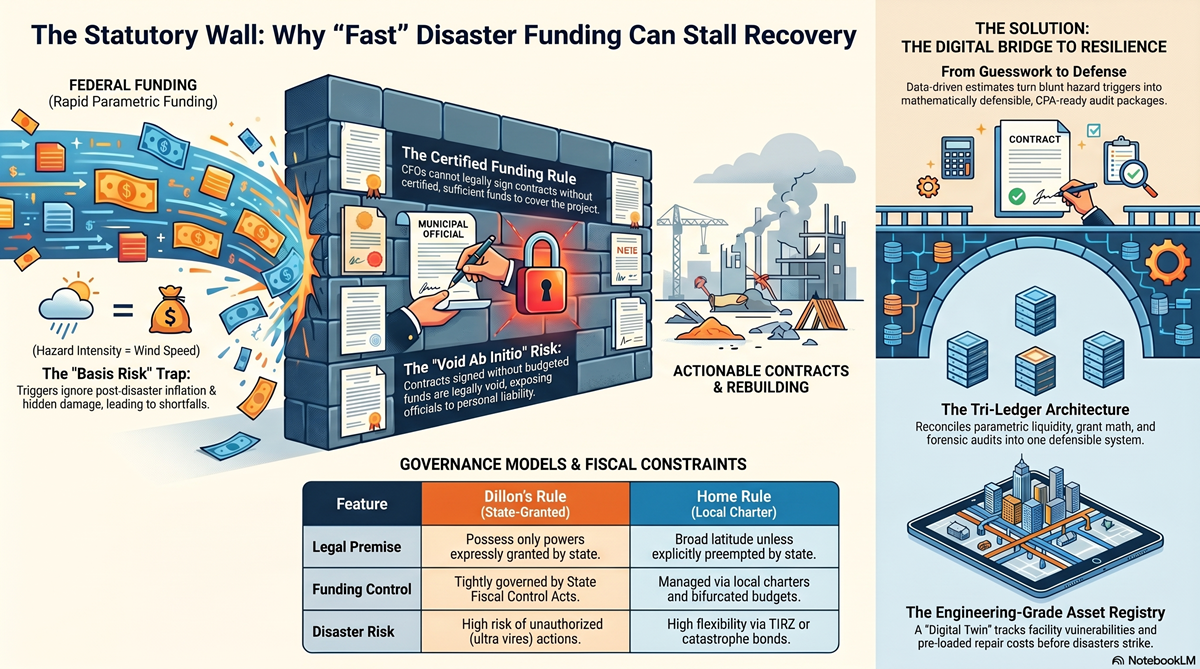
In the immediate aftermath of a disaster, the political and social pressure to secure funding is absolute. To meet this demand, federal policy is undergoing a significant paradigm shift, moving away from slow, itemized reimbursement models toward the "RAPID" funding approach proposed in H.R. 4669. This model promises upfront, formula-driven grants within 30 days, triggered by "parametric" data—such as peak wind speeds or flood depth measurements—rather than granular damage assessments.However, for those responsible for municipal finance, this promise of "immediate liquidity" represents a dangerous statutory trap. As a Chief Policy Strategist, I must warn that the fundamental tension lies in a harsh reality: a macro-level hazard trigger is not a construction cost estimate. When federal speed results in an understated grant, it hits a "statutory wall" of local budget laws, transforming a procedural hurdle into a total mathematical collapse. This creates a legal bottleneck where reconstruction halts because officials cannot legally commit to projects that lack sufficient, certified funding.
A foundational pillar of municipal finance is the Certified Funding Rule. This rule prevents governments from entering into binding obligations without the certified fiscal capacity to fulfill them. Consequently, a Chief Financial Officer (CFO) cannot legally execute a construction contract based on an "initial allocation" or a mere promise of federal funds.To satisfy auditors and remain compliant with the Stafford Act and 2 CFR § 200 (Uniform Administrative Requirements) , funding must be categorized correctly and legally bound before any work begins. An "initial allocation" fails to meet the legal threshold of committed funding, which requires an executed and legally bound federal grant agreement."The core tension lies in the fact that a macro-level hazard trigger is not a construction cost estimate. When federal speed results in an understated grant, it hits the 'statutory wall' of local budget laws that prohibit officials from committing to projects without certified, sufficient funds."
The authority of a local official to rebuild is governed by the jurisdiction’s specific "legal DNA." Whether your municipality operates under Dillon’s Rule or Home Rule determines the boundaries of your fiscal authority and your exposure to liability.| Feature | Dillon’s Rule (General State Laws) | Home Rule (Charter Framework) || ------ | ------ | ------ || Legal Premise | Municipalities possess only powers expressly granted by the state legislature. | Cities manage local affairs unless explicitly preempted by state law. || Funding Control | Tightly governed by Uniform Municipal Budget Laws and Local Government Fiscal Control Acts . | Managed via local charters; requires a strict bifurcated budget (Operating vs. Capital). || Disaster Financing | Static statutory pathways; alternative risk financing often prohibited without new state acts. | High flexibility; can utilize alternative risk stacks like TIRZ, 4B taxes, or catastrophe bonds. |
Under Dillon’s Rule, there is an existential risk of ultra vires actions. If an official signs a contract for an unbudgeted project, the contract is considered void ab initio (void from the beginning), exposing the official to personal and professional liability. Even under Home Rule, strict "appropriation ordinances" typically require a project to be fully funded before it can move from a Capital Improvement Plan (CIP) to an actionable contract.
In risk finance, "Basis Risk" is the gap between a parametric payout and the actual loss incurred. This gap is the primary catalyst for the failure of rapid recovery models. Parametric triggers, such as wind-speed sensors, are "blunt instruments" that provide data on storm intensity but fail to account for the actual damage to specific infrastructure.A sensor cannot detect facility-specific realities that drive up costs, such as:
When the RAPID model’s macro-hazard data results in an insufficient grant, it initiates a four-step failure chain that can stall recovery for years:
To bridge the gap between legal risk and engineering reality, municipalities must adopt an Engineering-Grade Asset Registry . This "Digital Twin" acts as a technical bridge, allowing officials to intersect hazard data with component-level vulnerabilities before a shortfall occurs, providing a defensible fiscal shield.A defensible recovery registry must be able to answer these five questions:
To satisfy the stringent requirements of auditors and CFOs, disaster data should be managed through a "Tri-Ledger Architecture." This system provides immutable evidence for recovery across three layers:
The core takeaway for municipal leaders is that a disaster trigger is not a cost estimate. Releasing funds based on hazard data without engineering data inevitably transfers the entirety of the financial risk to the local level.The law does not grant exceptions for "disaster urgency" or "good intentions." Without certified, appropriated funds that meet the requirements of Local Government Fiscal Control Acts, officials are legally powerless to sign contracts. Embracing the "Digital Imperative" through a pre-disaster Asset Registry is the only way to reconcile the need for speed with the accuracy required by law.As a leader, is your municipality equipped with a "Digital Twin" capable of turning immediate liquidity into a legally defensible rebuilding plan?
In the immediate aftermath of a catastrophe, the political and social pressure for rapid reconstruction is absolute. This urgency has prompted a significant paradigm shift in federal recovery policy, moving away from slow, itemized reimbursement models toward the "RAPID" funding model (as seen in H.R. 4669). This model promises upfront, formula-driven grants within 30 days based on "parametric triggers" like peak wind speeds or flood depths.However, for the municipal leader, this "immediate liquidity" can represent a dangerous Statutory Trap . The conflict arises when federal speed meets Statutory Reality : local budget laws strictly prohibit officials from committing to projects without certified, sufficient funds. When speed results in an understated grant, the recovery process hits a wall that no amount of political will can bypass."The core tension lies in the fact that a macro-level hazard trigger is not a construction cost estimate. When federal speed results in an understated grant, it hits the 'statutory wall' of local budget laws that prohibit officials from committing to projects without certified, sufficient funds."Municipal leaders must recognize that navigating this crisis requires an audit of their city’s "legal DNA," which defines the boundaries of their fiscal authority.
The capacity of a local official to legally authorize rebuilding depends entirely on the framework governing municipal power in their state.| Feature | Dillon’s Rule (General State Laws) | Home Rule (Charter Framework) || ------ | ------ | ------ || Legal Premise | Municipalities possess only those powers expressly granted by the state legislature. | Cities manage local affairs unless explicitly preempted by state law. || Funding Control | Tightly governed by Uniform Municipal Budget Laws and Local Government Fiscal Control Acts. | Managed via local charters; requires a strict bifurcated budget (Operating vs. Capital). || Flexibility in Disaster Financing | Static statutory pathways; alternative risk financing is often prohibited without state enabling acts. | High flexibility; can utilize "fiscal stacks" including TIRZ , 4B taxes , or catastrophe bonds. |
For Dillon’s Rule Jurisdictions: Officials face a severe risk of ultra vires actions—acting beyond legal authority. If an official signs a contract for an unbudgeted project, the contract is considered void ab initio (void from the beginning). This is not a mere procedural error; it exposes the official to significant personal and professional liability .For Home Rule Jurisdictions: While these cities can leverage complex "fiscal stacks" (mixing insurance, local taxes, and grants), they are bound by strict appropriation ordinances . These ordinances require a project to be fully funded before it can move from a Capital Improvement Plan (CIP) to an actionable, legally binding contract.Regardless of the model, both frameworks eventually hit the same uncompromising fiscal gatekeeper.
In municipal finance, a promise of federal money is not synonymous with the power to spend it. This is dictated by the Certified Funding Rule (the "Appropriation Before Contract" rule). Under this rule, the Chief Financial Officer (CFO) serves as the statutory gatekeeper. A CFO cannot legally execute a construction contract based on an "initial allocation" or a formula-based promise.To satisfy auditors and comply with federal Stafford Act mandates, two distinct types of funding must be established to avoid a Duplication of Benefits (DOB) :
The "RAPID" model’s reliance on blunt hazard data often triggers a step-by-step collapse of the recovery effort due to Basis Risk —the gap between a parametric payout and actual construction costs. Macro-sensors cannot detect facility-specific realities like electrical corrosion in switchgear or foundation erosion ( scour ).The Failure Chain follows four predictable steps:
To reconcile the need for speed with the requirement for legal accuracy, municipalities must implement an Engineering-Grade Asset Registry (a "Digital Twin"). This allows officials to intersect real-time hazard data with component-level vulnerabilities before a shortfall occurs.
Question,Required Data Capability
1. What was exposed?,Geospatial footprints and facility hierarchy.
2. How intense was the hazard?,"Intersection with high-water marks, wind swaths, or ShakeMaps ."
3. Which components are vulnerable?,"Component-level data (e.g., location of MEP systems, scour potential, roof age)."
4. What is the repair cost?,"Pre-loaded unit costs and ""damage-to-cost"" formulas."
5. What portion is insured?,Integration with insurance policy schedules and deductibles.
To satisfy the most stringent auditors, this data must be managed through a Tri-Ledger Architecture that provides immutable evidence :
A disaster trigger (hazard data) is not a cost estimate (engineering data). Releasing funds based on triggers alone—without component-level accuracy—inevitably transfers 100% of the financial risk to the local government.
The law does not recognize "good intentions" or "disaster urgency." Without certified, appropriated funds that meet the strict requirements of Local Government Fiscal Control Acts, officials are legally powerless to sign contracts and begin rebuilding.
A pre-disaster Asset Registry is the only way to reconcile the speed of modern federal funding with the accuracy required by law. It serves as the essential technical bridge that makes upfront funding legally defensible and sufficient to complete the mission of reconstruction.
In the immediate aftermath of a disaster, the political and social pressure for speed is absolute. To address this, federal policy is undergoing a significant paradigm shift —moving away from the slow, itemized reimbursement models of the past toward the "RAPID" funding model proposed in H.R. 4669. This model promises upfront, formula-driven grants within 30 days based on "parametric triggers" such as peak wind speeds or flood depth measurements.However, for the municipal finance professional, "immediate liquidity" can represent a dangerous statutory trap . The core tension lies in the fact that a macro-level hazard trigger is not a construction cost estimate. When federal speed results in an understated grant, it hits the "statutory wall" of local budget laws that prohibit officials from committing to projects without certified, sufficient funds. In this environment, speed without accuracy creates a legal bottleneck that effectively halts reconstruction. Navigating this conflict begins with understanding the specific legal DNA of the municipality, which dictates the boundaries of its fiscal authority.
The legal capacity of a local official to rebuild depends on whether their jurisdiction operates under the restrictive framework of state-granted powers or the broader latitude of a local charter.| Feature | Dillon’s Rule (General State Laws) | Home Rule (Charter Framework) || ------ | ------ | ------ || Legal Premise | Municipalities possess only those powers expressly granted by the state legislature. | Cities manage local affairs unless explicitly preempted by state law. || Funding Control | Tightly governed by Uniform Municipal Budget Laws and Local Government Fiscal Control Acts . | Managed via local charters; requires a strict bifurcated budget (Operating vs. Capital). || Flexibility in Disaster Financing | Static statutory pathways; alternative risk financing is often prohibited without new state enabling acts. | High flexibility; can utilize alternative risk stacks like TIRZ (Tax Increment Reinvestment Zones), 4B taxes , or catastrophe bonds. |
Even when federal funds are promised, a Chief Financial Officer (CFO) cannot legally execute a construction contract based on an "initial allocation." This is governed by the Certified Funding Rule , a foundational pillar of municipal finance that prevents governments from entering into binding obligations without the certified fiscal capacity to fulfill them.To satisfy auditors and comply with federal Stafford Act mandates, funding must be categorized correctly to avoid Duplication of Benefits (DOB) :
The "RAPID" model’s reliance on macro-hazard data often triggers a step-by-step collapse of the recovery effort:
The solution to the statutory trap is the implementation of an Engineering-Grade Asset Registry . This "Digital Twin" of the city’s infrastructure allows officials to intersect real-time hazard data with component-level vulnerabilities before a shortfall occurs.
Question,Required Data Capability
1. What was exposed?,Geospatial footprints and facility hierarchy.
2. How intense was the hazard?,"Intersection with high-water marks, wind swaths, or ShakeMaps."
3. Which components are vulnerable?,"Component-level data (e.g., location of MEP systems, roof age)."
4. What is the repair cost?,"Pre-loaded unit costs and ""damage-to-cost"" formulas."
5. What portion is insured?,Integration with insurance policy schedules and deductibles.
To satisfy the most stringent CFOs and auditors, this data must be managed through a Tri-Ledger Architecture that provides immutable evidence for recovery:
For future policy educators and municipal leaders, three takeaways define the path forward:
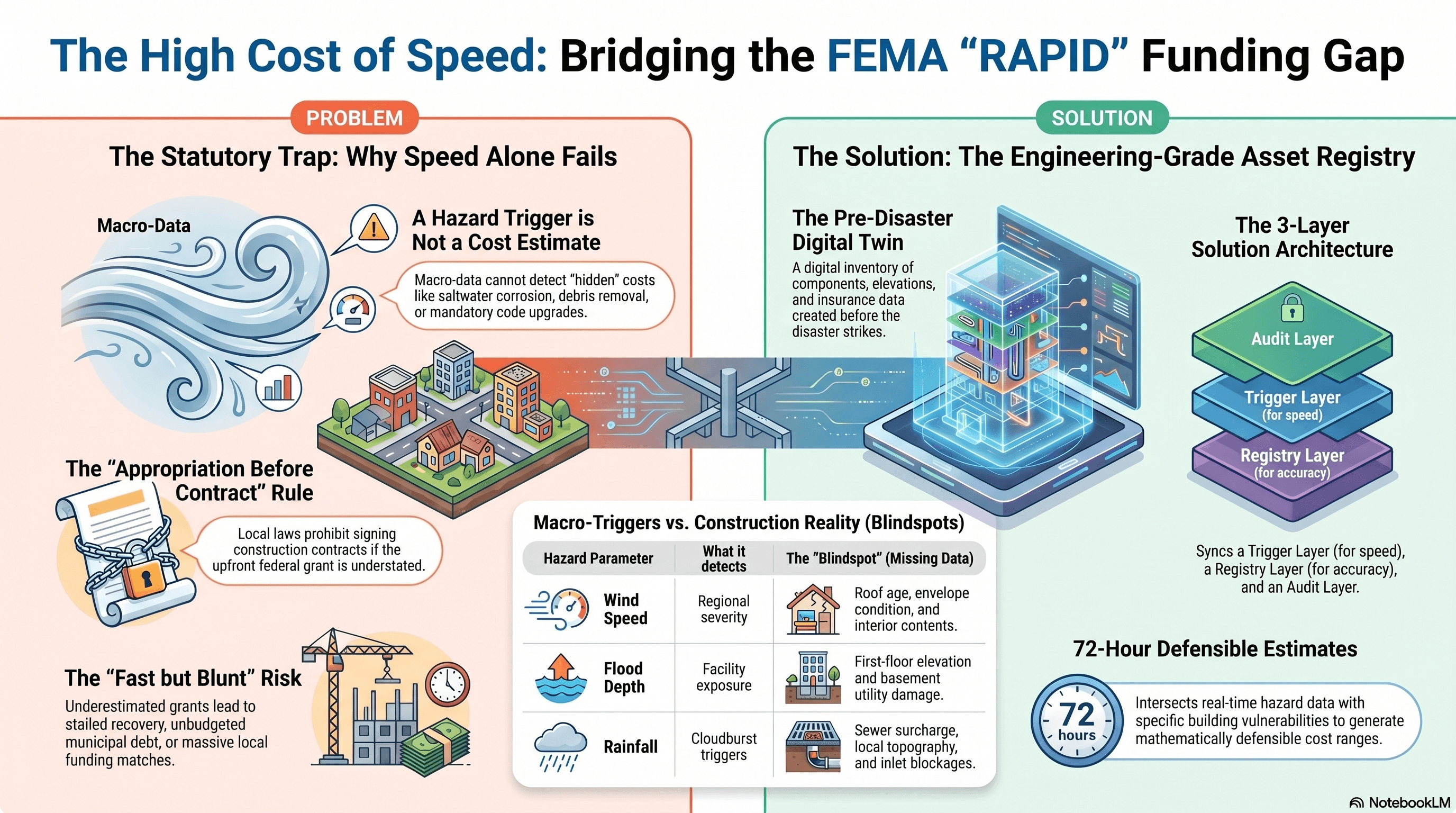
In the wake of a catastrophe, the friction of bureaucracy can be as damaging as the event itself. The federal government’s proposed solution is the RAPID model—a shift from slow, forensic reimbursement to upfront liquidity. However, as systems architects, we must recognize a fundamental truth: a disaster trigger is not a construction cost estimate. Moving money in 30 days is a significant achievement, but if that funding is decoupled from engineering reality, we aren't financing a recovery; we are financing a shortfall.Concept Callout: The RAPID Model RAPID (underpinned by legislative frameworks like H.R. 4669) is a funding reform designed to provide immediate liquidity to states and municipalities within 30 days of a disaster declaration. It replaces itemized site inspections with lump-sum formula grants triggered by objective hazard characteristics like wind speed or flood depth.While speed is a virtue in an emergency, accuracy is a legal and structural necessity. To bridge this tension, we utilize a Tri-Ledger Architecture —a system designed to ensure that rapid liquidity is both technically defensible and legally sufficient for a full recovery.
Layer 1 acts as the system's "funding switch." It utilizes Parametric Triggers —objective, measurable indices that confirm an event has crossed a severity threshold. This layer provides "Forensic Liquidity," releasing funds based on what the hazard was , rather than what the damage is .However, Layer 1 suffers from "Basis Risk"—the gap between the macro-data of a storm and the micro-reality of a facility. To an architect, a flood trigger sees only a blue plane of water at a certain elevation; it cannot see the vulnerability of the specific components beneath that plane.
Hazard Parameter,Utility,Basis-Risk Limitation
Wind Speed,Regional severity and event qualification.,"Does not know roof age, building envelope condition, or contents location."
Flood Depth,Facility exposure and equipment damage proxy.,"Does not know first-floor elevation, basement utilities, duration, or contamination."
Rainfall Intensity,Cloudburst and pluvial-flood triggers.,"Does not map sewer surcharge, local topography, or inlet blockage."
Earthquake PGA,Shaking intensity and structural damage screening.,"Does not know retrofit status, soil amplification, or equipment anchorage."
Key Insight: A parametric trigger is blind to engineering specifics. For example, in a Wastewater Pump Station (Asset ID: P-3056) , a flood elevation of +15.0 ft may be a regional trigger, but the trigger does not know if the SCADA control panels are elevated or if the submersible pump bearings and electrical switchgear have been inundated. If Layer 1 is the "switch," we require a more robust "engine" to determine the actual fuel—the funding—required for the mission.
The second layer is the Engineering-Grade Asset Registry , or the "Digital Twin." This is not merely a list; it is a high-resolution data environment. Legacy insurance "Statements of Values" (SoV) are often simple spreadsheets with addresses and lump-sum values. A reformed Registry, however, provides the granular detail required for defensible estimating:
To transform raw hazard data into a facility-specific cost range in days, the Registry follows a six-step workflow:
Without an accurate Asset Registry, the RAPID model isn't just fast—it’s a Financial Risk Transfer from the federal government to the local municipality. Speed is the bait, but the lack of data is the hook.Municipalities operate under rigid legal frameworks that make grant accuracy a prerequisite for action:
The third ledger validates spending and eligibility after the initial funding release. It ensures that the system can adjust to reality—specifically through Contract-Award Adjustments (Recommendation 4). The bid market is the first reliable test of actual construction cost; Layer 3 allows the grant to be "trued up" when real-world pricing differs from the early digital estimate.
To maintain fiscal integrity, the system classifies estimates by their maturity, preventing early guesses from being treated as final certainties.| Estimate Class | Usage Rules || ------ | ------ || Class R-1: Parametric Advance | Permitted: Immediate liquidity and state cash-flow planning. Prohibited: Use as a final fixed-cost grant. || Class R-2: Registry-Based Initial | Permitted: Allocation and inspection triage. Prohibited: Use for final project closeout. || Class R-3: Engineer-Validated | Permitted: Initial valuation for simpler assets. Prohibited: Final valuation for complex lifeline/SCADA assets. || Class R-4: Contract-Award | Permitted: Refinement of obligations based on bid market. Prohibited: Use to avoid procurement review. || Class R-5: Final Reconciled | Permitted: Audit, closeout, and final DOB check. Prohibited: Reopening the file absent fraud or material error. |
The Tri-Ledger Architecture represents the future of resilient recovery. By separating the Trigger (the switch), the Registry (the engine), and the Audit (the logbook), we create a system that respects the immediate need for cash without violating the statutory requirements of municipal finance.We must move beyond the "black box" of formula grants and toward an engineering-grade transparency that protects local taxpayers and federal interests alike.Final Takeaway "Without an enhanced facility and risk-metrics registry, upfront funding risks becoming fast but blunt. With a mature registry, FEMA reform can become a defensible system for rapid cost estimating, insurance integration, local allocation, audit closeout, and long-term resilience."
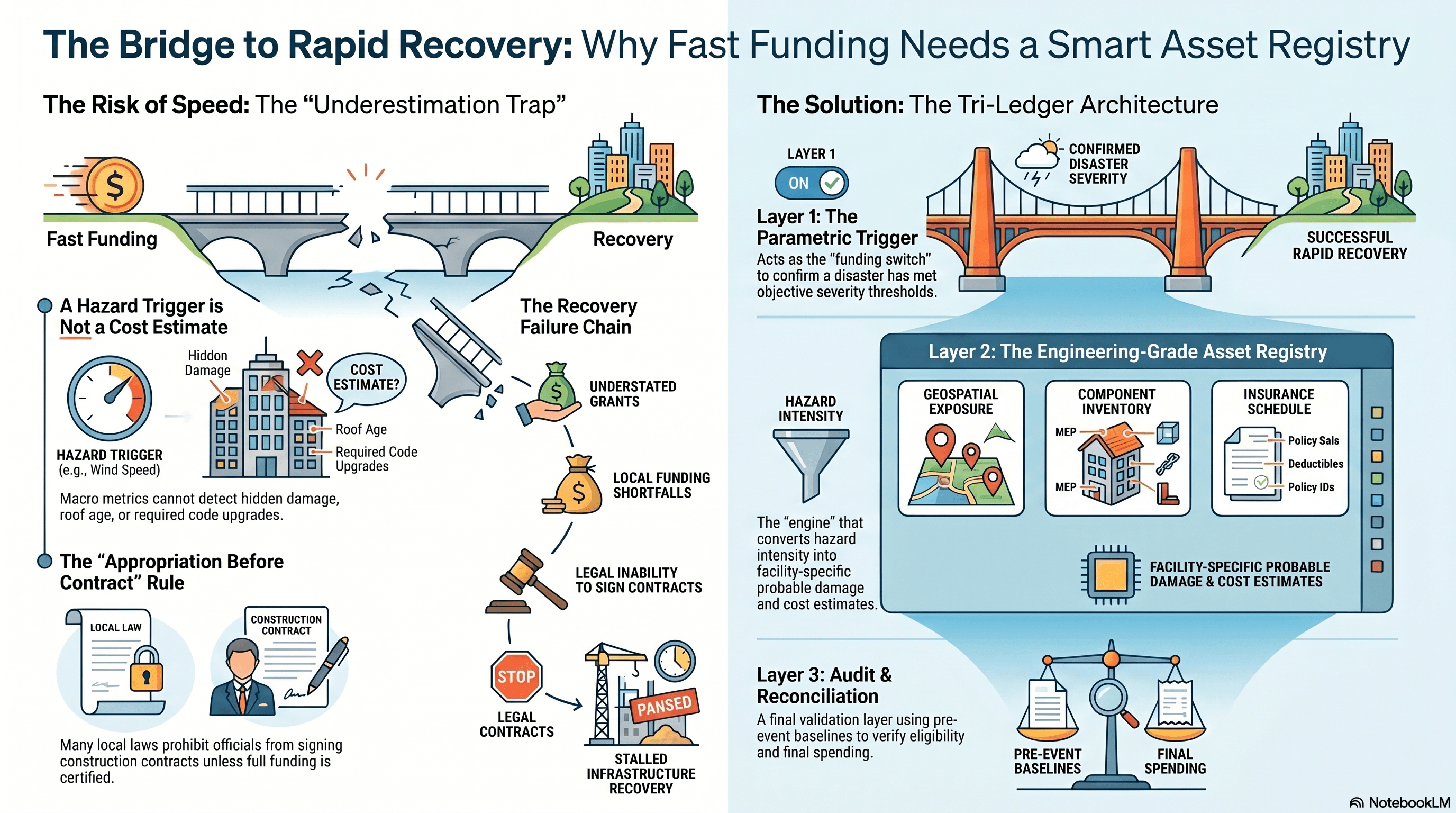
The Federal Emergency Management Agency (FEMA) is fundamentally re-engineering the fiscal architecture of federal disaster assistance. Driven by the RAPID model (H.R. 4669), the agency is pivoting away from the "verification-first" model of the legacy Public Assistance (PA) program toward a high-velocity, "liquidity-first" approach. This shift is a direct response to the systemic delays of itemized damage validation, which historically left municipalities in states of financial paralysis. However, this transition introduces a profound Technical Gap: the "Pace" of federal funding is now designed to outstrip the physical verification of damage. By moving the "Evidence Base" from site-specific physical inspections to modeled macro-hazard parameters, the federal government is shifting the risk of financial accuracy directly onto the local recipient.Legacy PA Sequence
The "Parametric Blindspot" defines the catastrophic disconnect between macro-level environmental data and the micro-level reality of construction costs. A "Parametric Trigger"—such as a peak gust wind speed or a peak flood elevation—is merely a measure of hazard intensity, not a definitive rebuilding estimate. Relying on these macro-proxies creates "Basis-Risk," where the federal grant fails to account for facility-specific variables such as roof age, MEP (mechanical, electrical, plumbing) elevation, and the structural condition of the building envelope. For a municipal architect, this gap represents the difference between a successful recovery and a permanent budget deficit.Basis-Risk Limitation Matrix| Hazard Parameter | Primary Utility | Critical Blindspot (Basis-Risk) || ------ | ------ | ------ || Wind Speed | Regional severity and event qualification. | Does not know roof age, building envelope condition, or contents location. || Flood Depth | Facility exposure and equipment damage proxy. | Does not know first-floor elevation, basement utilities, or contamination levels. || Rainfall Intensity | Cloudburst and pluvial-flood triggers. | Does not map sewer surcharge, local topography, or inlet blockages. || Earthquake (PGA/MMI) | Shaking intensity and structural damage screening. | Does not know retrofit status, soil amplification, or equipment anchorage. || Wildfire (Perimeter/Heat) | Burn probability and utility exposure. | Does not know defensible space, material class, or smoke-sensitive equipment. |
This technical underestimation is not a mere accounting variance; it is a legal barrier that triggers the "Deficit Trap."
Municipalities operate behind a "Statutory Wall" that renders federal speed useless if the underlying math is flawed. Public officials are legally prohibited from executing reconstruction contracts unless the full funding amount has been formally certified and appropriated upfront. If a RAPID grant is understated due to the Parametric Blindspot, the municipality enters a state of "Stalled Recovery." They cannot legally sign a contract for the full cost of a project without committing unbudgeted local funds or taking on municipal debt—actions that are often politically or legally impossible.The Legal Resilience Matrix
To make RAPID funding viable, we must implement a three-layer technical system that separates the trigger for funding from the calculation of the funding. This architecture ensures that the "funding switch" is fast, but the "cost engine" is accurate.
A "Digital Twin" is an engineering-grade Asset Registry that serves as the pre-disaster baseline for all fiscal claims. It is a comprehensive inventory capable of answering five critical questions within 72 hours of an event:
The "Damage-to-Cost Engine" is a fast-track pipeline designed to generate an "audit-defensible" cost range. Strategically, this avoids the peril of a "false single point" estimate that leads to budget shortfalls. The engine applies the following formula: Cost = (Component Quantity × Damage Ratio × Unit Replacement Cost × Local Cost Index) + Debris + Code/Resilience Allowances + Soft Costs - Insurance Recoverable.The Fast-Track Workflow
Without a mature Asset Registry, upfront disaster funding is a blunt instrument that threatens municipal solvency. To protect the integrity of the RAPID model, federal policy must be anchored by the following four guardrails:
The Robert T. Stafford Disaster Relief and Emergency Assistance Act (Stafford Act) is the primary legal mechanism governing federal intervention in domestic incidents. As a matter of strategic policy, executives must recognize that federal assistance is legally designed as a supplement to, and not a replacement for, the capabilities of State, Local, Tribal, and Territorial (SLTT) governments. Under 44 C.F.R. § 206.2, federal deployment is only authorized when the magnitude of an incident exceeds the combined response and recovery capacity of the affected SLTT jurisdictions.The "threshold of intervention" represents a regulatory mandate where the President determines that federal resources are essential to save lives, protect property, or avert the threat of a catastrophe. Within this framework, legal accountability is defined by three distinct roles:
The Preliminary Damage Assessment (PDA) is the evidentiary bedrock of a declaration request. It is the formal process used to demonstrate that an incident’s impact has exhausted jurisdictional capacity. Inaccurate or incomplete PDAs represent a primary risk factor for declaration denial or substantial funding delays, as they fail to provide the "unmet need" data required by FEMA.The process evolves from an initial State/Tribal assessment to a "Joint PDA," a collaborative verification phase involving FEMA, SLTT representatives, and PNPs. Under 44 C.F.R. § 206.33, the FEMA Regional Administrator may waive the joint assessment in catastrophic events, though this is rare. The objective is to document the "magnitude of the incident" through specific, auditable data.
Documentation Requirement,Strategic Value in FEMA Evaluation
Damaged Facilities & Design,Records pre-disaster design and capacity to establish a baseline for restoration vs. expansion.
Infrastructure Impact,Identifies specific critical infrastructure failures and the scale of recovery required.
Unmet Need vs. Local Capacity,Directly measures the gap between available SLTT resources and the total estimated recovery cost.
Insurance Policies,Prevents duplication of benefits; FEMA only considers costs not covered by existing insurance.
Jurisdictional Identification,"Maps specific counties, parishes, or tribal lands to justify geographic designations."
The technical accuracy of this lifecycle is the critical path to speed; comprehensive documentation at this stage ensures that federal authorizations are based on verified data rather than estimations.
The disaster declaration process is a high-stakes, time-sensitive executive function. The Governor or Tribal Chief Executive must personally certify that the incident is of such severity that effective response is beyond the capability of the jurisdiction. This request is not a mere formality; it is a strategic recommendation to the President that triggers significant federal obligation.Executives must choose between two primary request protocols:
Tribal Nations have the authority to act as their own Recipient (direct tribal declaration) or as a Subrecipient under a State declaration. To assist in this decision, Tribal Nations may request the deployment of a Tribal Liaison Officer (TLNO) from FEMA for direct, onsite technical assistance. While a Tribe may seek different aid types through different declarations (e.g., IA through a Tribal request and PA through a State request), the No Duplication of Benefits rule prohibits receiving the same type of assistance for the same incident twice.
FEMA’s evaluation is a data-driven exercise intended to measure "unmet need" against established per capita and demographic indicators, as codified in 44 C.F.R. § 206.48.
State and Territorial Factors,Tribal Nation Factors
Per Capita Indicators: Eligible damage measured against annual population-based financial thresholds.,Minimum Damage Amount: A specific threshold established by the Tribal Declarations Interim Guidance.
Localized Impacts: Analysis of extreme damage concentrations in specific areas that may justify aid despite low statewide impact.,Economic Impact: Direct assessment of the incident's effect on the tribal economy and resources.
Previous Mitigation: Consideration of how prior SLTT risk-reduction efforts averted further damage.,"Unique Conditions: Evaluation of demographic, cultural, or geographical factors unique to the Tribe."
12-Month Disaster History: Evaluation of cumulative financial impacts from all declarations in the past year.,24-Month Disaster History: A longer lookback period to account for the slower recovery cycles of tribal capacity.
These factors serve as the analytical multiplier that justifies the formal Presidential Determination.
The Presidential Determination is the definitive legal document setting the financial, geographical, and temporal boundaries of federal support. It designates the Incident Type (e.g., hurricane, flood), the Incident Period, and the specific Designated Areas.
FEMA typically provides a 75% cost share. A strategic trigger exists to increase this to a 90% federal obligation if actual federal obligations meet or exceed a specific qualifying threshold. Note: Administrative costs are strictly excluded from this 90% calculation. This is a vital budgetary distinction for State/Tribal CFOs planning long-term recovery financing.
The signature of a declaration marks a shift from "Requesting" to "Managing." The flow of federal funds is contingent upon the completion of the "Mandatory Document Suite," including Standard Forms SF-424 (A-D) and the formal FEMA-State/Tribal Agreement (FSA/FTA).
Before any project funding is obligated, the Recipient must have a FEMA-approved PAAP. This plan must satisfy 11 minimum requirements:
High-capacity Recipients may pursue a "Recipient-Led" model, where recovery is locally executed, state/tribally managed, and federally supported. This model is ideal for jurisdictions with a proven record of meeting grant management deadlines and robust fiscal systems.
Recipients must opt-in by signing an operational agreement addendum within a 72-hour window following the determination to pursue this model.
Recipient Lead Functions,FEMA Retained Responsibilities
Customer Service,General Oversight of PA Operations
Site Inspections,Quality Control Reviews
Scoping and Costing,Final Eligibility Determinations
Project Formulation,Obligation Authority & Legal/Regulatory Review
The objective of this framework is the mastery of the federal disaster process to build long-term jurisdictional resilience, ensuring that federal support acts as a force multiplier for local recovery leadership.
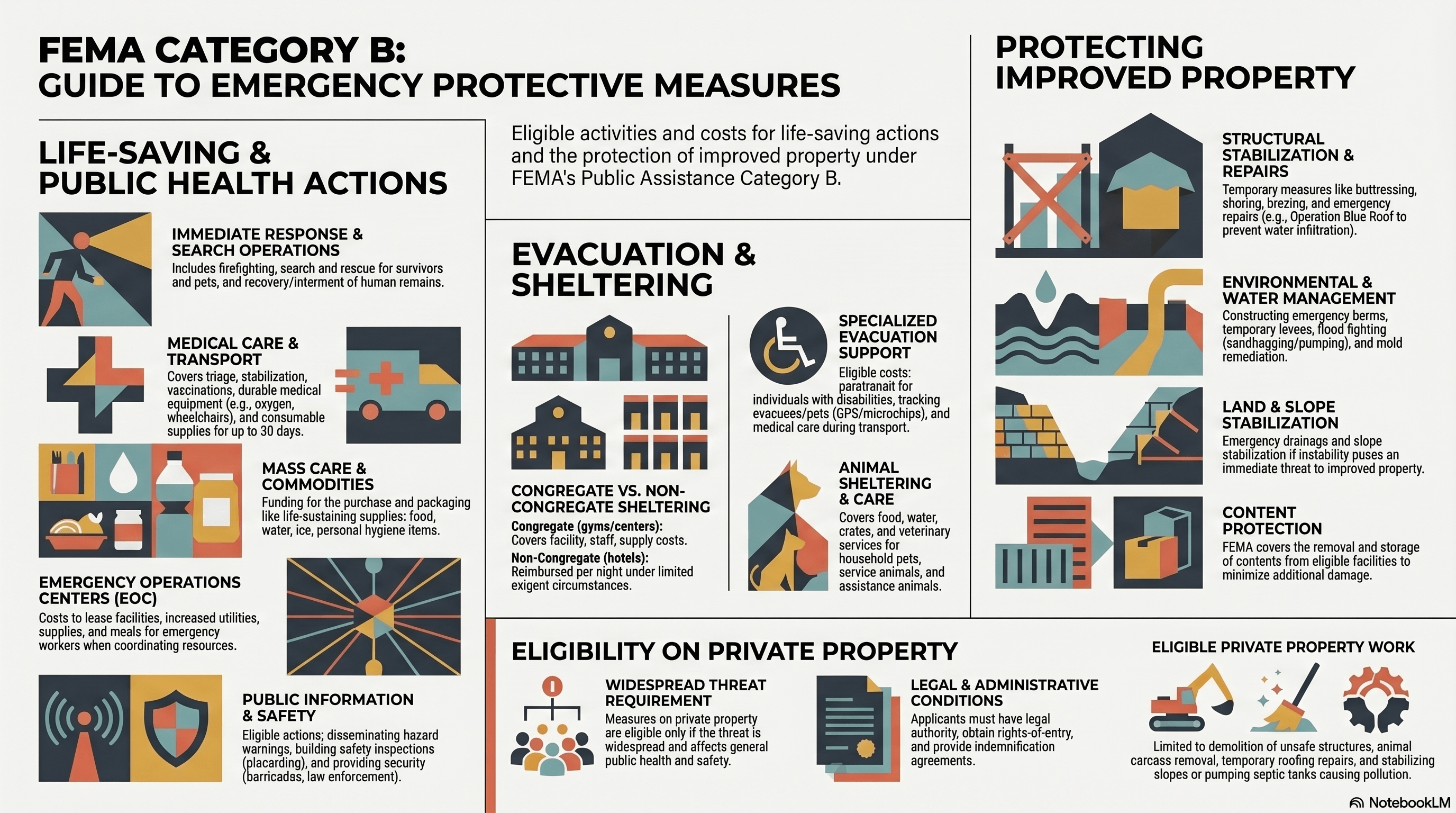
This briefing document outlines the requirements and eligible activities under FEMA’s Public Assistance (PA) Program for Emergency Protective Measures (Category B). These measures are defined as actions taken before, during, and after an incident to eliminate or lessen immediate threats to lives, public health, and safety, or to protect improved property in a cost-effective manner.Critical Takeaways:
Emergency protective measures are eligible if they eliminate or lessen immediate threats to lives, public health, or safety, or protect improved public or private property. FEMA may require certification from federal or State, Local, Tribal, or Territorial (SLTT) officials that includes:
Work on private property is limited to circumstances where:
PNPs are generally limited to activities protecting their own eligible facilities. They are not legally responsible for general emergency services (like fire or rescue). However, if an SLTT government formally requests and certifies a PNP to provide such services, FEMA may provide funding through the government entity as the applicant.
FEMA identifies a broad range of eligible activities intended to save lives and protect public health.| Category | Eligible Activities || ------ | ------ || Response Operations | Transporting/pre-positioning resources, search and rescue (including pets/service animals), firefighting, and Emergency Operations Center (EOC) activities. || Public Safety | Security (barricades, fencing, law enforcement), building safety inspections, and dissemination of hazard warnings/guidance. || Medical & Mortuary | Emergency medical care, transport, mass mortuary services, and storage of unidentified remains. || Access & Utilities | Provision of emergency access (clearing debris from roads), use of temporary generators for essential services, and hazardous materials stabilization. |
FEMA funds extraordinary costs for emergency medical care when the local system is overwhelmed.
Transportation of survivors, household pets, service animals, and necessary luggage/medical equipment is eligible. This includes:
Congregate sheltering provides safe, sanitary, and secure refuge for the community. Eligible costs include:
NCS (e.g., hotels, motels, RVs) is considered only under exigent circumstances, such as when congregate facilities are unavailable or insufficient.
If a facility providing essential community services is destroyed or unsafe, FEMA may fund the temporary relocation of those services.
Eligible work includes the separation, stabilization, and disposal of pollutants and hazardous substances. Short-term testing to ensure the elimination of an immediate threat is allowed, but long-term cleanup testing is ineligible.
Assistance is limited to a continuous 48-hour period (which may be extended by 24 hours in record-breaking events).
Remediation is eligible to prevent further damage to facilities and contents. It must not be the result of poor maintenance. Eligible activities include HEPA vacuuming, removal of contaminated gypsum board, and cleaning of HVAC systems.
Applicants may receive funding to repair public property or equipment damaged while performing eligible emergency work (Category A or B), provided the damage was:
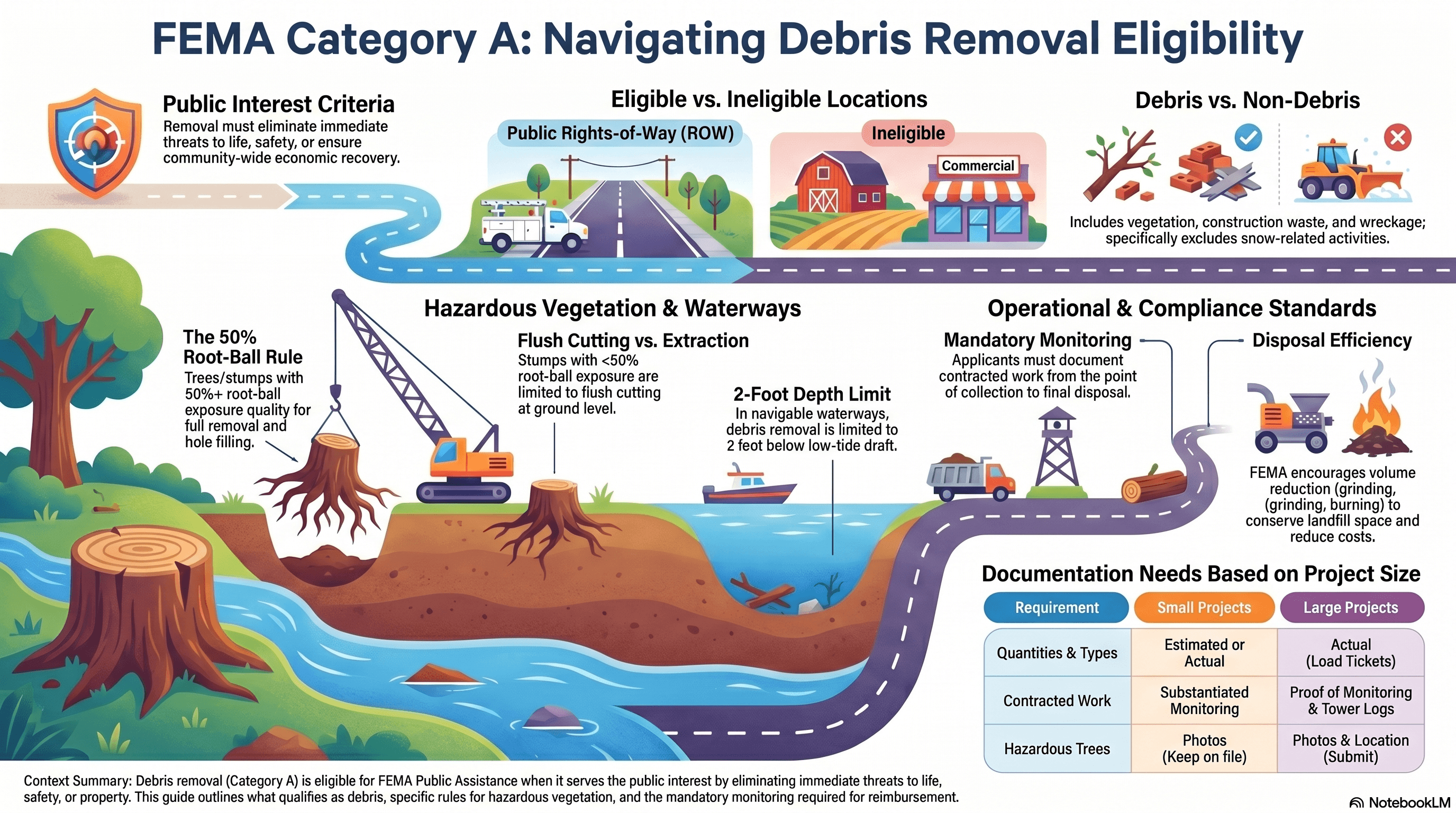
The strategic foundation for all Category A reimbursement claims rests upon the "Public Interest" criteria. These regulatory pillars serve as the foundation for all Category A reimbursement claims, ensuring that Federal Assistance (PA) funding is directed toward activities that provide a measurable benefit to the community’s safety and recovery. Understanding these thresholds is essential for preventing the de-obligation of funds, as they distinguish between routine municipal maintenance and emergency actions necessitated by a disaster.Debris removal is deemed in the public interest when the work is necessary to:
Once the material is confirmed as eligible debris, the applicant must determine if the removal falls within the correct geographic and ownership boundaries to establish legal responsibility.
Establishing "Legal Responsibility" is a critical first step in debris operations. Jurisdictional clarity prevents the duplication of benefits—where multiple federal programs might cover the same work—and ensures that the applicant has the legal authority to perform the removal. Without a clear mandate of responsibility, costs incurred during debris operations are at high risk for de-obligation.Eligible debris removal is generally limited to improved public property and Public Rights-of-Way (ROWs). Specific jurisdictional rules include:
Vegetative debris removal requires distinguishing between routine "maintenance" (ineligible) and "emergency protective measures" (eligible). To qualify, vegetation must pose an immediate threat to life, public health, safety, or improved property. If a tree is in a natural area and does not threaten a public-use area, it is ineligible.FEMA utilizes a "50 Percent Rule" for trees and stumps:
Waterway operations require multi-agency coordination (USACE, USCG, NRCS) to ensure compliance with the Endangered Species Act and navigational laws. Eligibility depends on the classification of the waterway:| Waterway Type | Eligibility Criteria | Responsible Agency / Limit || ------ | ------ | ------ || Navigable | Must obstruct vessel passage and be the applicant's legal responsibility. | Eligible to 2 feet below low-tide draft of largest pre-incident vessel. || Non-Navigable | Must pose threat to improved facilities (intakes, bridges, culverts) or cause flooding. | "5-year flood" rule: debris must threaten flooding during a 20% annual chance event. || Federally Maintained | Ineligible for PA funding. | Primary authority: USACE or USCG. |
Immediate Threat Nuances: If a tree is rooted to an embankment but floating/submerged, eligibility is limited to the cost to cut the tree at the water’s edge .Survey vs. Random Search: Funding for side-scan sonar or bathymetric surveys is only eligible if the applicant has already identified a specific area of impact and can demonstrate the need for a survey to identify a specific threat. "Random surveys" used to search for unknown debris are strictly ineligible.
PPDR is an exceptional, "limited-use" authority. FEMA may only authorize PPDR when debris is so widespread—as seen in SOURCE_IMAGE_1 , which depicts catastrophic, community-wide structural destruction and massive debris accumulation—that it constitutes an immediate threat to the community's health or safety.Legal Prerequisites for Reimbursement:
Monitoring is the single most critical factor in safeguarding reimbursement. Debris monitors verify work in real-time to prevent fraud and waste.
Requirement,Small Projects,Large Projects
Debris Quantities (Type/Volume/Weight),Required,Required
Disposal/Reduction Site Locations & Permits,Required,Required
Tower Logs,Not Required,Required
Load Tickets,Must be Retained*,Required
Proof of Monitoring,Required,Required
Photos of Debris Impacts,Recommended,Required
Waterway Pre-Existing Debris Proof,Required,Required
*For Small Projects, all documentation must be retained and made available for FEMA’s attribute-based sampling reviews.Compaction Reductions: Financial recovery is tied to loading methods.
The final phase involves efficient reduction (mulching/grinding) to preserve landfill capacity.Recycling Revenue: Generally, revenue from salvageable materials must be deducted from PA funding. However, an exception exists: if the contract allows the contractor to keep salvageable material to lower their bid price , the applicant has no further obligation to FEMA for that revenue.Temporary Debris Staging and Reduction Sites (TDSRs):
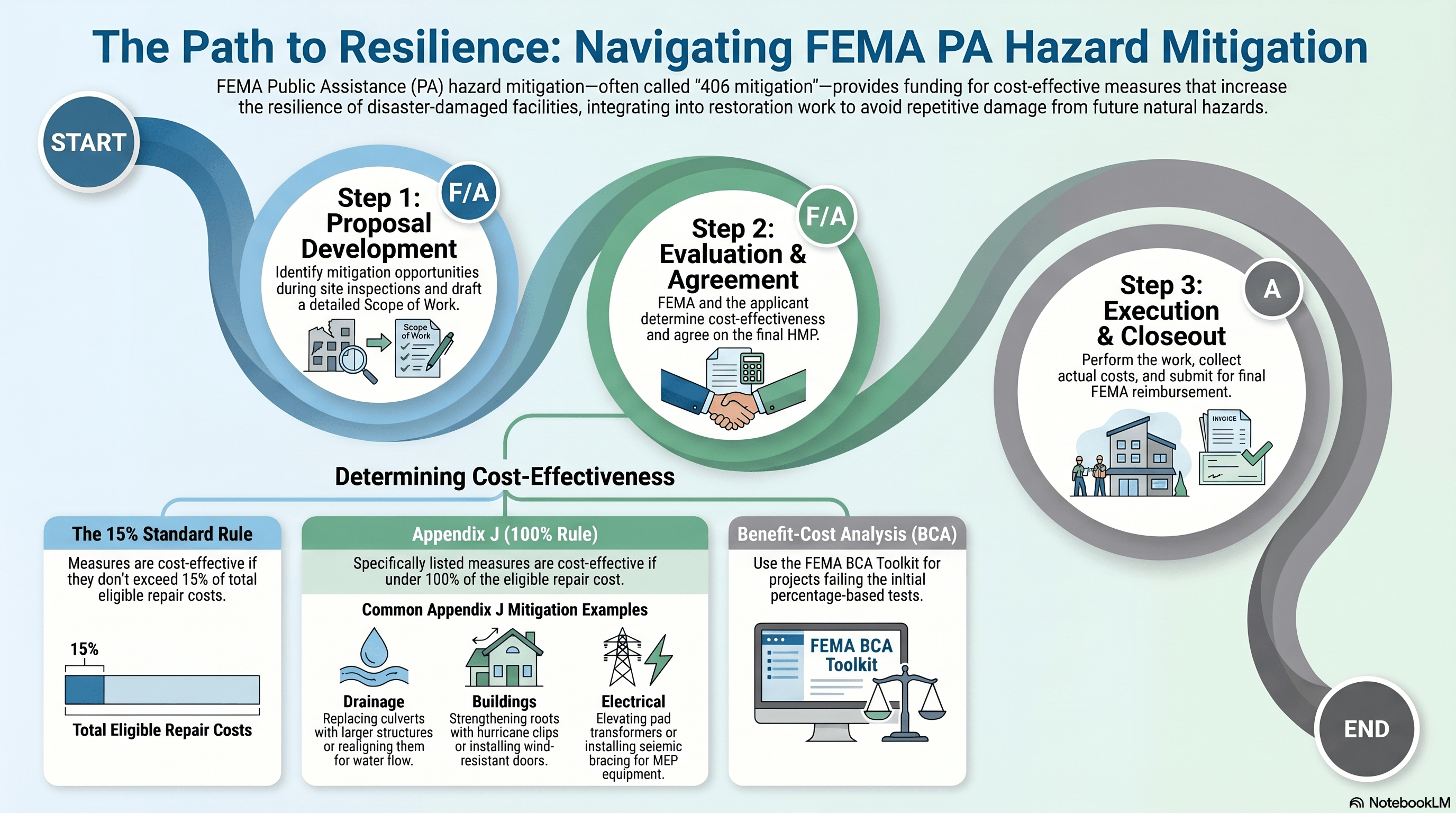
The cornerstone of the Federal Emergency Management Agency (FEMA) Public Assistance (PA) program is the restoration of damaged infrastructure to its pre-disaster state. For the Senior Strategist, "pre-disaster state" is not a subjective observation but a technical determination that hinges on two distinct concepts: pre-disaster design and pre-disaster function. These definitions establish the non-negotiable funding ceiling for any project. Misinterpreting these boundaries is a primary driver of funding disputes and subsequent deobligations, as applicants frequently conflate actual usage at the time of the disaster with the facility's legally recognized design capacity.| Core Eligibility Definitions | Description | Key Examples || ------ | ------ | ------ || Pre-disaster Design | The size or capacity of a facility as originally constructed or subsequently modified. | If a school designed for 100 students is destroyed, FEMA funds a 100-student replacement, regardless of 150-student enrollment. || Pre-disaster Function | The function for which the facility was designed or modified in accordance with codes. | An administrative building formally converted to a school is a school; an office used for storage without modification remains an office. |
When a facility serves a purpose other than its design—such as an office used as a warehouse without formal structural conversion—FEMA applies the "least cost" rule. The funding ceiling is dictated by the lower cost between restoring the facility to its original design or its alternate function. This rule prevents the federal government from subsidizing high-tier restorations for facilities providing lower-tier services. Establishing this baseline is the first step in securing a project; the framework must then account for modern regulatory overlays that necessitate upgrades beyond the pre-disaster state.
FEMA has adopted a resiliency-first model, mandating "consensus-based codes" to ensure federal investments withstand future hazards. This framework ensures that even in jurisdictions with weak or non-existent building codes, disaster-damaged infrastructure is rebuilt to modern, hazard-resistant benchmarks.FEMA’s consensus-based codes apply to the following facility categories:
Not all code requirements are eligible for PA funding. To qualify for reimbursement, a code or standard must satisfy a rigorous six-part regulatory test under 44 C.F.R. § 206.226(d).
Structural restoration often triggers the International Existing Building Code (IEBC), specifically the "Substantial Structural Damage" (SSD) threshold. SSD is defined specifically in terms of capacity loss to gravity load-carrying elements. This is a critical regulatory trigger: once gravity system damage meets the SSD threshold, it necessitates a professional engineering evaluation of the entire lateral force-resisting system. If the evaluation shows these elements do not meet IEBC criteria, upgrades to the entire structural system may be eligible for funding.FEMA limits funding to upgrades with a "direct relationship" to disaster-related damage, generally restricting eligibility to discrete elements. Strategic risks arise when local ordinances require upgrades that fail this test. For example:
Restoration projects must comply with the Americans with Disabilities Act (ADA) and the Architectural Barriers Act (ABA). These federal mandates apply regardless of whether the facility was in compliance before the disaster, provided the applicant was not already under a citation for a violation.Key accessibility definitions include the Primary Function Area (where major activity occurs, such as a dining hall or public office) and the Path of Travel (the continuous pedestrian passage connecting the area to the exterior, including sidewalks and parking).The 20% Rule and Calculation Nuances When a primary function area is restored, FEMA may fund upgrades to the path of travel and associated service facilities (restrooms, telephones, drinking fountains). However, PA funding for these upgrades is capped at 20% of the total cost to restore the primary function area .Crucially, per PAPPG v5 (Footnote 339), the calculation of the "total cost to restore the primary function area" must include the repair costs of the roof, HVAC systems, mechanical rooms, janitorial closets, locker rooms, and private offices directly associated with that area. Failure to include these elements will lead to an underestimated funding ceiling for ADA compliance. If costs exceed this 20% threshold, the applicant must prioritize elements that provide the greatest degree of access.
The administrative burden of proof for code compliance rests entirely with the applicant. FEMA validates compliance but will not identify applicable codes on the applicant’s behalf. To secure funding, the "Description of Work" must be meticulous, including:
There is a vital distinction between "restoring to code" (mandatory) and "Section 406 Hazard Mitigation" (discretionary). While code compliance is part of the restoration cost, Section 406 allows for work that exceeds code requirements to prevent repetitive future damage. Mitigation measures are deemed cost-effective if they do not exceed 100% of the eligible repair cost .For any mitigation involving drainage structures, applicants must provide Hydrologic and Hydraulic (H&H) studies . These studies are required to determine appropriate culvert sizing and ensure no adverse up- or downstream impacts, a technical requirement that is often a major hurdle for funding approval.Pre-Approved Cost-Effective Mitigation Measures (Appendix J)| Category | Examples of Eligible Mitigation Measures || ------ | ------ || Drainage Structures | Replacing structures with larger culverts; adding headwalls/wingwalls; installing debris barriers or risers (requires H&H study). || MEP Components | Seismic bracing for electrical/piping; elevating or dry floodproofing HVAC and generators; installing transfer switches/camlocks. || Building Envelopes | Installing hurricane clips/anchors; strengthening roof openings (hatches/skylights); upgrading to impact-resistant doors and windows. |
Navigating FEMA recovery requires a dual focus: meeting the mandatory requirements of the dual-code framework while leveraging Section 406 to build beyond minimum standards. By maintaining an audit-ready posture through professional engineering certifications and detailed "direct relationship" documentation, applicants can maximize recovery funding while ensuring long-term infrastructure resilience.# Regulatory Compliance Framework: Navigating FEMA Public Assistance Facility Restoration & Code-Triggered Upgrades
The cornerstone of the Federal Emergency Management Agency (FEMA) Public Assistance (PA) program is the restoration of damaged infrastructure to its pre-disaster state. For the Senior Strategist, "pre-disaster state" is not a subjective observation but a technical determination that hinges on two distinct concepts: pre-disaster design and pre-disaster function. These definitions establish the non-negotiable funding ceiling for any project. Misinterpreting these boundaries is a primary driver of funding disputes and subsequent deobligations, as applicants frequently conflate actual usage at the time of the disaster with the facility's legally recognized design capacity.| Core Eligibility Definitions | Description | Key Examples || ------ | ------ | ------ || Pre-disaster Design | The size or capacity of a facility as originally constructed or subsequently modified. | If a school designed for 100 students is destroyed, FEMA funds a 100-student replacement, regardless of 150-student enrollment. || Pre-disaster Function | The function for which the facility was designed or modified in accordance with codes. | An administrative building formally converted to a school is a school; an office used for storage without modification remains an office. |
When a facility serves a purpose other than its design—such as an office used as a warehouse without formal structural conversion—FEMA applies the "least cost" rule. The funding ceiling is dictated by the lower cost between restoring the facility to its original design or its alternate function. This rule prevents the federal government from subsidizing high-tier restorations for facilities providing lower-tier services. Establishing this baseline is the first step in securing a project; the framework must then account for modern regulatory overlays that necessitate upgrades beyond the pre-disaster state.
FEMA has adopted a resiliency-first model, mandating "consensus-based codes" to ensure federal investments withstand future hazards. This framework ensures that even in jurisdictions with weak or non-existent building codes, disaster-damaged infrastructure is rebuilt to modern, hazard-resistant benchmarks.FEMA’s consensus-based codes apply to the following facility categories:
Not all code requirements are eligible for PA funding. To qualify for reimbursement, a code or standard must satisfy a rigorous six-part regulatory test under 44 C.F.R. § 206.226(d).
Structural restoration often triggers the International Existing Building Code (IEBC), specifically the "Substantial Structural Damage" (SSD) threshold. SSD is defined specifically in terms of capacity loss to gravity load-carrying elements. This is a critical regulatory trigger: once gravity system damage meets the SSD threshold, it necessitates a professional engineering evaluation of the entire lateral force-resisting system. If the evaluation shows these elements do not meet IEBC criteria, upgrades to the entire structural system may be eligible for funding.FEMA limits funding to upgrades with a "direct relationship" to disaster-related damage, generally restricting eligibility to discrete elements. Strategic risks arise when local ordinances require upgrades that fail this test. For example:
Restoration projects must comply with the Americans with Disabilities Act (ADA) and the Architectural Barriers Act (ABA). These federal mandates apply regardless of whether the facility was in compliance before the disaster, provided the applicant was not already under a citation for a violation.Key accessibility definitions include the Primary Function Area (where major activity occurs, such as a dining hall or public office) and the Path of Travel (the continuous pedestrian passage connecting the area to the exterior, including sidewalks and parking).The 20% Rule and Calculation Nuances When a primary function area is restored, FEMA may fund upgrades to the path of travel and associated service facilities (restrooms, telephones, drinking fountains). However, PA funding for these upgrades is capped at 20% of the total cost to restore the primary function area .Crucially, per PAPPG v5 (Footnote 339), the calculation of the "total cost to restore the primary function area" must include the repair costs of the roof, HVAC systems, mechanical rooms, janitorial closets, locker rooms, and private offices directly associated with that area. Failure to include these elements will lead to an underestimated funding ceiling for ADA compliance. If costs exceed this 20% threshold, the applicant must prioritize elements that provide the greatest degree of access.
The administrative burden of proof for code compliance rests entirely with the applicant. FEMA validates compliance but will not identify applicable codes on the applicant’s behalf. To secure funding, the "Description of Work" must be meticulous, including:
There is a vital distinction between "restoring to code" (mandatory) and "Section 406 Hazard Mitigation" (discretionary). While code compliance is part of the restoration cost, Section 406 allows for work that exceeds code requirements to prevent repetitive future damage. Mitigation measures are deemed cost-effective if they do not exceed 100% of the eligible repair cost .For any mitigation involving drainage structures, applicants must provide Hydrologic and Hydraulic (H&H) studies . These studies are required to determine appropriate culvert sizing and ensure no adverse up- or downstream impacts, a technical requirement that is often a major hurdle for funding approval.Pre-Approved Cost-Effective Mitigation Measures (Appendix J)| Category | Examples of Eligible Mitigation Measures || ------ | ------ || Drainage Structures | Replacing structures with larger culverts; adding headwalls/wingwalls; installing debris barriers or risers (requires H&H study). || MEP Components | Seismic bracing for electrical/piping; elevating or dry floodproofing HVAC and generators; installing transfer switches/camlocks. || Building Envelopes | Installing hurricane clips/anchors; strengthening roof openings (hatches/skylights); upgrading to impact-resistant doors and windows. |
Navigating FEMA recovery requires a dual focus: meeting the mandatory requirements of the dual-code framework while leveraging Section 406 to build beyond minimum standards. By maintaining an audit-ready posture through professional engineering certifications and detailed "direct relationship" documentation, applicants can maximize recovery funding while ensuring long-term infrastructure resilience.
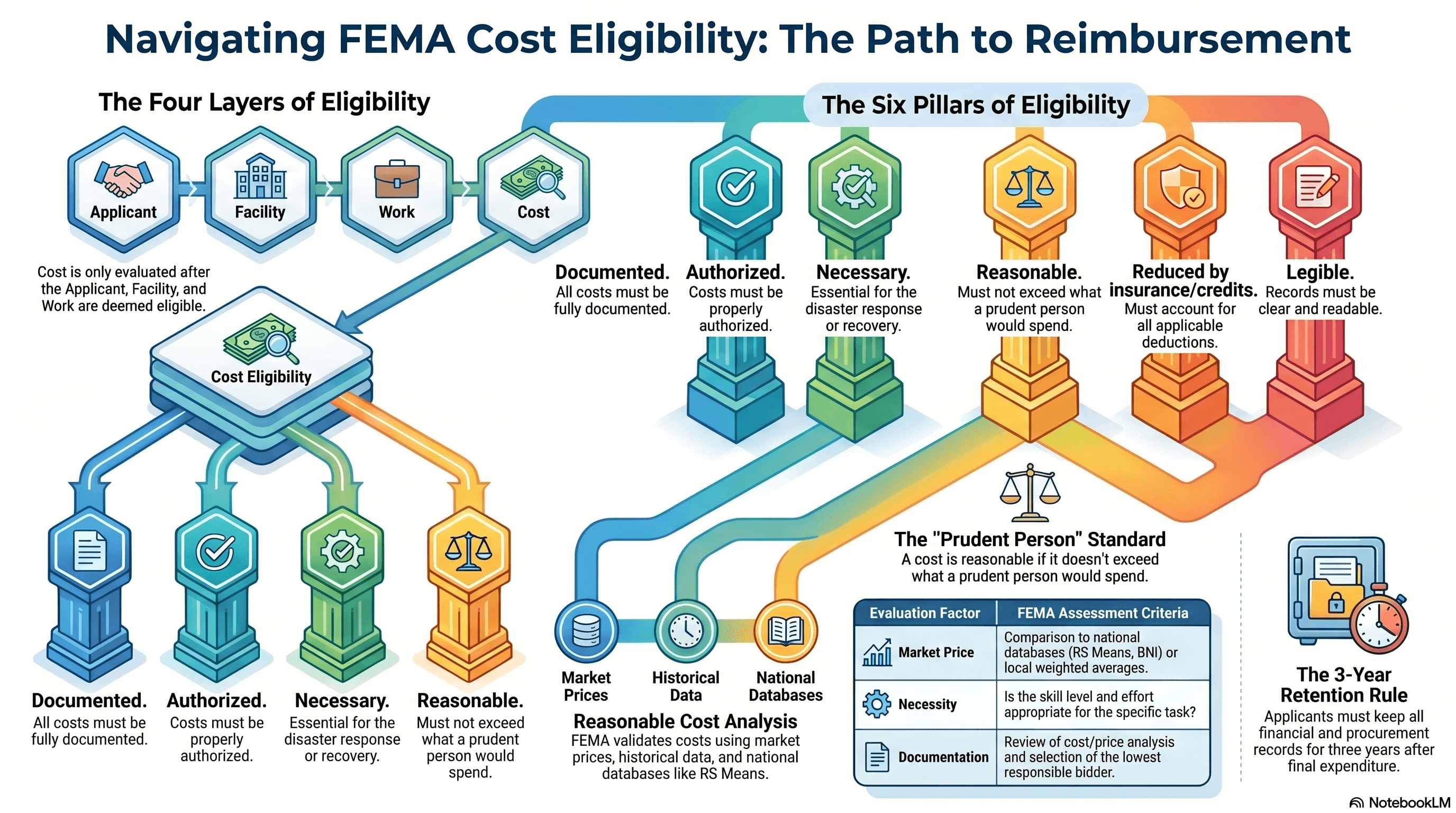
In federal disaster recovery, the "Cost Eligibility" hierarchy is the final and most perilous gate in the FEMA Public Assistance (PA) program. While an applicant may successfully prove their organizational eligibility, the eligibility of their facility, and the necessity of the work, the financial reimbursement hinges entirely on the final tier: the eligibility of the costs themselves. This is the primary site of federal "clawbacks" and de-obligations. Failure to secure this tier jeopardizes the entire grant, regardless of the merit of the recovery efforts.
As defined in the FEMA Cost Eligibility Pyramid (Figure 8), evaluation follows a strict four-tier progression:
To survive federal scrutiny, every claimed expense must satisfy these six foundational requirements:
The "Prudent Person" standard is the central pillar of federal spending. A cost is deemed reasonable if it does not exceed what a cautious, responsible individual would spend under the specific circumstances prevailing at the time the decision was made.
Compliance Mandate: FEMA does not perform a reasonable cost analysis for every expense; however, certain "Audit Triggers" necessitate immediate scrutiny:
Benchmarking against the current market is the primary defense against claims of overspending. If an applicant fails to provide a formal Cost or Price Analysis, FEMA will conduct its own evaluation, effectively stripping the applicant of control over the financial narrative.
FEMA utilizes a specific hierarchy of data sources to validate costs. Applicants should align their internal estimates with these tools:
Critical Warning: Failure to follow procurement mandates is the fastest route to funding disallowance. If an applicant selects a higher bidder without a documented Selection Rationale based on the original RFP criteria, FEMA will default to the "least-cost alternative" or the lowest bid received. This leaves the applicant liable for the price difference.
Disaster environments create unavoidable cost spikes. Reimbursement for these escalations requires strategic, real-time documentation of the environmental drivers.
FEMA recognizes five factors that justify costs exceeding market averages:
When justifying surge staffing or overtime, auditors focus on the number of consecutive hours worked .
Record retention is the final line of defense in federal litigation or OIG audits. In the absence of a complete record, FEMA reserves the right to "claw back" funds years after the project is closed.
Applicants must maintain the following for every project:
Strategic alignment with the procurement standards established in 2 C.F.R. Part 200 is not a mere administrative preference; it is a fundamental architectural requirement for safeguarding federal reimbursement. For State, Local, Tribal, and Territorial (SLTT) entities, the failure to strictly adhere to these federal standards does not simply create friction—it generates a profound financial liability. FEMA Public Assistance (PA) funding is contingent upon the applicant demonstrating that all contracts were executed under rigorous federal procurement protocols. Any deviation provides the Office of Inspector General (OIG) with the grounds necessary to recommend total cost disallowance.The regulatory requirements vary based on the applicant's legal status. Entities must understand their specific "Ground Truth" to build a compliant procurement framework.| Applicant Category | Primary Regulatory Standard | Key Compliance Ground Truths || ------ | ------ | ------ || State, Territorial, & Tribal Nations | 2 C.F.R. § 200.317 | Must follow the same documented internal policies used for non-federal procurements. Must comply with EPA guidelines (2 C.F.R. § 200.322) for recovered materials. Note: Territorial governments should consult counsel regarding the Buy American Act for public works. || Local Governments & PNPs | 2 C.F.R. § 200.318–327 | Must adhere to internal procedures, applicable SLTT laws, and federal regulations. In any conflict, the more restrictive rule applies. |
To validate this framework, FEMA often requires a formal certification. For State, Tribal, or Territorial entities, FEMA may request that a State or Tribal Attorney certify in writing that the applicant complied with their respective jurisdictional procurement policies. This certification is a primary mechanism for FEMA to validate that the internal standards used were legally sufficient.Once the jurisdictional framework is established, the entity must execute specific procedural requirements, beginning with the mandate for full and open competition.
"Full and Open Competition" serves as the bedrock of federal procurement. It is the primary structural safeguard for ensuring cost reasonableness. By engaging the open market, applicants create the transparency and competitive tension required to justify federal expenditures.To meet socio-economic obligations under 2 C.F.R. § 200.321, procurement officers must implement a six-step affirmative action checklist. Special Nuance for Tribal Nations: Tribal applicants may provide preference to Indian organizations or Indian-owned economic enterprises (51% or more ownership) if they substantiate compliance with the Indian Self-Determination and Education Act.Socio-Economic Compliance Checklist:
The contract is the primary evidence of compliance. To be eligible for PA funding, it must contain "verbatim" and "situational" clauses as defined in 2 C.F.R. § 200.327.Mandatory Federal Provisions:
Noncompetitive procurement is a high-risk compliance "red zone." Because it bypasses the market, FEMA applies a stringent "Reasonable Cost Analysis." This method is only allowable under four circumstances:
Meticulous record-keeping is the only defense against a post-disaster audit. The depth of documentation required scales with the project's complexity and size.| Requirement Category | Small Projects | Large Projects || ------ | ------ | ------ || Cost Summaries | Itemized summary of actual/estimated costs per contractor. | Itemized summary including: Contractor name, dates worked, billing/invoice numbers, and work descriptions. || Procurement History | Identification of method (Competitive vs. Non-competitive) and contract type. | Full History: Rationale for procurement method, basis for contract price, RFPs, bids, selection/rejection process, and cost/price analysis. || Financial Records | Total contract award amount. | Invoices, contracts, and all change orders. || Oversight Records | Review for cost reasonableness. | High-degree oversight documentation (Required for T&M/T&E): Daily/weekly logs and records of performance meetings. |
Time-and-Materials (T&M) and Time-and-Equipment (T&E): T&M and T&E contracts (commonly used by rural electrical cooperatives) are restricted. They are only eligible if no other contract type was suitable, they include a mandatory ceiling price (which the contractor exceeds at their own risk), and the applicant documents the high degree of oversight described above.
FEMA maintains broad authority to enforce compliance under 2 C.F.R. §§ 200.208 and 200.339. The documentation listed in Section 5 is the final barrier between the applicant and significant enforcement actions.Remedies for Non-compliance:
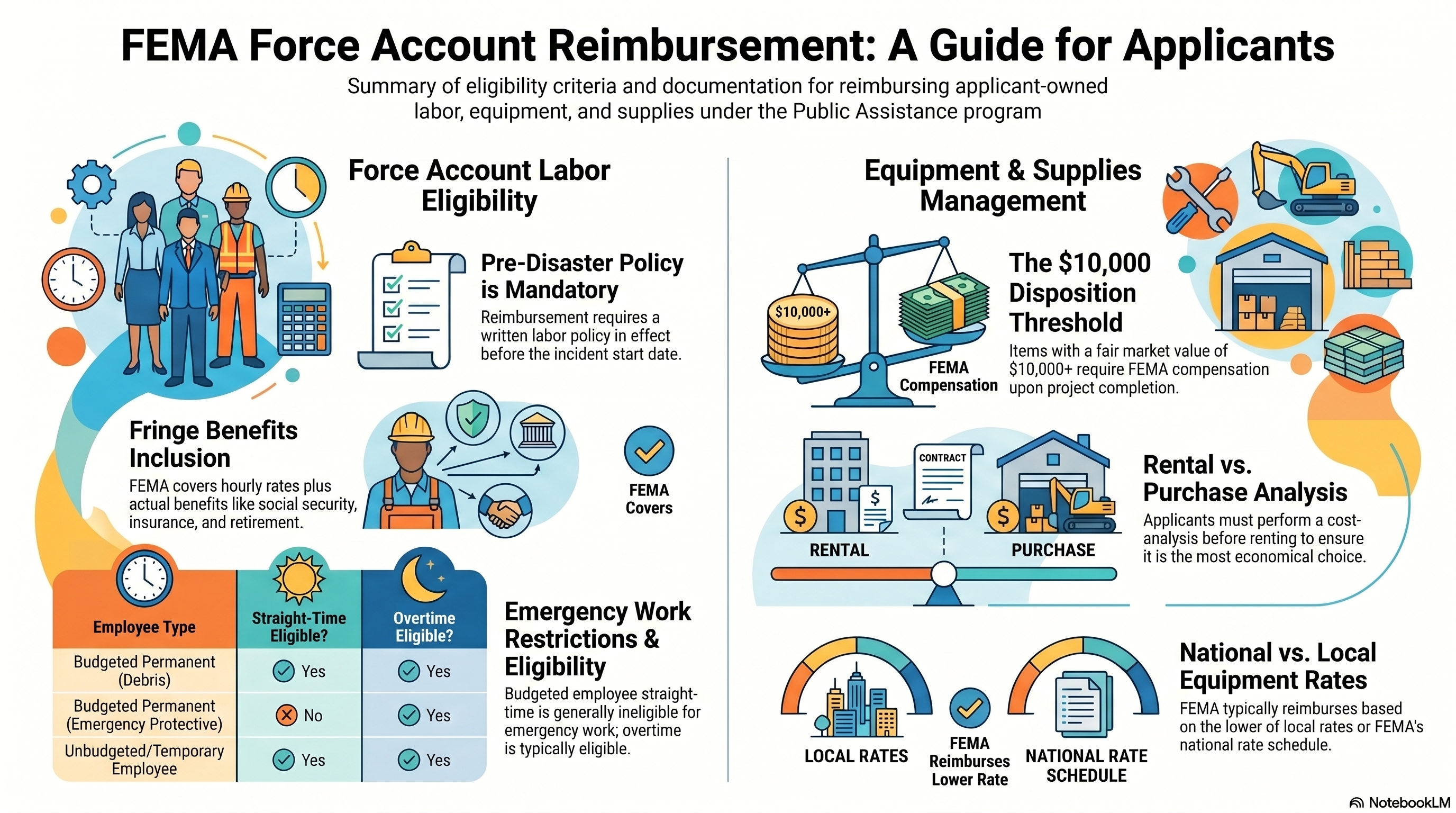
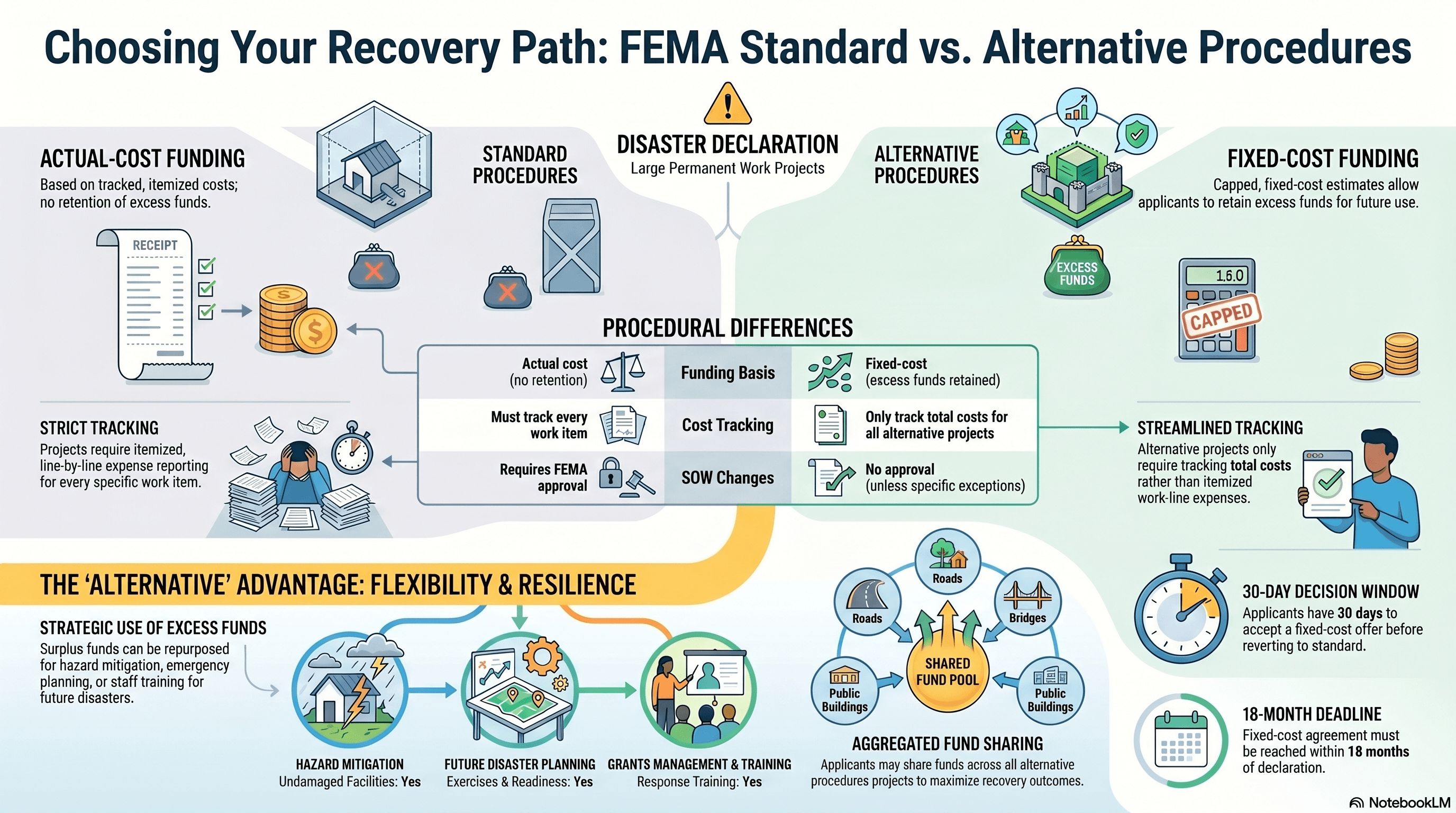
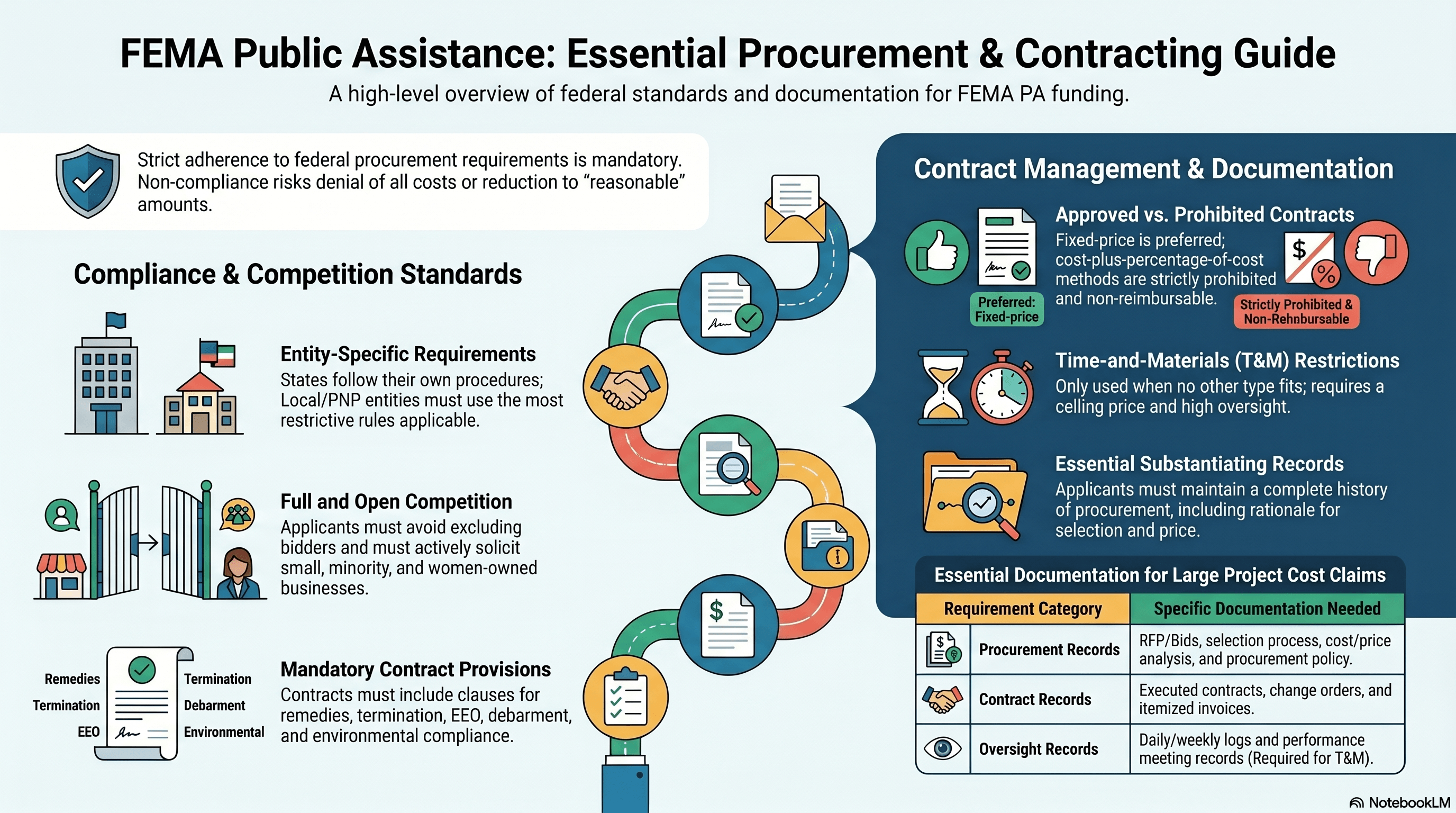
1. Introduction: The High-Stakes Race Against the Clock
For decades, municipal recovery has been a grueling marathon of "project-by-project" negotiation. Local governments have historically been trapped in a years-long cycle of documenting every cracked culvert and damaged sidewalk before federal reimbursement flows. This legacy model is failing; it is too slow for the modern disaster landscape and leaves cities carrying massive debt loads while waiting for federal validation.The FEMA Review Council has signaled a paradigm shift that effectively ends this era of post-disaster negotiation.
A new policy direction—the RAPID model—proposes 30-day "upfront" funding. While the prospect of a check arriving within weeks is a political win, it presents a lethal strategic liability for the unprepared: How can the federal government accurately fund a recovery before they even know what is broken? Without a technical foundation, "fast money" is a trap that leads to massive budget gaps and inevitable federal clawbacks.
2. The End of Post-Disaster Scrambling: The RAPID Funding Shift
The FEMA Review Council’s proposed shift moves away from the spreadsheet-heavy site inspections of the past toward a "formula-driven" disbursement architecture. Under this model, the federal government intends to bypass the site-by-site slog by issuing capital based on the objective characteristics of the disaster itself.As the source context explicitly recommends:"transforming Public Assistance into an up-front lump-sum formula grant to states, tribes, or territories based on hazard characteristics and affected population.
"This is a radical departure from "legacy" emergency management. It moves the burden of cost-estimation from the post-disaster field inspection to a pre-disaster data model. To survive this shift, cities must move beyond the "Damage Inventory" spreadsheet and adopt a three-layer system: the Trigger (event qualification), the Registry (damage estimation), and the Audit (reconciliation and defensibility).
3. The "Trigger Trap": Why Wind Speed Isn't a Cost Estimate
The RAPID model relies on "Parametric Triggers"—objective data like wind speed, flood depth, or Earthquake Peak Ground Acceleration (PGA). While these sensors provide immediate verification that an event occurred, they suffer from Financial Basis Risk : the gap between the measured hazard and the actual repair bill.Relying on a sensor at the local airport while ignoring asset-specific vulnerability creates an unfunded liability. Consider the following technical limitations:
4. Meet Your City’s Digital Twin: The Reformed Asset Registry
To make 30-day funding viable and keep the city from being underfunded, leaders must maintain a "Digital Twin" of their infrastructure. This "Asset Registry" is the central technical infrastructure that converts hazard intensity into a Rapid Initial Cost Estimate .The registry must be an engineering-grade, geospatially enabled inventory capable of answering five questions within 72 hours of an event:
5. Component-Level Data: Moving Beyond "Just a Building"
A simple list of buildings is a strategic failure. For critical infrastructure like wastewater plants or hospitals, "building-level" data is too blunt. You need "engineering-grade" details to prevent a massive funding shortfall.Essential component-level data points include:
6. The Invisible Bridge: Linking Insurance and Federal Aid
When money moves at 30-day speeds, the risk of Duplication of Benefits (DOB) skyrockets. If a city accepts a federal formula grant for the same damage later covered by the National Flood Insurance Program (NFIP) or private markets, the federal government will claw that money back during the Audit Layer .The Asset Registry acts as the vital reconciliation tool between the National League of Cities’ push for risk-based pricing and federal "obtain-and-maintain" requirements. Strategic leaders must use the registry to:
7. Conclusion: From Speed to Resilience
When a catastrophic event strikes a major metropolis, the city enters a perilous "liquidity gap." This is the window between the initial impact—when immediate cash is required for life-saving services and debris removal—and the eventual arrival of federal aid or traditional indemnity insurance settlements, which can take months or years. To bridge this divide, city finance leaders are increasingly looking toward parametric insurance: a rules-based financial instrument that triggers automatic payouts based on objective hazard data rather than lengthy loss adjustments.However, the efficacy of these tools depends on solving a critical technical challenge: Basis Risk . If the insurance trigger does not perfectly mirror the fiscal reality on the ground, the city’s financial resilience is compromised before the first responders even return to the station.
For a City CFO, the appeal of parametric insurance is speed, but the prerequisite is predictability. Basis risk is the primary obstacle to this predictability, representing a fundamental mismatch between a policy’s payout and the city's actual financial loss."Basis risk is the deviation between a parametric payout and realized losses—positive when a payout occurs without material loss, and negative when significant loss occurs without a payout."From a governance perspective, negative basis risk is a "nightmare" scenario: a city pays high premiums for a catastrophe cover that fails to trigger during a visible disaster. Conversely, positive basis risk can lead to audit challenges and political friction. To manage this, resilience strategists must design triggers that move beyond simple rainfall or wind metrics toward sophisticated "budget stabilization" tools that align with emergency liquidity horizons.
Traditional parametric triggers often suffer from a "cliff effect." Imagine a light switch: if a storm drops 9.9 inches of rain, the payout is zero; at 10.1 inches, the payout is 100%. This binary logic fails to reflect how municipal costs actually scale.The strategic solution lies in piecewise-linear payout functions —think of them as a "dimmer switch" for disaster finance. By using multi-tier thresholds, payouts scale incrementally with the disaster’s intensity. This approach utilizes Return-Period (RP) mapping , where hazard thresholds are tied to the statistical probability of the event. For example, a 1-in-10-year event might trigger 20% of the limit to cover staff overtime, while a 1-in-100-year event triggers 100% for massive infrastructure repair. This logic minimizes the Technical Rate-on-Line (ROL) by ensuring the premium paid is strictly optimized against expected municipal cash burn.
The evolution of Synthetic Aperture Radar (SAR) has revolutionized trigger accuracy. Unlike optical sensors, SAR can penetrate thick cloud cover and operate at night, providing high-resolution (10–30 m) mapping of standing water.However, a "Financial Innovation" lens requires more than just a "wet/dry" footprint. We now utilize Depth–Duration–Area (DDA) metrics. Inundation persistence—the "Duration" in DDA—is often a better predictor of fiscal loss than simple peak rainfall. By fusing SAR data with Digital Elevation Models (DEM), insurers can infer flood depth and volume. This "direct observation" replaces the flawed rainfall-gauge proxy, ensuring that a payout only occurs when water remains standing long enough to cause material structural or operational damage.
Urban environments possess "Urban Roughness"—the complex way skyscrapers and city grids alter wind loads and drainage. A "standard" hurricane model calibrated for a rural coastline will inevitably lead to massive basis risk in a dense city center. To minimize this risk, triggers must be hyper-local:
To ensure an "honest" insurance product, strategists are deploying Dual-Index triggers . This logic pairs a primary hazard (e.g., peak wind speed) with a secondary validator to filter out false positives. These validators include:
As climate volatility intensifies, the goal is to "compress" basis risk through high-fidelity, multi-sensor observations. By moving away from crude proxies and toward integrated technical models, cities can preserve the rapid payout speed of parametric insurance while ensuring that fiscal resources are deployed with surgical precision.Ultimately, this is a matter of transparency. Residents should demand to know: Is our city’s disaster insurance based on a guess, or on a scientifically validated, satellite-confirmed reality? Ensuring our financial safety nets are as robust as our physical levees is the hallmark of the next-generation climate-ready city."By combining multi-sensor observation, compound-event modeling, stepped payouts, and secondary validations—as practiced in leading public risk pools—cities can materially compress basis risk while preserving the speed and transparency that make parametric solutions valuable."
In the wake of a catastrophic event, a city’s survival is not measured in total dollars recovered, but in the velocity of those dollars. We are witnessing a fundamental decoupling of disaster recovery from the bureaucracy of loss adjustment, as traditional indemnity insurance fails to meet the immediate liquidity needs of modern municipalities. When a city cannot fund emergency payroll or debris removal within the first 72 hours, it suffers a liquidity crisis that threatens the very social contract between the government and its citizens.Traditional insurance is a "waiting game" that can leave urban centers in a fiscal chasm for months or years. Parametric insurance represents a "speed-over-indemnity" revolution, replacing the subjective eyes of an adjuster with the objective precision of a sensor. By pre-agreeing on payouts based on physical triggers rather than assessed damage, city leaders can finally bridge the 30-to-60-day gap where emergency operations are most at risk of stalling.
Parametric insurance is not a tool for total asset replacement; it is a strategic instrument for "rules-based liquidity." For a major municipality, the objective is typically to secure enough immediate cash to cover 30–60 days of emergency operations and maintenance (O&M) costs. In the high-stakes environment of urban recovery, $50 million available in seven days is infinitely more valuable for survival than $100 million delivered two years later.This shift in risk finance prioritizes the "liquidity horizon" over the precision of a claim. While traditional policies wait for every broken window to be counted, parametric products trigger automatically based on hazard intensity. This allows cities to stabilize their budgets and maintain service continuity during the most volatile phase of a disaster, treating the payout as a vital injection of contingent capital."Parametric insurance provides fast, rules-based liquidity to city governments... targeting fast liquidity for response and early recovery while minimizing fiscal volatility."
The central challenge for any Strategic Resilience Architect is managing "Basis Risk"—the delta between an insurance payout and the actual fiscal loss experienced. "Negative Basis Risk" occurs when a disaster causes clear devastation, but the mathematical trigger is not reached. This is not merely a fiscal gap; it is a political catastrophe that can end careers and erode public trust in government resilience.This paradox is driven by "spatial aggregation error" and "nonlinear damage functions." Because urban loss often follows specific thresholds—such as a storm surge overtopping at 9.5 feet—a minor variation in the hazard can cause a massive swing in realized damage. If a $50 million payout is missed because an airport anemometer didn't spin fast enough while a specific borough is underwater, the city faces a crisis that no spreadsheet can solve.
To bound basis risk tightly, we are moving away from "First-Generation" triggers that rely on a single, distant weather station. These older models often miss localized convective bursts or "micro-scale" gradients that drive urban destruction. The new frontier lies in "Second-Generation" triggers, which utilize gridded hazard fields and Synthetic Aperture Radar (SAR) to provide neighborhood-scale clarity.SAR technology is a strategic game-changer, offering wet/dry classification at 10–30 meter resolution. Unlike optical sensors, SAR can observe through clouds and at night, allowing for the creation of SAR-derived flood footprints in real-time. By utilizing Depth–Duration–Area (DDA) metrics and the Kriging of gauge networks, these instruments offer better peril physics and tunable payout curves that reflect the lived reality of vulnerable communities.
Modeling a dense metropolis requires accounting for "urban roughness" and "canyoning," where skyscrapers amplify wind gusts into "Midtown wind tunnels." Standard regional models fail to capture "backdoor harbor effects" or the complex "tide–surge interaction" that characterizes coastal urban centers. Furthermore, cities must contend with "sewer surcharge dynamics" where rainfall and surge compound to overwhelm drainage systems.Below-ground infrastructure, such as subway portals and pump stations, fails at very specific, localized thresholds. For these assets, a citywide index is an insufficient proxy; we must design for "micro-zonal" coverage. The goal is to move toward multi-index triggers that can account for "rainfall–surge compounding," ensuring the financial protection matches the specific physical vulnerabilities of the urban landscape.
Even the fastest parametric payout must survive the "FEMA Dance." To ensure "audit readiness," payouts must be meticulously structured to avoid a "Duplication of Benefits" (DOB) under 44 CFR 206. A city must be prepared to prove that its parametric cash did not cover the exact same losses being claimed through FEMA Public Assistance grants, which often requires maintaining a defendable linkage between the trigger and the fiscal need.There is a distinct irony in municipal risk finance: while the payout is designed for speed, the onboarding of these instruments is often slowed by federal standards. Under 2 CFR 200, cities must follow rigorous public-sector procurement rules even for insurance meant to bypass red tape. Success requires navigating "anti-donation clauses" while ensuring that the parametric layer acts as a "fast-liquidity top-up" that complements rather than complicates federal aid.
The future of urban resilience lies in "Climate-Conditioned" stochastic event sets that model the future, not just the past. As we integrate "Non-Damage BI" (Business Interruption) coverage triggered by heat indices and "multi-peril baskets," we are moving toward a more sophisticated, micro-zonal financial shield. The goal is no longer to eliminate basis risk entirely, but to use high-resolution data to bound it within tolerable limits.Ultimately, the integration of space-based radar and street-level telemetry forces us to confront a provocative question: can a city truly be "resilient" if its financial survival depends on the precision of a satellite’s sensor? As our modeling matures to include "compound hazard" dynamics and real-time validation, the answer will increasingly depend on our ability to turn algorithmic data into immediate, life-saving liquidity.
For decades, the standard response to an American catastrophe has been followed by a secondary, man-made crisis: the "disaster after the disaster." This is the realm of the multi-year wait for federal checks, the mountain of redundant paperwork, and a bureaucratic gridlock that often lasts longer than the physical recovery itself.However, the field of emergency management is currently undergoing a seismic transformation. This shift is being driven by two monumental catalysts: the FEMA Act of 2025 (H.R. 4669) and the FEMA Review Council Final Report , released on May 7, 2026. Together, these documents signal a pivot from reactive federal micromanagement toward localized execution and performance-driven accountability. The era of "wait and see" is being dismantled, and in its place is a model that prioritizes speed, certainty, and a radical transfer of liability to state and local leaders.
The most visible structural change is the elevation of FEMA to a standalone, Cabinet-level independent agency. By separating from the Department of Homeland Security (DHS), the agency gains budget and hiring independence, ending the "mission creep" that occurred when disaster response was folded into a national security apparatus.A critical tension exists here for policy experts: while the FEMA Act of 2025 mandates this "Independence," the FEMA Review Council Report recommends a leaner "FEMA 2.0" that remains within DHS but focuses purely on coordination. Regardless of the final organizational chart, the strategic benefit is clear: by officially removing "acts of terrorism" from FEMA's core purview and offloading that national security baggage to DHS, the new agency can operate as a "pure" logistics and resilience entity."FEMA has been synonymous with federal disaster response for 45 years... moving toward Cabinet status ensures direct accountability and streamlined decision-making, moving the agency away from DHS-level diversions to non-Stafford Act events."
The "work first, pay later" system is being replaced by the RAPID (Reformed and Partnered Initiative for Disasters) program. Under this framework, federal funds are wired directly to state treasuries within 30 days of a major declaration. For "small disasters"—defined as those between $1 million and $10 million —the Act authorizes optional block grants that allow Governors to bypass granular federal oversight entirely.| Feature | Legacy Reimbursement (Stafford Sec. 406) | The New Section 409 Expedited Model || ------ | ------ | ------ || Payment Basis | Reactive, multi-phase reimbursement of actual costs. | Engineer-certified cost estimates become the binding grant amount. || Funding Speed | Payments occur after work is completed and audited. | Funds wired within 30 days. Sec 403(e) mandates 25% of emergency work funds be released within 10 days. || Cost Scrutiny | Federal adjusters review every receipt and time-sheet. | Estimates by licensed professionals are statutorily presumed accurate. || Accountability | Retrospective audits often leading to clawbacks. | 8-year expenditure deadline ; real-time "Accountability Clocks" and automated data triggers. |
In a decisive move to dismantle the "disaster industrial complex"—the layers of consultants hired to argue with federal adjusters—the new law strips FEMA of its power to second-guess local engineers. Under Section 409, cost estimates generated by licensed local professionals are now statutorily presumed accurate and reasonable.This creates a "Safe Harbor" for local governments. FEMA has a strict 90-day review clock ; if the agency does not find explicit evidence of criminal fraud or computational error within that window, the estimate is automatically approved and obligated. This effectively ends multi-year administrative disputes regarding pre-existing maintenance, shifting the financial risk of cost overruns to the states while rewarding those who invest in qualified, up-front cost estimating.
To eliminate month-long manual loss assessments, the system is shifting toward index-based, parametric payment structures . Payouts are triggered by objective physical data rather than manual inspections. If a hurricane reaches a specific wind speed or a flood reaches a pre-defined depth, financial amounts are released immediately to the community.Authoritative Data Sources for Parametric Payouts:
The Individual Assistance process is being humanized via the FAIR (Framework for Accessible Individual Relief) program. This reform consolidates 15 overlapping relief categories into a single, flat direct payment package. The centerpiece is a "Single, Streamlined Application" that replaces the current patchwork used by FEMA, SBA, HUD, USDA, and HHS.This system aims to end the confusion of jargon-filled denial letters through plain language, multilingual, and mobile-friendly notices. The framework establishes high-stakes payout caps:
The new policy uses a performance-based sliding scale to force states to harmonize local building codes with federal standards.
The transition from administrative bloat to localized execution represents a fundamental shift in the American disaster philosophy. With "Accountability Clocks" in place—including the mandate to disburse 90% of emergency work costs within 120 days of documentation—and the creation of public dashboards to track every dollar in real-time, the era of the "disappearing" disaster fund is ending.The burden of risk and the power of the purse have shifted to state and local leaders. As a Senior Analyst, I must ask: With the financial liability now resting on your shoulders and the federal government's role narrowed to oversight, is your community's data and engineering foundation ready to drive, or will the new accountability standards reveal cracks you aren't prepared to fix?
For nearly four decades, the American disaster recovery engine has been stalled by a "reimbursement culture" that treats local governments as high-interest creditors to the federal government. Under the traditional Stafford Act model, municipalities often wait years—sometimes even decades—to be made whole, buried under a mountain of receipts and shifting "time-and-materials" documentation requirements.The FEMA Act of 2025 (H.R. 4669) changes the fundamental physics of disaster aid. As the most significant statutory rewrite of the Stafford Act since 1988, this bipartisan legislation moves the industry away from slow-motion reimbursement and toward a model defined by upfront liquidity and performance-based risk management. For policy analysts and emergency managers, this isn't just a regulatory update; it is a total overhaul of the fiscal relationship between the federal government and the states.
Under H.R. 4669, FEMA undergoes its most profound structural transformation since 2003. The agency will be extracted from the Department of Homeland Security (DHS) and established as a Cabinet-level independent agency .This "promotion" provides the agency with critical budget and hiring independence, ending the competition for resources that often occurs within the DHS national security apparatus. By refining its mission to focus exclusively on natural disasters and resilience—pointedly excluding acts of terrorism—the new FEMA is designed for singular, agile focus."Returning FEMA to a Cabinet-level agency will empower the Administrator to lead a coordinated, government-wide response to disasters, making the agency more agile and focused without diverting resources to support non-Stafford Act disasters."
The centerpiece of the Act is the replacement of the Section 406 cost-reimbursement model with the Section 409 "Expedited Repair" model . This shift is counter-intuitive: instead of auditing actual costs after the work is done, FEMA will now issue grants based on engineer-certified cost estimates that are "presumed accurate."This model introduces a rigid 180-day window from submission to obligation : FEMA has 90 days to deem an estimate approved (absent criminal fraud or computational error) and an additional 90 days to obligate the funds. This provides immediate liquidity but shifts a massive burden onto local governments: cost overruns are now generally non-reimbursable. Accuracy in the initial engineering estimate is no longer just a best practice; it is a requirement for municipal solvency.The New Rules of the Road:
The Act transforms the federal cost-share from a static 75% floor into a dynamic tool for policy enforcement. By tying funding levels to proactive risk reduction, the federal government is now "pricing" local preparedness.
The Act, synchronized with the 2024 Revisions to the Uniform Guidance (2 CFR 200) , replaces retrospective "gotcha" audits with a "Systemic Risk Management" framework. This shift is punctuated by a rise in the Single Audit threshold from $750,000 to $1,000,000 , concentrating oversight on high-risk projects.Accountability is now defined by the "Credible Evidence" standard . Grantees must disclose violations of fraud or bribery when they have a reasonable basis to believe they occurred, rather than waiting for legal proof. This is backed by mandated integration with the Treasury’s "Do Not Pay" (DNP) system and the use of Machine Learning to detect improper payment trends in real-time. Crucially, digital internal controls and cybersecurity measures are now explicitly linked to payment integrity; a failure in digital security is now a failure in federal grant compliance.
Reform also arrives for Individual Assistance (IA). The Act mandates a Unified Disaster Application System , an interoperable form that ends the "paperwork fatigue" of survivors navigating FEMA, SBA, HUD, USDA, and HHS.Crucially for long-term recovery planning, the maximum duration for housing assistance has been extended from 18 to 24 months . To ensure equitable delivery, FEMA will launch an Individual Assistance Dashboard within 90 days of a disaster, publicly tracking approvals and denials by income group to ensure the new, faster system does not leave vulnerable populations behind.
The bipartisan FEMA Act of 2025 serves as a stable middle ground compared to the "FEMA 2.0" leaked report from the FEMA Review Council. That alternative proposal suggests a more austere path: cutting the workforce by 50%, keeping the agency within DHS, and forcing states to meet a "minimum expenditure" threshold before federal aid triggers. H.R. 4669 rejects this "abandonment" model, choosing instead to empower local leaders with faster funding, provided they can meet higher professional standards.
The shift from a "reimbursement" mindset to a "performance and risk management" mindset is the most profound change in a generation. Local leaders must stop viewing FEMA as a back-end accountant and start viewing it as a front-end insurance and investment partner.To prepare, jurisdictions must move beyond general readiness and take three specific strategic actions:
For decades, the physical devastation of a natural disaster has been compounded by a secondary "paperwork disaster." Survivors and local governments have navigated a recovery framework defined by transactional friction, administrative burden, and a reactive reimbursement model that often leaves communities waiting years for fiscal closure.H.R. 4669, the Fixing Emergency Management for Americans (FEMA) Act of 2025, represents a generational pivot in federal disaster policy. This is more than a legislative update; it is a structural re-engineering intended to shift FEMA from a DHS sub-component into an agile, survivor-centric lead agency. For state, local, tribal, and territorial (SLTT) leaders, the Act introduces a performance-driven regime that rewards proactive mitigation but transfers significant fiscal risk to those unprepared for the new "binding estimate" environment.
The most visible shift in H.R. 4669 is the extraction of FEMA from the Department of Homeland Security (DHS). By re-establishing FEMA as a standalone, cabinet-level agency, the Act grants the Administrator direct access to the President and eliminates the "DHS higher-ups" traditionally required for high-level approvals.From a strategic perspective, this independence protects the Disaster Relief Fund (DRF) from being diverted to non-Stafford Act priorities, such as border security or counter-terrorism efforts. This narrowed mission focus ensures that federal disaster resources and personnel remain dedicated to natural disaster response and long-term resilience."FEMA will become more agile and focused on helping Americans—not bogged down by having its resources and personnel diverted to support non-Stafford Act disasters... reporting directly to the President." — House Transportation and Infrastructure Committee
The most significant operational shift is the creation of Stafford Act Section 409: Expedited Repair, Restoration, and Replacement . This provision effectively sunsets the legacy Section 406 cost-reimbursement model, which will become unavailable for new disasters just 180 days after the Act's enactment .The new Section 409 model replaces the time-and-materials approach with a market-responsive grant system:
Currently, survivors navigate a fragmented patchwork involving up to nine different federal entities. H.R. 4669 mandates a Unified Disaster Application System to consolidate intake across FEMA, SBA, HUD, USDA, and HHS .By requiring only a single application for all direct federal aid, the Act aims to eliminate "survivor attrition," where the administrative burden of recovery causes the most vulnerable to abandon the process.The Transparency Mandate To ensure accountability, the Act requires an Individual Assistance Dashboard to be made public within 90 days of a disaster. This dashboard will track approvals and denial reasons, specifically broken down by income group, to allow for real-time monitoring of equity and program performance.
H.R. 4669 uses federal cost-shares as a lever to compel local resilience. The standard federal share remains 75%, but the Act introduces aggressive tiers based on pre-disaster posture:| Federal Cost-Share | Eligibility Criteria || ------ | ------ || 85% Federal Share | The Incentive: Awarded to jurisdictions with modern building codes and "pre-approved state mitigation project plans" vetted by a 30-member expert panel. || 75% Federal Share | The Floor: The standard rate for applicants maintaining basic compliance. || 65% Federal Share | The Penalty: A reduced rate for jurisdictions that fail to take appropriate mitigation actions for known, repetitive hazards. |
The Ticking Clock: Jurisdictions have a three-year window following enactment to submit their mitigation plans to the expert panel. Failure to do so results in the automatic forfeiture of eligibility for the 85% cost-share.Rep. Jeff Van Drew (R-NJ) emphasized that the 85% share is a "major boost" for "expensive shoreline and public safety projects," providing the necessary capital for beaches and dunes to serve as a primary line of defense.
To reduce transactional friction for lower-magnitude events, the new Stafford Title VIII allows Governors and Tribal leaders to elect optional, lump-sum block grants for disasters that do not exceed 125% of the state per-capita damage indicator.
H.R. 4669 signals the end of the open-ended reimbursement era. By elevating FEMA and shifting to the Section 409 grant model, the federal government is offering faster funding and reduced bureaucracy in exchange for local precision and accountability.However, the "Presumption of Accuracy" is a double-edged sword. As the margin for error in engineering and data management shrinks, local governments must ask themselves: Is our community truly "data-ready" to provide the binding, engineer-certified estimates required by this new regime, or will we be left absorbing the costs of underprepared implementation?
For decades, the American disaster recovery machine has been fueled by a toxic mix of adrenaline and paper clips. Local officials, standing amidst the literal wreckage of their communities, have been forced into a secondary catastrophe: a grueling, multi-year "paper-clip audit" where every sandwich receipt for a bulldozer operator is scrutinized with forensic intensity. This "reimbursement-based model" has long reached its breaking point, leaving municipalities to choose between insolvency or taking out high-interest loans while waiting years for federal checks.That era is officially on life support. The introduction of H.R. 4669, the Fixing Emergency Management for Americans (FEMA) Act of 2025 , represents the most seismic statutory rewrite of the Stafford Act since 1988. It is not a mere incremental update; it is a fundamental transfer of risk and responsibility. Perhaps most importantly for recovery professionals, the clock is ticking: the traditional "time-and-materials" model (Section 406) is slated to sunset for new disasters just 180 days after enactment .
The Act begins by liberating FEMA from the sprawling Department of Homeland Security (DHS), elevating it to a standalone, Cabinet-level entity. While this might sound like inside-the-beltway musical chairs, the strategic implications are profound. For years, FEMA’s personnel and resources have been diverted to non-Stafford Act missions—border security, special events, and counter-terrorism—leaving the recovery mission under-resourced.By establishing FEMA as an independent agency reporting directly to the President, the Act grants the Administrator "direct accountability" and "budget independence." This structural shift is designed to foster agile decision-making, removing the "DHS higher-ups" layer that often slows down the disaster declaration process."Returning FEMA to a Cabinet-level agency will empower the Administrator to lead a coordinated, government-wide response to disasters, making the agency more agile and focused... This structure mirrors the Stafford Act, which authorizes the President to direct federal disaster response efforts through the Disaster Relief Fund."
The most counter-intuitive and high-stakes change is the creation of Section 409 , which replaces the legacy cost-reimbursement model (Section 406) with a system of Engineer-Certified Cost Estimates .Under Section 409, a licensed professional’s estimate becomes the binding grant amount. This introduces a "Presumption of Accuracy"—unless there is evidence of criminal fraud or a math error, FEMA must approve the estimate within 90 days and obligate the funds. However, this freedom comes with a sharp edge: the "Transfer of Risk." If your project goes over budget, the community is "locked-in" and responsible for the deficit.The Act provides a single "One-Time Two-Year Adjustment" for market fluctuations in labor and materials, but the message is clear: professional certification is no longer just a requirement; it is your community's liability shield. If your organization hasn't invested in top-tier estimating talent, the 180-day sunset of traditional reimbursement for new disasters will be a cold awakening.
While the FEMA Act changes the law, the Office of Management and Budget (OMB) is overhauling the rules of vigilance. The 2024 revisions to the Uniform Guidance (2 CFR 200) and Circular A-123 signal a pivot from "compliance-only" oversight to "Systemic Risk Management."Key technical shifts include:
To solve the "municipal insolvency" crisis triggered by federal slow-rolling, the Act injects upfront liquidity through Title VIII (Block Grants for Small Disasters) . For events between $1M and $10M, Governors can elect to receive a lump-sum grant (80% of estimated damages) delivered within 30 days.Furthermore, Section 118 introduces a massive "Procurement Parity" shift: local governments will now be treated as "states" for 2 CFR 200 purposes. This provides local leaders with the same procurement flexibility enjoyed by state agencies, but it removes the "I didn't know the federal rule" defense during an audit.| Feature | Legacy Stafford Act (Section 406) | FEMA Act 2025 (Section 409/Title VIII) || ------ | ------ | ------ || Payment Basis | Strict reimbursement (Work first, pay later). | Upfront funding ; 25% of federal share within 10 days. || Cost Estimates | FEMA-developed; heavily audited. | Engineer-certified; presumed accurate. || Accountability | Forensic audit of every individual receipt. | Systemic risk management ; DNP integration. || Management Costs | Capped per individual event. | Section 108 pooling across open disasters. |
For the first time, Section 108 allows grantees to pool excess management funds across all open events. This allows budget officers to build permanent, high-capacity recovery teams rather than hiring "expendable" consultants for every storm.
The FEMA Act replaces the traditional 75% cost-share "floor" with a dynamic "Carrot and Stick" model.
While H.R. 4669 focuses on independence and expansion, a "leaked" report from the FEMA Review Council suggests a radically different path: FEMA 2.0 . This alternative vision advocates for keeping FEMA inside DHS but slashing its workforce by 50%, transforming it into a coordinate-only body that pushes all financial risk onto the states. The tension between the Act’s "Independence" model and the leaked "Consolidation" model will define the next decade of American recovery policy.
The FEMA Act of 2025 promises to cut the red tape that has historically strangled recovery, but it replaces that tape with a higher bar for professional readiness. The burden of precision has shifted from federal auditors to local estimators.The era of "waiting for a check" is over. The era of "managing the risk" has begun. To prepare, every sophisticated recovery organization must:
For 45 years, the Federal Emergency Management Agency (FEMA) has operated as a standard-bearer for disaster response, but for local governments, it has frequently been the architect of "reimbursement hell." In the wake of massive catastrophes, the agency’s legacy has often been defined by the Katrina backlog—a bureaucratic logjam including over 1,000 lingering declarations that kept communities waiting decades for funding.That paradigm is shifting. The FEMA Act of 2025 (H.R. 4669), paired with the 2024 OMB Uniform Guidance revisions, marks the most significant evolution in federal recovery policy since 1988. This overhaul pivots FEMA from a defensive, "compliance-only" posture to a proactive, "risk-based" model that prioritizes liquidity over red tape.
The hallmark of this reform is the transition from the legacy Stafford Act Section 406 reimbursement model to the new Section 409: Expedited Repair . Under the old rules, FEMA scrutinized every receipt before releasing a dime. Under Section 409, "engineer-certified cost estimates" become the binding grant amount.To prevent the multi-year approval delays of the past, the Act establishes a legal "Presumption of Accuracy." The statute is explicit:"Absent evidence of criminal fraud or computational error, the estimate 'shall be deemed to be approved not later than 90 days after the submission of the estimate...'"For local leaders, this is a financial revolution. Because these estimates are binding and "presumed accurate," CFOs can now approach bond markets with a "federal guarantee" of the grant amount. This provides the certainty needed to secure low-interest financing for reconstruction before a single brick is laid.
In the past, a disaster costing $1.5 million required the same exhaustive documentation as a $1 billion catastrophe. To eliminate this "transactional friction," the FEMA Act introduces Block Grants for Small Disasters (Stafford Title VIII) .Governors and Tribal leaders can now opt for a lump-sum payment equal to 80% of estimated damages for events that fall at or below 125% of the state per-capita indicator . Typically covering events in the $1 million to $10 million range, these funds must be delivered within 30 days. This aligns with the 2024 Uniform Guidance (2 CFR 200), which raised the Single Audit threshold to $ 1 million, effectively creating a high-speed lane for minor events.
While the federal government is releasing the purse strings, it is tightening the leash on oversight. Grantees are now entering a regime of Systemic Risk Management where internal controls are the only shield against clawbacks. Under 2 CFR § 200.113 , the standard for reporting fraud has changed.Grantees must now disclose potential violations of fraud, bribery, or gratuity whenever they have a "reasonable basis to believe" an infraction occurred. You can no longer wait for a formal legal conviction to report an issue. In this new era, your jurisdiction's ability to demonstrate robust cybersecurity and real-time data-matching is the prerequisite for maintaining "expedited" status.
The Act uses the federal cost share as a strategic lever to force data-driven portfolio planning. While the baseline federal share remains 75%, it is now dynamic based on local proactivity:
5. The "Unified" Survivor Experience
For the individual survivor, the Act ends the exhaustion of navigating multiple federal silos. The Unified Disaster Application System mandates a single, web-based portal that covers FEMA, the SBA, HUD, USDA, and HHS.This system isn't just about convenience; it allows FEMA to share data with other agencies to prevent duplication of benefits , a chronic headache for local administrators. To ensure equity, a new Individual Assistance Dashboard will launch within 90 days of a disaster, tracking approvals and denials by income group to provide unprecedented transparency into the recovery process.
The FEMA Act of 2025 represents a fundamental trade-off: up-front funding in exchange for high-stakes oversight. By moving away from the "work first, pay later" model, the federal government is providing the liquidity necessary for rapid recovery. However, this autonomy shifts the "estimating and compliance risk" squarely onto the shoulders of local leaders.The question for every mayor, county manager, and emergency director is no longer whether the money is coming. The question is: Is your jurisdiction’s internal data and risk management infrastructure sophisticated enough to handle the driver's seat of its own recovery?