
pa readiness
Damages & Work
Costs & Estimates
Insurance & DOB
Compliance Controls
FEMA Reform
Resource Hub
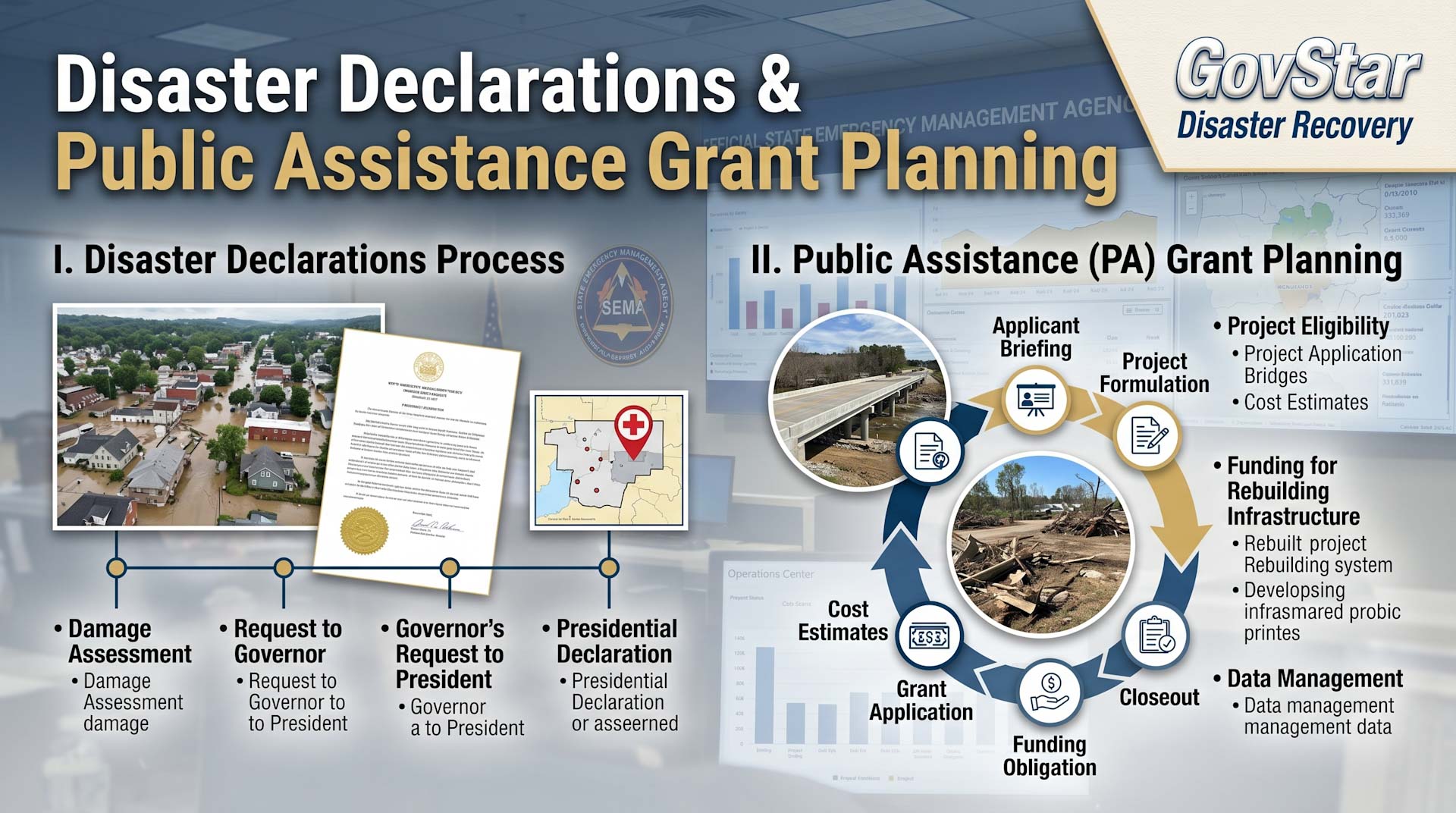
The Stafford Act authorizes the president to provide federal assistance when the magnitude of an incident or threatened incident exceeds the affected state, local, Tribal Nation, and territorial (SLTT) government capabilities to respond and recover. This chapter explains requirements for damage assessments, declaration requests, FEMA's evaluation criteria, the contents of the declaration, and the initial administrative requirements for a state, Tribal Nation, and territorial (STT) government to receive assistance.
After an incident causes widespread damage, the STT government conducts an initial damage assessment before requesting a joint Preliminary Damage Assessment (PDA) to confirm the need for federal assistance. When the STT government determines that the incident exceeds its ability to respond, it requests a joint PDA with FEMA.
The initial damage assessment plays a critical role in establishing the baseline parameters of the disaster environment. It must systematically address the following factors:
During a joint PDA, FEMA, SLTT governments, and certain private nonprofit (PNP) organization officials work together to estimate and document the impact and magnitude of the incident. Accurate and comprehensive PDAs are critical to enabling efficient response and recovery. FEMA's Preliminary Damage Assessment Guide provides detailed information to assist staff involved with damage assessments and describes how FEMA utilizes the information when preparing requests for major disaster declarations.
The Regional Administrator consults with the STT to determine if the requirement for a joint PDA may be waived based on the severity and magnitude of the incident.
Insurance Notice: Applicants must provide insurance policies when requested during a PDA, as FEMA only considers costs that would be eligible for reimbursement through the Public Assistance (PA) Program in its declaration determination.
When an entity applies for PA funding, it is an applicant. Once an applicant receives funding, it is a subrecipient.
The governor or tribal chief executive requests a declaration from the president through FEMA.
A Tribal Nation may elect to be a recipient or a subrecipient under a state or territorial declaration, or request its own declaration as a recipient. A Tribal Nation may seek different types of assistance through Tribal Nation and state declarations. For example, a Tribal Nation may seek PA and the Hazard Mitigation Grant Program (HMGP) through the state, while seeking Individual Assistance (IA) through a tribal declaration.
Important Restriction: A Tribal Nation cannot receive the same type of assistance (e.g., PA, IA, and HMGP) through both tribal and state declarations for the same incident. This is necessary to ensure that FEMA does not provide duplicative benefits.
When a severe or catastrophic incident occurs, the governor or tribal chief executive may submit a declaration request prior to completion of the PDA. This process is referred to as an expedited declaration request.
Limitation Notice: In accelerated circumstances, assistance is strictly limited to that which would address immediate needs (lifesaving or life-sustaining items) based on rapid assessments until the PDA is fully completed.
Generally, FEMA uses PDA information to evaluate the need for assistance under the PA Program as follows:
Snow Assistance Note: FEMA will only provide authorization for snow assistance under a major disaster declaration when specifically requested. Requests for snow assistance are only eligible for major disaster declarations and must be submitted with a winter storm or snowstorm declaration request. Additional information is available in Appendix K: Snow Declarations.
For state and territorial governments, FEMA's evaluation for a major disaster declaration is based on six primary factors:
FEMA compares the estimated eligible amounts to the established annual per capita indicators. To account for localized impacts when the statewide per capita impact is low, FEMA evaluates whether there are extraordinary concentrations of damage resulting in significantly high per capita impacts at the local government level.
To encourage hazard mitigation, FEMA considers whether SLTT government mitigation measures taken prior to the incident likely reduced the damage impacts, especially if such mitigation averted damage that would have increased the estimated eligible cost above the per capita indicator.
FEMA also evaluates the overall impacts of federal and STT declarations that have occurred within the past 12 months and the extent to which the STT government has expended their funds. If there were disasters prior to the 12-month period that still have substantial impacts on SLTT governments, FEMA also considers impacts from those disasters.
FEMA will consider a declaration request from a federally recognized Tribal Nation if the estimated PA-eligible damage or costs meet or exceed the threshold for the minimum damage amount per the Tribal Declarations Interim Guidance.
FEMA evaluates Tribal Nation requests for a major disaster declaration based on the following specific factors:
The Tribal Declarations Interim Guidance is a comprehensive resource for Tribal Nations on Stafford Act declarations, disaster assistance, and related requirements. Tribal Nations may request technical assistance at no cost.
Direct Support: At any time prior to, during, and after a Tribal Declaration request, Tribal Nations may request from FEMA the deployment of a Tribal Liaison Officer (TLNO), when available, to provide direct, onsite technical assistance.
For FEMA to provide assistance, the president must declare that an emergency or major disaster exists. The declaration establishes the:
The declaration designates the type of incident (e.g., hurricane, wildfire, or earthquake).
The declaration designates the incident period, which is the span of time during which the federally declared incident occurred. This period varies in duration, depending on the incident. The declaration includes an incident start date and typically includes an end date to the incident period, though in some cases, the end date may be designated as "continuing".
The declaration specifies which areas (e.g., county, parish, city, or tribe) are eligible to receive federal assistance, referred to as the "declared area". FEMA may add additional areas after the initial designation.
To request an addition, the governor or the governor's authorized representative (GAR), or for Tribal Nation declarations, the tribal chief executive or tribal authorized representative (TAR), must submit the request within 30 days of the declaration date or the end of the incident period, whichever is later. FEMA will extend the deadline if a written extension request providing justification for the delay is submitted within the 30-day window.
The declaration designates the types of federal assistance authorized, which differ between emergency and major disaster declarations and may vary among declared areas.
FEMA Regional Administrators have the authority to issue Fire Management Assistance Grant (FMAG) declarations for wildfires that threaten to cause such destruction that would constitute a major disaster. The FMAG Program is separate and distinct from the PA Program.
The assistance FEMA provides through its PA Program is subject to a federal cost share, which means that FEMA provides funding for a portion of the project and the recipient or applicant is responsible for the remaining portion. The federal cost share ensures local interest and involvement through financial participation.
Applicants may only apply other federal award funds toward the PA non-federal cost share if the other federal agency has specific statutory authority allowing its funds to be used to meet cost-share requirements. For example, the U.S. Department of Housing and Urban Development's (HUD's) Community Development Block Grant (CDBG) Program may be used toward the non-federal cost share on PA projects if certain requirements are met.
Important Rule: FEMA applies the federal cost share at the project level. Therefore, any other agency's federal funds must be applied at the project level and cannot be used across multiple projects (except for permanent work alternative procedure projects). Applicants cannot apply PA funds toward the non-federal cost share of other federal agency awards.
The governor, tribal chief executive, GAR, or TAR may appeal or request time extensions to appeal a denial of the types of assistance or areas. However, only the governor or tribal chief executive may appeal, or request a time extension to appeal, a full declaration denial. FEMA's Assistant Administrator for the Recovery Directorate at FEMA Headquarters approves time extensions when there is a justified reason for delay.
There are several administrative requirements recipients must fulfill before FEMA obligates funds. FEMA provides funding to cover administrative costs related to managing grants and offers technical assistance at no extra cost.
The declared state, Tribal Nation, or territory must complete and submit the following Standard Forms (SFs) before FEMA provides assistance:
The SF-424 includes the period of performance (POP) for the PA award (referred to as the prime award). The prime award POP begins on the first day of the incident period and initially extends four years from the declaration date.
After every declaration, FEMA and the applicable STT government enter into a FEMA-state agreement (FSA) or FEMA-Tribal Nation agreement (FTA) that defines the understanding, commitments, and conditions under which FEMA provides assistance. FEMA and the governor or tribal chief executive must sign this agreement before FEMA provides assistance.
Emergency Rule: If necessary because of exigent circumstances, FEMA may authorize essential emergency services or housing assistance under the Individuals and Households Program while the agreement is actively in process for signature.
FEMA provides PA funding to recipients via the U.S. Department of Health and Human Services (HHS) Payment Management System. Therefore, if an entity is a recipient for the first time, it must request access to the Payment Management System and complete the "Direct Deposit Form" (SF-1199A) to obtain a FEMA-specific account before FEMA can provide funding.
Recipients must have a FEMA-approved administrative plan that describes how they intend to administer the PA Program before FEMA provides PA funding for any project. At a minimum, the administrative plan must include:
The plan must detail clear operational procedures for:
State and territorial recipients must submit their administrative plan to FEMA annually. Additionally, an amendment is required for each disaster declaration to address the specifics of the new incident. Tribal Nations submit their PA administrative plan for each declared disaster in which they are a recipient. Subrecipients do not require PA administrative plans.
Hazard mitigation is most effective when implemented under a comprehensive, long-term mitigation plan that considers future conditions. Communities engage in mitigation planning to identify risks and vulnerabilities to develop long-term strategies for protecting people and property from future incidents.
Plan Prerequisite: Recipients must have a FEMA-approved hazard mitigation plan before FEMA can provide PA funding for any permanent work. A recipient must show in its plan how it intends to reduce risks from natural hazards. Recipients are required to update the plan every 5 years.
FEMA has found that recovery efforts are most successful when locally executed, state or Tribal Nation managed, and federally supported. This approach forms the basis of recipient-led PA operations. While it may not be suitable for widespread disasters that could overwhelm local, state, or Tribal Nation resources, recipient-led PA events offer opportunities to build local capacity and capability while addressing the specific needs of the recovering community.
In recipient-led PA events, recipients can lead any of the following key PA functions in lieu of FEMA:
In addition to any support requested by recipients, FEMA maintains the following core responsibilities:
FEMA and the recipient discuss whether a recipient-led PA operation is appropriate given the recipient's current capacity. Typically, the best candidates for recipient-led PA are recipients with the following factors:
To opt-in to recipient-led PA, the Regional Administrator and the governor/GAR, or the tribal chief executive/TAR, must enter into an operational agreement as an addendum to the FSA or FTA.
Sign-off Cutoff: After generating and issuing the operational agreement addendum, recipients have a strict 72 hours to sign. The Regional Administrator may approve late requests to participate in recipient-led PA after the 72 hours have lapsed at their sole discretion.
Compliance CTA: Establish the declaration file for Hazard Mitigation Plan early. Validate incident dates, affected jurisdictions, eligible categories of assistance, cost-share assumptions, insurance information, and preliminary damage estimates before submitting or relying on the request. Keep the PDA, SLTT certifications, maps, photos, estimate support, and correspondence in the project record so later eligibility and appeal positions trace back to the declaration record.
Compliance CTA: Establish the declaration file for Public Assistance Administrative Plan early. Validate incident dates, affected jurisdictions, eligible categories of assistance, cost-share assumptions, insurance information, and preliminary damage estimates before submitting or relying on the request. Keep the PDA, SLTT certifications, maps, photos, estimate support, and correspondence in the project record so later eligibility and appeal positions trace back to the declaration record.
Compliance CTA: Establish the declaration file for Payment Management System early. Validate incident dates, affected jurisdictions, eligible categories of assistance, cost-share assumptions, insurance information, and preliminary damage estimates before submitting or relying on the request. Keep the PDA, SLTT certifications, maps, photos, estimate support, and correspondence in the project record so later eligibility and appeal positions trace back to the declaration record.
Compliance CTA: Establish the declaration file for FEMA-State/Tribal Nation Agreement early. Validate incident dates, affected jurisdictions, eligible categories of assistance, cost-share assumptions, insurance information, and preliminary damage estimates before submitting or relying on the request. Keep the PDA, SLTT certifications, maps, photos, estimate support, and correspondence in the project record so later eligibility and appeal positions trace back to the declaration record.
Compliance CTA: Establish the declaration file for Application for Federal Assistance early. Validate incident dates, affected jurisdictions, eligible categories of assistance, cost-share assumptions, insurance information, and preliminary damage estimates before submitting or relying on the request. Keep the PDA, SLTT certifications, maps, photos, estimate support, and correspondence in the project record so later eligibility and appeal positions trace back to the declaration record.
Compliance CTA: Establish the declaration file for Recipient Administrative Requirements early. Validate incident dates, affected jurisdictions, eligible categories of assistance, cost-share assumptions, insurance information, and preliminary damage estimates before submitting or relying on the request. Keep the PDA, SLTT certifications, maps, photos, estimate support, and correspondence in the project record so later eligibility and appeal positions trace back to the declaration record.
Compliance CTA: Establish the declaration file for Declaration-Related Appeals early. Validate incident dates, affected jurisdictions, eligible categories of assistance, cost-share assumptions, insurance information, and preliminary damage estimates before submitting or relying on the request. Keep the PDA, SLTT certifications, maps, photos, estimate support, and correspondence in the project record so later eligibility and appeal positions trace back to the declaration record.
Compliance CTA: Establish the declaration file for Federal Cost Share early. Validate incident dates, affected jurisdictions, eligible categories of assistance, cost-share assumptions, insurance information, and preliminary damage estimates before submitting or relying on the request. Keep the PDA, SLTT certifications, maps, photos, estimate support, and correspondence in the project record so later eligibility and appeal positions trace back to the declaration record.
Compliance CTA: Establish the declaration file for Types of Assistance early. Validate incident dates, affected jurisdictions, eligible categories of assistance, cost-share assumptions, insurance information, and preliminary damage estimates before submitting or relying on the request. Keep the PDA, SLTT certifications, maps, photos, estimate support, and correspondence in the project record so later eligibility and appeal positions trace back to the declaration record.
Compliance CTA: Establish the declaration file for Designated Areas early. Validate incident dates, affected jurisdictions, eligible categories of assistance, cost-share assumptions, insurance information, and preliminary damage estimates before submitting or relying on the request. Keep the PDA, SLTT certifications, maps, photos, estimate support, and correspondence in the project record so later eligibility and appeal positions trace back to the declaration record.
Compliance CTA: Establish the declaration file for Incident Period early. Validate incident dates, affected jurisdictions, eligible categories of assistance, cost-share assumptions, insurance information, and preliminary damage estimates before submitting or relying on the request. Keep the PDA, SLTT certifications, maps, photos, estimate support, and correspondence in the project record so later eligibility and appeal positions trace back to the declaration record.
Compliance CTA: Establish the declaration file for Incident Type early. Validate incident dates, affected jurisdictions, eligible categories of assistance, cost-share assumptions, insurance information, and preliminary damage estimates before submitting or relying on the request. Keep the PDA, SLTT certifications, maps, photos, estimate support, and correspondence in the project record so later eligibility and appeal positions trace back to the declaration record.
Compliance CTA: Establish the declaration file for Declaration Determinations . early. Validate incident dates, affected jurisdictions, eligible categories of assistance, cost-share assumptions, insurance information, and preliminary damage estimates before submitting or relying on the request. Keep the PDA, SLTT certifications, maps, photos, estimate support, and correspondence in the project record so later eligibility and appeal positions trace back to the declaration record.
Compliance CTA: Establish the declaration file for Tribal Nations early. Validate incident dates, affected jurisdictions, eligible categories of assistance, cost-share assumptions, insurance information, and preliminary damage estimates before submitting or relying on the request. Keep the PDA, SLTT certifications, maps, photos, estimate support, and correspondence in the project record so later eligibility and appeal positions trace back to the declaration record.
Compliance CTA: Establish the declaration file for State and Territorial Governments early. Validate incident dates, affected jurisdictions, eligible categories of assistance, cost-share assumptions, insurance information, and preliminary damage estimates before submitting or relying on the request. Keep the PDA, SLTT certifications, maps, photos, estimate support, and correspondence in the project record so later eligibility and appeal positions trace back to the declaration record.
Compliance CTA: Establish the declaration file for Declaration Evaluation early. Validate incident dates, affected jurisdictions, eligible categories of assistance, cost-share assumptions, insurance information, and preliminary damage estimates before submitting or relying on the request. Keep the PDA, SLTT certifications, maps, photos, estimate support, and correspondence in the project record so later eligibility and appeal positions trace back to the declaration record.
Compliance CTA: Establish the declaration file for Declaration Request early. Validate incident dates, affected jurisdictions, eligible categories of assistance, cost-share assumptions, insurance information, and preliminary damage estimates before submitting or relying on the request. Keep the PDA, SLTT certifications, maps, photos, estimate support, and correspondence in the project record so later eligibility and appeal positions trace back to the declaration record.
Compliance CTA: Establish the declaration file for Damage Assessments early. Validate incident dates, affected jurisdictions, eligible categories of assistance, cost-share assumptions, insurance information, and preliminary damage estimates before submitting or relying on the request. Keep the PDA, SLTT certifications, maps, photos, estimate support, and correspondence in the project record so later eligibility and appeal positions trace back to the declaration record.