
pa readiness
Damages & Work
Costs & Estimates
Insurance & DOB
Compliance Controls
FEMA Reform
Resource Hub
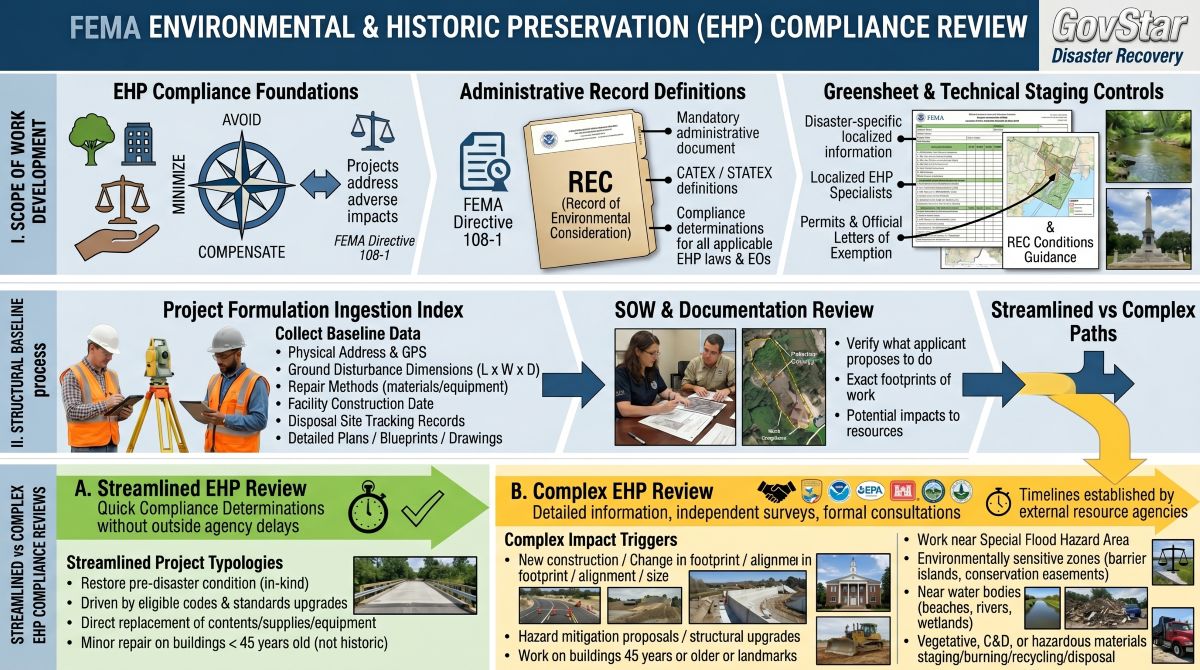
All federally funded projects are required to undergo a review process to assess potential impacts and compliance with applicable federal laws, regulations, and executive orders (EOs). This chapter is designed to inform applicants on the requirements and expectations of the environmental and historic preservation (EHP) compliance review process to ensure smooth communication and efficient progress throughout the Public Assistance (PA) Grant Lifecycle.
PA funded projects must comply with FEMA Directive 108-1, Environmental Planning and Historic Preservation Responsibilities and Program Requirements. Projects must address adverse impacts to environmental and historic resources through avoidance, minimization, or compensatory measures.
A greensheet is an administrative tool prepared by EHP at the beginning of each declaration that outlines the localized EHP information specific to the designated disaster area. EHP specialists provide technical expertise regarding legal mandates, including:
When an EHP review is finalized, the determinations are captured in a Record of Environmental Consideration (REC). The REC is a mandatory administrative document that records the application of a categorical exclusion (CATEX) or statutory exclusion (STATEX) to a specific proposed scope of work and captures the compliance determinations made for all applicable EHP laws and EOs.
EHP specialists review an applicant's scope of work (SOW) and supporting documentation to verify what the applicant proposes to do, the exact footprints of the work, and what natural or cultural resources may be impacted.
Applicants must provide the following baseline data fields during the project formulation stage to support the review:
FEMA collaborates with regulatory partners to create streamlined procedures, such as programmatic agreements or pre-determined consultations. These tools enable specialists to make quick compliance determinations without outside agency delays.
Projects with the potential to impact natural or cultural resources require detailed information, independent surveys, and formal consultations with external resource agencies. Timelines for these reviews are established by the responsible external federal, state, or tribal resource agencies.
The following project categories automatically necessitate a complex EHP review:
Section 316 of the Stafford Act exempts most emergency actions from detailed review under the National Environmental Policy Act (NEPA). However, compliance with all other environmental laws and executive orders remains mandatory.
FEMA must verify that an applicant's debris operations avoid impacts to floodplains, wetlands, threatened/endangered species, and historic or maritime archaeological resources. Operations must prevent hazardous gas release and water supply contamination.
Staging Boundary Constraints: Applicants must stage debris at a safe distance from property boundaries, surface water bodies, floodplains, wetlands, structures, utility wells, and active septic tanks with leach fields. Upon completion of debris sorting and reduction, full site remediation is required at staging yards and other impacted staging properties.
FEMA must ensure Category B measures avoid impacts to listed species, critical habitats, and historic properties while evaluating the flood risk potential to surrounding areas. For work completed prior to application submission, full documentation must be provided after-the-fact to demonstrate compliance.
Permanent work projects involving alternate scopes, improved designs, facility relocations to undisturbed areas, or alterations to the pre-disaster size and location trigger intensive EHP compliance workflows.
For alternate and alternative procedures projects where the applicant chooses to abandon the original facility, specific safety and EHP rules apply to the original site.
Site Abandonment Rule: If the original facility is left unrepaired and presents a public safety hazard, the applicant must render the facility safe and secure by restricting public access, locking doors, and erecting a perimeter fence, or must fully demolish it. FEMA adjusts capped project funding by the value of any salvaged materials, less the estimated costs to demolish the structure or secure the site.
Outside Agency Coordination: When no PA funding is utilized for activities at the abandoned site, the applicant is required, as a condition of their grant funding, to coordinate independently with the SHPO/THPO, USFWS, NMFS, or USACE. They must determine if the abandoned structure will adversely affect historic or natural resources and implement any recommended minimization or treatment measures. The applicant bears all costs for this external coordination unless directly related to restoring disaster-related damage.
NEPA requires that the effects of proposed federal actions and alternatives on the human environment be shared with the public and considered before execution. FEMA applies four distinct tiers of NEPA compliance review:
Section 106 of the NHPA requires FEMA to assess whether PA-eligible work affects historic buildings, structures, or archaeological resources. FEMA must consult with the SHPO and/or THPO to resolve adverse effects through avoidance, minimization, or programmatic treatment measures.
Section 7 of the ESA requires FEMA to review funded actions for potential effects on federally listed endangered or threatened species and their designated critical habitats. If an effect is identified, FEMA must engage in formal or informal consultation with the USFWS or NMFS, which may result in project conditions such as seasonal construction timing restrictions or explicit best management practices.
The CBRA designates undeveloped land along the Atlantic and Gulf Coasts as part of the John H. Chafee Coastal Barrier Resources System (CBRS), making these zones ineligible for most new federal assistance. PA funding inside a CBRS unit is permitted only if the project qualifies for an explicit statutory exception under Section 6 of the CBRA and undergoes formal consultation with the USFWS Ecological Services field office. Proposed actions carried out within or adjacent to an "Otherwise Protected Area" (such as a national wildlife refuge or park) are exempt from this USFWS consultation requirement.
The CWA regulates pollutant discharges into the Waters of the United States (WOTUS).
The following projects regularly trigger CWA Section 404 permitting requirements:
When multiple federal agencies fund or permit projects in the same geographic area, the UFR process provides a framework to unify environmental reviews, prevent conflicting EHP standards, and offer higher-level dispute resolution if an impasse is reached. For example, when a public housing authority receives PA funds, FEMA EHP coordinates directly with HUD to streamline the environmental review.
HENTF is a partnership between FEMA’s Office of Environmental Planning and Historic Preservation (OEHP) and the Smithsonian Cultural Rescue Initiative (SCRI). It protects cultural and historic resources from disaster effects and supports the Natural & Cultural Resources Recovery Support Function. HENTF identifies impacts to private nonprofit cultural institutions (museums, libraries, historical societies) and provides specialized technical support to field staff by advising on conservators and evaluating scopes of work for treating damaged cultural objects.
Compliance CTA: For Partnerships and Resources, start EHP screening during scoping, not after construction. Identify ground disturbance, floodplain/wetland, historic, threatened species, coastal, water, air, hazardous materials, and other resource impacts; obtain required reviews or permits; follow FEMA conditions; and retain correspondence and approvals before work proceeds where required.
Compliance CTA: For Coordination with Other Federal Agencies, start EHP screening during scoping, not after construction. Identify ground disturbance, floodplain/wetland, historic, threatened species, coastal, water, air, hazardous materials, and other resource impacts; obtain required reviews or permits; follow FEMA conditions; and retain correspondence and approvals before work proceeds where required.
Compliance CTA: For Understanding EHP Laws and Executive Orders, start EHP screening during scoping, not after construction. Identify ground disturbance, floodplain/wetland, historic, threatened species, coastal, water, air, hazardous materials, and other resource impacts; obtain required reviews or permits; follow FEMA conditions; and retain correspondence and approvals before work proceeds where required.
Compliance CTA: For Navigating the EHP Compliance Process, start EHP screening during scoping, not after construction. Identify ground disturbance, floodplain/wetland, historic, threatened species, coastal, water, air, hazardous materials, and other resource impacts; obtain required reviews or permits; follow FEMA conditions; and retain correspondence and approvals before work proceeds where required.
Compliance CTA: For Projects Requiring Complex EHP Review, start EHP screening during scoping, not after construction. Identify ground disturbance, floodplain/wetland, historic, threatened species, coastal, water, air, hazardous materials, and other resource impacts; obtain required reviews or permits; follow FEMA conditions; and retain correspondence and approvals before work proceeds where required.
Compliance CTA: For Projects that Qualify for Streamlined EHP Review, start EHP screening during scoping, not after construction. Identify ground disturbance, floodplain/wetland, historic, threatened species, coastal, water, air, hazardous materials, and other resource impacts; obtain required reviews or permits; follow FEMA conditions; and retain correspondence and approvals before work proceeds where required.
Compliance CTA: For EHP Compliance Review, start EHP screening during scoping, not after construction. Identify ground disturbance, floodplain/wetland, historic, threatened species, coastal, water, air, hazardous materials, and other resource impacts; obtain required reviews or permits; follow FEMA conditions; and retain correspondence and approvals before work proceeds where required.
Compliance CTA: For EHP Compliance, start EHP screening during scoping, not after construction. Identify ground disturbance, floodplain/wetland, historic, threatened species, coastal, water, air, hazardous materials, and other resource impacts; obtain required reviews or permits; follow FEMA conditions; and retain correspondence and approvals before work proceeds where required.