- SEO Title FEMA PA Appendix L: Validation of Applicant Cost Estimates
- SEO Summary Review the regulatory review checklist, professional certifications, and cost variance rules required to validate large project funding applications.
- ACTUAL GEMINI chapter OUTPUT CONTENT
Appendix L: Validation of Applicant-Provided Cost Estimates
This appendix provides a checklist that FEMA Public Assistance (PA) staff must use to review and validate cost estimates submitted to FEMA for large permanent work projects. FEMA staff may also use relevant portions of this checklist for emergency work.
I. Baseline Professional Certifications
FEMA staff must systematically evaluate the core compliance credentials and formatting of the submitted documentation.
Baseline Ingestion Fields
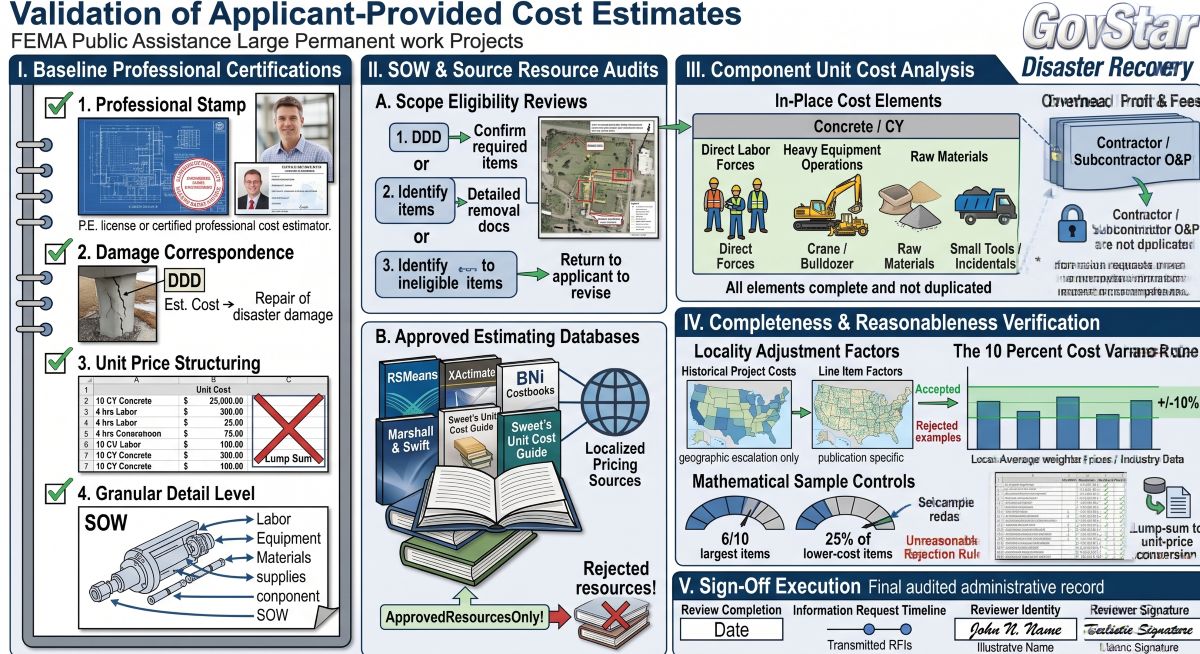
Reviewers must verify that the applicant's estimate fulfills each of the following four criteria:
- Professional Stamp: Is prepared by a licensed professional engineer or other estimating professional, such as a licensed architect or certified professional cost estimator, who certifies that the estimate was prepared in accordance with industry standards. In lieu of a license or certification, an individual with professional experience and proficiency in the field of cost estimating may prepare and sign the estimate.
- Damage Correspondence: Includes a formal certification that the estimated cost directly corresponds to the repair of the agreed-upon disaster damage.
- Unit Price Structuring: Is based strictly on unit costs for each component of the scope of work (SOW) and does not utilize a lump sum amount.
- Granular Detail Level: Contains a level of detail sufficient for FEMA to validate that all individual components correspond directly with the agreed-upon SOW.
II. Scope of Work & Source Resource Audits
A. Scope Eligibility Reviews
FEMA must review the SOW and cost estimate to verify that only eligible items are included. Staff will execute one of the following determinations:
- Confirm the SOW items in the cost estimate are required based on the agreed-upon damage description and dimensions (DDD).
- Identify ineligible items, manually remove the ineligible components from the estimate, and attach detailed documentation explaining the reasons for removal.
- Identify ineligible items and formally return the estimate to the applicant to revise.
B. Approved Estimating Cost Databases
Reviewers must determine whether the unit costs are from an approved source of industry standard information and whether current cost data publications were used. If an inappropriate tracking resource was used, the estimate must be returned to the applicant for revision. Approved resources are limited to:
- Industry Standard Databases: RSMeans, XActimate, BNi Costbooks, Marshall & Swift, or Sweet's Unit Cost Guide.
- Localized Pricing Sources: Local cost data, or verified contract unit costs from recently completed public works projects.
III. Component Unit Cost Analysis
FEMA staff must thoroughly evaluate the components making up the unit costs to ensure that elements are fully understood and are not duplicated elsewhere in the estimate or the Cost Estimating Format (CEF).
In-Place Cost Elements
Each individual unit cost must represent a complete and in-place cost that incorporates all of the following elements:
- Direct labor forces and heavy equipment operations;
- Raw construction materials and supplies; and
- Small tools, local incidentals, and material hauling costs necessary to complete that discrete element of work.
Overhead, Profit, and Professional Fee Controls
The estimate must be audited to verify that contractor overhead and profit are handled correctly:
- If both general contractor and subcontractor overhead and profit are included within the base unit costs, staff must confirm these costs are not duplicated elsewhere.
- If the estimate does not contain sufficient information regarding unit cost components, FEMA will generate an information request and return the project to the applicant.
- Surveying costs, construction inspection fees, and permit compliance fees must be separate and not duplicated within any base unit cost.
IV. Completeness & Reasonableness Verification
A. Locality Adjustment Factors
Reviewers must confirm that the appropriate locality adjustment factor from the selected cost estimating publication is applied to each individual line item. Where historical project costs are used, a geographic locality adjustment must not be applied, but appropriate cost escalation factors must be added. Estimates with improperly applied locality metrics will be returned to the applicant for revision.
B. The 10 Percent Cost Variance Rule
Mathematical Sample Controls
To satisfy completeness and baseline reasonableness metrics, specific core line items within the estimate must be within 10 percent of either local average weighted unit prices or industry standard construction databases.
Statistical Validation Checklist
- Primary Cost Elements: At least six of the ten largest cost items (or 100 percent of all cost items if there are less than ten total in the project) must be reviewed individually and fall within the 10 percent variance window.
- Secondary Cost Elements: At least 25 percent of all remaining lower-cost items across the rest of the estimate must fall within the 10 percent variance window.
Failure and Revision Rules
Rejection Rule: If the checked cost items fall outside the 10 percent variance window of local average weighted unit prices or industry standard construction data, the estimate is determined unreasonable, and FEMA will return the package to the applicant to completely revise. Any lump sum amounts included for active work must be converted to unit prices before validation can be completed.
V. Sign-Off Execution
Tracking Parameters
To finalize the validation review, the administrative record must capture the following four signature blocks:
- Review Completion Date: The exact calendar date the final verification was completed.
- Information Request Timeline: The exact dates that formal RFIs were transmitted to the applicant.
- Reviewer Identity: The printed name of the validating FEMA PA staff member.
- Reviewer Signature: The binding physical or electronic signature of the reviewer.