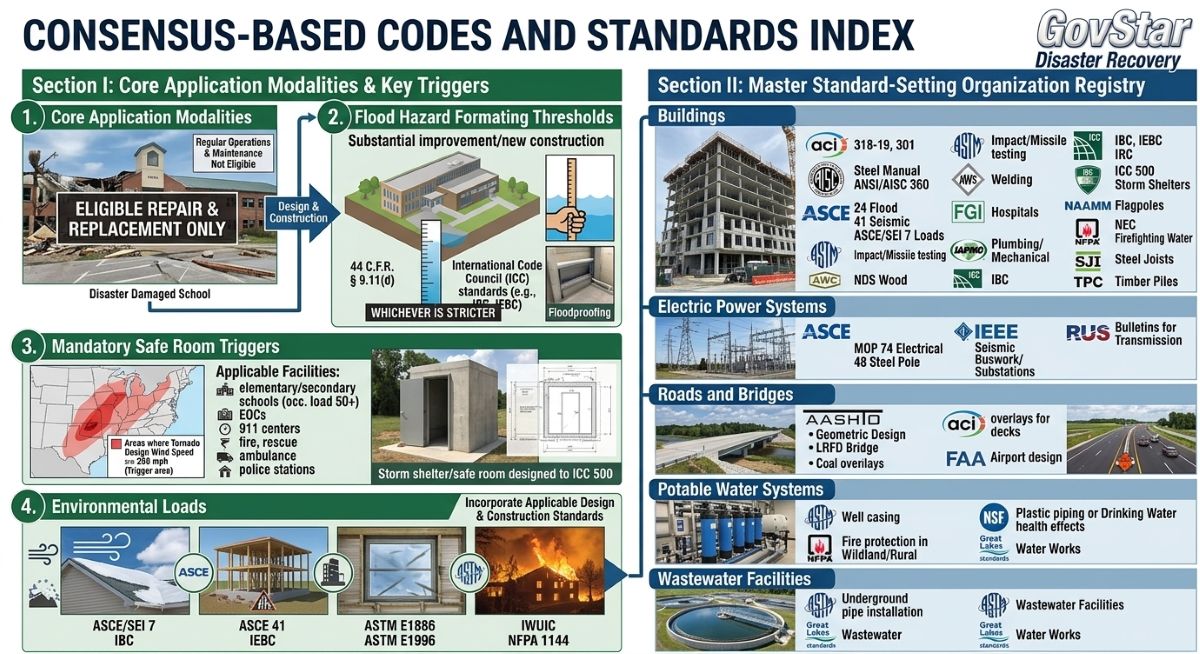
Consensus-Based Codes, Specifications, and Standards
The most recent edition of codes, specifications, and standards from the following organizations, as published at the time of the disaster declaration, will be applied to the design and construction of certain facilities. The scope of this policy is currently limited to buildings, electrical power, roads and bridges, potable water, and wastewater systems. FEMA may issue updates to these codes in a separate document before the version 6 release of the "Public Assistance Program and Policy Guide" (PAPPG).
I. Core Application Modalities
These consensus-based codes, specifications, and standards apply only to the repair and replacement of disaster-damaged elements and facilities. This appendix does not make costs for regular operations and maintenance eligible for assistance.
Flood Hazard Formatting Thresholds
Eligible building projects that involve substantial improvement or new construction in flood hazard areas must meet the minimum floodproofing or elevation standards set out in 44 C.F.R. § 9.11(d), or the standards of the International Code Council (e.g., International Building Code, International Existing Building Code, International Energy Conservation Code, or International Residential Code), whichever requirement is stricter.
Mandatory Safe Room Triggers
When triggered by these FEMA-identified codes, applicants must incorporate the latest applicable criteria:
- Tornado Shelter Mandate: In areas where tornado shelter design wind speeds are 250 mph or greater, the applicant must incorporate a storm shelter or safe room designed to International Code Council (ICC) 500 standards.
- Applicable Facilities: This safe room installation is mandatory for elementary and secondary schools with an occupant load of 50 or more, Emergency Operations Centers (EOCs), 911 call stations, fire stations, rescue stations, ambulance stations, and police stations.
- Environmental Loads: Concerning requirements for wind, seismic, flood, temperature, ice and snow, and wildfire, the applicant must incorporate applicable design and construction standards contained in the International Building Code (IBC), International Existing Building Code (IEBC), International Residential Code (IRC) and their referenced standards (e.g., ASCE/SEI 7, ASCE 24, and ASCE 41), and the International Wildland-Urban Interface Code (IWUIC).
II. Master Standard-Setting Organization Registry
When executing permanent repairs under alternative or standard procedures, structural and non-structural designs must align with the corresponding engineering criteria detailed below.
A. Buildings
- American Concrete Institute (ACI): ACI 318-19, "Building Code Requirements for Reinforced Concrete"; ACI 301 Specifications for Concrete Construction; ACI 318, Building Code Requirements for Structural Concrete and Commentary.
- American Institute of Steel Construction (AISC): AISC 325, Steel Construction Manual; ANSI/AISC 303, Code of Standard Practice for Steel Buildings and Bridges; ANSI/AISC 360, Specification for Structural Steel Buildings; ANSI/AISC 341, Seismic Provisions for Structural Steel Buildings.
- American Iron and Steel Institute (AISI): AISI S100, North American Specification for the Design of Cold-formed Steel Structural Members.
- American National Standards Institute and FM Approvals (ANSI/FM Approvals): ANSI/FM Approvals 2510-2020, American National Standard for Flood Mitigation Equipment.
- American Society of Civil Engineers (ASCE): ASCE 24, Flood Resistant Design and Construction; ASCE 41, Seismic Evaluation and Retrofit of Existing Buildings; ASCE/SEI 7, Minimum Design Loads and Associated Criteria for Buildings and Other Structures; ASCE 8, Standard Specification for the Design of Cold-formed Stainless-Steel Structural Members; ASCE 49, Wind Tunnel Testing for Buildings and Other Structures.
- American Society Mechanical Engineers (ASME): ASME/A17.1/CSA B44-16, Safety Code for Elevators and Escalators.
- American Society of Testing and Materials (ASTM): ASTM E1886, Standard Test Method for Performance of Exterior Windows, Curtain Walls, Doors and Impact Protective Systems Impacted by Missile(s) and Exposed to Cyclic Pressure Differentials; ASTM E1996, Specification for Performance of Exterior Windows, Curtain Walls, Doors and Impact Protective Systems Impacted by Windborne Debris in Hurricanes.
- American Wood Council (AWC): NDS, National Design Specification (NDS) for Wood Construction-with NDS Supplement.
- American Welding Society (AWS): AWS D1.4/D1.4M Structural Welding Code-Reinforcing Steel.
- Facilities Guideline Institute (FGI): Guidelines for Design and Construction of Hospitals/Outpatient.
- International Association of Plumbing and Mechanical Officials (IAPMO): IAPMO UMC Uniform Plumbing Code, UPC Uniform Mechanical Code.
- International Code Council (ICC): International Building Code (IBC); International Existing Building Code (IEBC); International Residential Code (IRC); International Energy Conservation Code (IECC); International Wildland-Urban Interface Code (IWUIC); International Plumbing Code (IPC); International Mechanical Code (IMC); International Fire Code (IFC); ICC 500, Standard on the Design and Construction of Storm Shelters; ICC 600, Standard for Residential Construction in High-wind Regions.
- National Association of Architectural Metal Manufacturers (NAAMM): NAAMM FP 1001, Guide Specifications for Design of Metal Flag Poles.
- National Fire Protection Association (NFPA): NFPA 70, National Electrical Code (NEC); NFPA 1142, Standard on Water Supplies for Suburban and Rural Firefighting; NFPA 1144, Standard for Reducing Structure Ignition Hazards from Wildland Fire.
- Steel Joist Institute (SJI): SJI 100 Standard Specification Load Tables and Weight Tables for Steel Joists and Joist Girders K-Series, LH-Series, DLH-Series, Joist Girders; SJI 200, Standard Specification for Composite Steel Joists, CJ-Series.
- The Aluminum Association (TAA): ADM1, Aluminum Design Manual, Part 1 - A Specification for Aluminum Structures.
- The Masonry Society (TMS): TMS 402, Building Code for Masonry Structures; TMS 602, Specification for Masonry Structures.
- Timber Piling Council (TPC): TPC, Timber Pile Construction.
B. Electric Power Systems
- American Society of Civil Engineers (ASCE): ASCE MOP 74 Guidelines for Electrical Transmission Line Structural Loading; ASCE 48 Design of Steel Transmission Pole Structures.
- Institute of Electrical and Electronics Engineers (IEEE): IEEE 1527, Recommended Practice for the Design of Buswork Located in Seismic Active Areas; IEEE 693 Recommended Practice for Seismic Design of Substations.
- U.S. Department of Agriculture Rural Utilities Service (RUS): RUS Bulletins Transmission - 1724E-200, 1724E-204, 1724E-206, 1724E-214, 1724E-216, 1724E-224, 1724E-226, 1724E-300, 1728F-803, 1728F-804, 1728F-806, 1728F-810, 1728F-811, 1728H-701.
C. Roads and Bridges
- American Association of State Highway and Transportation Officials (AASHTO): A Policy on Geometric Design of Highways and Streets; Standard Specifications for Highway Bridges; LRFD Bridge Construction Specifications; LRFD Bridge Design Specifications; LRFD Movable Highway Bridge Design Specifications; AASHTO/AWS D1.5M/D1.5 Bridge Welding Code; LRFD Guide Specifications for Accelerated Bridge Construction; Guide Specifications for LRFD Seismic Bridge Design; Guide Specifications for Design of Bonded FRP Systems for Repair or Strengthening of Concrete Bridge Elements; Guide Specifications for Design and Construction of Segmental Concrete Bridges; Guide Specifications for Wind Loads on Bridges During Construction; Guidelines for Geometric Design of Low-Volume Local Roads; M288 Standard Specifications for Geosynthetic Specifications for Highway Applications; Manual on Uniform Traffic Control Devices (MUTCD).
- American Concrete Institute (ACI): ACI-548.10 Specification for Type MMS (Methyl Methacrylate Slurry) Polymer Overlays for Bridge and Parking Garage Decks; ACI-548.8 Specification for Type EM (Epoxy Multi-Layer) Polymer Overlay for Bridge and Parking Garage Decks; ACI-548.9 Specification for Type ES (Epoxy Slurry) Polymer Overlays for Bridge and Parking Garage Decks.
- Federal Aviation Administration (FAA): FAA AC150/5300 Airport Design.
D. Potable Water Systems
- American Society of Testing and Materials (ASTM): ASTM-F-480-17, Standard Specification for Thermoplastic Well Casing Pipe and Couplings Made in Standard Dimension Ratios (SDR).
- National Fire Protection Association (NFPA): NFPA 1141 Standard for Fire Protection for Land Development in Wildland, Rural, and Suburban Areas.
- National Sanitation Foundation (NSF): NSF Standard 14, Plastic Piping System Components and Related Materials; NSF Standard 61, Drinking Water System Components - Health Effects.
- Great Lakes Upper Mississippi River Board of State and Provincial Public Health and Environmental Managers: Recommended Standards for Water Works.
E. Wastewater Facilities
- American Society of Testing and Materials (ASTM): ASTM D-2321-18, Standard Practice for Underground Installation of Thermoplastic Pipe for Sewers and Other Gravity Flow Installations; ASTM F-1417, Standard Practice for Installation Acceptance of Plastic Gravity Sewer Lines Using Low-Pressure Air; ASTM C-12, Standard Practice for Installing Vitrified Clay Pipe Lines; ASTM C-828, Standard Test Method for Low Pressure Air Test of Vitrified Clay Pipe Lines; ASTM C-478, Standard Specification for Circular Precast Reinforced Manhole Sections; ASTM C-1244, Standard Test Method for Concrete Sewer Manholes Negative Air Pressure (Vacuum) Test Prior to Backfill.
- Great Lakes Upper Mississippi River Board of State and Provincial Public Health and Environmental Managers: Recommended Standards for Wastewater Facilities.