
pa readiness
Damages & Work
Costs & Estimates
Insurance & DOB
Compliance Controls
FEMA Reform
Resource Hub
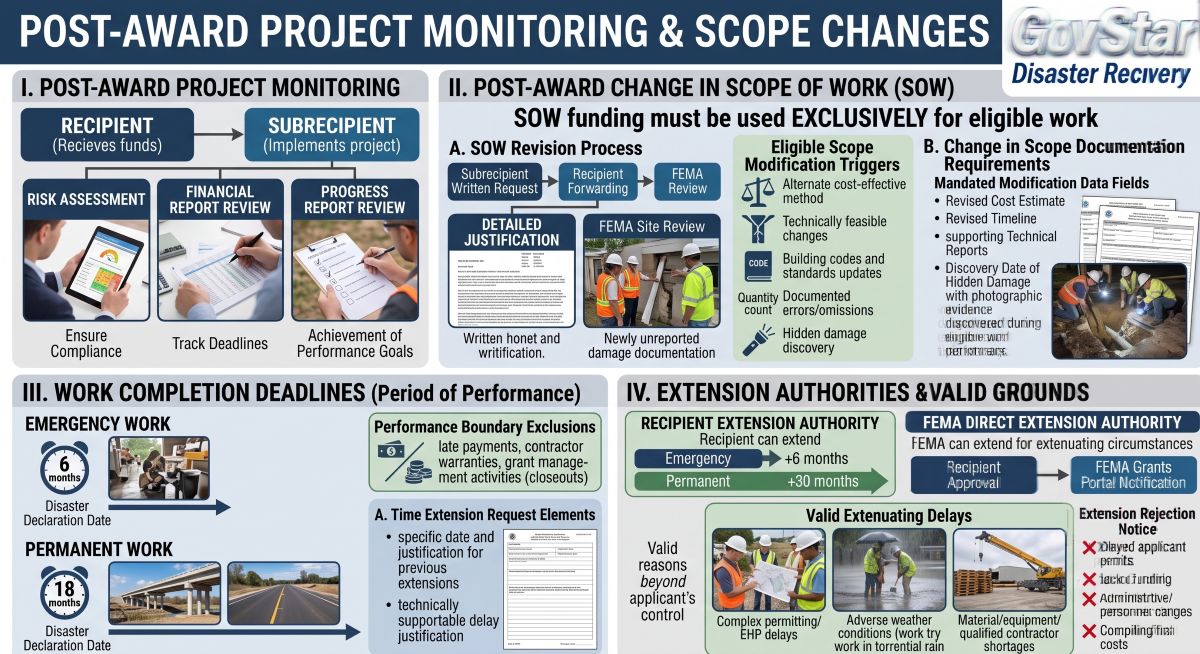
Post-award project monitoring includes managing projects, ensuring subrecipients use funds in alignment with the approved scope of work (SOW), adhering to set deadlines, and meeting compliance requirements. Recipients are responsible for assessing the risk of non-compliance for each subrecipient and, if necessary, imposing additional conditions or requirements. Monitoring subrecipients is essential to ensure compliance with federal regulations and the achievement of performance goals, which includes reviewing financial and progress reports.
PA staff support recipients, track the overall progress of disaster operations, and manage requests for changes in scope, time extensions, project closeouts, appeals, audits, and arbitration.
Subrecipients must ensure PA funding is used exclusively for eligible work specified in the approved project. If a change to the SOW becomes necessary, subrecipients should promptly consult with both the recipient and FEMA to allow sufficient time for FEMA to review the proposed changes for eligibility.
To request a change, subrecipients must submit a written request to the recipient, including a detailed justification explaining why the change is necessary and supporting documentation for FEMA to substantiate the eligibility of the proposed revision. If the request involves previously unreported damage, subrecipients must provide documentation linking the work directly to the disaster. The recipient then forwards the request and its formal recommendation to FEMA.
Commonly eligible reasons for SOW changes include:
To facilitate evaluation, the subrecipient's written request must systematically outline the following information for both small and large projects:
FEMA provides PA funding only for work completed and costs incurred within specified regulatory deadlines. FEMA considers these timelines as the approved period of performance (POP) for a project, defining work completion as fulfilling all tasks in the approved SOW and meeting compliance requirements.
Scope Notice: The period of performance window does not include late payments for invoices, contractor warranty periods, or grant management activities such as submitting closeout documentation, reconciling finances, or requesting final payment.
If additional time is required, subrecipients must submit a written request to the recipient containing:
Recipients have the initial authority to grant time extensions due to extenuating circumstances on a project-by-project basis:
Any time extensions extending beyond a recipient's maximum boundary require formal FEMA approval. FEMA holds the authority to grant further extensions if justified by extenuating circumstances beyond the applicant's control.
Extension Rejection Notice: FEMA does not recognize the following as valid grounds for an extension: delayed permit submissions by the applicant, general lack of local funding, internal administrative or personnel changes, or delays in compiling final cost documentation.
Funding for PA large projects is based on estimated costs, contracted costs, or a combination of both for an approved scope of work, with grant funds obligated accordingly. Regular reviews and timely identification of any changes in project costs are essential.
The large project Quarterly Progress Report (QPR) is an administrative tool used to track project expenditures relative to completion percentages, compare completed work costs against obligated funding, monitor fund drawdowns, and assess overfunding or underfunding. It tracks open large projects pending final federal payment and highlights issues that could cause noncompliance with grant conditions. Quarterly progress reporting is strictly prohibited from being requested or required for small projects.
FEMA requires recipients to report on the status of all open large projects each quarter. QPRs must be submitted to FEMA within 30 days of each fiscal quarter's end.
Subrecipients and recipients must fulfill specific tracking fields based on the physical completion status of the large project:
Recipients must submit the Federal Financial Report (SF-425) quarterly to their respective FEMA Regional Office. These reports detail the financial status of funds for the prime award, track the recipient's expenditure drawdowns, and verify that the recipient is meeting its statutory cost-share requirements.
FFATA mandates that FEMA manage and administer awards to ensure federal funding is expended in full accordance with the U.S. Constitution, federal law, and public policy requirements. This includes regulations protecting free speech, religious liberty, public welfare, the environment, and prohibiting discrimination.
Recipients are responsible for complying with all FFATA provisions, including executive compensation disclosures and non-federal entity regulations under 2 C.F.R. Parts 25 and 170. Recipients must register in the FFATA Subaward Reporting System and report on all awards and subawards equal to or greater than $30,000.
Recipients and subrecipients are subject to federal and non-federal audits by state or territorial auditors, FEMA, the U.S. Department of Homeland Security Office of Inspector General (OIG), and the U.S. Government Accountability Office (GAO). FEMA reserves the authority to adjust project funding based on audit findings.
Audit Trigger: A recipient or subrecipient that expends $1 million or more in total federal funds during its fiscal year must perform a formal single audit or program-specific audit in compliance with 2 C.F.R. § 200.501.
The OCR holds the authority to conduct investigations and compliance reviews to ensure that FEMA financial assistance is administered without discrimination. OCR reviews recipient documentation before, during, and after disasters, investigates public complaints alleging civil rights violations, and can render formal decisions or refer complaints to other agencies.
FEMA conducts audit assessments on drawdowns to recover payments identified as improper under the Payment Integrity Information Act.
The VAYGo review process is an expanded grant payment review framework applied to all PA and Fire Management Assistance Grant (FMAG) disasters.
Compliance CTA: For FEMA Office of Civil Rights, operate a post-award controls calendar. Track scope changes before work deviates, completion deadlines, time-extension justifications, quarterly progress reports, financial status reporting, FFATA, audit requests, civil-rights obligations, fraud reporting, and improper-payment recovery exposure.
Compliance CTA: For Office of the Inspector General, operate a post-award controls calendar. Track scope changes before work deviates, completion deadlines, time-extension justifications, quarterly progress reports, financial status reporting, FFATA, audit requests, civil-rights obligations, fraud reporting, and improper-payment recovery exposure.
Compliance CTA: For Government Accountability Office, operate a post-award controls calendar. Track scope changes before work deviates, completion deadlines, time-extension justifications, quarterly progress reports, financial status reporting, FFATA, audit requests, civil-rights obligations, fraud reporting, and improper-payment recovery exposure.
Compliance CTA: For Single Audits, operate a post-award controls calendar. Track scope changes before work deviates, completion deadlines, time-extension justifications, quarterly progress reports, financial status reporting, FFATA, audit requests, civil-rights obligations, fraud reporting, and improper-payment recovery exposure.
Compliance CTA: For Audits, operate a post-award controls calendar. Track scope changes before work deviates, completion deadlines, time-extension justifications, quarterly progress reports, financial status reporting, FFATA, audit requests, civil-rights obligations, fraud reporting, and improper-payment recovery exposure.
Compliance CTA: For Federal Funding Accountability and Transparency Act, operate a post-award controls calendar. Track scope changes before work deviates, completion deadlines, time-extension justifications, quarterly progress reports, financial status reporting, FFATA, audit requests, civil-rights obligations, fraud reporting, and improper-payment recovery exposure.
Compliance CTA: For Financial Status Reports, operate a post-award controls calendar. Track scope changes before work deviates, completion deadlines, time-extension justifications, quarterly progress reports, financial status reporting, FFATA, audit requests, civil-rights obligations, fraud reporting, and improper-payment recovery exposure.
Compliance CTA: For Large Project Quarterly Progress Reports, operate a post-award controls calendar. Track scope changes before work deviates, completion deadlines, time-extension justifications, quarterly progress reports, financial status reporting, FFATA, audit requests, civil-rights obligations, fraud reporting, and improper-payment recovery exposure.
Compliance CTA: For Project Schedule, operate a post-award controls calendar. Track scope changes before work deviates, completion deadlines, time-extension justifications, quarterly progress reports, financial status reporting, FFATA, audit requests, civil-rights obligations, fraud reporting, and improper-payment recovery exposure.
Compliance CTA: For Work Completion Deadlines, operate a post-award controls calendar. Track scope changes before work deviates, completion deadlines, time-extension justifications, quarterly progress reports, financial status reporting, FFATA, audit requests, civil-rights obligations, fraud reporting, and improper-payment recovery exposure.
Compliance CTA: For Post Award Change in Scope of Work, align the scope, cost, insurance, EHP, hazard mitigation, and eligibility record before obligation. Use the review stage to resolve inconsistencies, unsupported quantities, omitted reductions, and compliance conditions; then document how funds are requested, managed, and drawn consistent with FEMA and recipient requirements.