
pa readiness
Damages & Work
Costs & Estimates
Insurance & DOB
Compliance Controls
FEMA Reform
Resource Hub
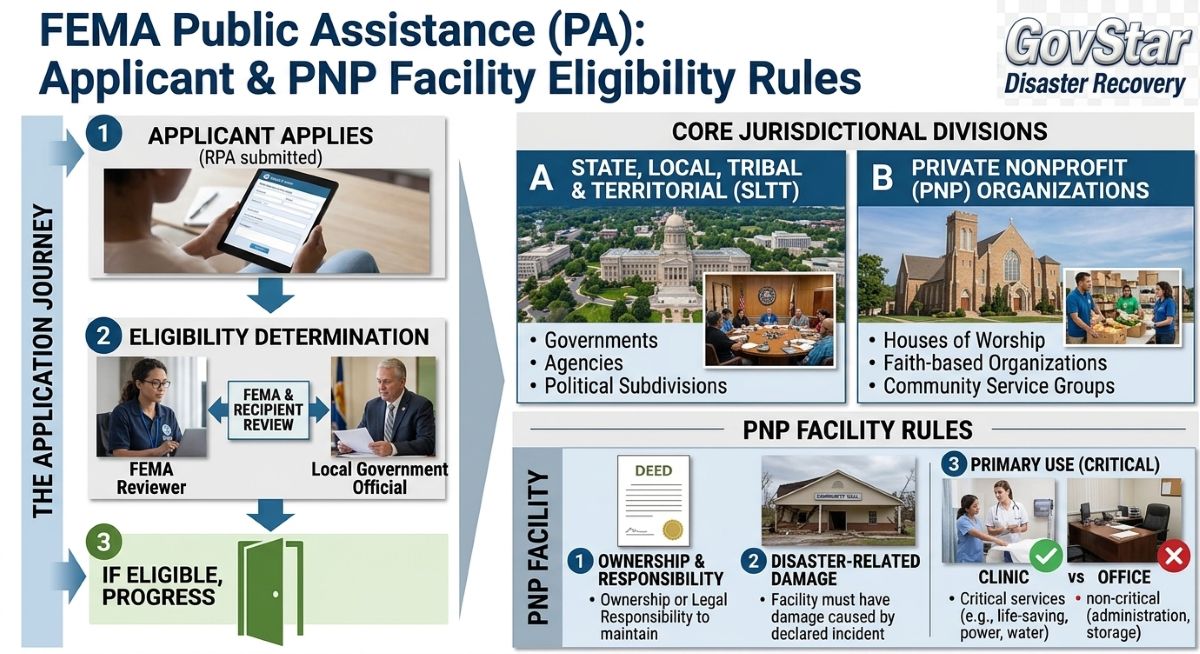
This chapter defines the process to request assistance for Public Assistance (PA), starting with the Request for Public Assistance (RPA). It provides information relating to organizations that can benefit from the PA Program, requirements to substantiate eligibility, and important steps that take place following a presidential declaration.
FEMA provides assistance to eligible applicants. As a foundational principle, FEMA must first determine whether an applicant is eligible before evaluating the applicant's claim. FEMA and the recipient review the RPA to determine whether an applicant is eligible for assistance.
There are two primary categories of entities that may apply for the PA Program:
As soon as possible following the president's declaration, a recipient conducts briefings for all potential applicants. Recipients are responsible for notifying potential applicants of the date, time, and location of the applicant briefing.
The Request for Public Assistance (RPA) serves as the official application for the PA Program. If an SLTT government entity or PNP wishes to request reimbursement for costs related to damage and impacts from a presidential declaration, it must submit an RPA to FEMA via the PA Grants Portal within 30 days after the respective area is designated. Recipients must also submit an RPA to be eligible to request funding. Once an RPA is approved, the entity becomes an applicant and is eligible to submit projects.
FEMA extends the deadline for submitting an RPA if a recipient submits a request in writing with justification based on extenuating circumstances beyond an applicant's or recipient's control.
The recipient reviews each RPA to determine if the entity meets the criteria of an eligible applicant, provides an assessment of the applicant's risk of noncompliance, and recommends whether FEMA should approve the RPA.
State and territorial governments, including the District of Columbia, American Samoa, the Commonwealth of the Northern Mariana Islands, Guam, Puerto Rico, and the U.S. Virgin Islands, are eligible applicants. This includes any agency or instrumentality thereof, exclusive of local governments.
The state or territorial government designates one of its agencies (usually the emergency management agency) as the recipient. The recipient serves as the pass-through entity to the other agencies, which act as subrecipients.
Federally recognized Indian Tribal Nations, including Alaska Native villages and organizations, are eligible applicants. When a federally recognized Tribal Nation receives a presidential emergency or major disaster declaration, they do not need to designate a separate department or agency to act as the recipient.
Ineligibility Notice: Alaska Native Corporations are ineligible to apply for assistance as they are privately owned. State-recognized Tribal Nations that are not federally recognized cannot request a presidential declaration, but they remain eligible to receive PA as subrecipients, as do heritage groups.
The following specific types of local governments are eligible applicants:
Community development districts are special districts that finance, plan, establish, acquire, construct, or reconstruct, operate, and maintain systems, facilities, and basic infrastructure within their community development. To be eligible, the district must own and be legally responsible for the maintenance and operation of an eligible facility that is open to and serves the general public.
FEMA evaluates a PNP's organization status, and the services provided in each facility owned or operated by the PNP, to determine whether it is eligible. To be eligible, a PNP must have been an established PNP organization, have owned or operated an eligible PNP facility at the time of the incident period, and ensured that the facility provides an eligible service (categorized as either critical or noncritical but essential social services).
For an organization to demonstrate its qualifications as a PNP, it must provide a ruling letter from the U.S. Internal Revenue Service granting tax exemption under sections 501(c), (d), or (e) of the Internal Revenue Code, or documentation from the state substantiating it is a non-revenue producing, nonprofit entity organized or doing business under state law.
Documentation Alternative: If the organization is not required to obtain 501(c)(3) status or tax-exempt status under applicable state law, it must provide articles of association, bylaws, or other documents indicating that it is an organized entity, alongside a certification that it is compliant with Internal Revenue Code section 501(c)(3) and state law requirements.
For-profit entities are strictly ineligible applicants for assistance from FEMA under the PA Program.
Reimbursement Provision: SLTT government entities may contract with private entities, including for-profit entities, to carry out eligible emergency protective measures. In these cases, FEMA will reimburse the eligible applicant for the cost of eligible work, and the applicant may then compensate the private entity for the provision of goods or services.
Prior to determining whether a PNP is an eligible applicant, FEMA must first determine whether the PNP owns or operates an eligible facility that provides an eligible service.
A facility owned or operated by a PNP that provides a noncritical, but essential social service must provide those services to the general public to be eligible. PNP facilities meet the requirement of serving the general public if all the following conditions are met:
Special Facility Allowances: Certain types of facilities that restrict access in a manner clearly related to the nature of the facility—such as senior centers, center-based childcare, custodial care, rehabilitation, or educational facilities—or houses of worship that limit membership to individuals who share a religious faith or practice, are still considered to provide essential social services to the general public.
Facilities established or primarily used for political, athletic, or recreational activities, vocational training, conferences, retreats, or similar activities are ineligible for PA funding.
If a PNP operates multiple facilities, or a single facility composed of more than one building, FEMA must evaluate each building independently, even if all are located on the same grounds. Structures that are part of a complex that includes outdoor facilities (e.g., swimming pools, athletic fields, or tennis courts) are not evaluated separately from the rest of the complex when determining the eligibility of the building.
Eligibility for PNP mixed-use facilities is dependent on the primary use of the facility, which is determined by the amount of physical space dedicated to eligible versus ineligible services. Primary use is the use for which more than 50 percent of the physical space in the facility is dedicated. FEMA evaluates the entire structure when determining primary use; it does not separately address individual areas, such as floors, basements, or wings. Common space, such as bathrooms, hallways, lobbies, closets, stairways, and elevators, are excluded from mixed-use space calculations.
Proration Rule: If FEMA determines that 50 percent or more of physical space is dedicated to ineligible services, the entire facility is ineligible. If the facility is eligible, FEMA prorates funding based on the percentage of physical space dedicated to eligible services. The applicant is responsible for the balance of restoration costs and must restore the entire facility to receive funding for repairs to the eligible-use portions.
In cases where the same physical space is used for both eligible and ineligible services, the primary use is the use for which more than 50 percent of the operating time is dedicated in that shared physical space. If space is available for use, but the applicant cannot support that it is used for eligible services for more than 50 percent of the operating time, this criterion is not met. If 50 percent or more of the operating time in the shared physical space is dedicated to ineligible services, FEMA does not include that physical space when evaluating primary use.
If an eligible PNP leases a facility to another eligible PNP that provides an eligible service in that facility, the facility is eligible. Whichever PNP (the owner or the lessee) has the legal responsibility to maintain the facility under the lease agreement is the eligible applicant.
Following a major disaster declaration, PNPs with facilities that provide noncritical, essential social services must apply for a disaster loan from the Small Business Administration (SBA) and receive a determination before FEMA can provide PA funding for permanent work. FEMA only provides funding for permanent work costs that an SBA loan will not cover.
SBA Framework Constraints: If the PNP misses the SBA application deadline, including any SBA-approved extension, permanent work is completely ineligible for PA funding. If the PNP declines an SBA loan, PA funding is limited to the costs that the loan would not have otherwise covered. This applies even when the PNP cannot accept the terms of the loan (e.g., due to collateral requirements), resulting in an SBA denial.
To be categorized as an eligible critical service, the establishment must fall under one of the following diagnostic categories:
The following establishments are recognized as eligible noncritical, essential social services:
Compliance CTA: Confirm applicant eligibility for Small Business Administration Loan Requirement before project formulation. Document legal status, ownership or operating responsibility, eligible public or PNP service, RPA submission, SBA loan requirement where applicable, and any mixed-use or leased-facility limitations. Keep organizing documents, tax-exempt records, service descriptions, leases, and facility-use evidence in the Grants Portal file.
Compliance CTA: Confirm applicant eligibility for Leased Facilities before project formulation. Document legal status, ownership or operating responsibility, eligible public or PNP service, RPA submission, SBA loan requirement where applicable, and any mixed-use or leased-facility limitations. Keep organizing documents, tax-exempt records, service descriptions, leases, and facility-use evidence in the Grants Portal file.
Compliance CTA: Confirm applicant eligibility for Use by Multiple Entities before project formulation. Document legal status, ownership or operating responsibility, eligible public or PNP service, RPA submission, SBA loan requirement where applicable, and any mixed-use or leased-facility limitations. Keep organizing documents, tax-exempt records, service descriptions, leases, and facility-use evidence in the Grants Portal file.
Compliance CTA: Confirm applicant eligibility for Multiple Services before project formulation. Document legal status, ownership or operating responsibility, eligible public or PNP service, RPA submission, SBA loan requirement where applicable, and any mixed-use or leased-facility limitations. Keep organizing documents, tax-exempt records, service descriptions, leases, and facility-use evidence in the Grants Portal file.
Compliance CTA: Confirm applicant eligibility for Mixed-Use Space before project formulation. Document legal status, ownership or operating responsibility, eligible public or PNP service, RPA submission, SBA loan requirement where applicable, and any mixed-use or leased-facility limitations. Keep organizing documents, tax-exempt records, service descriptions, leases, and facility-use evidence in the Grants Portal file.
Compliance CTA: Confirm applicant eligibility for Mixed-Use Facility before project formulation. Document legal status, ownership or operating responsibility, eligible public or PNP service, RPA submission, SBA loan requirement where applicable, and any mixed-use or leased-facility limitations. Keep organizing documents, tax-exempt records, service descriptions, leases, and facility-use evidence in the Grants Portal file.
Compliance CTA: Confirm applicant eligibility for Multiple Facilities before project formulation. Document legal status, ownership or operating responsibility, eligible public or PNP service, RPA submission, SBA loan requirement where applicable, and any mixed-use or leased-facility limitations. Keep organizing documents, tax-exempt records, service descriptions, leases, and facility-use evidence in the Grants Portal file.
Compliance CTA: Confirm applicant eligibility for Facility Eligibility before project formulation. Document legal status, ownership or operating responsibility, eligible public or PNP service, RPA submission, SBA loan requirement where applicable, and any mixed-use or leased-facility limitations. Keep organizing documents, tax-exempt records, service descriptions, leases, and facility-use evidence in the Grants Portal file.
Compliance CTA: Confirm applicant eligibility for For-Profit Entities before project formulation. Document legal status, ownership or operating responsibility, eligible public or PNP service, RPA submission, SBA loan requirement where applicable, and any mixed-use or leased-facility limitations. Keep organizing documents, tax-exempt records, service descriptions, leases, and facility-use evidence in the Grants Portal file.
Compliance CTA: Confirm applicant eligibility for Organization Eligibility before project formulation. Document legal status, ownership or operating responsibility, eligible public or PNP service, RPA submission, SBA loan requirement where applicable, and any mixed-use or leased-facility limitations. Keep organizing documents, tax-exempt records, service descriptions, leases, and facility-use evidence in the Grants Portal file.
Compliance CTA: Confirm applicant eligibility for Applicant Eligibility: Private Nonprofit Organizations before project formulation. Document legal status, ownership or operating responsibility, eligible public or PNP service, RPA submission, SBA loan requirement where applicable, and any mixed-use or leased-facility limitations. Keep organizing documents, tax-exempt records, service descriptions, leases, and facility-use evidence in the Grants Portal file.
Compliance CTA: Confirm applicant eligibility for Local Governments before project formulation. Document legal status, ownership or operating responsibility, eligible public or PNP service, RPA submission, SBA loan requirement where applicable, and any mixed-use or leased-facility limitations. Keep organizing documents, tax-exempt records, service descriptions, leases, and facility-use evidence in the Grants Portal file.
Compliance CTA: Confirm applicant eligibility for Tribal Nations before project formulation. Document legal status, ownership or operating responsibility, eligible public or PNP service, RPA submission, SBA loan requirement where applicable, and any mixed-use or leased-facility limitations. Keep organizing documents, tax-exempt records, service descriptions, leases, and facility-use evidence in the Grants Portal file.
Compliance CTA: Confirm applicant eligibility for State and Territorial Governments before project formulation. Document legal status, ownership or operating responsibility, eligible public or PNP service, RPA submission, SBA loan requirement where applicable, and any mixed-use or leased-facility limitations. Keep organizing documents, tax-exempt records, service descriptions, leases, and facility-use evidence in the Grants Portal file.
Compliance CTA: Confirm applicant eligibility for Applicant Eligibility: State, Local, Tribal Nation, and Territorial Government Entities before project formulation. Document legal status, ownership or operating responsibility, eligible public or PNP service, RPA submission, SBA loan requirement where applicable, and any mixed-use or leased-facility limitations. Keep organizing documents, tax-exempt records, service descriptions, leases, and facility-use evidence in the Grants Portal file.
Compliance CTA: Confirm applicant eligibility for Request for Public Assistance before project formulation. Document legal status, ownership or operating responsibility, eligible public or PNP service, RPA submission, SBA loan requirement where applicable, and any mixed-use or leased-facility limitations. Keep organizing documents, tax-exempt records, service descriptions, leases, and facility-use evidence in the Grants Portal file.
Compliance CTA: Confirm applicant eligibility for Applicant Briefing before project formulation. Document legal status, ownership or operating responsibility, eligible public or PNP service, RPA submission, SBA loan requirement where applicable, and any mixed-use or leased-facility limitations. Keep organizing documents, tax-exempt records, service descriptions, leases, and facility-use evidence in the Grants Portal file.
Compliance CTA: Confirm applicant eligibility for Applicant Eligibility before project formulation. Document legal status, ownership or operating responsibility, eligible public or PNP service, RPA submission, SBA loan requirement where applicable, and any mixed-use or leased-facility limitations. Keep organizing documents, tax-exempt records, service descriptions, leases, and facility-use evidence in the Grants Portal file.