
pa readiness
Damages & Work
Costs & Estimates
Insurance & DOB
Compliance Controls
FEMA Reform
Resource Hub
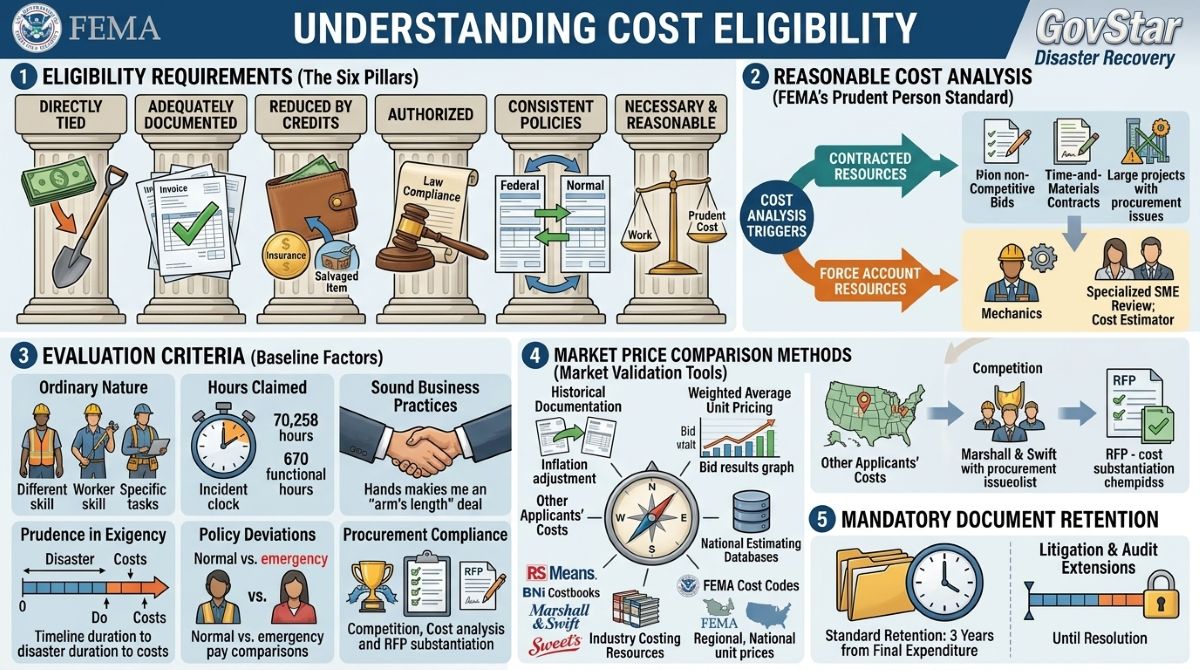
This chapter provides information relating to Public Assistance (PA) cost eligibility. Not all costs arising from the incident are eligible for reimbursement through the PA Program, and applicants must meet explicit criteria to qualify.
Applicants must retain cost, financial, procurement information, real property and equipment records, programmatic records, supporting documents, and all other records pertinent to the grant.
Costs are the final component evaluated for eligibility, and these criteria apply to all costs claimed. To be eligible, costs must be:
A cost is reasonable if, in its nature and amount, it does not exceed that which would be incurred by a prudent person under the circumstances prevailing at the time an applicant makes the decision to incur the cost.
FEMA conducts a formal reasonable cost analysis under specific contract and resource scenarios:
FEMA performs a preliminary review to assess project complexity. If specialized expertise is required, a subject matter expert (such as an engineer, architect, or cost estimator) conducts the analysis.
FEMA determines reasonableness by evaluating the following baseline factors:
FEMA compares claimed costs against current market prices in the same geographical area using one or more of the following validation methods:
Remedy Rule: If claimed costs are determined unreasonable, FEMA may disallow all or part of the costs by adjusting funding to a reasonable level. FEMA may use the least-cost alternative, the lowest bid received, the pricing of another applicant's properly procured contractor, or a FEMA-developed estimate using industry resources.
FEMA refers to an applicant's personnel as "force account" and reimburses labor based on actual hourly rates plus the cost of actual fringe benefits. Fringe benefits are calculated as a percentage of the hourly pay rate and may include holiday leave, sick/vacation leave, social security/Medicare matching, unemployment insurance, workers' compensation, retirement, and health/life/disability insurance.
Ineligibility Notice: Costs associated with the salary and benefits of an employee on leave (e.g., sick leave), regardless of the nature of the leave and whether the employee has leave to use, are strictly ineligible. Administrative leave or labor costs incurred for employees sent home or told not to report due to emergency conditions are likewise ineligible.
Eligibility is determined based on the applicant's pre-disaster written labor policy. "Pre-disaster" means prior to the incident start date identified in the approved declaration. The policy must meet the following criteria:
Labor reimbursement differs based on the category of work performed, pay type (straight-time vs. overtime), and whether the employee is budgeted or unbudgeted.
Both straight-time and overtime pay are eligible for budgeted and unbudgeted employee labor costs.
Costs for employees reassigned to perform work outside their normal job functions (e.g., a police officer clearing debris) are eligible based on the reassigned employee's normal pay rate. If funded from an external source, straight-time hours are eligible only if reassigned to eligible emergency work that the external source does not fund, subject to confirming no duplication of benefits exists.
If an employee is performing eligible emergency work, the costs to temporarily replace them in their normal duties are eligible under limited conditions. If the backfill employee is budgeted or called in from scheduled leave, only their overtime hours are eligible. If the backfill employee is unbudgeted (temporary or contracted hire), their straight-time hours are eligible.
Second-level supervisors and above (e.g., commissioners, mayors, directors, chiefs) are usually exempt from overtime requirements under the Fair Labor Standards Act; therefore, their overtime costs are ineligible unless the applicant demonstrates direct involvement with a specific project, normally charges that individual's time to specific projects, and incurs the cost under an eligible labor policy.
FEMA considers bonuses and incentive pay to be discretionary rewards rather than premium pay required for actual hours worked; they are ineligible even when related to hazardous situations caused by the incident.
Labor costs for intermittent standby time are eligible only for staff conducting eligible evacuation, sheltering, search and rescue, or emergency medical care. Standby pay must be required by an established labor policy, contract, or union agreement, and the hours must be reasonable and necessary to keep lifesaving resources available. For firefighter portal-to-portal continuous support (24-hour shifts), reimbursement is limited to timeframes that are reasonable and necessary, not to exceed 14 calendar days from the start of the incident period.
FEMA provides PA funding for the use of force account equipment based on hourly equipment rates, or based on mileage for vehicles if documented and less costly than hourly rates. Rates apply only to active operational time. Equipment standby time is ineligible unless the operator uses the equipment intermittently for more than half of the working hours for a given day.
Procurement Prohibition: Applicants are legally prohibited from expending FEMA awards on systems identified in the National Defense Authorization Act. Funding cannot be used to procure, extend, or renew contracts for substantial or critical technology components provided by covered foreign entities.
Leasing costs are eligible provided the applicant performed a pre-rent cost analysis comparing leasing versus purchasing, and the total leasing costs do not exceed the cost of purchasing and maintaining the item over the project life. If the applicant has a rent-to-own agreement and obtains ownership during the project, funding shifts to force account hourly equipment rates from that point forward.
The cost of supplies and materials is eligible if purchased for the incident or taken from the applicant's stock. Stock withdrawals must be tracked via inventory records and are funded based on invoices or the applicant's established inventory pricing method. If no method exists, historical data or local vendor pricing is used.
Disposition rules apply when purchased equipment or supplies are no longer needed for federally funded projects. Equipment is defined as tangible personal property with a useful life of more than one year and a per-unit acquisition cost of at least $10,000; items below this threshold are supplies.
When unused residual supplies are no longer needed, all applicants (including STT entities) must calculate the aggregate fair market value of residual inventory across all projects. If the aggregate total is greater than $10,000, the applicant must compensate FEMA based on the cost share. If the aggregate total is under $10,000, no reduction is applied. For small projects, supply disposition is addressed during formulation and assumes aggregate unused supplies do not exceed $10,000.
If an applicant acquires or improves real property with PA funds, they must obtain specific, formal disposition and reporting instructions from FEMA once the property is no longer needed for its authorized purpose.
State and territorial government agencies and Tribal Nations must comply with federal procurement procedures at 2 C.F.R. § 200.317, meaning they must follow the same policies used for non-federal funds and comply with EPA guidelines for recovered materials.
Under 2 C.F.R. § 200.327, all contracts awarded by state or tribal entities must incorporate explicit provisions covering:
Local governments and PNPs must utilize their own documented procedures, applicable SLTT laws, and federal regulations under 2 C.F.R. § 200.318 through 200.327, adhering to the most restrictive requirement in the event of a conflict.
Applicants must utilize one of five formal procurement methods: micro-purchases, small purchase procedures, sealed bids (formal advertising), competitive proposals, or noncompetitive proposals.
Sole-sourcing is allowable only under four specific circumstances: the item is available from a single source; public exigency or emergency will not permit competitive delays; FEMA or the recipient expressly authorizes it in writing; or competition is deemed inadequate after soliciting multiple sources. For public exigency or emergency contracts, the sole-source allowance applies only while the immediate threat exists; applicants must immediately begin a competitive procurement process to transition the work as soon as circumstances cease.
FEMA flatly prohibits and will not reimburse the increased profit costs associated with cost-plus-percentage-of-cost or percentage-of-construction contract methods, as they provide a financial incentive to the contractor to escalate performance costs. Time-and-materials (T&M) contracts are restricted to instances where a clear SOW cannot be defined, and they must include a strict ceiling price and a high degree of documented applicant oversight.
FEMA advises against the use of cooperative purchasing programs and piggyback contracting due to frequent compliance conflicts with federal regulations, particularly because standard cooperative agreements rarely match the specific scope of work or open-competition rules required for the disaster area. If used, applicants must explicitly document and prove how the transaction met all federal procurement requirements.
Enforcement Rule: If an applicant fails to comply with federal procurement requirements, FEMA may deny all costs associated with the contract. Alternatively, if sufficient documentation is provided to substantiate a reasonable amount for eligible work completed, FEMA may choose to reimburse only the portion of costs it deems reasonable and allowable. Non-monetary high-risk remedies may also be imposed.
FEMA provides PA funding directly to the requesting entity legally responsible for the work, never to the assisting entity providing the resources. Regular time, overtime, and benefits for the assisting entity's personnel are treated as contract labor, provided rates are reasonable. Equipment and personnel transport costs are eligible.
If requesting and assisting entities lack a pre-existing written agreement, they may use a verbal agreement to deploy resources. However, prior to project funding, the verbal agreement must be codified in writing, formally adopted by officials from both entities, and outline the exact resources requested and cost arrangements.
Reimbursement is prohibited for an assisting entity's deployment preparation, dispatch operations located outside the receiving state/territory, training/exercises, or long-term recovery and mitigation operations.
EMAC is a national interstate mutual aid agreement. Work performed outside the receiving state associated with EMAC operations (such as tracking resources) is ineligible unless tied directly to the receiving state's emergency operations. FEMA does not subject EMAC projects to a reasonable cost analysis, provided established EMAC rules were fully followed.
When severe disaster impacts overwhelm the capability of SLTT governments to perform or contract emergency protective measures, recipients may request that the federal government provide assistance directly. FEMA issues a formal "Mission Assignment" to task another federal agency with executing the work. DFA is subject to the standard cost-share provisions established in the declaration.
When an increased federal cost share is authorized for a limited window, it applies strictly to eligible costs related to work performed through 11:59 p.m. (local time zone) on the expiration date. Applicants must clearly delineate costs:
FEMA does not provide direct funding for the value of donated resources; instead, the value of third-party volunteer labor, donated equipment, or materials is used as an offset to credit and reduce the applicant's non-federal local cost share.
Costs related to assessing overall incident impacts, locating general debris, or conducting preliminary damage assessments (PDAs) are ineligible as direct project costs, though they may be claimed as Category Z management costs if the underlying facility is eligible. Further, detailed engineering inspections performed after the declaration to determine the explicit repair method or debris quantities are eligible as direct project costs. For partially damaged systems, inspection costs are prorated based on the percentage of the system that sustained incident damage.
FEMA is legally prohibited from duplicating funding from other sources, including other federal agencies, insurance proceeds, cash donations, or third-party legal liability. If financial assistance is received from another source for the same work, FEMA reduces eligible project costs or deobligates funding by the duplicated amount.
FEMA reduces eligible project costs by the actual insurance proceeds received, or by the anticipated proceeds based on the policy if the final settlement is unknown. Applicants must make reasonable, documented efforts to pursue all claims to which they are entitled.
If insurance covers both eligible and ineligible losses (such as business interruption), FEMA calculates the reduction based on the explicit proceeds specified by type of loss in settlement documents, policy category limits, or the ratio of total eligible losses to total ineligible losses. Reasonable legal or adjusting costs expended by the applicant to pursue more insurance proceeds than the initial settlement amount may be used to offset the overall insurance reduction.
The Stafford Act does not authorize FEMA to provide PA funding for the following specific losses or cost categories:
Compliance CTA: For Tax Assessments, demonstrate that claimed costs are necessary, reasonable, allocable, and adequately supported. Compare actual costs, estimates, procurement results, historical data, unit prices, FEMA or applicant estimates, insurance reductions, and completed-work documentation. Segregate ineligible, duplicate, excessive, or unsupported costs before obligation and drawdown.
Compliance CTA: For Loss of Useful Service Life, demonstrate that claimed costs are necessary, reasonable, allocable, and adequately supported. Compare actual costs, estimates, procurement results, historical data, unit prices, FEMA or applicant estimates, insurance reductions, and completed-work documentation. Segregate ineligible, duplicate, excessive, or unsupported costs before obligation and drawdown.
Compliance CTA: For Loss of Revenue, demonstrate that claimed costs are necessary, reasonable, allocable, and adequately supported. Compare actual costs, estimates, procurement results, historical data, unit prices, FEMA or applicant estimates, insurance reductions, and completed-work documentation. Segregate ineligible, duplicate, excessive, or unsupported costs before obligation and drawdown.
Compliance CTA: For Ineligible Costs, demonstrate that claimed costs are necessary, reasonable, allocable, and adequately supported. Compare actual costs, estimates, procurement results, historical data, unit prices, FEMA or applicant estimates, insurance reductions, and completed-work documentation. Segregate ineligible, duplicate, excessive, or unsupported costs before obligation and drawdown.
Compliance CTA: For Interest on Loans, demonstrate that claimed costs are necessary, reasonable, allocable, and adequately supported. Compare actual costs, estimates, procurement results, historical data, unit prices, FEMA or applicant estimates, insurance reductions, and completed-work documentation. Segregate ineligible, duplicate, excessive, or unsupported costs before obligation and drawdown.
Compliance CTA: For Duplication of Funding Between FEMA Programs, demonstrate that claimed costs are necessary, reasonable, allocable, and adequately supported. Compare actual costs, estimates, procurement results, historical data, unit prices, FEMA or applicant estimates, insurance reductions, and completed-work documentation. Segregate ineligible, duplicate, excessive, or unsupported costs before obligation and drawdown.
Compliance CTA: For Other Federal Awards, demonstrate that claimed costs are necessary, reasonable, allocable, and adequately supported. Compare actual costs, estimates, procurement results, historical data, unit prices, FEMA or applicant estimates, insurance reductions, and completed-work documentation. Segregate ineligible, duplicate, excessive, or unsupported costs before obligation and drawdown.
Compliance CTA: For Third-Party Liability, demonstrate that claimed costs are necessary, reasonable, allocable, and adequately supported. Compare actual costs, estimates, procurement results, historical data, unit prices, FEMA or applicant estimates, insurance reductions, and completed-work documentation. Segregate ineligible, duplicate, excessive, or unsupported costs before obligation and drawdown.
Compliance CTA: For Non-Federal Grants and Cash Donations, demonstrate that claimed costs are necessary, reasonable, allocable, and adequately supported. Compare actual costs, estimates, procurement results, historical data, unit prices, FEMA or applicant estimates, insurance reductions, and completed-work documentation. Segregate ineligible, duplicate, excessive, or unsupported costs before obligation and drawdown.
Compliance CTA: For Insurance Proceeds, demonstrate that claimed costs are necessary, reasonable, allocable, and adequately supported. Compare actual costs, estimates, procurement results, historical data, unit prices, FEMA or applicant estimates, insurance reductions, and completed-work documentation. Segregate ineligible, duplicate, excessive, or unsupported costs before obligation and drawdown.
Compliance CTA: For Duplication of Benefits, demonstrate that claimed costs are necessary, reasonable, allocable, and adequately supported. Compare actual costs, estimates, procurement results, historical data, unit prices, FEMA or applicant estimates, insurance reductions, and completed-work documentation. Segregate ineligible, duplicate, excessive, or unsupported costs before obligation and drawdown.
Compliance CTA: For Surveys to Assess or Locate Damage or Debris Impacts, demonstrate that claimed costs are necessary, reasonable, allocable, and adequately supported. Compare actual costs, estimates, procurement results, historical data, unit prices, FEMA or applicant estimates, insurance reductions, and completed-work documentation. Segregate ineligible, duplicate, excessive, or unsupported costs before obligation and drawdown.
Compliance CTA: For Grant Management and Administration, demonstrate that claimed costs are necessary, reasonable, allocable, and adequately supported. Compare actual costs, estimates, procurement results, historical data, unit prices, FEMA or applicant estimates, insurance reductions, and completed-work documentation. Segregate ineligible, duplicate, excessive, or unsupported costs before obligation and drawdown.
Compliance CTA: For Project Management and Design Services, demonstrate that claimed costs are necessary, reasonable, allocable, and adequately supported. Compare actual costs, estimates, procurement results, historical data, unit prices, FEMA or applicant estimates, insurance reductions, and completed-work documentation. Segregate ineligible, duplicate, excessive, or unsupported costs before obligation and drawdown.
Compliance CTA: For Required Documentation and Information for Donated Resources, demonstrate that claimed costs are necessary, reasonable, allocable, and adequately supported. Compare actual costs, estimates, procurement results, historical data, unit prices, FEMA or applicant estimates, insurance reductions, and completed-work documentation. Segregate ineligible, duplicate, excessive, or unsupported costs before obligation and drawdown.
Compliance CTA: For Offset Amounts, demonstrate that claimed costs are necessary, reasonable, allocable, and adequately supported. Compare actual costs, estimates, procurement results, historical data, unit prices, FEMA or applicant estimates, insurance reductions, and completed-work documentation. Segregate ineligible, duplicate, excessive, or unsupported costs before obligation and drawdown.
Compliance CTA: For Donated Resources, demonstrate that claimed costs are necessary, reasonable, allocable, and adequately supported. Compare actual costs, estimates, procurement results, historical data, unit prices, FEMA or applicant estimates, insurance reductions, and completed-work documentation. Segregate ineligible, duplicate, excessive, or unsupported costs before obligation and drawdown.
Compliance CTA: For Increased Federal Cost Share for a Limited Timeframe, demonstrate that claimed costs are necessary, reasonable, allocable, and adequately supported. Compare actual costs, estimates, procurement results, historical data, unit prices, FEMA or applicant estimates, insurance reductions, and completed-work documentation. Segregate ineligible, duplicate, excessive, or unsupported costs before obligation and drawdown.
Compliance CTA: For Direct Federal Assistance, demonstrate that claimed costs are necessary, reasonable, allocable, and adequately supported. Compare actual costs, estimates, procurement results, historical data, unit prices, FEMA or applicant estimates, insurance reductions, and completed-work documentation. Segregate ineligible, duplicate, excessive, or unsupported costs before obligation and drawdown.
Compliance CTA: For National Guard, demonstrate that claimed costs are necessary, reasonable, allocable, and adequately supported. Compare actual costs, estimates, procurement results, historical data, unit prices, FEMA or applicant estimates, insurance reductions, and completed-work documentation. Segregate ineligible, duplicate, excessive, or unsupported costs before obligation and drawdown.
Compliance CTA: For Prisoners, demonstrate that claimed costs are necessary, reasonable, allocable, and adequately supported. Compare actual costs, estimates, procurement results, historical data, unit prices, FEMA or applicant estimates, insurance reductions, and completed-work documentation. Segregate ineligible, duplicate, excessive, or unsupported costs before obligation and drawdown.
Compliance CTA: For Required Documentation and Information for Mutual Aid, demonstrate that claimed costs are necessary, reasonable, allocable, and adequately supported. Compare actual costs, estimates, procurement results, historical data, unit prices, FEMA or applicant estimates, insurance reductions, and completed-work documentation. Segregate ineligible, duplicate, excessive, or unsupported costs before obligation and drawdown.
Compliance CTA: For Emergency Management Assistance Compact, demonstrate that claimed costs are necessary, reasonable, allocable, and adequately supported. Compare actual costs, estimates, procurement results, historical data, unit prices, FEMA or applicant estimates, insurance reductions, and completed-work documentation. Segregate ineligible, duplicate, excessive, or unsupported costs before obligation and drawdown.
Compliance CTA: For Eligibility, demonstrate that claimed costs are necessary, reasonable, allocable, and adequately supported. Compare actual costs, estimates, procurement results, historical data, unit prices, FEMA or applicant estimates, insurance reductions, and completed-work documentation. Segregate ineligible, duplicate, excessive, or unsupported costs before obligation and drawdown.
Compliance CTA: For Post-Incident Agreements, demonstrate that claimed costs are necessary, reasonable, allocable, and adequately supported. Compare actual costs, estimates, procurement results, historical data, unit prices, FEMA or applicant estimates, insurance reductions, and completed-work documentation. Segregate ineligible, duplicate, excessive, or unsupported costs before obligation and drawdown.
Compliance CTA: For Mutual Aid, demonstrate that claimed costs are necessary, reasonable, allocable, and adequately supported. Compare actual costs, estimates, procurement results, historical data, unit prices, FEMA or applicant estimates, insurance reductions, and completed-work documentation. Segregate ineligible, duplicate, excessive, or unsupported costs before obligation and drawdown.
Compliance CTA: For Required Documentation and Information for Procurement and Contracting, demonstrate that claimed costs are necessary, reasonable, allocable, and adequately supported. Compare actual costs, estimates, procurement results, historical data, unit prices, FEMA or applicant estimates, insurance reductions, and completed-work documentation. Segregate ineligible, duplicate, excessive, or unsupported costs before obligation and drawdown.
Compliance CTA: For Time-and-Materials Contracts, demonstrate that claimed costs are necessary, reasonable, allocable, and adequately supported. Compare actual costs, estimates, procurement results, historical data, unit prices, FEMA or applicant estimates, insurance reductions, and completed-work documentation. Segregate ineligible, duplicate, excessive, or unsupported costs before obligation and drawdown.
Compliance CTA: For Noncompetitive Procurement, demonstrate that claimed costs are necessary, reasonable, allocable, and adequately supported. Compare actual costs, estimates, procurement results, historical data, unit prices, FEMA or applicant estimates, insurance reductions, and completed-work documentation. Segregate ineligible, duplicate, excessive, or unsupported costs before obligation and drawdown.
Compliance CTA: For Procurement and Contracting Requirements, demonstrate that claimed costs are necessary, reasonable, allocable, and adequately supported. Compare actual costs, estimates, procurement results, historical data, unit prices, FEMA or applicant estimates, insurance reductions, and completed-work documentation. Segregate ineligible, duplicate, excessive, or unsupported costs before obligation and drawdown.
Compliance CTA: For Disposition of Real Property ., demonstrate that claimed costs are necessary, reasonable, allocable, and adequately supported. Compare actual costs, estimates, procurement results, historical data, unit prices, FEMA or applicant estimates, insurance reductions, and completed-work documentation. Segregate ineligible, duplicate, excessive, or unsupported costs before obligation and drawdown.
Compliance CTA: For Disposition for Small Projects, demonstrate that claimed costs are necessary, reasonable, allocable, and adequately supported. Compare actual costs, estimates, procurement results, historical data, unit prices, FEMA or applicant estimates, insurance reductions, and completed-work documentation. Segregate ineligible, duplicate, excessive, or unsupported costs before obligation and drawdown.
Compliance CTA: For Disposition of Purchased Supplies, demonstrate that claimed costs are necessary, reasonable, allocable, and adequately supported. Compare actual costs, estimates, procurement results, historical data, unit prices, FEMA or applicant estimates, insurance reductions, and completed-work documentation. Segregate ineligible, duplicate, excessive, or unsupported costs before obligation and drawdown.
Compliance CTA: For Disposition of Purchased Equipment, demonstrate that claimed costs are necessary, reasonable, allocable, and adequately supported. Compare actual costs, estimates, procurement results, historical data, unit prices, FEMA or applicant estimates, insurance reductions, and completed-work documentation. Segregate ineligible, duplicate, excessive, or unsupported costs before obligation and drawdown.
Compliance CTA: For Disposition of Equipment and Supplies, demonstrate that claimed costs are necessary, reasonable, allocable, and adequately supported. Compare actual costs, estimates, procurement results, historical data, unit prices, FEMA or applicant estimates, insurance reductions, and completed-work documentation. Segregate ineligible, duplicate, excessive, or unsupported costs before obligation and drawdown.
Compliance CTA: For Supplies, demonstrate that claimed costs are necessary, reasonable, allocable, and adequately supported. Compare actual costs, estimates, procurement results, historical data, unit prices, FEMA or applicant estimates, insurance reductions, and completed-work documentation. Segregate ineligible, duplicate, excessive, or unsupported costs before obligation and drawdown.
Compliance CTA: For Rented or Leased Equipment, demonstrate that claimed costs are necessary, reasonable, allocable, and adequately supported. Compare actual costs, estimates, procurement results, historical data, unit prices, FEMA or applicant estimates, insurance reductions, and completed-work documentation. Segregate ineligible, duplicate, excessive, or unsupported costs before obligation and drawdown.
Compliance CTA: For Telecommunications Equipment Purchase, demonstrate that claimed costs are necessary, reasonable, allocable, and adequately supported. Compare actual costs, estimates, procurement results, historical data, unit prices, FEMA or applicant estimates, insurance reductions, and completed-work documentation. Segregate ineligible, duplicate, excessive, or unsupported costs before obligation and drawdown.
Compliance CTA: For Equipment with No Established Rate, demonstrate that claimed costs are necessary, reasonable, allocable, and adequately supported. Compare actual costs, estimates, procurement results, historical data, unit prices, FEMA or applicant estimates, insurance reductions, and completed-work documentation. Segregate ineligible, duplicate, excessive, or unsupported costs before obligation and drawdown.
Compliance CTA: For Local Rates, demonstrate that claimed costs are necessary, reasonable, allocable, and adequately supported. Compare actual costs, estimates, procurement results, historical data, unit prices, FEMA or applicant estimates, insurance reductions, and completed-work documentation. Segregate ineligible, duplicate, excessive, or unsupported costs before obligation and drawdown.
Compliance CTA: For State, Tribal Nation, or Territorial Rates, demonstrate that claimed costs are necessary, reasonable, allocable, and adequately supported. Compare actual costs, estimates, procurement results, historical data, unit prices, FEMA or applicant estimates, insurance reductions, and completed-work documentation. Segregate ineligible, duplicate, excessive, or unsupported costs before obligation and drawdown.
Compliance CTA: For FEMA Rates, demonstrate that claimed costs are necessary, reasonable, allocable, and adequately supported. Compare actual costs, estimates, procurement results, historical data, unit prices, FEMA or applicant estimates, insurance reductions, and completed-work documentation. Segregate ineligible, duplicate, excessive, or unsupported costs before obligation and drawdown.
Compliance CTA: For Applicant-Owned and Purchased Equipment, demonstrate that claimed costs are necessary, reasonable, allocable, and adequately supported. Compare actual costs, estimates, procurement results, historical data, unit prices, FEMA or applicant estimates, insurance reductions, and completed-work documentation. Segregate ineligible, duplicate, excessive, or unsupported costs before obligation and drawdown.
Compliance CTA: For Eligibility Criteria for Reimbursement of Employee Labor Costs, demonstrate that claimed costs are necessary, reasonable, allocable, and adequately supported. Compare actual costs, estimates, procurement results, historical data, unit prices, FEMA or applicant estimates, insurance reductions, and completed-work documentation. Segregate ineligible, duplicate, excessive, or unsupported costs before obligation and drawdown.
Compliance CTA: For Labor Policies, demonstrate that claimed costs are necessary, reasonable, allocable, and adequately supported. Compare actual costs, estimates, procurement results, historical data, unit prices, FEMA or applicant estimates, insurance reductions, and completed-work documentation. Segregate ineligible, duplicate, excessive, or unsupported costs before obligation and drawdown.
Compliance CTA: For Applicant (Force Account) Labor, demonstrate that claimed costs are necessary, reasonable, allocable, and adequately supported. Compare actual costs, estimates, procurement results, historical data, unit prices, FEMA or applicant estimates, insurance reductions, and completed-work documentation. Segregate ineligible, duplicate, excessive, or unsupported costs before obligation and drawdown.
Compliance CTA: For Reasonable Cost Analysis, demonstrate that claimed costs are necessary, reasonable, allocable, and adequately supported. Compare actual costs, estimates, procurement results, historical data, unit prices, FEMA or applicant estimates, insurance reductions, and completed-work documentation. Segregate ineligible, duplicate, excessive, or unsupported costs before obligation and drawdown.
Compliance CTA: For Reasonable Costs, demonstrate that claimed costs are necessary, reasonable, allocable, and adequately supported. Compare actual costs, estimates, procurement results, historical data, unit prices, FEMA or applicant estimates, insurance reductions, and completed-work documentation. Segregate ineligible, duplicate, excessive, or unsupported costs before obligation and drawdown.
Compliance CTA: For Eligibility Requirements, demonstrate that claimed costs are necessary, reasonable, allocable, and adequately supported. Compare actual costs, estimates, procurement results, historical data, unit prices, FEMA or applicant estimates, insurance reductions, and completed-work documentation. Segregate ineligible, duplicate, excessive, or unsupported costs before obligation and drawdown.