
pa readiness
Damages & Work
Costs & Estimates
Insurance & DOB
Compliance Controls
FEMA Reform
Resource Hub
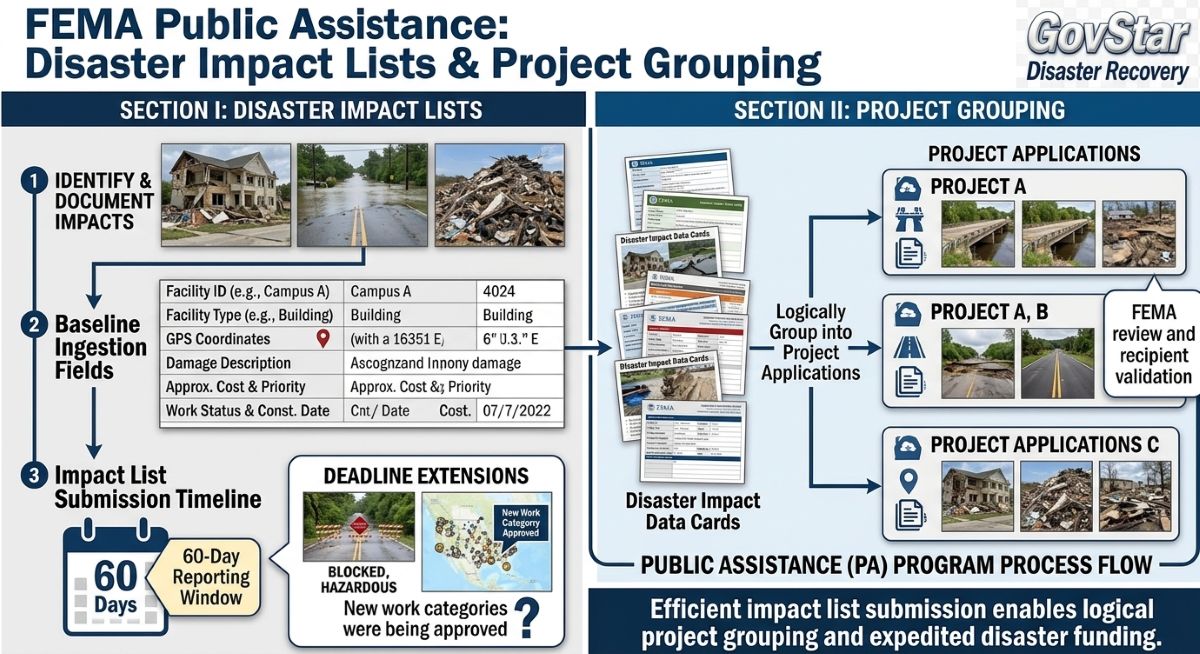
The Public Assistance (PA) Program provides reimbursement to address damage, debris impacts, and emergency protective measures necessary as a direct result of the declared incident. This chapter provides information on determining what damage and impacts are eligible, identifying damage and impacts, finalizing the list of impacts, and logically grouping into project applications.
Applicants must submit a list that includes each facility damaged, each debris impacted site, and each overarching emergency protective measure taken to address immediate threats to the general public. Applicants must also identify whether they are claiming management costs or work and costs for building code, floodplain management administration, or enforcement activities. An applicant lists the information by location with a rough estimate of the associated cost.
Each activity and impacted site in the initial impact list must systematically include the following data points:
Applicants are required to identify and report all incident-related impacts and damage to FEMA within 60 days of attending a recovery scoping meeting.
FEMA may extend the deadline to identify and report the impacts if an applicant submits a request with justification based on extenuating circumstances beyond the recipient's or applicant's control. Qualified extension scenarios include:
Inundated and submerged roads should not be assessed until flood waters have receded to ensure safety and allow time for saturated soil to dry out. Allowing adequate time for saturated soil to dry out is necessary to effectively determine if eligible surface damage has occurred.
Regulatory Match: If flood waters have not receded prior to the 60-day deadline, FEMA may approve a time extension for those sites if it remains feasible to wait until water recedes to safely assess damage. Applicants must formally inform FEMA if roadways experience inundation from closed basin flooding that may result in indefinite submersion due to an inability to drain.
FEMA, the recipient, and the applicant work together to combine documented impacts, facilities, and sites into logical projects. This is a two-step process where entities first create groups based on categories of work and facility types, and then identify individual sites or facilities that must be isolated into separate projects.
Facilities under the authority of other federal agencies or those that are ineligible for PA (such as inactive or partially inactive structures) must not be formulated into a project. Applicants must withdraw these sites from their impact list, or FEMA will issue a formal ineligibility determination.
Prohibited Practices: Logical grouping frameworks must be driven strictly by infrastructure and category alignment. Grouping combinations must never be based on project size thresholds or grant administration convenience.
FEMA initially separates debris removal work into independent project groups based on the following property types:
FEMA initially groups Category B immediate threat operations into separate project applications by activity type:
FEMA groups permanent infrastructure restoration projects into separate applications based on distinct infrastructure categories:
All roads, bridges, low water crossings, culverts, mass transit facilities (subways/railways), airports, ports, and harbors.
All dams, reservoirs, canals, drainage channels, ditches, acequias, aqueducts, stormwater retention/detention basins, and shoreline protection facilities (levees, berms, seawalls, sand revetments).
All school campuses, public housing campuses, hospital complexes, and standalone medical facilities.
All police stations, fire stations, emergency operations centers (EOCs), courthouses, prisons, administrative complexes, and non-emergency civic buildings.
Power generation plants (including wind turbines, generators, and substations within the plant confines), alongside the entire power transmission, power distribution, and natural gas systems.
All water and wastewater treatment plants, entire water distribution systems, entire wastewater collection networks, entire irrigation systems, and all communication systems.
All public parks, golf courses, fish hatcheries, public beaches, cemeteries, tribal burial grounds, sacred sites, libraries, museums, and art galleries.
FEMA includes administrative and support facilities at a site in the same project as the primary facility, though applicants must report each damaged structure as a separate line item on the impact list. Supporting structures include maintenance sheds, storage yards, pump stations, parking lots, ramps, fences, and sidewalks.
After initial grouping, FEMA isolates specific sites or facilities out into separate projects if they meet any of the following technical conditions:
SBA Staging Rule: PNP applicants must separate critical service facilities into distinct projects from noncritical service facilities. This prevents projects containing critical infrastructure from being delayed while noncritical facilities await Small Business Administration (SBA) loan determinations.
All administrative and enforcement activities eligible under the Disaster Recovery Reform Act (DRRA) Section 1206 must be grouped together within a dedicated Category I project application.
All grant management activities eligible under DRRA Section 1215 and FEMA's Public Assistance Management Costs policy must be grouped into a dedicated Category Z project application.
Compliance CTA: Use Final Grouping to control the project pipeline. Submit impacts by the required deadline, group damages into logical projects by category and facility/system, and preserve site-level descriptions, dimensions, photos, coordinates or alternative sensitive-location documentation, initial estimates, and documentation showing how the final grouping supports eligible scope, cost, and closeout.
Compliance CTA: Use Initial Permanent Work Grouping (Categories C-G) to control the project pipeline. Submit impacts by the required deadline, group damages into logical projects by category and facility/system, and preserve site-level descriptions, dimensions, photos, coordinates or alternative sensitive-location documentation, initial estimates, and documentation showing how the final grouping supports eligible scope, cost, and closeout.
Compliance CTA: Use Initial Emergency Protective Measures Grouping (Category B) to control the project pipeline. Submit impacts by the required deadline, group damages into logical projects by category and facility/system, and preserve site-level descriptions, dimensions, photos, coordinates or alternative sensitive-location documentation, initial estimates, and documentation showing how the final grouping supports eligible scope, cost, and closeout.
Compliance CTA: Use Initial Debris Removal Grouping (Category A) to control the project pipeline. Submit impacts by the required deadline, group damages into logical projects by category and facility/system, and preserve site-level descriptions, dimensions, photos, coordinates or alternative sensitive-location documentation, initial estimates, and documentation showing how the final grouping supports eligible scope, cost, and closeout.
Compliance CTA: Use Grouping Impacts into Projects to control the project pipeline. Submit impacts by the required deadline, group damages into logical projects by category and facility/system, and preserve site-level descriptions, dimensions, photos, coordinates or alternative sensitive-location documentation, initial estimates, and documentation showing how the final grouping supports eligible scope, cost, and closeout.
Compliance CTA: Use Inundated and Submerged Roads to control the project pipeline. Submit impacts by the required deadline, group damages into logical projects by category and facility/system, and preserve site-level descriptions, dimensions, photos, coordinates or alternative sensitive-location documentation, initial estimates, and documentation showing how the final grouping supports eligible scope, cost, and closeout.
Compliance CTA: Use Impact List Submission Deadline to control the project pipeline. Submit impacts by the required deadline, group damages into logical projects by category and facility/system, and preserve site-level descriptions, dimensions, photos, coordinates or alternative sensitive-location documentation, initial estimates, and documentation showing how the final grouping supports eligible scope, cost, and closeout.
Compliance CTA: Use Impact List to control the project pipeline. Submit impacts by the required deadline, group damages into logical projects by category and facility/system, and preserve site-level descriptions, dimensions, photos, coordinates or alternative sensitive-location documentation, initial estimates, and documentation showing how the final grouping supports eligible scope, cost, and closeout.