
pa readiness
Damages & Work
Costs & Estimates
Insurance & DOB
Compliance Controls
FEMA Reform
Resource Hub
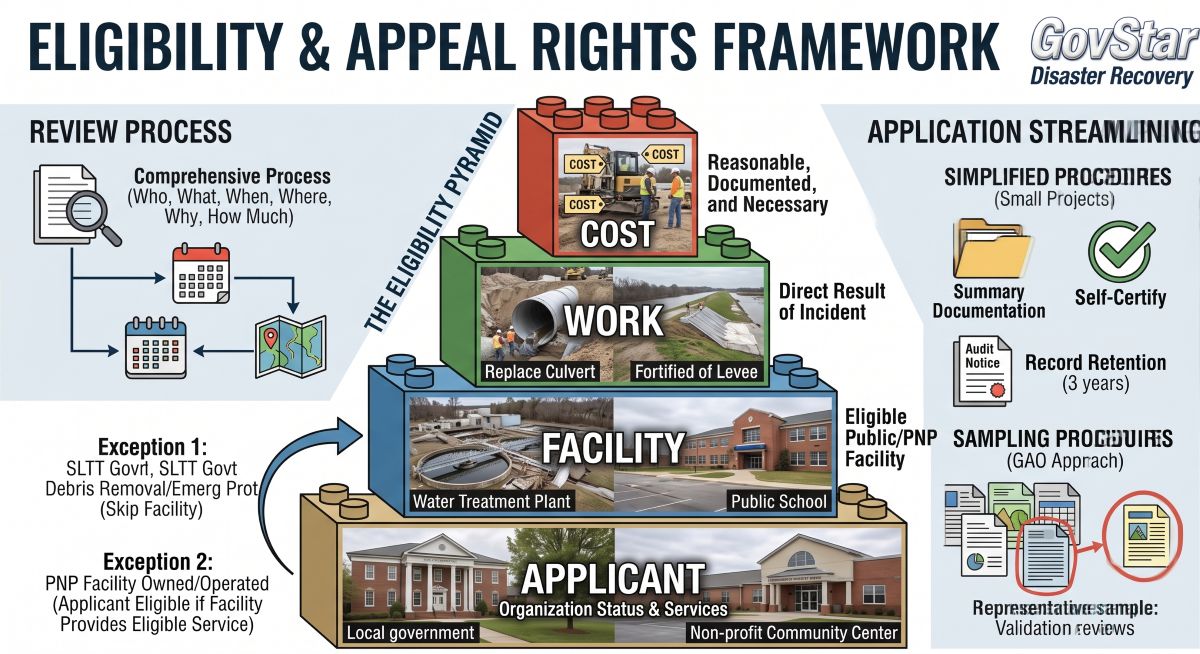
FEMA and recipients work in partnership to administer the Public Assistance (PA) Program and provide customer service to each applicant. This chapter defines how FEMA documents its eligibility determinations and explains applicants' rights to appeal decisions by FEMA.
The four basic components of PA eligibility are applicant, facility, work, and cost. FEMA refers to these components as the building blocks of the eligibility pyramid. FEMA evaluates each building block to determine eligibility, starting at the foundation (applicant) and working up to cost at the top of the pyramid.
FEMA follows a comprehensive process based on specific information and documentation submitted by applicants to verify the "who, what, when, where, why, and how much" needed to support each claim. If an applicant cannot demonstrate eligibility for any of the four components, FEMA will not be able to approve PA funding.
There are two exceptions to the standard eligibility pyramid review process:
Section 422 of the Robert T. Stafford Act allows simplified procedures for small projects to speed up recovery and lower administrative burdens. Applicants can submit summary documentation and self-certify rather than providing a burdensome amount of records prior to funding obligation.
Audit Notice: Applicants must retain all source documentation, including project eligibility records and financial records, for 3 years after the date the recipient submits the certification of completion for the applicant's last small project to FEMA.
FEMA uses the Government Accountability Office (GAO) approach to sampling to increase program efficiency. When applicants have a significant number of documents or damaged sites, they may submit a summary, and FEMA will select a representative sample to validate for document reviews or site inspections.
Most PA projects are free of eligibility disputes, but open communication is intended to resolve misconceptions quickly.
When discussions reach an impasse, PA staff may offer the opportunity to participate in a facilitated discussion led by a trained FEMA alternative dispute resolution specialist to find avenues for resolution.
During the PA process, FEMA requests missing data by submitting a Request for Information (RFI). FEMA establishes the deadline based on the nature of the request, providing a minimum of 15 days to respond.
Denial Notice: If an applicant fails to meet the deadline and does not receive an approved time extension from FEMA, FEMA will deny assistance for the applicant, facility, work, or costs that cannot be verified due to the missing information.
If FEMA determines that any eligibility component is missing, it provides electronic notice through a determination memorandum or letter containing the explanation of denied assistance, the specific regulatory basis for the denial, and details on appeal rights.
Applicants may appeal any FEMA determination related to an application for assistance under the PA Program, including eligibility denials or time extension denials.
FEMA provides two opportunities for formal administrative appeal:
All appeals must be in writing and submitted electronically through the Grants Portal. The appeal must include documented justification, the specific funding amount in dispute, and specify the provisions of law, regulation, or policy with which the determination was inconsistent.
Timing Exception: If the 60th or 120th day falls on a Saturday, Sunday, or federal holiday, FEMA accepts it as timely if received by the first business day after the deadline. Missing either deadline results in a denial of the appeal as untimely.
FEMA must provide its appeal decision simultaneously to the recipient and applicant within 90 days of receiving the appeal. If FEMA requests more information via an RFI or technical expert review, it will issue the decision within 90 days of receiving the data or the technical recommendations. Second appeal decisions represent the Agency's final administrative decision.
Applicants have the option to submit a request for arbitration to the Civilian Board of Contract Appeals (CBCA) if all the following conditions apply:
Applicants must file a request for arbitration within 60 calendar days from the date FEMA transmits its first appeal decision. If choosing arbitration due to a missing 180-day decision, applicants must withdraw their first appeal and submit the arbitration request within 30 days of that withdrawal. Applicants may submit a second appeal or arbitration request, but not both; the CBCA decision constitutes the final administrative decision.
Expense Notice: The CBCA arbitrates at no cost to the parties, but each party is directly responsible for its own expenses, including attorney's fees, representative fees, and copying costs. These costs are entirely ineligible for FEMA funding.
Compliance CTA: Treat Appeal Review and Decisions as a deadline-driven record-control issue. Track every FEMA determination, RFI, facilitated discussion, appeal deadline, supporting exhibit, and recipient transmittal. Build the administrative record before the deadline expires, address the exact basis for FEMA’s determination, and preserve proof of timely submission and receipt.
Compliance CTA: Treat Appeal Deadlines as a deadline-driven record-control issue. Track every FEMA determination, RFI, facilitated discussion, appeal deadline, supporting exhibit, and recipient transmittal. Build the administrative record before the deadline expires, address the exact basis for FEMA’s determination, and preserve proof of timely submission and receipt.
Compliance CTA: Treat Appeal Rights and Requirements as a deadline-driven record-control issue. Track every FEMA determination, RFI, facilitated discussion, appeal deadline, supporting exhibit, and recipient transmittal. Build the administrative record before the deadline expires, address the exact basis for FEMA’s determination, and preserve proof of timely submission and receipt.
Compliance CTA: Treat Notification of an Ineligibility Determination as a deadline-driven record-control issue. Track every FEMA determination, RFI, facilitated discussion, appeal deadline, supporting exhibit, and recipient transmittal. Build the administrative record before the deadline expires, address the exact basis for FEMA’s determination, and preserve proof of timely submission and receipt.
Compliance CTA: Treat Requests for Information as a deadline-driven record-control issue. Track every FEMA determination, RFI, facilitated discussion, appeal deadline, supporting exhibit, and recipient transmittal. Build the administrative record before the deadline expires, address the exact basis for FEMA’s determination, and preserve proof of timely submission and receipt.
Compliance CTA: Treat Facilitated Discussions as a deadline-driven record-control issue. Track every FEMA determination, RFI, facilitated discussion, appeal deadline, supporting exhibit, and recipient transmittal. Build the administrative record before the deadline expires, address the exact basis for FEMA’s determination, and preserve proof of timely submission and receipt.
Compliance CTA: Treat Sampling Procedures as a deadline-driven record-control issue. Track every FEMA determination, RFI, facilitated discussion, appeal deadline, supporting exhibit, and recipient transmittal. Build the administrative record before the deadline expires, address the exact basis for FEMA’s determination, and preserve proof of timely submission and receipt.
Compliance CTA: Treat Simplified Procedures as a deadline-driven record-control issue. Track every FEMA determination, RFI, facilitated discussion, appeal deadline, supporting exhibit, and recipient transmittal. Build the administrative record before the deadline expires, address the exact basis for FEMA’s determination, and preserve proof of timely submission and receipt.
Compliance CTA: Treat PA Eligibility as a deadline-driven record-control issue. Track every FEMA determination, RFI, facilitated discussion, appeal deadline, supporting exhibit, and recipient transmittal. Build the administrative record before the deadline expires, address the exact basis for FEMA’s determination, and preserve proof of timely submission and receipt.