
pa readiness
Damages & Work
Costs & Estimates
Insurance & DOB
Compliance Controls
FEMA Reform
Resource Hub
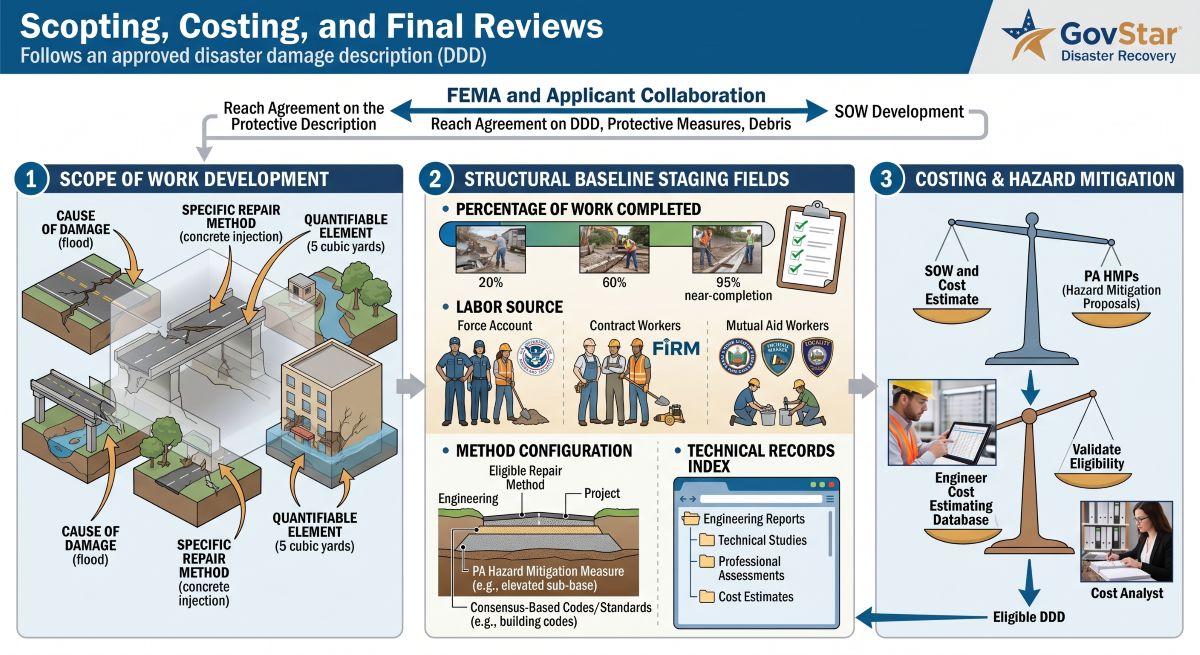
Damage and impact information is the foundation of the project because the scope of work (SOW) and cost eligibility are tied to the eligible damage. FEMA and the applicant should work together to reach an agreement on the disaster-related damage description and dimensions (DDD), emergency protective measures, and debris impacts before proceeding with SOW development. FEMA reviews applicant-provided information to develop or validate the SOW and cost estimate for each project, develop Public Assistance (PA) Hazard Mitigation Proposals (HMPs), and ensure compliance with applicable requirements.
The scope of work describes the method of repair of damaged elements. The method of repair refers to the specific approach or technique used to restore, replace, or repair damaged facilities or infrastructure. The scope of work necessary to repair the damage or address the impacts must be completely described and correspond directly to the cause of damage. Descriptions of repair work should be specific to elements of damage and defined in quantifiable and descriptive terminology.
To develop the scope of work, applicants should provide the following data fields for each individual site:
FEMA maintains well-established protocols for scoping and estimating standard public infrastructure restoration based on national standards and best practices. While the primary focus of PA is on public infrastructure, it has provisions that extend to tribal-owned residential structures and tribal ceremonial buildings. However, standard PA engineering processes fail to account for traditional tribal structures that must be built in a manner consistent with maintaining their cultural, historical, governmental, or ceremonial construct, which can be traditionally made of adobe, mud, earth, clay, rock, and wood.
Tribal Sovereignty Rule: To bridge this administrative gap, FEMA will accept a Tribal Nation's certified damage assessment, scope of work for restoration, and estimated costs for traditional tribal residences or tribal ceremonial buildings. Additionally, PA supports Tribal Nations' ability to build back stronger by identifying available codes and standards applicable for traditional residential structures that Tribal Nations can consider adopting and that can be incorporated into restoration scopes of work in future disasters. Further, cost-effective mitigation measures for traditional tribal residential structures and ceremonial buildings will be provided to tribal applicants and recipients to preserve the homes of indigenous people.
While FEMA or the recipient may assist the applicant with preparing project applications based on actual or estimated costs, the applicant is ultimately responsible for developing and documenting all costs.
FEMA establishes a minimum project threshold for each federal fiscal year based on the Consumer Price Index. If a project application totals less than the minimum threshold, the project is completely ineligible for FEMA funding. The project application total includes hazard mitigation costs and accounts for insurance proceeds and other reductions to avoid a duplication of benefits.
FEMA establishes a dollar threshold each federal fiscal year under Section 422 of the Stafford Act to define a project as large or small:
FEMA determines whether a project is large or small based on the final approved amount of eligible costs after any cost adjustments, including insurance reductions.
FEMA may provide expedited funding for emergency work projects (Category A or B) that meet or exceed the large project threshold. FEMA funds expedited projects at 50 percent of the federal share of the estimated project cost. Requests for expedited projects must be submitted to FEMA within 60 days of an applicant's recovery scoping meeting. FEMA will work to obligate funding within 90 days of receipt of the request.
Drawdown Restriction: FEMA's obligation of an expedited project is not an authorization for a recipient to advance funds without the documentation to support the drawn funds. Expedited advance payments are strictly limited to the minimum amounts needed and must be timed based on the actual, immediate cash requirements to perform the eligible work.
To develop and obligate an expedited project, an applicant must provide the following data broken down by the applicant's monthly or bi-weekly operational periods:
Proration Rule: If Category A or B has an increased federal cost-share for a limited timeframe, applicants must explicitly separate work anticipated to be completed within the increased cost-share window from that to be completed after the increased cost-share period expires.
FEMA estimates the cost of the work based on cost information provided by applicants. If an applicant does not provide sufficient cost information, FEMA may use average historical pricing. For contracted work, FEMA uses the unit cost from the contract if it determines the costs are reasonable, but this is only for the purpose of expediting funding based on an estimate. FEMA reviews the applicant's procurement and contracting for compliance and addresses any noncompliance prior to or at final reconciliation and closeout of the project. FEMA provides the remaining 50 percent federal share once an applicant provides all documentation required for a standard project application.
When work for a large project is 100 percent complete, FEMA provides funding based on actual costs. FEMA works with applicants to verify and collect programmatic, insurance, and hazard mitigation information; ensure Environmental and Historic Preservation (EHP) grant conditions are met; verify documentation requirements; and ensure communities are not negatively impacted by the work completed. FEMA reviews the documentation submitted by the applicant and will make its eligibility determination based on the documentation received. FEMA will deny assistance for costs that are not supported by documentation.
If actual cost documentation is not readily available and the applicant has provided sufficient documentation to define the scope of work completed, FEMA will provide funding for completed work based on a cost estimate.
During review, if FEMA determines additional explanation is required, it may generate a request for information (RFI) specifying a deadline for response. If documentation is not provided to fully support eligibility within that window, a formal determination memorandum (DM) denying the unsupported costs will be issued.
For small projects, FEMA may accept an official certification in lieu of full documentation to support costs claimed, processing the project based on estimated costs even if all work is completed. Small project estimates are not subsequently adjusted to reflect actual costs. However, applicants must still retain all source documentation to preserve their right to request a net small project overrun appeal at closeout.
With the exception of debris removal and emergency repair projects, emergency work is often difficult to estimate due to the type of work conducted. Unlike permanent work, where a detailed scope of work is usually determined and estimated based on the damage, the detailed scope of work to address emergency response activities is often unknown and therefore difficult to estimate in advance. Additionally, emergency response activities generally do not have established unit pricing and other variables, which can impact pricing. If an applicant provides sufficient information, FEMA may process emergency work projects based on estimates.
When work is not yet complete, FEMA determines permanent funding based on the estimated cost to restore the damaged facility to its pre-disaster design and function, including eligible codes and standards. The amount may include a reasonable amount of anticipated soft costs but strictly excludes costs that are only related to, or only triggered by, subsequent changes to the pre-disaster design or function. These allowable baseline elements include:
If FEMA develops the scope of work, it will also develop the associated cost estimate.
Some projects may require an engineering analysis to determine the proper method of repair. In these cases, FEMA will provide PA funding for engineering and design services if requested by an applicant.
FEMA accepts an applicant-submitted cost estimate for uncompleted permanent work only if the estimate meets the following six structural tests:
When FEMA develops cost estimates for sites with permanent work that are less than 90 percent complete and total costs are expected to meet or exceed the large project threshold, FEMA mandates the use of the Cost Estimating Format (CEF) in accordance with the CEF Instructional Guide. The guide defines various structural factors and the range of percentage values that FEMA may apply to projects. Only FEMA Headquarters has the authority to approve the use of factors that exceed the CEF specified range or approve additional factors.
Capping Rule: For capped projects (improved projects and alternate projects), FEMA only includes the specific CEF contingency factor "Applicant Reserve for Change Orders" and is strictly prohibited from including any additional structural factors or risk premiums.
FEMA reduces the estimate to account for insurance coverage based on actual insurance proceeds, if known, or anticipated insurance proceeds based on the applicant's insurance policy if the amount of actual proceeds is unknown.
FEMA conducts a rigorous series of programmatic reviews to ensure grant compliance before funds can be released. FEMA reviews projects for quality assurance, compliance with mandatory insurance obtain-and-maintain requirements, PA hazard mitigation eligibility, and environmental and historic preservation (EHP) compliance.
FEMA obligates the federal share of the eligible project cost to the recipient, and once obligated, the project constitutes the official record of the approved scope of work. FEMA's authority to provide funding for small projects as one lump sum based on an estimate does not require recipients to obligate funding to subrecipients in the same manner. Recipients must expend and account for the federal award in accordance with their own specific laws and procedures for expending and accounting for their state, tribal, or territory's own funds.
Strategic funds management is FEMA's process for obligating PA funding based on an applicant's schedule to execute the work.
Phased Obligation Trigger: If a permanent work project is greater than $1 million and the applicant does not need funds for more than 180 days from the time the project is ready for obligation, FEMA obligates funds incrementally based on the project completion schedule rather than as a single block.
The recipient is responsible for notifying the applicant that funds are available and for distributing the funds to the appropriate subrecipient. Funds that FEMA has obligated are available to recipients to pass through to the appropriate subrecipient.
Compliance CTA: For Obtaining Funds, align the scope, cost, insurance, EHP, hazard mitigation, and eligibility record before obligation. Use the review stage to resolve inconsistencies, unsupported quantities, omitted reductions, and compliance conditions; then document how funds are requested, managed, and drawn consistent with FEMA and recipient requirements.
Compliance CTA: For Obligation, align the scope, cost, insurance, EHP, hazard mitigation, and eligibility record before obligation. Use the review stage to resolve inconsistencies, unsupported quantities, omitted reductions, and compliance conditions; then document how funds are requested, managed, and drawn consistent with FEMA and recipient requirements.
Compliance CTA: For Compliance Reviews, align the scope, cost, insurance, EHP, hazard mitigation, and eligibility record before obligation. Use the review stage to resolve inconsistencies, unsupported quantities, omitted reductions, and compliance conditions; then document how funds are requested, managed, and drawn consistent with FEMA and recipient requirements.
Compliance CTA: For Estimating Permanent Work Projects with Work to be Completed, demonstrate that claimed costs are necessary, reasonable, allocable, and adequately supported. Compare actual costs, estimates, procurement results, historical data, unit prices, FEMA or applicant estimates, insurance reductions, and completed-work documentation. Segregate ineligible, duplicate, excessive, or unsupported costs before obligation and drawdown.
Compliance CTA: For Estimating Emergency Work Projects with Work to be Completed, demonstrate that claimed costs are necessary, reasonable, allocable, and adequately supported. Compare actual costs, estimates, procurement results, historical data, unit prices, FEMA or applicant estimates, insurance reductions, and completed-work documentation. Segregate ineligible, duplicate, excessive, or unsupported costs before obligation and drawdown.
Compliance CTA: For Costs for Projects with All Work Completed, demonstrate that claimed costs are necessary, reasonable, allocable, and adequately supported. Compare actual costs, estimates, procurement results, historical data, unit prices, FEMA or applicant estimates, insurance reductions, and completed-work documentation. Segregate ineligible, duplicate, excessive, or unsupported costs before obligation and drawdown.
Compliance CTA: For Expedited Projects for Emergency Work, demonstrate that claimed costs are necessary, reasonable, allocable, and adequately supported. Compare actual costs, estimates, procurement results, historical data, unit prices, FEMA or applicant estimates, insurance reductions, and completed-work documentation. Segregate ineligible, duplicate, excessive, or unsupported costs before obligation and drawdown.
Compliance CTA: For Project Thresholds, demonstrate that claimed costs are necessary, reasonable, allocable, and adequately supported. Compare actual costs, estimates, procurement results, historical data, unit prices, FEMA or applicant estimates, insurance reductions, and completed-work documentation. Segregate ineligible, duplicate, excessive, or unsupported costs before obligation and drawdown.
Compliance CTA: For Cost Development, demonstrate that claimed costs are necessary, reasonable, allocable, and adequately supported. Compare actual costs, estimates, procurement results, historical data, unit prices, FEMA or applicant estimates, insurance reductions, and completed-work documentation. Segregate ineligible, duplicate, excessive, or unsupported costs before obligation and drawdown.
Compliance CTA: For Scope of Work Development, align the scope, cost, insurance, EHP, hazard mitigation, and eligibility record before obligation. Use the review stage to resolve inconsistencies, unsupported quantities, omitted reductions, and compliance conditions; then document how funds are requested, managed, and drawn consistent with FEMA and recipient requirements.