FEMA Public Assistance FAQs
Straight answers to the questions applicants ask most, on procurement, costs, documentation, eligibility, emergency work, sheltering, debris, environmental review and more. Search, filter by topic, and share a link to any answer.
Will there be Category Z Project Worksheets (PWs)?
Yes, FEMA will obligate Category Z PWs in line with the Public Assistance
Management Costs (Interim) FEMA Recovery Policy FP 104-11-2 applicable to
Emergency Declarations under Stafford Act's Section 502.
Why is it important for applicants to familiarize themselves with latitude and longitude coordinates?
Why Latitude and Longitude Matter for Public Assistance Grants
Understanding latitude and longitude coordinates is crucial for Public Assistance Grant applicants. Here's how this knowledge benefits the application process:
- Accurate Documentation: Precise coordinates pinpoint the exact location of a damaged facility, ensuring accurate reporting and damage assessments.
- Mapping and Geospatial Analysis: Coordinates enable visualizing damage on maps, facilitating a clear understanding of the geographical scope of the disaster.
- Communication and Coordination: Sharing locations through coordinates allows for efficient communication and collaboration between applicants, FEMA, and other involved parties.
- Georeferencing and Data Integration: Coordinates enable integrating damage data with other geospatial datasets (e.g., flood zones, infrastructure) for better analysis and decision-making.
- Compliance with FEMA Requirements: FEMA often requires location data in the form of coordinates to process applications and ensure accurate assessments.
- Efficient Damage Assessment: Rapidly identifying locations through coordinates streamlines damage assessment efforts and speeds up the recovery process.
- Effective Communication with Stakeholders: Using coordinates allows for clear communication about damage locations with elected officials, community members, and other stakeholders.
- Compliance with Regulations: Many grant programs require geospatial data for compliance purposes. Knowing coordinates ensures adherence to these regulations.
In essence, familiarity with latitude and longitude coordinates enhances the effectiveness and efficiency of the entire Public Assistance grant process, from initial application to final recovery.
Why are photographs important for documenting disaster-related damage?
A Picture is Worth a Thousand Words: Why Photos Matter in Disasters
In the aftermath of a disaster, chaos reigns. But amidst the destruction, photographs emerge as powerful tools for recovery. They're not just memories; they're vital evidence for a smoother and more effective path back to normalcy.
- Seeing is Believing: Photos provide undeniable proof of the extent and nature of the damage. A single image can capture the devastation of a collapsed building or a flooded landscape, far more effectively than words alone.
- Objectivity in the Face of Crisis: Emotions run high after a disaster. Photographs offer objective documentation, free from bias. They provide a clear picture of the situation, crucial for accurate damage assessments and insurance claims.
- Building Back Better: Photos become blueprints for the future. They guide project planning and monitoring, ensuring reconstruction efforts target the most critical areas. By comparing before-and-after shots, progress becomes clear, motivating both workers and communities.
- A Bridge for Communication: A single image can bridge communication gaps. Photos shared with aid agencies, government officials, and the public facilitate clear communication and informed decision-making about resource allocation and recovery strategies.
- Remembering the Past, Shaping the Future: Photographs serve as a historical record of the event. They not only capture the devastation, but also the community's resilience. This visual record becomes a valuable tool for future preparedness and mitigation efforts.
By enhancing accuracy, transparency, and effectiveness, photographs become a cornerstone of disaster documentation. They are a powerful tool for ensuring a smoother, more efficient recovery for everyone involved.
Who reviews and validates the estimates in the 50% Rule calculations?
The estimates in the 50% Rulecalculations are reviewed and validated by a team of qualified professionalswith specific expertise. According to the document, the following individualsare responsible for reviewing and validating the estimates used in the 50% Rulecalculations:
- FEMA's Professionally Licensed Engineers and Architects: some text
- These individuals play a key role in developing or reviewing and validating the estimates used in the 50% Rule calculations.
- Qualified Cost Estimators:some text
- Cost estimators with the necessary qualifications are involved in the review and validation process to ensure accuracy and compliance with guidelines.
- Construction Managers:some text
- Construction managers contribute their expertise to assess the estimates and ensure they align with construction standards and requirements.
- Staff with Other Technical Expertise:some text
- Additional staff members with relevant technical expertise are included in the review process as necessary to provide comprehensive validation of the estimates.
By involving a team of professionalswith diverse backgrounds and expertise, FEMA aims to ensure the accuracy,reliability, and compliance of the estimates used in the 50% Rule calculations.This multi-disciplinary approach helps in making informed decisions regardingrepair or replacement funding for damaged facilities.
Who is the target population for non-congregate sheltering?
Examples of target populations include those who test positive for COVID-19 who do not require hospitalization but need isolation (including those exiting from hospitals); those who have been exposed to COVID-19 who do not require hospitalization; and asymptomatic high-risk individuals needing social distancing as a precautionary measure, such as people over 65 or with certain underlying health conditions (respiratory, compromised immunities, chronic disease). Sheltering specific populations in non-congregate shelters should be determined by a public health official’s direction or in accordance with the direction or guidance of health officials by the appropriate state or local entities. The request should specify the populations to be sheltered. Non-congregate sheltering of healthcare workers and first responders who require isolation may be eligible when determined necessary by the appropriate state, local, tribal, or territorial public health officials and when assistance is not duplicated by another federal agency.
Who is responsible for documenting all costs?
The applicant is responsible fordocumenting all costs associated with the project. This includes maintaining records ofexpenses such as labor costs, equipment costs, supplies, contract work, and anyother eligible costs related to the project. The applicant must ensure that allcosts are properly documented and accounted for in accordance with FEMAguidelines and regulations.
Who is responsible for developing and documenting all costs?
The responsibility for developing anddocumenting all costs lies with the applicant, who is ultimately responsiblefor preparing project applications, providing detailed descriptions of work,substantiating the eligibility of work and costs, ensuring all costs arereasonable and supported by documentation. FEMA collaborates with the applicantto review the information provided and develop or validate the Scope of Work(SOW) and cost estimate for each project during the Scoping and Costing phase.
Who is eligible for Public Assistance funding?
State, Territorial, and Indian Tribal Governments Local Governments
The following types of local governments are eligible Applicants
- Counties and parishes
- Municipalities, cities, towns, boroughs, and townships
- Local public authorities
- School districts
- Intrastate districts
- Councils of governments (regardless of whether incorporated as nonprofit corporations under State law)
- Regional and interstate government entities
- Agencies or instrumentality of local governments
- State-recognized Tribes
- Special districts established under State law
- Community Development Districts are special districts that finance, plan, establish, acquire, construct or reconstruct, operate, and maintain systems, facilities, and basic infrastructure within their respective jurisdictions. To be eligible, a Community Development District must be legally responsible for ownership, maintenance, and operation of an eligible facility that is accessible to the general public.
The State or a political subdivision of the State may submit applications on behalf of rural communities, unincorporated towns or villages, and other public entities not listed above.
- Private Non-Profit Organizations - Fact Sheet for COVID-19 and Private Nonprofit Organizations
Only certain Private Non-Profit (PNP) Organizations are eligible Applicants. To be an eligible PNP Applicant, the PNP must show that it meets the tax-exempt status, own or operate an eligible facility. An eligible facility is one that provides an eligible service.
Tax-Exempt Status
- A current ruling letter from the U.S. Internal Revenue Service granting tax exemption under sections 501(c), (d), or (e) of the Internal Revenue Code of 1954;
- Documentation from the State substantiating it is a non-revenue producing, nonprofit entity organized or doing business under State law.
Eligible Services - click here for a chart of Critical, Non-Critical and Non-Eligible Services
- A facility that provides a critical service, which is defined as education, utility, emergency, or medical; or
- A facility that provides a non-critical, but essential social service AND provides those services to the general public. PNP facilities generally meet the requirement of serving the general public if ALL the following conditions are met:
Facility use is not limited to any of the following:
- A certain number of individuals;
- A defined group of individuals who have a financial interest in the facility, such as a condominium association;
- Certain classes of individuals; or
- An unreasonably restrictive geographical area, such as a neighborhood within a community;
Facility access is not prohibited with gates or other security systems; and
Any membership fees meet all the following criteria:
- Are nominal;
- Are waived when an individual can show inability to pay the fee;
- Are not of such magnitude to preclude use by a significant portion of the community; and
- Do not exceed what is appropriate based on other facilities used for similar services.
Certain types of facilities, such as senior centers, that restrict access in a manner clearly related to the nature of the facility, are still considered to provide essential social services to the general public.
In cases where the facility provides multiple services, such as a community center, FEMA reviews additional items to determine the primary service that facility provides, such as:
- U.S. Internal Revenue Service documentation
- Pre-disaster charter, bylaws, and amendments
- Evidence of longstanding, routine (day-to-day) use (e.g., a calendar of activities)
Facilities established or primarily used for political, athletic, recreational, vocational, or academic training, conferences, or similar activities are not eligible.
Please utilize the FEMA Public Assistance Program and Policy Guide (PAPPG) as a reference for applicant eligibility questions; Chapter 2 Public Assistance Policy, II. Applicant Eligibility (Link below) –
FEMA PAPPG Link - https://www.fema.gov/media-library-data/1525468328389- 4a038bbef9081cd7dfe7538e7751aa9c/PAPPG_3.1_508_FINAL_5-4-2018.pdf
Where do I register for the FEMA Grants Portal sight?
Where do I register for the FEMA Grants Portal sight?
Answer: If you DO NOT have an account in the FEMA Grants Portal, please send an email to your STATE Recovery Staff to request an account. Provide the primary contact name, jurisdiction/potential applicant, phone number and email address. You will then receive an automated email invitation from the FEMA Grants Portal. After the account activation is completed you will be requested to submit a Request for Public Assistance (RPA) form for COVID-19 for your State Declaration DR-xxxx or EM-xxxx
10: How do we know if we have a FEMA Grants Portal account? Answer:
A jurisdiction/applicant that hasn’t participated in a federally declared disaster event since 2017 in all probability will not have an account
Where can insurance documentation be uploaded in Grants Portal?
Insurance documentation can be uploaded in the organization profile section of Grants Portal by following these steps: Select the "My Organization" tab and then the "Organization Profile" tab. Look for the "Upload Insurance Document" button and click on it.
Choose the insurance documentation file from your device and enter the filename and description.
Select the appropriate category and click on the "Add Document" button to upload the insurance documentation. It is recommended to consult the specific instructions and guidance provided by FEMA or reach out to the FEMA point of contact for assistance.
What wrap-around services are eligible? For example, are food or mental health counseling eligible?
Eligible costs related to sheltering should be necessary based on the type of shelter, the specific needs of those sheltered, and determined necessary to protect public health and safety and in accordance with guidance provided by appropriate health officials. However, support services such as case management, mental health counseling, and others are not eligible.
What work is eligible for funding as Category A?
FEMA's Public Assistance (PA) program offers Category A funding for debris removal associated with a declared disaster. Here's a breakdown of the key characteristics of eligible work under Category A:
- Focus: Removing debris that poses an immediate threat to life, public health, or safety.
- Examples of Eligible Debris:
- Construction and demolition debris (wood, concrete, metal)
- Yard waste and landscaping debris
- Flood debris (furniture, appliances, etc.)
- Storm debris (trees, branches)
- Sand and debris blocking roadways or critical infrastructure
- Animal carcasses posing a health hazard
- Public vs. Private Property: Generally, Category A prioritizes debris removal on public property (roads, parks, infrastructure). However, in specific situations, FEMA may authorize removal of debris from improved private property if it meets certain criteria:
- Blocking access to a public right-of-way (e.g., roads, sidewalks)
- Posing a significant threat to public health or safety (e.g., blocking access for emergency vehicles, hazardous materials)
- Direct Result of the Disaster: The debris must be a direct consequence of the disaster for which a federal Public Assistance declaration has been issued. Debris from pre-existing conditions or unrelated events wouldn't be eligible.
Here are some resources for more information:
- FEMA Public Assistance: Category A - Debris Removal including Private Property Debris: This fact sheet offers details on what debris removal qualifies for Category A funding: https://www.fema.gov/sites/default/files/documents/fema_pa-category-a-debris-removal-ppdr-factsheet.pdf
- FEMA Public Assistance Program and Policy Guide (PAPPG): Chapter 2: Public Assistance Policy, Section V Cost Eligibility ([invalid URL removed]) (This comprehensive guide details eligibility criteria for various cost categories under PA)
Remember: Specific eligibility requirements might vary depending on the circumstances of the disaster. For the most up-to-date information and to determine if your debris removal project qualifies for Category A assistance, it's always recommended to consult directly with FEMA.
What types of projects qualify for streamlined EHP review?
Projects that qualify for streamlinedEnvironmental and Historic Preservation (EHP) review include:
- Projects falling under Statutory Exclusion (STATEX) exempt from NEPA review.
- Actions eligible for Categorical Exclusion (CATEX) not requiring detailed NEPA review.
- Projects within or adjacent to Otherwise Protected Areas under the Coastal Barrier Resources Act.
- Projects with minimal impacts on endangered species or critical habitats.
- Actions not triggering Clean Water Act Section 404 permitting requirements.
- Projects intended to restore the facility back to pre-disaster condition.
- Projects with codes and standards upgrades.
- Projects involving replacement of contents, supplies, or equipment.
- Projects with minor repair, restoration, or construction on buildings or structures less than 45-50 years old or not listed or eligible for listing in the National Register of Historic Places.
What types of facilities does FEMA apply the 50% Rule to?
FEMA applies the 50% Rule to thefollowing types of facilities as explicitly mentioned in the document:
- Individual Components of Systems:some text
- Drainage channel or irrigation system: a section from damaged node to damaged node.
- Water or sewer line system: a section of piping from damaged manhole to damaged manhole, a lift station, or a manhole structure.
- Water or wastewater treatment plant: a control building, clarifier, or sedimentation pond.
- Electrical distribution systems are evaluated for replacement based on specific criteria.
- Entire Facilities:some text
- Bridges
- Culverts
- Buildings
- Pumping stations
- Piers
- Pools, including integral pumping
- Equipment
- Lighting structures
For the facilities listed above, FEMA appliesthe 50% Rule either to individual components of the system or to the entirefacility to determine whether repair or replacement is more appropriate.
What types of emergency work are ineligible for funding?
What types of emergency services are PNPs generally responsible for?
What types of education institutions (if any) are eligible?
Here's a breakdown of the types of educational institutions eligible for FEMA Public Assistance (PA) funding:
Eligible Institutions:
- Primary and Secondary Schools: Both public and private day or residential schools that provide elementary and secondary education as determined by the state's compulsory attendance requirements.
- Higher Education Institutions: These institutions must meet all the following criteria:
- Admit students with a high school diploma or equivalent.
- Be legally authorized to provide education beyond the secondary level.
- Award a bachelor's degree or an associate's degree that is transferable and creditable towards a bachelor's degree.
- Be a public institution or a private non-profit institution.
- Be accredited by a nationally recognized agency or association (as determined by the Secretary of the Department of Education).
Important Considerations:
- Religious Schools: Religious schools meeting the eligibility criteria above can qualify for PA funding.
- Focus on Public Benefit: The damaged facility must be used primarily for educational purposes that provide a public benefit.
- Ineligible Institutions: Facilities offering vocational training that don't meet the higher education criteria or daycare centers typically wouldn't be eligible.
Here are some resources for more information:
- FEMA Public Assistance Program and Educational Facilities Factsheet: https://www.fema.gov/
- FEMA Public Assistance Program and Policy Guide (PAPPG): While it doesn't explicitly list educational institutions, Chapter 2: Public Assistance Policy, Section II Applicant Eligibility provides a broader overview of eligible applicants ([invalid URL removed])
Remember: FEMA regulations can be intricate. It's always best to consult directly with FEMA to determine the specific eligibility of your educational institution for PA funding. They can provide the most up-to-date information and guidance based on the specifics of your situation.
What types of documentation should the Applicant provide to FEMA?
Building a Strong Case: Essential Documentation for Public Assistance Grants
Securing FEMA Public Assistance grant funding requires a comprehensive documentation strategy. Here's a breakdown of the key documents needed:
1. Damage Assessment Documentation:
- Painting the Picture: This documentation provides a clear picture of the disaster's impact.
- What it Includes:
- Extent of damage
- Affected areas
- Specific facilities or infrastructure impacted
- Examples: Photographs, site inspection reports, and other relevant records.
2. Cost Documentation:
- Justifying Expenses: This documentation verifies the costs associated with eligible work.
- What it Includes:
- Labor costs (invoices, payroll records)
- Equipment costs (invoices, rental agreements)
- Material costs (invoices, receipts)
- Other direct costs (contracts, financial documentation)
3. Scope of Work Documentation:
- A Detailed Roadmap: This documentation outlines the specific tasks and activities required for repairs or reconstruction.
- What it Includes:
- Detailed descriptions of the work
- Specifications and plans
- Purpose:
- Helps determine eligible costs
- Ensures proposed work aligns with program requirements
4. Eligibility Documentation:
- Meeting the Criteria: This documentation establishes that the applicant, facility, and work meet the eligibility requirements for Public Assistance grants.
- What it Includes:
- Proof of ownership or legal responsibility for the facility (deeds, leases)
- Insurance policies
- Maintenance records
- Other relevant documentation demonstrating eligibility
5. Environmental and Historic Preservation Documentation:
- Protecting the Environment and History: If your project might impact the environment or historic properties, additional documentation is required to comply with relevant regulations.
- What it Includes:
- Environmental assessments
- Permits
- Compliance documentation
Important Notes:
- Specific documentation requirements may vary depending on the project's nature, facility type, and applicable regulations.
- FEMA provides guidance and instructions on required documentation through the Public Assistance program and its associated processes.
What types of damages to collections are reported?
Types of damages to collections thatare reported include:
- Physical damage such as structural damage to buildings or facilities where collections are housed.
- Damage to artifacts, documents, or objects within collections due to disasters like floods, fires, or other incidents.
- Water damage affecting collections due to leaks, flooding, or water infiltration.
- Fire damage impacting collections stored in buildings or facilities.
- Mold or mildew growth on collections due to moisture or water exposure.
- Damage from debris or contaminants affecting collections during or after a disaster event.
- Damage to collections caused by structural collapse or other related incidents.
- Any other forms of damage that may impact the integrity or preservation of collections within a facility.
- Extent and severity of damage to facilities.
- Types of collections affected, such as paintings, books, and documents.
- Types of damaged special collections, like government records, rare books, and manuscripts.
- The extent of damage to collections.
- Identification of potential measures to treat impacted collections, which may involve evaluating work scopes for the treatment of objects.
What types of areas are considered for construction work?
- Special flood hazard areas like regulatory floodways or the 1% annual chance floodplain zone (100-year) or the 0.2% annual chance floodplain zone (500-year) for critical actions.
- Environmentally sensitive areas such as barrier islands, conservation easements, fish hatcheries, preserves, state and national parks, and wildlife management areas.
- Areas near beaches, canals, lakes, rivers, streams, wetlands, or other bodies of water including fishing piers.
- Floodplains
- Wetlands
- Coastal Barrier Resources System units
- Waters of the United States (WOTUS)
- Critical habitat for endangered or threatened species
- Historic properties
- Areas with environmental justice concerns
What types of areas are considered environmentally sensitive?
Types of environmentally sensitiveareas considered for construction work:
- Barrier islands
- Conservation easements
- Fish hatcheries
- Preserves
- State and national parks
- Wildlife management areas These areas are highlighted as environmentally sensitive and require specific considerations and regulations to ensure protection during construction activities and to minimize adverse impacts on the environment.
What types of activities are eligible for reimbursement in flood fighting?
Here's a breakdown of the types of activities that might be eligible for reimbursement in flood fighting under FEMA's Public Assistance (PA) program:
Emergency Protective Measures (Category B):
- Activities with a direct impact on saving lives and protecting public health and safety qualify for reimbursement under Category B of FEMA's PA program. In the context of flood fighting, this could include:
- Sandbagging operations to prevent floodwaters from entering structures or critical infrastructure.
- Evacuation and sheltering of people from flooded areas.
- Search and rescue of people trapped in floodwaters.
- Traffic control measures to protect public safety and divert traffic from flooded areas.
- Diking and temporary levee construction to divert floodwaters. (Note: Permanent repairs to levees typically fall under FEMA's permanent work programs)
- Operating emergency pumps to remove floodwaters from critical infrastructure or public property.
Important Considerations:
- Costs must be necessary and reasonable: Only expenses directly related to the flood fighting activities and essential for protecting lives or property are eligible.
- Proper documentation is crucial: Maintain detailed records of the flood fighting activities undertaken, the threats addressed, and all associated costs.
Other Potentially Reimbursable Activities:
- Debris Removal (Category A): Removal of debris blocking critical infrastructure or access routes, posing an immediate threat to public health or safety, might be eligible under Category A. This could include flood debris like:
- Large objects blocking waterways or roads
- Debris posing a health hazard (e.g., animal carcasses)
Activities Generally Not Eligible:
- Long-term repairs or permanent replacements: These typically fall under FEMA's permanent work programs.
- Preventative measures not directly related to an immediate threat: For example, stockpiling sandbags in advance of a flood season wouldn't be eligible.
Finding More Information:
- FEMA Public Assistance Program and Policy Guide (PAPPG): Chapter 2: Public Assistance Policy, Section V Cost Eligibility ([invalid URL removed]) offers a comprehensive overview of eligible costs under PA.
- FEMA Public Assistance: Category A - Debris Removal including Private Property Debris: https://www.fema.gov/sites/default/files/documents/fema_pa-category-a-debris-removal-ppdr-factsheet.pdf
- FEMA Eligible Emergency Protective Measures - Fact Sheet: While superseded by a more recent policy document, this fact sheet provides a general overview of eligible measures: https://www.fema.gov/fact-sheet/eligible-emergency-protective-measures
Remember, FEMA regulations can be intricate. For the most up-to-date information and to determine if your specific flood fighting activities qualify for reimbursement, it's always recommended to consult directly with FEMA.
What type of documentation supports eligibility for Public Assistance grant funding?
d
What type of costs does FEMA consider for PA funding?
FEMA considers various types of costsfor Public Assistance (PA) funding, including:
- Costs related to restoring damaged facilities to their pre-disaster design and function, including eligible codes and standards.
- Anticipated soft costs that are reasonable and directly related to the restoration work.
- Engineering and design costs.
- Environmental and Historic Preservation (EHP) compliance costs.
- Work required by codes or standards identified by the applicant and verified by FEMA.
- Actual costs for work completed at the time the cost estimate is developed.
- Any foreseeable contingency costs such as security, staging, etc.
- Debris removal costs.
- Emergency protective measures expenses.
- Emergency work costs incurred for activities that eliminate or lessen immediate threats to life, public health, or safety.
- Permanent work costs for repairing, restoring, reconstructing, or replacing damaged facilities.
What the eligibility criteria for reassigned employees to be funded
Reassigned Employees on External Funding: Understanding FEMA Reimbursement
The Public Assistance (PA) program offers financial support for disaster response and recovery efforts. Here's a specific scenario related to reassigned employees and FEMA reimbursement:
The Case of Reassigned Employees Funded Externally
- Employee Reassignment: An existing employee (permanent) is assigned tasks outside their usual job duties to address the emergency.
- For instance, a police officer might be reassigned to clear debris.
- External Funding Source: The employee's salary is typically funded by an external source, such as a grant from another federal agency or dedicated funds.
- No Duplication of Funding: FEMA needs to confirm that the external funding source doesn't already cover the specific emergency work the employee is doing.
- Essentially, FEMA shouldn't reimburse costs already covered by another source.
FEMA Reimbursement and Considerations:
- Reimbursement Based on Normal Pay Rate: If the above criteria are met, FEMA reimburses the applicant based on the employee's normal pay rate, not the rate typically associated with the reassigned work.
- Documentation Importance: Applicants must provide proper documentation and evidence to demonstrate the eligibility of these reassigned employees for reimbursement. This ensures FEMA reimburses only for valid claims.
In essence, FEMA helps cover the cost of an employee's regular salary when they are temporarily reassigned to perform essential emergency work that is not funded by another source.
By understanding these guidelines, applicants can ensure they are properly documenting and claiming reimbursement for eligible reassigned employees funded from external sources.
What supplies are provided for survivors in shelters?
What should entities eligible for funding be doing to increase the chance of receiving reimbursements under the COVID-19 disaster declaration?
As governments and other eligible entities prepare to manage their response to COVID-19, they should begin tracking costs by setting up cost centers in their accounting systems to capture disaster-related charges such as labor costs, supplies, and equipment.
- Track spending separately: Identify and keep funds and expenditures separate by creating an independent disaster account for this “incident” to enable clear tracking of disaster-related expenditures, including employee timekeeping.
- Properly procure everything: Get three quotes for everything, even if you’re working under the emergency procurement procedures: We know it can be challenging, but even documenting phone calls with vendors will help out tremendously when you later have to justify your costs and following of procurement rules.
- Compile and keep documents to support cost claims: Document control/scan all supporting information and keeping them in a centralized (electronic) file system that is backed up somewhere.
- Assign a point of contact: The point of contact will be the point person for communicating with state and federal agencies.
- Track with detailed records on every dollar spent related to response and recover: Track and document equipment use during the response phase (what, who, how, and duration of use), and be as specific as possible. If there is overtime for Force Account Labor: ensure it is in a spreadsheet and then can be converted to the appropriate FEMA forms. For any contracted staff, anything that is performed related to wipe-downs/emergency protective measures should be tracked separately so it can get reimbursed, and that time needs a description that is as detailed as possible.
- Secure the ability to cash flow the response/recovery expenses effectively: If you need to (if there are no emergency reserves), you may need to start talking to financial institutions about getting a line of credit to pay the unbudgeted emergency expenses until they can be (partially) reimbursed. Private businesses/your vendors are most likely facing their own cash flow issues with this disaster, so they will need to be paid in a timely fashion per your contract with them.
- Start tracking your losses (not just your costs): Depending on the parameters of forthcoming legislation, there may be some financial relief for financial losses in revenue or income caused directly from this disaster.
- If you need extra/outside disaster management staff: Depending upon the circumstances of your entity, emergency procurement may be an option (we recommend consulting your state emergency management office to discuss your particular circumstances). See links below on emergency procurement. However, an entity can always issue a request for proposal (RFP) that meets federal procurement requirements to bring on additional specialized resources to help manage the emergency expenses and requests for reimbursement from the anticipated multiple federal agencies that will be offering support. (Federal guidelines for procurement can be found here.
Navigating the FEMA reimbursement process, documentation preparation, compilation, and preservation are crucial to obtaining FEMA funding. Eligible hospitals everywhere need to take the following key actions at this time in order to optimize their opportunities for FEMA reimbursement:
- Establish a Separate Cost Center for Accounting Purposes to Capture all COVID-19 Related Emergency Preparedness Expenses-Having the ability to capture all emergency preparedness related expenses allows for a more accurate accounting of incurred costs and allows hospitals to more quickly assess the financial impact incurred.
- Establish a Formal Practice for Electronically Capturing & Cataloguing; Retain all COVID-19 Related Expense Documentation-FEMA eligible expenses are only reimbursed if sufficient documentation exists and can be made available:
- Vendor Contracts
- Purchase Orders
- Invoices
- Proof of Payment Documentation
- Take Photos of any Temporary Facilities Established to Test, Treat and Isolate COVID-19 Patients-Document through photos the establishment of temporary facilities for COVID-19 testing, treatment, and isolation.
- Have Formal Written & Executed Mutual Aid Agreements in Place with Red Cross and Area Shelters-Red Cross & local health departments will commonly not have sufficient resources to respond to an emergency; therefore, they may request assistance from area hospitals: the Establishment of a Mutual Aid Agreement may assist with obtaining FEMA reimbursement for such costs.
What restrictions apply to Alternate Project funds?
The restrictions that apply toAlternate Project funds, as explicitly mentioned in the document, are:
- Alternate Project funds may not be used for the following purposes: some text
- Meeting budget shortfalls.
- Creating a new community plan.
- Landscaping.
- Paying for operating expenses.
- Purchasing supplies, furniture, or equipment costing less than $5,000 per unit.
- Paying the non-federal share of any PA project.
- Funding buyouts for mitigation, such as acquiring flood-prone property to create open space.
- Supplementing funds on projects that utilize other federal agency grants.
- Funding a project located in a FEMA-designated floodway.
- If the Alternate Project involves construction, the applicant must obtain FEMA approval before starting construction to ensure compliance with appropriate Environmental and Historic Preservation (EHP) laws, regulations, and Executive Orders.
- If the Statement of Work (SOW) to restore a facility includes PA mitigation, and the applicant chooses to proceed with an Alternate Project, FEMA does not include costs related to the PA mitigation in the capped amount for the Alternate Project.
What provisions must the Applicant include in all contracts awarded?
Building Compliant Contracts for Public Assistance Grants
The Public Assistance Grant Program requires applicants to include specific provisions in all awarded contracts. These provisions ensure both adherence to federal regulations and successful project completion. Here's a breakdown of the key contract clauses:
1. Compliance with Federal Procurement Standards (2 CFR 200.322 & 200.326):
- Promote fair and open competition for contracts.
- Encourage participation of minority-owned businesses and firms in labor surplus areas (when possible).
- Ensure objective evaluation of contractor performance.
- Establish written standards of conduct for all parties involved.
2. Records and Documentation:
- Contractor Responsibilities: Maintain detailed procurement records including:
- Justification for the chosen procurement method (e.g., sealed bid, sole source)
- Selection process for the contract type
- Contractor selection/rejection rationale
- Basis for the final contract price
- FEMA Access: Provide FEMA with any additional documentation requested for audits or reviews.
3. Compliance with Environmental and Historic Preservation Requirements:
- Contractor Obligations: Ensure adherence to all applicable environmental and historic preservation regulations.
- Examples:
- Obtaining necessary permits
- Conducting environmental reviews
- Protecting historic properties throughout the project
4. Compliance with Hazard Mitigation Requirements (if applicable):
- For projects in hazard-prone areas, contracts should include provisions for:
- Implementing specific design standards
- Integrating mitigation measures to reduce future disaster risks
5. Reporting and Monitoring:
- Contractor Requirements:
- Submit regular progress reports to the applicant.
- Facilitate monitoring by FEMA representatives.
Ensuring Compliance:
- Applicants must review and include these provisions in all awarded contracts.
- FEMA may also provide additional guidance or specific requirements for contract clauses.
By incorporating these essential provisions, applicants can ensure their Public Assistance Grant-funded projects are executed in compliance with federal regulations and achieve successful completion.
What percentage of debris in hand-loaded trucks does FEMA fund?
FEMA provides funding for 50% of the vegetative debris in hand-loaded trucks and trailers. Additionally, FEMA funds up to a maximum of 85% of the debris in trucks without solid tailgates. It's important for the Applicant to document the types and total quantity of hand-loaded debris and debris hauled in trucks without solid tailgates to ensure appropriate reductions are taken for this debris.
What must FEMA consider in the decision-making process?
In the decision-making process, FEMAmust consider a variety of factors including:
- Location of the proposed action in the floodplain or wetland.
- Compliance with Executive Orders related to floodplain management and wetlands protection.
- Environmental consequences and impacts on the human environment.
- Compliance with federal laws and regulations related to environmental and historic preservation.
- Impacts on natural, cultural, and historical resources.
- Adverse effects on low-income and minority populations.
- Consultation requirements with various regulatory agencies.
- Review of project details, resource impacts, and compliance requirements.
- Differentiation between projects for streamlined or complex EHP review.
- Coordination with applicants to ensure compliance before funding projects.
- Documentation and evidence of compliance provided by applicants.
- Adherence to permit conditions and best management practices.
- Providing technical assistance to facilitate the EHP review process.
What methods are eligible for reducing vegetative debris volume?
What is the reimbursement limit for standby time?
FEMA Reimbursement for Standby Time During Disasters
When disaster strikes, having essential personnel on standby can be lifesaving. FEMA's Public Assistance (PA) program may reimburse applicants for labor costs associated with this standby time, but certain criteria must be met.
What is Standby Time?
Standby time refers to intermittent periods when staff are on hold, ready to respond to emergencies. They may not be actively working but are available for immediate deployment during critical situations.
When Does FEMA Reimburse Standby Time?
FEMA may reimburse standby time costs if all these conditions are fulfilled:
- Aligned with Labor Policy: The use and pay for standby time should be consistent with the applicant's pre-disaster labor policy or contractual obligations. This policy should also reflect past practices during non-disaster emergencies.
- Necessity for Life-Saving Actions: Standby time is only eligible if it was essential to have resources readily available for critical life-saving actions, such as evacuation or medical care.
- Reasonable Use of Resources: The number of personnel on standby and the duration of standby time must be reasonable and justified based on the life-saving needs of the situation.
- Direct Involvement: Employees on standby should be directly involved in the life-saving actions for which they were on hold.
- Meeting Other Criteria: All other FEMA labor cost eligibility criteria must also be met for reimbursement.
Reimbursement Limit?
Unfortunately, the document doesn't specify a concrete reimbursement limit for standby time. It's advisable to consult directly with FEMA or refer to their latest guidelines and policies for clarification on this aspect.
Key Takeaway:
Standby time can be crucial during disasters, and FEMA may reimburse associated costs under specific circumstances. By ensuring your labor policies and practices align with FEMA's criteria, you can increase your chances of receiving reimbursement for this essential emergency response measure.
What is the purpose of the Unified Federal Review (UFR) process?
The purpose of the Unified FederalReview (UFR) process is to expedite and unify environmental reviews forprojects involving multiple federal agencies, provide coordinationopportunities between FEMA and other federal agencies, allow for higher-levelresolution in cases of disagreement, promote streamlining of Environmental andHistoric Preservation (EHP) compliance, ensure consistent application of EHPstandards within the same geographic area or on the same project, facilitateefficient decision-making and project implementation by reducing duplication ofefforts and conflicting requirements, enhance collaboration and communicationamong federal agencies involved in disaster recovery and mitigation efforts,streamline and coordinate the environmental review and permitting process forfederally funded projects, reduce duplication of efforts, expedite projectdelivery, ensure compliance with environmental laws and regulations, promoteinteragency collaboration, facilitate efficient decision-making, enhance communicationamong stakeholders, promote environmental stewardship, and support projectdevelopment.
What is the purpose of the National Environmental Policy Act (NEPA)?
The purpose of the NationalEnvironmental Policy Act (NEPA) is to ensure that environmental factors aregiven equal consideration alongside other factors in the decision-makingprocess of federal agencies. NEPA mandates that the effects of proposed actions andalternatives on the human environment be disclosed to the public and evaluatedby an agency before making a decision. It aims to assess and address the environmentalconsequences of proposed actions or connected activities, emphasizing theimportance of public involvement, consideration of the natural and physicalenvironment, and the relationship of people within that environment. NEPA requires federal agencies toassess the environmental effects of their proposed projects, consideralternatives, involve the public in the decision-making process, and disclosethe environmental impact information to the public. The act aims to promoteenvironmentally responsible decision-making and sustainable practices infederal projects and activities.
What is the purpose of project documentation?
What is the purpose of FEMA's Public Assistance Alternative Procedures (PAAP) program
The purpose of FEMA's Public Assistance Alternative Procedures (PAAP)program is to provide an alternative method for the repair, restoration, andreplacement of damaged facilities following disasters.The program aims toreduce costs to the Federal Government, increase flexibility in administration,expedite assistance provision, and provide financial incentives for timely andcost-effective project completion.It offers flexibilities such as using excessfunds for approved activities, not requiring specific cost tracking, andallowing flexibility in rebuilding damaged facilities beyond their pre-disasterconditions.
What is the purpose of Categorical Exclusion (CATEX)?
The purpose of a Categorical Exclusion(CATEX) is to streamline the environmental review process for actions that donot individually or cumulatively have a significant effect on the humanenvironment. CATEX allows federal agencies to exclude certain categories of actions from therequirement to prepare an Environmental Assessment (EA) or Environmental ImpactStatement (EIS) under the National Environmental Policy Act (NEPA). It helps in efficiently managingroutine or low-risk projects by providing a predetermined exclusion from themore detailed environmental review processes, allowing agencies to makeinformed decisions while still considering environmental factors. CATEXprovides a form of compliance with NEPA for actions that do not require adetailed NEPA review, saving time and resources while ensuring regulatorycompliance.
What is the process for FEMA's fixed-cost offers?
The process for FEMA's fixed-costoffers involves several key steps:
- Applicant Acceptance: The applicant has up to 18 months from the disaster declaration date to accept a fixed-cost offer for each project. If the applicant is requesting Public Assistance (PA) hazard mitigation funding, they must determine the actual Scope of Work (SOW) and hazard mitigation measures to be performed within the 30-day and 18-month deadlines.
- Transmittal of Offer: Once the applicant accepts the fixed-cost offer, FEMA transmits the offer to the recipient via PA Grants Manager/Grants Portal for consideration.
- Review by Applicant: The recipient and applicant have a combined total of 30 calendar days from the date of FEMA’s transmittal to accept the offer, not exceeding the 18-month deadline.
- Adjustments: If the estimated amount is less than what the applicant is willing to accept as a fixed cost, the applicant may decline the offer. In such cases, FEMA obligates the project based on the estimated amount in the offer and adjusts funding based on actual eligible costs at closeout.
- Expert Panel Review: For fixed-cost offer projects with an estimated federal share of $25 million or greater, an independent third-party panel of cost estimating experts may review project estimates. The review focuses on cost elements and does not make decisions related to the eligibility of work.
- Compliance Reviews: FEMA conducts compliance reviews during various phases to ensure program compliance, quality assurance, insurance requirements, PA hazard mitigation eligibility, and Environmental and Historic Preservation (EHP) compliance.
- Obligation: During the Obligation and Recovery Transition phase, FEMA obligates funding to recipients, finalizing the approved scope of work and cost estimate as the official record.
Overall, the fixed-cost offer processinvolves careful consideration, review, and acceptance by the applicant beforeFEMA finalizes the funding based on the agreed-upon fixed amount.
What is the maximum hourly rate provided by FEMA for State, Territorial, or Tribal rates?
According to the provided document, FEMA provides Public Assistance (PA) funding based on State, Territorial, or Tribal (SLTT) rates up to $75 per hour. This means that if the SLTT rates established under State, Territorial, or Tribal guidelines for normal day-to-day operations are below or equal to $75 per hour, FEMA will provide reimbursement based on those rates. However, if the SLTT rates exceed $75 per hour, the Applicant must demonstrate that each component of the rate is comparable to current market prices. FEMA evaluates the rate for approval on a case-by-case basis, considering whether the rate is reasonable and comparable to prevailing market rates. It's important to note that the document does not mention any specific maximum hourly rate beyond $75 for SLTT rates. Therefore, $75 per hour appears to be the threshold for reimbursement unless the Applicant can justify higher rates based on market prices and receives approval from FEMA.
What is the key requirement for the applicant during the increased cost share timeframe?
- Separate the work anticipated to be completed within the increased cost share period from that to be completed after the increased cost share period.
- Notify FEMA if the applicant needs funds for more than 180 days from the time the project is ready for obligation.
- Provide documentation demonstrating that the increased cost share is due to extraordinary circumstances beyond the applicant's control.
What is the eligibility criteria for supplies cost reimbursement?
Keeping Track of Supplies: Essential Requirements for FEMA Reimbursement
FEMA's Public Assistance program provides financial assistance for eligible supplies used during disaster response and recovery efforts. Here's a breakdown of the key criteria for reimbursement:
Eligibility:
- Purchased and Necessary: Supplies (including materials) must be:
- Purchased: Acquired specifically for the disaster response or recovery.
- Justified as Necessary: Directly contribute to the effectiveness of these efforts.
- Taken from Existing Stock: If using existing supplies:
- Used for the Incident: They must be demonstrably used in the response or recovery.
- Documented Usage: Inventory withdrawal and usage records must track these items.
Documentation:
- Purchased Supplies:
- Cost Documentation: Provide original invoices or historical cost records to verify the cost.
- Supplies from Stock:
- Inventory Records: Maintain records detailing the type and quantity of supplies used.
Justification for Unused Supplies:
- Purchased but Unused:
- Justification Required: Explain why the supplies were not needed. This ensures FEMA reimburses only for essential supplies.
Unused Residual Supplies:
- Fair Market Value Calculation: When supplies are no longer needed for FEMA-funded projects, calculate their current fair market value if the total exceeds $5,000.
- Potential Funding Reduction: FEMA may reduce reimbursement by this amount.
Importance of Documentation:
Maintaining proper documentation and justification for supplies is crucial for ensuring compliance with FEMA's reimbursement requirements. This helps demonstrate the eligibility and necessity of the supplies claimed.
By following these guidelines, applicants can ensure a smooth and successful FEMA Public Assistance application process for supplies cost reimbursement.
What is the difference between medical sheltering, quarantine facilities, and non-congregate sheltering?
The term “medical sheltering” is meant to address the specific needs directly resulting from this Public Health Emergency. For purposes of eligibility under the COVID-19 declarations, FEMA will consider non-congregate sheltering for health and medical-related needs, such as isolation and quarantine resulting from the public health emergency. Alternate care sites and temporary hospitals are not considered non-congregate sheltering and such requests should be routed through the proper channels. Please refer to the Emergency Medical Care for COVID-19 Fact Sheet.
Medical sheltering (e.g. when existing facilities are reasonably forecasted to become overloaded in the near future and cannot accommodate needs)
o All sheltering must be conducted in accordance with standards or guidance approved by HHS/CDC and must be implemented in manner that incorporates social distancing measures.
o Non‐congregate medical sheltering is subject to prior approval by FEMA and is limited to that
o Household pet sheltering and containment actions related to household pets in accordance with CDC guidelines.·
o Purchase and distribution of food, water, ice,medicine, and other consumable supplies, to include personal protective equipment and hazardous material suits.·
o Movement of supplies and persons.·
o Security and law enforcement.·
o Communications of general health and safety information to the public.·
o Search and rescue to locate and recover members of the population requiring assistance.·
o Reimbursement for state, tribe, territory and/or local government force account overtime costs.
What is the difference between demolition and debris removal?
What is the difference between Alternative Procedures and Standard Projects?
Key differences between AlternativeProcedures Projects and Standard Projects:
- Alternative Procedures Project:some text
- Fixed-cost project with use of excess funds.
- May use funds across all Alternative Procedure Permanent Work Projects.
- Approval only required for specific changes involving buildings or structures aged 45 years or older, ground disturbing activities, or work in or near water.
- Do not need to track costs associated with changes to the Scope of Work (SOW) specifically.
- Do not need to track work to specific Alternative Procedures Projects, only need to show work is related to the approved SOW across projects.
- Standard Project:some text
- Actual cost project with no retention of excess funds associated with the approved estimate.
- Can only use funds toward the specific work identified in each project.
- Approval required for any change to the SOW.
- Must track costs associated with all changes to the SOW.
- Must track costs specific to each work item within each individual project.
What is the definition of 'Emergency Work' according to FEMA?
Emergency Work: Saving Lives, Property, and Infrastructure After Disasters
Following a disaster, immediate action is crucial. FEMA's Public Assistance program recognizes this through "Emergency Work" funding, which supports essential activities undertaken before, during, and after an incident.
What is Emergency Work?
Emergency Work encompasses the immediate actions taken to:
- Protect Lives and Public Health: Eliminate or reduce immediate threats to life, public health, or safety.
- Prevent Further Damage: Minimize the risk of significant additional damage to public or private property in a cost-effective manner.
Examples of Emergency Work Activities:
- Emergency Protective Measures: This includes tasks such as transporting and pre-positioning resources, flood fighting, ensuring emergency access for responders, and providing medical care and transportation to those in need.
- Evacuation and Sheltering: Moving people to safe locations and providing temporary housing after a disaster.
- Safety Measures: Performing safety inspections, removing animal carcasses, demolishing unstable structures, and implementing security measures after a disaster.
- Search and Rescue: Locating and rescuing people in distress.
- Firefighting: Extinguishing fires and mitigating fire hazards.
- Public Communication: Disseminating vital information to the public during and after a disaster.
- Human Remains: Proper storage and interment of human remains.
The Goal of Emergency Work:
The primary purpose of Emergency Work is to:
- Eliminate or Lessen Immediate Threats: Address the most pressing dangers posed by the disaster.
- Restore Functionality: Restore the damaged facilities, infrastructure, or property to their pre-disaster design and function as much as possible.
Timeline for Completion:
Generally, Emergency Work must be completed within 6 months of the disaster declaration date. However, extensions may be granted by the Recipient (usually the state) or FEMA under specific circumstances.
Understanding Emergency Work is essential for:
- Government Agencies and Organizations: Applying for FEMA Public Assistance funding to reimburse costs associated with these vital activities.
- Citizens: Being aware of the crucial role Emergency Work plays in disaster response and recovery efforts within their communities.
By prioritizing Emergency Work, communities can initiate the recovery process swiftly, minimizing further damage and prioritizing the safety and well-being of citizens.
What is the deadline to complete Emergency Work?
FEMA Deadlines for Completing Emergency Work after Disasters
Following a disaster declaration, FEMA sets deadlines for completing emergency work funded by Public Assistance grants. Understanding these deadlines is crucial for efficient project completion and potential extensions.
Emergency Work Deadline:
- Generally 6 Months: You have 6 months from the disaster declaration date to finish emergency work, unless a formal extension is granted.
Who Can Grant Extensions?
- Initial 6 Months: The Recipient (usually the state) has the authority to extend the deadline for emergency work for an additional 6 months.
- Temporary Facilities: Extensions for temporary facilities beyond the initial 6 months require FEMA approval.
Permanent Work and Beyond 6 Months:
- Up to 12 Months: If restoring the original damaged facility takes longer than 6 months, FEMA may approve additional time and funding up to 12 months.
- Beyond 12 Months: Written requests for extensions exceeding 12 months must be submitted to FEMA.
FEMA Approval Criteria for Extensions Beyond 12 Months:
- Construction Starts Within 12 Months: Generally, FEMA only approves extensions if construction on the damaged facility begins within 12 months of the declaration date.
- Exceptions: Exceptions may be considered if circumstances beyond your control prevented construction from starting within the timeframe.
Key Takeaway:
Be mindful of the initial 6-month deadline for emergency work. If an extension is needed, work with the Recipient for initial extensions and contact FEMA directly for extensions beyond 12 months. Remember, demonstrating a timely start to construction strengthens your case for approval.
What is the Work Completion Date defined as?
The Work Completion Date is defined asthe date when the applicant completes all work associated with the approvedScope of Work (SOW), including meeting all compliance requirements. It is also the date when all work ona project is completed or when the applicant notifies FEMA that work iscomplete, whichever comes first. Additionally, it is the date when all work is completed,inspected, and accepted by the applicant as eligible for Public Assistancefunding.
What is the Special Considerations Questionnaire
Public Assistance Grants: Navigating Special Considerations
The Federal Emergency Management Agency (FEMA) uses the Special Considerations Questionnaire to identify potential environmental, historical, hazard mitigation, and insurance concerns for Public Assistance grant projects.
What is the Questionnaire?
This form consists of nine questions designed to assess if your project requires special considerations in these areas. By answering these questions, you help FEMA determine any potential compliance needs.
What does the Questionnaire cover?
The nine questions delve into various aspects of your project, including:
- Environmental impact: Potential effects on protected ecosystems or endangered species.
- Historic preservation: Impact on historical sites or structures.
- Hazard Mitigation: Measures to reduce future vulnerability to disasters.
- Insurance considerations: Applicant's insurance coverage and potential overlaps with grant funding.
How do I answer the Questionnaire?
Each question allows for a simple "Yes," "No," or "Unsure" response. It's crucial to elaborate with comments, especially for "Yes" or "Unsure" answers. This clarifies your response and helps FEMA understand your project's specifics.
Why is the Questionnaire important?
Completing this questionnaire is vital as it helps FEMA identify potential issues early on. An "Unsure" response indicates you might need further guidance or investigation regarding a specific consideration.
What happens after I submit the Questionnaire?
Based on your answers, FEMA may request additional documentation to ensure your project complies with all special considerations. This could involve environmental studies, historic preservation plans, or mitigation strategies.
By working collaboratively with FEMA through this questionnaire, you can ensure a smooth grant application process and address any potential concerns upfront.
What is the FEMA PA requirement for disposition of equipment and supplies funded in PA grants
The disposition requirements for equipment and supplies funded through FEMA Public Assistance (PA) grants depend on the type of recipient and the fair market value of the items:
State and Territorial Applicants:
- Equipment: State and territorial applicants have more flexibility in disposing of equipment purchased with PA funds. They can dispose of the equipment according to their own laws and procedures. (https://www.fema.gov/sites/default/files/documents/fema_pa-covid-19-disposition-requirements-equipment-supplies-faq_0.pdf)
All Other Applicants (Local Governments, Tribes, Non-Profits):
- Equipment: These applicants must dispose of equipment in accordance with FEMA regulations. There are two main options:
- Retain or transfer the equipment: The applicant can retain the equipment for continued use in federally-funded programs or projects. They must notify FEMA of their intent to retain the equipment and potentially compensate FEMA for its residual fair market value.
- Sell or dispose of the equipment: The applicant can sell or otherwise dispose of the equipment, but must ensure disposal complies with applicable state and territorial laws and regulations.
Disposition Requirements for Supplies:
- All Applicants: Regardless of applicant type, all recipients must calculate the current fair market value of any unused residual supplies (including materials) funded by FEMA for any of their projects.
- If the aggregate total of unused residual supplies is greater than $5,000, FEMA reduces the eligible funding provided in the PA grant by the applicable amount.
- Applicants must document the disposition of these supplies and maintain proper records.
Important Considerations:
- Disposal Costs: FEMA will provide funding for the disposal of eligible supplies and equipment obtained under a PA grant or provided by FEMA as Direct Federal Assistance. These costs are eligible up to 90 days after the work completion deadline on the PA grant. (https://www.fema.gov/sites/default/files/documents/fema_pa-covid-19-disposition-requirements-equipment-supplies-faq_0.pdf)
- Documentation: It's crucial for applicants to maintain proper documentation to demonstrate their compliance with FEMA's disposition requirements for both equipment and supplies.
Resources:
- COVID-19 Pandemic: Public Assistance (PA) Disposition Requirements for Equipment and Supplies Frequently Asked Questions Version 2: https://www.fema.gov/sites/default/files/documents/fema_pa-covid-19-disposition-requirements-equipment-supplies-faq_0.pdf
- FEMA Public Assistance Grant Program Website: https://www.fema.gov/assistance/public
By understanding these requirements, applicants can ensure they properly dispose of equipment and supplies funded through FEMA PA grants while maximizing their eligible reimbursement for disaster recovery efforts.
What is the FEMA EHP Policy Guidance for FEMA Grant Applications
Federal Laws:
- National Historic Preservation Act (NHPA): This is the foundation of federal historic preservation policy. It establishes the National Register of Historic Places (NRHP) and outlines procedures for considering the effects of federal undertakings on historic properties. (https://www.nps.gov/subjects/archeology/national-historic-preservation-act.htm)
- National Environmental Policy Act (NEPA): NEPA requires federal agencies to consider the environmental impacts of their actions, which can include potential effects on historic properties. (https://www.whitehouse.gov/ceq/)
- E.O. 11593 - Protection and Enhancement of Cultural Properties: This Executive Order directs federal agencies to identify and consider historic properties when undertaking activities that might affect them. (https://www.archives.gov/federal-register/codification/executive-order/11593.html)
- Other Federal Laws: Depending on the specific project and location, other federal laws related to historic preservation, such as the Archaeological and Historic Preservation Act or the Advisory Council on Historic Preservation Act, might also be referenced.
State and Local Regulations:
- Many states and localities have their own historic preservation laws and regulations that might be more specific than federal requirements. The Greenbook likely references the relevant regulations for the state the guide applies to.
- You can find information on your state's historic preservation office and regulations through the National Conference of State Historic Preservation Officers (NCSHPO): https://ncshpo.org/
FEMA Regulations and Policies:
- FEMA EHP Policy Guidance for FEMA Grant Applications: This guidance document outlines FEMA's expectations for EHP review within the PA Program. It elaborates on how FEMA incorporates EHP considerations into project reviews and ensures compliance with relevant federal laws and regulations. (https://www.fema.gov/emergency-managers/practitioners/environmental-historic)
- FEMA Public Assistance Policy Guide (PAPPG): While there isn't a single online version of the latest PAPPG, specific chapters might address EHP considerations within the PA grant application and review process. Search for "FEMA Public Assistance Policy Guide" + Chapter number (e.g., Chapter 3) on FEMA's website.
Additional Considerations:
- The specific EHP regulations cited in the Greenbook will depend on the type of disaster, the location of the project, and the nature of the potentially affected historic properties.
- It's always recommended to consult directly with your State Historic Preservation Office (SHPO) and FEMA EHP specialists for the most up-to-date guidance on EHP regulations applicable to your specific situation.
By understanding these general categories and the importance of consulting with relevant authorities, you can navigate the EHP review process within the FEMA PA Program more effectively.
What is the Disaster Incident Date? From what date should I begin tracking costs for this incident?
What is the Disaster Incident Date? From what date should I begin tracking costs for this incident?
Answer: The COVID-19 incident start date is January 20, 2020. The period will still ultimately decided
Time Limitations for Completion of Work
Emergency medical care costs are typically only eligible for up to 30 days from the declaration date unless extended by FEMA.
Under the COVID-19 Declarations, eligible emergency medical care costs are eligible for the duration of the Public Health Emergency, as determined by HHS.
What is the Cost-share for Grant? Will it change?
The federal share of assistance is not less than 75 percent of the eligible cost. The Recipient determines how the non-federal share (up to 25 percent) is split with the sub-recipients (i.e. eligible applicants).
April 2, 2020
President Donald J. Trump
The White House
1600 Pennsylvania Avenue, N.W.
Washington, D.C. 20500
Dear President Trump:
On behalf of the nation’s governors, we write in support of the numerous requests for you to direct the Federal Emergency Management Agency (FEMA) to waive all cost-share requirements for assistance, where authorized, under your Emergency Declaration and any superseding Major Disaster Declaration in response to the COVID-19 pandemic.
FEMA is authorized to increase the federal cost-share to 100 percent for emergency work, including Direct Federal Assistance “if warranted by the needs of a disaster” (44 CFR§ 206.47(d)). We believe that the unprecedented size, scale and duration of the COVID-19 impacts far exceed the response capabilities of the states and territories and warrants the full force and support of the federal government. Waiving the cost-share requirements will ensure that states and territories are able to adequately and rapidly respond to and support the American people.
This is also a crisis unlike any other. FEMA’s reimbursement process for disaster recovery is designed around rebuilding after widespread physical damage from a natural disaster, such as a hurricane. In this case, states are responding to an ongoing and evolving public health crisis. We need federal funding that is immediately accessible and flexible enough to address emerging needs for critical materials.
We appreciate the continued partnership of the administration and FEMA in ensuring that our response is locally-executed, state-managed and federally-supported.
Sincerely,
Governor Larry Hogan, Chair
Governor Andrew Cuomo, Vice Chair
What is the Americans with Disabilities Act (ADA)
The Americans with Disabilities Act (ADA) plays a role in FEMA's Public Assistance (PA) program to ensure disaster recovery efforts are inclusive and accessible to all. Here's a breakdown of the key requirements:
Accessibility of Repaired or Replaced Facilities:
- When FEMA provides funding to repair or replace a public facility (building, park, infrastructure) damaged in a disaster, the ADA requires that the facility must be accessible to and usable by people with disabilities.
- This applies whether or not the facility was accessible before the disaster.
Funding for ADA Compliance:
- FEMA will provide funding for ADA compliance measures associated with the repaired or replaced elements of the damaged facility.
- This includes features like:
- Ramps
- Accessible restrooms
- Braille signage
- Lowered countertops
Limits on ADA Funding:
- There might be limitations on funding for ADA compliance measures that are not directly related to the damaged elements.
- For example, FEMA might not cover upgrading an entire bathroom to meet ADA standards if only a minor fixture was damaged.
Pre-Disaster Accessibility Not a Requirement:
- FEMA funding for ADA compliance is not contingent on the pre-disaster accessibility of the facility.
Additional Considerations:
- FEMA policies distinguish between repairs to existing facilities and entirely new construction projects.
- New facilities funded by FEMA must meet all current ADA standards, regardless of the disaster.
- FEMA's Office of Disability Integration and Coordination (ODIC) offers resources and guidance on incorporating ADA considerations into disaster recovery efforts.
Finding More Information:
- FEMA ADA Access Requirements: https://training.fema.gov/emi.aspx
- FEMA Public Assistance Policy Guide (PAPPG): Chapter 8: Public Assistance Policy - Repair, Replacement, Restoration ([invalid URL removed]) (This guide offers a detailed explanation of ADA requirements for PA projects)
- FEMA Office of Disability Integration and Coordination (ODIC): https://www.fema.gov/about/offices/disability
Remember, FEMA regulations can be complex. It's always recommended to consult directly with FEMA or your state emergency management office for the latest information on ADA requirements specific to your PA project.
What is required for an Expedited Project request to FEMA?
- The applicant needs to provide detailed information about the work, including a description of the immediate threat, work activities, locations, cost estimates, insurance policies, labor details, equipment information, supplies, contract work documentation, and other emergency work costs.
- The project must be a permanent work project with a total estimated cost of $1 million or less.
- The project must be able to be completed within 180 days from the time it is ready for obligation.
- For small projects with a total estimated cost of $55,000 or less, the project must be for emergency work.
- The applicant must submit a detailed scope of work, cost estimate, and schedule for the project to FEMA for review and approval.
What is considered Emergency Work according to FEMA
What is a Record of Environmental Consideration (REC)?
A Record of EnvironmentalConsideration (REC) is a FEMA administrative document that records theapplication of a categorical exclusion (CATEX) or statutory exclusion (STATEX)to a specific proposed action (scope of work) and captures the compliance determinationsmade for all applicable Environmental and Historic Preservation (EHP) laws andExecutive Orders (EOs). The REC is used to convey any conditions for compliancethat have been placed on the project. It serves as a formal record of the environmental reviewprocess and the decisions made regarding compliance with EHP requirements for aparticular project.
What is Policy on Donated Labor and Supplies and Where can we get Donated Resource information?
FEMA's Public Assistance (PA) program allows eligible applicants to offset some of their disaster recovery costs with donated resources, including volunteer labor and donated supplies. Here's a breakdown of the policy and where to find more information:
Policy on Donated Labor and Supplies:
- Offsetting Costs: Donated resources can be used to reduce the documented cost share that an applicant (state, tribe, local government, or eligible non-profit) would normally have to pay under the PA program.
- Valuation Required: The value of donated resources must be documented and included in the applicant's PA program request.
- Valuation Standards: FEMA has established standards for valuing donated labor and supplies.
- Donated Labor: The hourly rate for similar work performed by local government employees is typically used.
- Donated Supplies: The value is generally based on the current market value or documented acquisition costs with invoices or receipts.
Benefits of Donated Resources:
- Reduced Costs: By utilizing donated resources effectively, applicants can lower their overall disaster recovery expenses.
- Increased Capacity: Donated labor and supplies can supplement existing resources and expedite recovery efforts.
Finding Donated Resource Information:
- FEMA Public Assistance Program and Policy Guide (PAPPG): Chapter 3: Cost Eligibility, Section III Donated Resources ([invalid URL removed]) provides detailed information on valuing and documenting donated resources.
- FEMA Donated Resources Can Help Offset Public Assistance Project Costs: This FEMA webpage offers a general overview of how donated resources can be used under PA: https://www.fema.gov/appeal/donated-resources
- Instructions on Capturing Donated Resources | Catholic Extension: While not directly affiliated with FEMA, this guide provides a helpful template for tracking volunteer hours, qualifications, and other details needed to value donated labor: https://www.catholicextension.org/grant-information/faq-and-policies/
Additional Tips:
- Develop a System for Tracking Donations: Establish a system to record and document all donated resources, including the type of donation, source, value, and how it was used.
- Maintain Documentation: Keep detailed records of volunteer hours, qualifications (if applicable), and receipts or invoices for donated supplies.
Remember, FEMA regulations can be complex. It's always recommended to consult directly with FEMA for the latest information on donated resources and specific requirements for including them in your PA program application.
What is Policy on Donated Labor and Supplies and Where can we get Donated Resource information?
Answer: Please see FEMA Public Assistance Program and Policy Guide (PAPPG) – Under Chapter 2: Public Assistance Policy, Section V. Costs Eligibility, Subpart L. Donated Resources Value of Resources. 44 CFR 13.24 addresses how donated resources are to be valued. The following instructions are based on that part of the CFR: 1. Volunteer Labor: The value of volunteer labor is discussed in 44 CFR 13.24 (c) (1).
The rate placed on volunteer labor should be the same rate (plus reasonable fringe benefits) ordinarily paid for similar work within the applicant's organization. Premium rates will not be used. If the applicant does not have employees performing similar work, the rate should be consistent with those ordinarily performing the work in the same labor market.
To determine the value of volunteer labor, the labor rate should be multiplied by the total number of volunteer labor hours. Credit may be given for volunteer labor in any field reasonably required for emergency work, including the work of volunteer equipment operators.
FEMA 2018 PAPPG Link - https://www.fema.gov/media-library-data/1525468328389- 4a038bbef9081cd7dfe7538e7751aa9c/PAPPG_3.1_508_FINAL_5-4-2018.pdf
What is My State Emergency Agency website URL
STATE EM
Alabama Emergency Management Agency
Cal OES Internet Home Cal OES Home
Home | Department of Emergency and Military Affairs
Arkansas Department of Emergency Management | Home
Emergency Preparedness and Response contacts | Department of Public Health and Environment
Division of Emergency Management and Homeland Security
Delaware Emergency Management Agency (DEMA)
Georgia Emergency Management and Homeland Security Agency
Guam Homeland Security - Office of Civil Defense | GHS OCD - Government of Guam
Hawaii Emergency Management Agency
Welcome » Office of Emergency Management
https://www2.illinois.gov/agencies/IEMA
Iowa Homeland Security and Emergency Management - Home
Kentucky Emergency Management Kentucky Emergency Management (KYEM)
Home | Maine Emergency Management Agency
Maryland Emergency Management Agency (MEMA)
Massachusetts Emergency Management Agency | Mass.gov
MSP - Emergency Management & Homeland Security
HSEM Home - Pages - Homeland Security and Emergency Management - Home
Mississippi Emergency Management Agency | MEMA
Missouri State Emergency Management Agency
Welcome | Nebraska Emergency Management Agency
DEM Home;Emergency Manangement
Welcome - Homeland Security & Emergency Management, NH DOS
New Jersey Office of Emergency Management | ReadyNJ
New Mexico Department of Homeland Security & Emergency Management
NYS Division of Homeland Security & Emergency Services - OEM
North Dakota Emergency Management Association - Home
ODPS | Ohio Emergency Management Agency
Oklahoma Department of Emergency Management - Home
Oregon Office of Emergency Management : OEM Home Page : State of Oregon
Home-Emergency Management Agency
South Carolina Emergency Management Division
South Dakota Emergency Management | SD DPS
Tennessee Emergency Management Agency
Texas Division of Emergency Management
DPS – Emergency Management | Emergency Management
Home Page | Vermont Emergency Management
Department of Emergency Management - Commonwealth of Virginia
WV Division of Homeland Security and Emergency Management
National Oceanic and Atmospheric Administration | U.S. Department of Commerce
Google Maps brings huge new feature to iOS and Android phones | Metro News
What is Facility eligibility
The facility must be:
The legal responsibility of an eligible Applicant and not under the specific authority of another Federal agency.
Located in the designated disaster area.
Damaged by the declared disaster or emergency.
In active use and open to the general public at the time of the disaster.
What is FEMA's response if documentation is insufficient?
FEMA's response to insufficientdocumentation includes issuing a Request for Information (RFI) for additionaldocumentation, potentially issuing a Determination Memo if necessarydocumentation is not provided, conducting compliance reviews to address noncomplianceissues, and providing appeal rights to applicants. FEMA works with applicants to ensureaccurate reimbursement and may request technical assistance to improvedocumentation quality.
What is FEMA PA Debris Removal
Debris removal activities, such as clearance, removal, and disposal, are eligible as Category A if the removal is in the public interest based on whether the work:
• Eliminates immediate threats to lives, public health, and safety;
• Eliminates immediate threats of significant damage to improved public or private property; or
• Ensures economic recovery of the affected community to the benefit of the community at large.
What is FEMA PA 50% Rule and how it differs from the NFIP 50% substantial damage rule
Here's a breakdown of the FEMA PA 50% Rule, how it's calculated, and how it differs from the NFIP 50% substantial damage rule:
FEMA PA 50% Rule:
- Applies to structures located within a Special Flood Hazard Area (SFHA) following a disaster.
- The rule states that if the cost to repair a damaged structure equals or exceeds 50% of the structure's market value before the disaster, the structure is considered substantially damaged.
Calculation of FEMA PA 50% Rule:
- Market Value: This is the value of the structure itself, not including the land it sits on. It's typically determined by a qualified appraiser or based on county property assessments.
- Repair Cost: This includes the estimated cost to repair the structure to its pre-disaster condition. FEMA might involve specialists to assess damage and estimate repair costs.
Consequences of Substantial Damage (FEMA PA):
- If a structure is deemed substantially damaged under the 50% rule, it must be brought into compliance with current local floodplain management standards before repairs can proceed.
- This might involve elevating the structure, floodproofing measures, or meeting stricter building codes.
Key Differences from NFIP 50% Substantial Damage Rule:
- Program: The FEMA PA 50% Rule applies to the FEMA Public Assistance (PA) Grant Program, which helps communities and certain entities recover from disasters. The NFIP 50% rule is associated with the National Flood Insurance Program (NFIP), which provides flood insurance to property owners.
- Eligibility: The FEMA PA program assists with repairs to public infrastructure and essential services, not necessarily individual homes. The NFIP provides flood insurance for covered structures.
- Trigger: The FEMA PA rule is triggered by any disaster, not just floods. The NFIP rule specifically applies to flood damage.
Additional Points:
- FEMA might have stricter regulations in some communities that exceed the minimum 50% threshold.
- It's always best to consult with your local floodplain management office or FEMA directly to understand the specific requirements in your area.
What is Expedited Funding
EXPEDITED FUNDING FOR COVID-19 EMERGENCY RESPONSE COSTS
FEMA has advised that Expedited Funding may be available for Covid-19 costs for applicants responding to the Covid-19 disaster. An agency or local government may have a cash flow need for funding to conduct response activities that address an immediate threat. If governments undertake these activities in response to a Presidentially-declared disaster, FEMA may provide expedited funding for Public Assistance Emergency Work projects. FEMA will base the funding amount on estimated costs instead of actual costs or site inspections, as is required for non-expedited projects.
The official FEMA Covid-19 Expedited Funding policy has not been released yet (4/6/20), but the established Expedited Funding guidance from FEMA should provide a reasonable outline of what to expect.
- FEMA may provide expedited funding for Emergency Work projects (Category A or B) that meet or exceed the large project threshold ($131,000).
- FEMA funds Expedited Projects at 50 percent of the Federal share (75%) of the estimated project cost.
- Requests for Expedited Projects must be submitted to FEMA within a specific period. (Your State will advise)
- Applicants must provide enough information for FEMA to validate that the work and costs are eligible.
- Applicants must substantiate its legal responsibility for the work.
- Applicant needs to provide the estimates or actual costs broken down by the Applicant’s monthly (or bi-weekly) operational periods a limited timeframe(Could impact cost share % and balance of funding obligations)
Emergency Work projects for Covid-19 will be difficult to estimate due to the type of work conducted. Unlike Permanent Work, where a detailed SOW is usually determined and estimated with unit pricing in advance, the detailed scope of work to address Covid-19 Emergency Work is unknown and therefore, difficult to estimate in advance. Additionally, emergency response activities do not generally have established unit pricing and have a lot of variables that can impact pricing. If the Applicant provides sufficient information, FEMA may process Emergency Work projects based on estimates. Force Account labor could be based on daily estimates of related Covid-19 payroll costs. Actual costs for supplies and materials and contracts should also be used in estimates.
The Expedited Funding policy below is NOT the official Covid-19 expedited funding policy which is expected to be quicker and easier, but provides an initial guide on the process. Keep in mind that Expedited Funding must ultimately be reconciled and supported at a later date.
To request an expedited project, applicants must provide FEMA with detailed lists containing high-level descriptions of activities the applicant has performed, or will perform. PA activity descriptions must include:
- How the activities were or will be performed;
- How the threat created a necessity for action;
- Locations where activities were or will be performed; and
- Dates emergency work was or will be performed.
What is Costs eligibility
Generally, costs that can be directly tied to the performance of eligible work are eligible. Costs must be:
Reasonable and necessary to accomplish the work.
Compliant with Federal, State and local requirements for procurement.
Reduced by all applicable credits, such as insurance proceeds and salvage values.
Cost is reasonable if it is a cost that is both fair and equitable for the type of work being performed.
he cost of eligible work is typically a shared cost. The Federal share of assistance is generally not less than 75 percent of the eligible cost for Emergency Measures and Permanent Work. The grant recipient is usually the State. The Recipient determines how the non-Federal share – up to 25 percent – is split with eligible Subrecipients (Applicants). There are exceptions.
Under certain circumstances the Federal share may be 90 percent or even 100 percent.
What is Category B – Emergency protective measures and what is eligible?
Category B of FEMA's Public Assistance (PA) Program reimburses state, tribal, and local governments, along with certain private non-profits, for eligible emergency protective measures taken to save lives, protect public health and safety, or lessen further damage to property in the face of a declared disaster.
Here's a breakdown of what's eligible under Category B:
- Measures Taken:
- The actions must be necessary to address an immediate threat caused by the disaster.
- These are typically short-term actions taken in the immediate aftermath of the event, focusing on preventing further harm rather than permanent repairs.
- Eligible Activities (Examples):
- Evacuation and sheltering: Costs associated with moving people out of harm's way and providing temporary housing in shelters.
- Search and rescue: Efforts to locate and evacuate people who might be trapped or injured.
- Debris removal that poses an immediate threat: Removing debris blocking roads, emergency routes, or posing a health hazard (e.g., hazardous materials, contaminated food)
- Sandbagging to prevent flooding
- Structural shoring to prevent building collapse
- Traffic control and road closures
- Firefighting measures (in some cases)
- Medical care and transport for sheltering populations
- Security measures to protect public property and prevent looting
- Disseminating public information about dangers and safety measures
- Cost Eligibility:
- Costs must be necessary, reasonable, and directly related to the emergency protective measures taken.
- Proper documentation, including justifications for the actions and detailed records of expenses, is crucial for reimbursement.
Important Considerations:
- Focus on Immediate Threats: Category B addresses immediate threats, while permanent repairs or replacements typically fall under FEMA's permanent work programs.
- Public vs. Private Property: The focus is on public property; however, limited actions on private property might be eligible if they address an immediate threat to public health or safety (e.g., removing debris blocking a public road).
- Documentation: Maintain detailed records of the emergency protective measures taken, the threats addressed, and the costs incurred.
Resources for More Information:
- FEMA Public Assistance: Category A - Debris Removal including Private Property Debris: This fact sheet offers details on debris removal as an emergency protective measure: https://www.fema.gov/sites/default/files/documents/fema_pa-category-a-debris-removal-ppdr-factsheet.pdf
- FEMA Public Assistance Program and Policy Guide (PAPPG): Chapter 2: Public Assistance Policy, Section V Cost Eligibility ([invalid URL removed]) (This comprehensive guide details eligibility criteria for various cost categories)
- FEMA Eligible Emergency Protective Measures - Fact Sheet: While superseded by a more recent policy document, this fact sheet provides a general overview of eligible measures: https://www.fema.gov/fact-sheet/eligible-emergency-protective-measures
What is Available from PDAT (Procurement Disaster Assistance Team)
Procurement Under Grants Public Assistance Policy
Please visit the Procurement Disaster Assistance Team webpage.
Procurement Under Grants for Public Assistance. If you are a state, tribe, local government or private non-profit seeking reimbursement from FEMA for Public Assistance work, then there are federal procurement requirements that you must adhere to when contracting for the completion of that work. Below you will find a 40-minute narrated presentation that will familiarize you with the major procurement-related requirements imposed by federal regulations on Public Assistance grantees and subgrantees, as well as the potential consequences of non-compliance. In addition, below you will find job aids on procurement requirements for private non-profits and for local and tribal governments.
The purpose of this template is to serve as a resource to applicable to local governments, Indian tribes, nonprofit organizations, and institutions of higher education that are required to follow state procurement rules. However, this template is voluntary for the states to fill out. If the state decides to use this template, it should fill in the boxes, which include bracketed instructions, with applicable state information, such as the specific state or state agency, rule, citation, or resource.
The purpose of this template is to serve as a resource to applicable to local governments, Indian tribes, nonprofit organizations, and institutions of higher education that are required to follow state procurement rules. However, this template is voluntary for the states to fill out. If the state decides to use this template, it should fill in the boxes, which include bracketed instructions, with applicable state information, such as the specific state or state agency, rule, citation, or resource.
Procurement Under Public Assistance Awards Brochure
This brochure provides an overview of the procurement rules applicable to local governments, tribes, institutions of higher education, and other nonprofits regarding the Federal procurement rules that apply to FEMA’s Public Assistance Program.
This document provides a description of the top 10 issues that recipients and subrecipients of FEMA’s Public Assistance Program face regarding the Federal procurement under grants requirements.
FAQs for Sole Sourcing in Exigency or Emergency Circumstances
This document provides answers to frequently asked questions about the exigency or emergency circumstances exception to the full and open competition requirements under 2 C.F.R. § 200.320(f)(2). This document also provides a template for justifying noncompetitive proposals (also known as sole source procurements) using this exception.
FEMA Pricing Guide for Recipients and Subrecipients
This Guide is written with the specific intent of assisting FEMA’s recipients and subrecipients (formerly referred to as “grantees” and “subgrantees,” and now collectively referred to as “non-federal entities” or “NFEs”) with identifying and executing basic contract cost and price analysis requirements associated with procurements under Federal disaster assistance grants. Accordingly, this Guide will identify and discuss commonly used general standards and techniques that various entities at all levels of government and industry use to meet the pricing requirements found within the Uniform Administrative Requirements, Cost Principles, and Audit Requirements for Federal (Uniform Rules).
Procurement Guidance for Recipients and Subrecipients Under 2 CFR Part 200 (Uniform Rules)
This document provides guidance for Non-Federal Entity (“NFE”) recipients and subrecipients of Federal financial assistance awarded by the Federal Emergency Management Agency when using that assistance to finance procurements of property and services. The guidance provided by this document only applies to Federal financial assistance (e.g., grants and cooperative agreements) subject to the procurement standards of the government-wide Uniform Administrative Requirements, Cost Principles, and Audit Requirements for Federal Awards, at 2 C.F.R. §§ 200.317 to 200.326, which were adopted by the Department of Homeland Security.
Checklist for Procurements Associated with Disasters BEFORE Dec 26 2014 - IHE, Hospitals, and PNPs
This checklist was created to assist FEMA grantees and subgrantees in complying with the federal requirements that procurements must meet in order for FEMA to reimburse eligible expenses. Importantly, this checklist is intended to provide general guidance only and does not provide a detailed explanation of the Federal procurement requirements – it is NOT intended to serve as legal advice and FEMA makes no guarantee that adherence to this checklist will result in full reimbursement of eligible expenses. To understand the requirements fully, the user should review the provisions of 2 C.F.R. §§ 215.40-48, which is the source of these requirements as they apply to Institutions of Higher Education (IHE), Hospitals, and Other Non-Profit Organizations.Field Manual, Public Assistance Grantee and Subgrantee Procurement Requirements, which is available on the internet by searching for "FEMA Procurement Field Manual." If any questions arise, please contact your servicing attorney or legal counsel for assistance. 1 In addition, the user may review FEMA’s
This document provides a short description of the Procurement Under FEMA Awards Presentation.
Key Points Regarding Contracting Practices for Local and Tribal Governments
In the aftermath of a disaster resulting in a disaster declaration by the President of the United States, FEMA provides grant funding to local and tribal governments and non-profit ("PNP") entities to assist them with recovering from the event. Local governments and non-profit entities are generally referred to as "Subrecipients" because they receive grant funds through the state; tribal governments also are Subrecipients when not receiving grant funds directly from FEMA.1 Subrecipients must comply with the federal procurement standards to ensure their procurements are eligible for federal grant funding. These standards are found in Title 2 of the Code of Federal Regulations ("CFR"), sections 200.318 through 200.326 and became effective for declarations issued on or after December 26, 2014.2 While this document is intended to provide a summary of general guidance on FEMA’s standards for procurement, it is not intended to be comprehensive, serve as legal advice, or replace the advice of your servicing legal counsel.
This checklist was created to assist FEMA recipients and subrecipients in complying with the federal requirements that procurements must meet in order for FEMA to reimburse eligible expenses. Importantly, this checklist is intended to provide general guidance only and does not provide a detailed explanation of the Federal procurement requirements – it is not intended to serve as legal advice and FEMA makes no guarantee that adherence to this checklist will result in full reimbursement of eligible expenses. To understand the requirements fully, the user should review the provisions of 2 C.F.R. § 200.317 – 326, which is the source of these requirements. FEMA’s in –depth guidance on these provisions can be found in its Supplement to the Public Assistance Field Manual. In addition, the user may review FEMA’s Field Manual, Public Assistance Grantee and Subgrantee Procurement Requirements, which is available on the internet by searching for "FEMA Procurement Field Manual." While the Field Manual was drafted to specifically address the Federal procurement standards that were in effect prior to 26 December 2014 (44 C.F.R. § 13.36(a)-(i) – States, Local and Tribal Governments; and 2 C.F.R. § 215.40-48 – Institutions of Higher Education, Hospitals, and other Non-Profit Organizations), many of the concepts are similar or identical in substance, and thus remains an excellent tool for navigating the current Federal procurement standards. If any questions arise, please contact your servicing attorney or legal counsel for assistance.
2 C.F.R. § 200.326 and 2 C.F.R. Part 200, Appendix II, Required Contract Clauses (1-09-17)
Requirements under the Uniform Rules. A non-Federal entity’s contracts must contain the applicable contract clauses described in Appendix II to the Uniform Rules (Contract Provisions for non-Federal Entity Contracts Under Federal Awards), which are set forth below. 2 C.F.R. § 200.326. For some of the required clauses we have included sample language or a reference a non-Federal entity can go to in order to find sample language. Please be aware that this is sample language only and that the non-Federal entity alone is responsible ensuring that all language included in their contracts meets the requirements of 2 C.F.R. § 200.326 and 2 C.F.R. Part 200, Appendix II. We do not include sample language for certain required clauses (remedies, termination for cause and convenience, changes) as these must necessarily be written based on the non-Federal entity’s own procedures in that area.
OCC Toolbox Series PNP Requirements
This document is intended to help attorneys and procurement officials for private nonprofits understand the requirements for procurements under Federal grants set forth at 2 C.F.R. §§ 215.40-48.
OCC Toolbox Series Non-State Requirements
This document is intended to help attorneys and procurement officials for local and tribal governments understand the requirements for procurements under Federal grants set forth at 44 C.F.R. § 13.36.
Public Assistance Grantee & Subgrantee Procurement Field Manual
The PA Grantee and Subgrantee Procurement Field Manual provides a description and explanation of the mandatory requirements for Public Assistance grantees and subgrantees when using Public Assistance funding to finance their procurements. We developed this Field Manual to support FEMA employees in assisting grantees and subgrantees to comply with the procurement requirements and to increase consistency in the FEMA’s application of these standards across the agency.
This checklist was created to assist FEMA recipients and subrecipients in complying with the federal requirements that procurements must meet in order for FEMA to reimburse eligible expenses. Importantly, this checklist is intended to provide general guidance only and does not provide a detailed explanation of the Federal procurement requirements – it is not intended to serve as legal advice and FEMA makes no guarantee that adherence to this checklist will result in full reimbursement of eligible expenses. To understand the requirements fully, the user should review the provisions of 2 C.F.R. § 200.317 – 326, which is the source of these requirements. In addition, the user may review FEMA’s Field Manual, Public Assistance Grantee and Subgrantee Procurement Requirements, which is available on the internet by searching for “FEMA Procurement Field Manual.” While the Field Manual was drafted to specifically address the Federal procurement standards that were in effect prior to 26 December 2014 (44 C.F.R. § 13.36(a)-(i) – States, Local and Tribal Governments; and 2 C.F.R. § 215.40-48. -Institutions of Higher Education, Hospitals, and other Non-Profit Organizations), many of the concepts are similar or identical in substance, and thus remains an excellent tool for navigating the current Federal procurement standards. If any questions arise, please contact your servicing attorney or legal counsel for assistance.
2 C.F.R. § 200.317 – 326 became effective on December 26, 2014. For disasters (and their associated projects) declared prior to that date, the relevant procurement standards can continue to be found in 44 C.F.R. § 13.36(a)-(i) (States, local and tribal governments) and 2 C.F.R. § 215.40-48 (Institutions of Higher Education, Hospitals, and Private Non-Profits).1 As indicated above, while many of the concepts are similar or identical, there are some substantive differences between the old and the new standards. Accordingly, this checklist should not be used for procurements associated with declarations issued prior to 26 December 2014. Instead, see procurement standards Checklists 13.36 and 215.
This checklist was created to assist State, Local and Tribal governments in complying with the federal requirements that procurements must meet in order for FEMA to reimburse eligible expenses for disasters and emergencies declared prior to 26 December 2014. Importantly, this checklist is intended to provide general guidance only and does not provide a detailed explanation of the Federal procurement requirements – it is NOT intended to serve as legal advice and FEMA makes no guarantee that adherence to this checklist will result in full reimbursement of eligible expenses. To understand the requirements fully, the user should review the provisions of 44 C.F.R. § 13.36, which is the source of these requirements as they apply to State, Local and Tribal governments. If any questions arise, please contact your servicing attorney or legal counsel for assistance.
Requirements under the Uniform Rules. A non-Federal entity’s contracts must contain the applicable contract clauses described in Appendix II to the Uniform Rules (Contract Provisions for non-Federal Entity Contracts Under Federal Awards), which are set forth below. 2 C.F.R. § 200.326. For some of the required clauses we have included sample language or a reference a non-Federal entity can go to in order to find sample language. Please be aware that this is sample language only and that the non-Federal entity alone is responsible ensuring that all language included in their contracts meets the requirements of 2 C.F.R. § 200.326 and 2 C.F.R. Part 200, Appendix II. We do not include sample language for certain required clauses (remedies, termination for cause and convenience, changes) as these must necessarily be written based on the non-Federal entity’s own procedures in that area.
Procurement Under Grants PA Policy (PowerPoint Presentation)
What information should be included in the request for non-congregate sheltering?
What information is required for each individual in the labor policies?
FEMA Labor Policy Documentation: A Breakdown for Each Employee
FEMA requires detailed information on employees included in your labor policies to ensure accurate reimbursement calculations and compliance with labor cost regulations. Here's a breakdown of the necessary details for each individual:
1. Employee Identification:
- Name: Clearly identify the employee for record-keeping purposes.
2. Role and Responsibilities:
- Job Title and Function: Specify the employee's job title and the function they perform within the project. This helps understand their specific duties and responsibilities.
3. Employment Status:
- Type of Employee: Indicate whether the employee is full-time (exempt or non-exempt), part-time, temporary, or contractual. This determines their employment classification and associated labor policies.
4. Time Tracking and Compensation:
- Days and Hours Worked: Document the days and hours worked by the employee. This is crucial for calculating total labor hours and determining eligibility for overtime or straight-time pay.
- Pay Rates and Fringe Benefits: Provide the employee's pay rate, including any applicable fringe benefits, to ensure accurate calculation of labor costs.
5. Work Performed:
- Description of Work Performed: Describe the specific tasks and duties the employee completed. This helps demonstrate the nature of their work and ensures the claimed labor costs are reasonable and necessary for the disaster response or recovery efforts.
6. Verification (Optional, but Recommended):
- Representative Sample of Daily Logs/Activity Reports (if available): Providing a sample of daily logs or activity reports documenting the employee's work and hours worked can further support your claims and ensure transparency.
Benefits of Detailed Documentation
By providing this comprehensive information for each employee in your labor policies, you can demonstrate the legitimacy of your labor costs and ensure compliance with FEMA's regulations. This strengthens your application and facilitates a smooth reimbursement process.
What information is required for EHP review?
The information required forEnvironmental and Historic Preservation (EHP) review includes:
- Physical address, GPS coordinates, and dimensions of work sites
- Repair or restoration details
- Original construction date and renovations
- Equipment and materials staging details
- Debris disposal site information
- Timeframe of work
- Source of fill material
- Maps, photographs, plans, drawings, or blueprints supporting the Scope of Work (SOW)
- Studies and surveys if requested
- Applicable permits, authorizations, and correspondence with regulatory agencies
- Detailed project information
- Maps showing project locations
- Permits obtained or needed
- Correspondence with relevant agencies
- Documentation of alternatives considered to minimize adverse impacts
- Compliance with permit conditions
- Utilization of best management practices
- Verification of meeting conditions post-completion of work
This comprehensive set of informationsupports a smooth EHP review process and ensures compliance with environmentaland historic preservation regulations.
What information do EHP Specialists need for project review?
- Details of the proposed project, including location, scope of work, and ground disturbance dimensions.
- Potential environmental impacts of the project on natural or cultural resources.
- Compliance with federal laws and Executive Orders related to environmental and historic preservation.
- Identification of any historic properties or cultural resources that may be affected.
- Assessment of impacts on endangered species or critical habitats.
- Consideration of floodplain and wetland management requirements.
- Evaluation of potential disproportionate effects on minority and low-income populations.
- Documentation of consultations with relevant regulatory agencies.
- Review of permits and certifications required for the project.
- Coordination with other federal agencies involved in the project.
- Consideration of alternative locations or actions to minimize adverse impacts.
- Public input and feedback on the proposed project.
- Compliance with Clean Water Act regulations for water quality and discharge permits.
- Adherence to Coastal Barrier Resources Act restrictions for funding in protected areas.
- Integration of environmental justice considerations into the project development stage.
- Collaboration with the Heritage Emergency National Task Force for cultural and historic resource protection during disasters.
- Scope of Work (SOW) details and supporting documentation.
- Locations of the work, including equipment and material staging locations.
- Repair or restoration specifics, such as materials and equipment used.
- Original construction date of facilities and subsequent renovations.
- Information on equipment and material staging.
- Temporary and final disposal site details for debris.
- Timeframe of work performed.
- Source of fill material.
- Maps, photographs, plans, drawings, or blueprints supporting the SOW.
- Studies and surveys if requested.
- Applicable permits, authorizations, and correspondence with regulatory agencies.
What immediate threat mean as respects FEMA emergency work?
Understanding "Immediate Threats" in FEMA Public Assistance
The term "immediate threat" plays a crucial role in determining eligibility for FEMA Public Assistance grants. Here's a breakdown of this concept:
What are Immediate Threats?
These are potential additional damages or destruction that are:
- Reasonably Expected: There's a realistic chance they'll occur within 5 years of the disaster for which assistance was declared.
- Not Limited by Cause: The threat itself can stem from any type of incident, not necessarily the one that caused the initial damage.
Example: Flood-Related Immediate Threats
For flood disasters, an immediate threat is defined as a threat from a 5-year flood. This means there's a 20% chance of such a flood happening in any given year within the next 5 years.
Example: Immediate Threats Beyond Floods
For disasters other than floods, an immediate threat refers to imminent danger that can reasonably be expected within 5 years of the declared incident. Importantly, the initial disaster must have created this imminent danger.
Key Points to Remember:
- The 5-year timeframe is a general guideline. Specific circumstances might influence this timeframe.
- The threat itself can be from any kind of incident, not just the original disaster type.
- FEMA considers the initial disaster to be the root cause that created the environment for the potential future threat.
By understanding the concept of immediate threats, applicants can better assess project eligibility for Public Assistance funding and ensure their proposed work addresses these potential future dangers.
pen_spark
tuneshare
more_vert
What happens if an applicant doesn't follow the procurement rules?
If an applicant fails to comply with any term of an award (including the contracting requirements discussed in this Fact Sheet), whether stated in a Federal statute or regulation, an assurance, in a State plan or application, a notice of award, or elsewhere, FEMA may:
• Temporarily withhold payment, or take more severe enforcement action;
• Disallow all or part of the cost of the activity or action not incompliance;
• Wholly or partly suspend or terminate the applicant's current award;
• Withhold further awards; or
• Take other remedies that may be legally available.
What guidance documents and fact sheets on project eligibility and requirements are available
The following are guidance documents and fact sheets on project eligibility and requirements.
COVID-19 Eligibility Emergency Protective Measures Fact Sheet
COVID-19 Policy Question Provision of Water Eligibility
COVID-19 Fact Sheet Environmental and Historic Preservation (EHP)
COVID-19 Floodplain Considerations for Temporary Critical Facilities
Procurement During Emergency/Exigent Circumstances Fact Sheet
Procurement Under Emergency/Exigent Circumstances Memo
Public Assistance Program and Policy Guide
What forms of non-congregate sheltering will FEMA support?
Sheltering solutions should be determined by the Applicant requesting assistance, such as hotels, motels, dormitories, or other forms of non-congregate sheltering. The solutions should meet the criteria of non-congregate sheltering for the COVID-19 emergency, including what is necessary to protect public health and safety, be in accordance with guidance provided by appropriate health officials, and be reasonable and necessary to address the threat to public health and safety.
What does FEMA base cost estimates on?
FEMA bases cost estimates on variousfactors and information provided by the applicant, includingapplicant-submitted estimates, cost estimating tools, insurance reductions,fixed-cost offers for alternative procedures projects, expert panel review forlarge projects, compliance reviews, damage and impact information provided bythe applicant, the applicant's schedule to execute the work, and FEMA'sguidelines and procedures for fund obligation.
What documentation is required for force account materials?
Keeping Track of Materials: Essential Documentation for FEMA Force Account Projects
When using force account labor for Public Assistance projects, proper documentation of materials is crucial for FEMA reimbursement. Here's a breakdown of the key documents you'll need:
1. Proof of Purchase: Material Purchase Invoices
- What they are: Invoices or receipts that serve as proof you purchased the materials used in your project.
- What they should include:
- Quantity of each material purchased
- Detailed description of each material
- Unit price of each material
- Total cost of each material purchased
2. Tracking Material Use: Material Usage Logs
- What they are: Logs that meticulously document how materials were used throughout the project.
- What they should include:
- Date the materials were used
- Quantity of materials used
- Description of the materials used
- Specific project or task the materials were used for
3. Inventory Management: Material Inventory Records
- What they are: Records that provide a clear picture of your material inventory at all times.
- What they should include:
- Type of material in stock
- Current quantity of each material on hand
- Adjustments made to the inventory (materials used, new materials received)
4. Approval Process (if applicable): Material Requisition Forms
- What they are: Forms used to document the authorized request and use of materials for specific project tasks (if your agency utilizes them).
- What they should include:
- Date of the requisition
- Quantity of materials requested
- Detailed description of the materials requested
- Intended purpose of the requested materials
5. Cost Justification: Material Cost Documentation
- What it is: Documentation that verifies the reasonableness and necessity of the costs associated with the used materials.
- What it may include:
- Price quotes from vendors
- Vendor contracts
- Other evidence that demonstrates the fair market value of the materials
Why is this documentation important?
Maintaining accurate and detailed documentation for force account materials serves two key purposes:
- Supporting Your Claims: This documentation helps you substantiate your claims for reimbursement from FEMA by demonstrating the appropriate use of materials and the validity of the costs incurred.
- Compliance with FEMA Requirements: Proper documentation ensures you comply with FEMA's regulations and avoid any potential issues during the reimbursement process.
By keeping comprehensive records of your materials, you can ensure a smooth and successful FEMA Public Assistance project.
What documentation is required for calculating Public Assistance grant funding?
The documentation required for calculating Public Assistance grant funding includes: Damage Assessment Documentation: This documentation provides an assessment of the damage caused by the disaster event. It includes information such as the extent of the damage, the affected areas, and the specific facilities or infrastructure impacted. Damage assessment documentation can include photographs, site inspection reports, and other relevant records. Cost Documentation: To calculate grant funding, documentation is needed to support the costs associated with the eligible work. This includes documentation of labor costs, equipment costs, material costs, and other direct costs. It may involve invoices, receipts, contracts, payroll records, and other financial documentation that demonstrates the actual expenses incurred.Scope of Work Documentation: The scope of work documentation outlines the specific activities and tasks required to repair or reconstruct the damaged facilities. It includes detailed descriptions, specifications, and plans for the work to be performed. This documentation helps determine the eligible costs and ensures that the proposed work aligns with program requirements. Eligibility Documentation: Documentation is required to establish the eligibility of the Applicant, facility, and work for Public Assistance grant funding. This can include proof of ownership or legal responsibility for the facility, insurance policies, maintenance records, and other relevant documentation that demonstrates the eligibility criteria are met. Environmental and Historic Preservation Documentation: If the project involves activities that may impact the environment or historic properties, additional documentation may be required to comply with environmental and historic preservation regulations. This can include environmental assessments, permits, and compliance documentation. It is important to note that the specific documentation requirements may vary depending on the nature of the project, the type of facility, and the applicable regulations and policies. FEMA provides guidance and instructions on the required documentation through the Public Assistance program and its associated documentation processes.
What documentation is required for Contracts and Procurement: Procurement Methods
The documentation required for contracts and procurement depends on the procurement method used. Generally, the required documentation includes invitation for bids (IFB), bid evaluation, contract award, request for proposals (RFP), proposal evaluation, justification for sole source, emergency declaration, contractor qualifications and certifications, bid or proposal bonds, insurance certificates, contract amendments or modifications, invoices and payment records, and correspondence related to the procurement process. It is important to consult the specific procurement guidelines and requirements of the funding agency or program.
What documentation is needed to substantiate eligible work?
The documentation needed tosubstantiate eligible work includes:
- Detailed description of the work activities performed or planned.
- Description of immediate threat.
- Work locations.
- Itemized cost estimate with basis for estimate.
- Insurance policies.
- Labor costs, including budgeted and unbudgeted employees, mutual aid, and average rates.
- Equipment details, including owned, purchased, rented, or leased equipment.
- Supplies information, including purchased and stock supplies.
- Documentation for contract work, such as request for proposals, bid documents, or contracts.
- Debris monitoring information if applicable.
- Other emergency work costs like travel, meals, and miscellaneous expenses.
- Detailed scope of work reflecting the damage description and dimensions.
- Percentage of work completed.
- Information on who performed or will perform the work.
- Proposed or completed scope of work, including hazard mitigation measures and consensus-based codes, specifications, and standards requirements.
- Technical studies, reports, and assessments.
What documentation is needed for contract work?
- Detailed scope of work outlining repairs needed.
- Cost estimate for the work.
- Evidence of competitive procurement process.
- Signed contract between applicant and contractor.
- Invoices, payment records, change orders.
- Compliance with regulations.
- Progress reports, completion certificates.
- Written contract with scope, cost breakdown, schedule, terms.
- Permits, licenses.
- Evidence of insurance coverage.
- Documentation supporting the estimate.
- Debris monitoring info if applicable.
- Detailed work description.
- Itemized cost estimate with basis.
What do applicants have to do to provide full and open competition?
Applicants seeking government contracts or grants must strive to achieve full and open competition. This means ensuring a fair and transparent process where all responsible sources have the opportunity to compete for the award. Here are some key steps applicants can take to demonstrate full and open competition:
Open and Accessible Solicitation:
- Public Notice: Publicly announce the funding opportunity through various channels to reach a broad range of potential qualified sources. This could involve using government websites, industry publications, or professional organization newsletters.
- Clear and Complete Solicitation Documents: Develop clear, complete, and unambiguous solicitation documents outlining the project requirements, evaluation criteria, and submission process.
- Minimum Time for Proposals: Allocate sufficient time for potential applicants to prepare and submit high-quality proposals.
Fair and Objective Evaluation:
- Evaluation Criteria: Establish clear, objective, and well-defined evaluation criteria that will be used to assess proposals. These criteria should be directly linked to the project requirements.
- Conflict of Interest: Implement procedures to avoid conflicts of interest during the evaluation process. This might involve using a diverse evaluation panel and excluding individuals with potential conflicts from the selection process.
- Documentation: Maintain clear documentation of the evaluation process, including scores, rankings, and justifications for selection decisions.
Opportunities for All Qualified Sources:
- No Unnecessary Restrictions: Avoid placing unnecessary restrictions that might limit competition. This includes overly specific requirements that favor certain providers or exclude qualified applicants based on arbitrary factors.
- Small Business Considerations: If applicable, consider setting aside specific opportunities or offering evaluation preferences for small businesses to promote participation.
Additional Considerations:
- Debriefing: Offer unsuccessful applicants the opportunity for a debriefing to understand why their proposal was not selected. This can improve transparency and fairness in the process.
- Protests: Establish a process for handling protests from potential applicants who believe the competition was not conducted fairly.
Resources:
- Part 6 - Competition Requirements | Acquisition.GOV: This section of the Acquisition.GOV website provides detailed guidance on full and open competition for federal government contracts: https://www.acquisition.gov/far/subpart-6.1
- What do applicants have to do to provide full and open competition? | GovStar: This webpage offers a breakdown of full and open competition requirements for grant applicants: https://www.acquisition.gov/far/subpart-6.1
Remember, the specific requirements for full and open competition can vary depending on the funding agency and the type of opportunity (grant vs. contract). It's always recommended to consult with the relevant agency or refer to their official guidelines for the most up-to-date information.
What determines the total eligible cost for FEMA funding?
The total eligible cost for FEMAfunding is determined based on several factors and considerations outlined inthe document. Here are the key elements that influence the determination of the totaleligible cost for FEMA funding:
- Repair vs. Replacement Evaluation:some text
- The decision on whether to repair or replace a facility is crucial in determining the total eligible cost.
- If replacement is deemed necessary based on the 50% Rule or feasibility considerations, the actual replacement cost becomes eligible for FEMA funding.
- Cost Caps:some text
- FEMA sets limits on the eligible cost based on whether the facility is eligible for replacement under the 50% Rule.
- If the total estimated repair cost exceeds the total estimated replacement cost, FEMA caps the eligible cost at the replacement cost.
- Mitigation Measures:some text
- FEMA allows for the inclusion of cost-effective hazard mitigation funding on replacement projects.
- The total eligible project cost is determined after adding PA hazard mitigation costs and considering all reductions.
- Independent Review:some text
- For replacement requests exceeding $5 million, FEMA submits the estimates to an independent third party for additional review.
- FEMA considers the results of the third-party review before approving replacement funding.
- Compliance with Codes and Standards:some text
- Eligible costs are determined based on compliance with consensus-based codes, specifications, and standards.
- Costs associated with upgrades, selective demolition, site work, soft costs, contents, hazard mitigation measures, and emergency work are excluded from the calculation.
- Professional Evaluation:some text
- FEMA's professionally licensed engineers, architects, cost estimators, construction managers, and technical staff develop or review and validate the estimates used in the 50% Rule calculations.
By taking into account these factors,FEMA calculates the total eligible cost for funding, ensuring that the costsalign with the repair or replacement needs of the facility, comply withregulations, and incorporate necessary mitigation measures.
What determines the eligibility for off-site support facility construction?
The eligibility for off-site supportfacility construction is determined by FEMA based on the following criteriaexplicitly mentioned in the document:
- Proximity to Utilities:some text
- FEMA considers the proximity of the new site to utilities such as water, sewer, and electric.
- FEMA approves the least costly solution for construction based on the proximity of utilities to the new site.
- Exclusive Utility Service:some text
- Construction of an off-site support facility is only eligible if it is a utility that would serve the relocated facility exclusively.
- FEMA limits PA funding to the amount necessary to make the relocated facility and its associated components operational.
These criteria are essential indetermining the eligibility for off-site support facility construction underFEMA's guidelines.
What determines relocation eligibility for PA funding?
Relocation eligibility for PublicAssistance (PA) funding is determined based on specific criteria outlined inthe document. Here are the factors that influence relocation eligibility:
- Cost-Effectiveness:some text
- Relocation may be eligible for PA funding if the overall project, including all costs, is deemed cost-effective.
- If the cost to relocate the facility is less than the eligible cost to replace the facility at its original location, the project is considered cost-effective.
- Regulatory Compliance:some text
- Project approval for relocation should not be hindered by other regulations.
- Compliance with applicable codes or standards may also influence relocation eligibility.
- FEMA Review:some text
- FEMA evaluates the cost-effectiveness of relocation using its Benefit-Cost Analysis (BCA) process and software.
- The Regional Administrator may approve funding for relocation based on the results of this evaluation.
- Applicant's Choice:some text
- If the Regional Administrator mandates relocation, but the applicant believes it is not in the community's best interest, the applicant can opt for an Alternate Project instead of relocation.
- An Alternate Project allows funding to be used for repairing or expanding other public facilities, purchasing capital equipment, or implementing hazard mitigation measures unrelated to the original facility.
- Facility Conditions:some text
- Facilities subject to repetitive heavy damage due to their location, such as those in Special Flood Hazard Areas (SFHA) or wildland-urban interfaces, may be considered for relocation eligibility.
- Real Property Provisions:some text
- The property to which the facility is relocated and the relocated facility itself are subject to real property provisions, including disposition and reporting requirements under specific regulations.
By considering these factors, FEMAdetermines the eligibility of relocation for PA funding, ensuring that therelocation aligns with cost-effectiveness, regulatory requirements, and thebest interests of the community.
What costs related to pre-positioning resources are eligible?
FEMA's Public Assistance (PA) program generally doesn't reimburse the costs of pre-positioning resources in anticipation of a disaster. However, there are some exceptions:
Eligible Pre-Positioning:
- Evacuation and Medical Care: FEMA may reimburse costs associated with pre-positioning resources specifically for evacuation or providing emergency medical care during the evacuation period. This could include:
- Buses or other transportation: Mobilizing vehicles beforehand to facilitate faster evacuations when a disaster strikes.
- Medical supplies and personnel: Pre-positioning medical teams and supplies in anticipation of a disaster to aid evacuees or deliver care in affected areas.
General Rule:
- Post-Disaster Response: FEMA typically reimburses costs associated with resources used for response and recovery efforts after a disaster declaration is issued, not for pre-positioning in anticipation of an event.
Here's why pre-positioning is generally not eligible:
- Uncertainty: Disasters can change course, and pre-positioned resources might not be needed in the final impact zone.
- Inefficiency: Pre-positioning everywhere could lead to unnecessary expenses and resource allocation in areas that might not be affected.
Alternative Strategies:
- Contracts with Service Providers: Consider establishing contracts with service providers who can mobilize resources quickly when needed.
- Mutual Aid Agreements: Develop agreements for mutual aid with neighboring communities to share resources during disasters.
Finding More Information:
- FEMA Pre-positioned Resources Appeal: This FEMA webpage discusses an appeal case regarding pre-positioning costs and FEMA policy: https://www.fema.gov/appeal/pre-positioned-resources
- FEMA Public Assistance Program and Policy Guide (PAPPG): While it doesn't specifically address pre-positioning, this guide offers a comprehensive overview of eligible costs under PA. ([invalid URL removed])
Remember: FEMA regulations can be complex. For the most up-to-date information and to determine the eligibility of specific pre-positioning costs, it's always recommended to consult directly with FEMA.
What costs associated with operating the EOC are eligible?
Here are some of the costs associated with operating an Emergency Operations Center (EOC) that might be eligible for reimbursement under FEMA's Public Assistance (PA) program:
Eligible Operational Costs:
- Supplies and Equipment: Costs associated with essential supplies and equipment needed to operate the EOC effectively. This could include:
- Communication equipment (phones, radios, internet access)
- Computers, printers, and other office supplies
- Maps, reference materials, and disaster response software
- Personal protective equipment (PPE) for EOC staff
- Facility Costs: Costs associated with the physical space used for the EOC. This may include:
- Rent or lease payments for a temporary facility
- Utilities (electricity, water, internet) for the EOC space
- Increased utility costs at a government-owned facility used as the EOC
- Staffing: Costs associated with staffing the EOC during the disaster response and recovery period. This includes:
- Overtime pay for regular staff performing EOC duties
- Salaries and benefits for temporary staff hired specifically for EOC operations (if necessary)
- Meals and refreshments for EOC staff working extended hours (in some cases)
Important Considerations:
- Direct Result of the Disaster: The EOC operation and associated costs must be a direct result of the declared disaster.
- Necessary and Reasonable: Costs must be deemed necessary and reasonable for operating the EOC effectively.
- Documentation: Maintain detailed records of all EOC expenditures, including receipts, invoices, and justifications for the expenses.
Costs Generally Not Eligible:
- Normal Operations: Costs associated with an agency's regular operations, even if increased due to the disaster, are not typically eligible. (e.g., salaries for non-EOC staff)
- Routine Maintenance: Costs for routine maintenance of the EOC facility or equipment are not covered.
Finding More Information:
- FEMA Public Assistance Program and Policy Guide (PAPPG): Chapter 2: Public Assistance Policy, Section V Cost Eligibility ([invalid URL removed]) (This guide offers a comprehensive overview of eligible costs under PA)
- FEMA Public Assistance: What Costs Are Eligible? While not EOC specific, this FAQ provides a general idea of eligible cost categories: https://www.fema.gov/grants/mitigation/guide/part-4/k
Remember: Specific eligibility requirements might vary depending on the circumstances. It's always recommended to consult directly with FEMA to determine if your specific EOC operational costs qualify for reimbursement under their Public Assistance program.
What constitutes "Historic Properties" under FEMA PA EHP requirements:
FEMA's Public Assistance (PA) Program integrates Environmental and Historic Preservation (EHP) considerations into its review process. Here's a breakdown of what constitutes "Historic Properties" under FEMA PA EHP requirements:
Broad Definition:
- FEMA's EHP regulations define historic properties broadly to encompass a wide range of cultural resources.
- This includes properties that may or may not be formally listed on any historic register.
Specific Examples:
- Properties listed in or eligible for listing in the National Register of Historic Places (NRHP) are prime examples of historic properties under FEMA's EHP purview. The NRHP is the official federal list of districts, sites, buildings, structures, and objects deemed worthy of preservation.
- However, FEMA's definition extends beyond the NRHP. It can encompass:
- Older buildings or structures with historical or cultural significance, even if not formally listed.
- Archaeological sites containing artifacts or evidence of past human activity.
- Tribal lands or cultural resources with significance to specific Native American groups.
- Historic battlefields or cemeteries.
- Traditional cultural places significant to a community's heritage.
Identification Process:
- The onus of identifying potential historic properties falls on both the applicant (seeking PA funding) and FEMA.
- Applicants should consider the history and age of their damaged facilities and consult with their State Historic Preservation Office (SHPO) for guidance.
- FEMA also conducts its own review process, utilizing expertise from federal agencies and consulting tribes as needed.
EHP Review and Mitigation Strategies:
- Once a potential historic property is identified, FEMA performs an EHP review to assess the potential impacts of the proposed PA project (repairs or replacements) on the historic property.
- The goal is to minimize or avoid adverse effects on these cultural resources.
- FEMA works with applicants to explore mitigation strategies like:
- Repair methods that preserve the historic character of the property.
- Documentation of the historic property before, during, and after repairs.
- Relocation of historic features if necessary.
Importance of Early Consultation:
- If your PA project involves a potentially historic property, it's crucial to consult with your SHPO and FEMA EHP specialists early in the process.
- Early engagement can help identify potential issues, explore mitigation strategies, and ensure your project complies with EHP requirements while facilitating a smoother path to FEMA PA grant approval.
Resources:
- FEMA Environmental and Historic Preservation (EHP) Guidance for FEMA Grant Applications: https://www.fema.gov/emergency-managers/practitioners/environmental-historic
- National Register of Historic Places: https://www.nps.gov/nationalregister
- State Historic Preservation Offices (SHPOs): https://ncshpo.org/
By understanding the scope of "historic properties" under FEMA PA EHP requirements and the importance of early consultation, applicants can ensure their disaster recovery efforts are implemented while protecting valuable cultural heritage.
What conditions must be met for the removal of privately-owned vehicles and vessels to be eligible?
The conditions that mustbe met for the removal of privately-owned vehicles and vessels to be eligibleare as follows:
- Immediate threat to life,public health, and safety: The vehicles or vessels must pose an immediatethreat to life, public health, or safety.
- Certification by a SLTTgovernment official: A SLTT government official must certify in writing thatthe removal of the vehicles or vessels is necessary to eliminate the immediatethreat.
- Legal authority andresponsibility: The Applicant must have the legal authority and responsibilityto enter private property and remove the vehicles or vessels.
- Documentation of threatand removal process: The Applicant must provide documentation thatsubstantiates the immediate threat posed by the vehicles or vessels and theprocess followed for their removal..
- The vehicles or vesselsmust have been damaged as a direct result of the incident for which thedeclaration was made.
- The damage to thevehicles or vessels must have been unavoidable and not due to improper orexcessive use.
- The Applicant must havelegal responsibility for repairing the damage caused by the removal of thevehicles or vessels
- The vehicles or vesselsmust be obstructing access to a public-use area.
- The vehicles or vesselsmust be abandoned.
- The Applicant must followthe applicable ordinances or laws of the State, Territorial, Tribal, or local(SLTT) government for the removal of private vehicles or vessels.
- The Applicant mustdocument the handling of the vehicle or vessel.
What are the two types of force account groups for calculating eligible costs?
Demystifying Force Account Costs: A Breakdown for FEMA Reimbursement
The Public Assistance program reimburses applicants for eligible costs incurred during disaster response and recovery. A key concept is understanding "force account" costs, which fall into two categories:
1. Force Account Labor
- Who: Labor costs associated with the applicant's own personnel involved in disaster response and recovery projects.
- Eligible Costs: Calculated by combining:
- Actual Hourly Rates: The base pay of your employees.
- Fringe Benefits: Additional employer costs like health insurance, retirement contributions, and social security.
- Documentation Required:
- Timesheets: Documenting hours worked.
- Employee Information: Verifying employee status.
- Labor Policies: Demonstrating how pay and benefits are determined.
2. Force Account Equipment and Materials
- Equipment: The applicant's own equipment used for disaster response and recovery (generators, backhoes, etc.).
- Materials: Supplies used during the response or recovery (sandbags, tarps, etc.).
- Documentation Required:
- Equipment Details: Type, attachments, size/capacity.
- Usage Logs: Recording location, hours used, and operator name.
- Equipment Rates: Demonstrating they are comparable to market prices.
- If exceeding FEMA's threshold, provide justification for the higher rate.
- Material Descriptions: Type and quantity of materials used.
Benefits of Categorization:
By separating force account costs into these two groups, FEMA can efficiently calculate eligible reimbursement for:
- Force Account Labor (wages and fringe benefits)
- Force Account Equipment and Materials (equipment usage and materials cost)
Understanding this breakdown helps applicants ensure proper documentation and accurate reimbursement calculations for their force account costs.
What are the rules for using FEMA funds to contract emergency response services and exceptions that apply under exigent or emergency circumstances.
Procurement Under Grants: Under Exigent or Emergency Circumstances
Release date:
March 20, 2020
Release Number:
FACT SHEET
The Federal Emergency Management Agency (FEMA) provides financial assistance to states, territories, tribes, local governments, nonprofits, institutions of higher education, and other non-Federal entities. All FEMA grant programs are subject to the Federal procurement standards found at 2 C.F.R. §§ 200.317 – 200.326. Recognizing that FEMA’s recipients and subrecipients may face exigencies or emergencies when carrying out a FEMA award, this Fact Sheet provides key information to consider when utilizing contracted resources under exigent or emergency circumstances.
What Rules Apply to State Entities?
States are required to follow their own procurement procedures as well as the Federal requirements for procurement of recovered materials and inclusion of required contract provisions per 2 C.F.R. §§ 200.317, 200.322, and 200.326.
For purposes of the Federal procurement requirements, states are defined as the 50 states, the District of Columbia, the Commonwealth of Puerto Rico, the U.S. Virgin Islands, Guam, American Samoa, the Commonwealth of Northern Mariana Islands, and any agency or instrumentality thereof except for local governments. Tribal governments are not considered to be states when applying Federal procurement standards required by 2 C.F.R. Part 200.
What Rules Apply to Non-State Entities?
For all other types of entities, referred to as “non-state entities” in this Fact Sheet, Federal regulations (2 C.F.R. Part 200 – Uniform Administrative Requirements, Cost Principles, and Audit Requirements for Federal Awards) establish requirements for the exigency or emergency exception that permits the use of noncompetitive procurements,
frequently referred to as “sole-source contracting.” This exception and associated procurement requirements are discussed further below. In general, it will be fact-specific and entity-specific as to when exigent or emergency circumstances necessitate the use of noncompetitive procurements. The answers to the frequently asked questions below provide additional guidance on the acceptable use of noncompetitive proposals under exigent or emergency circumstances, which is described in regulation at 2 C.F.R. § 200.320(f)(2).
It is essential that all non-state entities understand that both FEMA and the U.S. Department of Homeland Security’s Office of Inspector General (OIG) closely review procurement actions and contract selections, with a particular emphasis on noncompetitive procurement actions, to evaluate compliance with Federal requirements. Failure to follow Federal contracting and procurement requirements puts non-state entities at risk of not receiving reimbursement or not being able to use FEMA grant funds for otherwise eligible costs.
What is the exigency or emergency exception?
Non-state entities must follow the procurement requirements found at 2 C.F.R. §§ 200.317 – 200.326. However, Federal regulations allow for noncompetitive procurements under certain circumstances, including when a non-state entity determines that immediate actions required to address the public exigency or emergency cannot be delayed by a competitive solicitation. This represents an exception to requirements for full and open competition. FEMA approval is not required for use of noncompetitive procurements under the emergency or exigency exception; however, the non-state entity must document its justification for using noncompetitive procurements and must still comply with other procurement requirements and ensure that costs are reasonable.
When referring to procurement activity, FEMA defines both exigency and emergency as situations that demand immediate aid or action. The difference between the two is that:
- In the case of an exigency, there is a need to avoid, prevent, or alleviate serious harm or injury, financial or otherwise, to the non-state entity, and use of competitive procurement proposals would prevent the urgent action required to address the situation. Thus, a noncompetitive procurement may be appropriate.
- In the case of an emergency, a threat to life, public health or safety, or improved property requires immediate action to alleviate the threat.
While emergency conditions generally are short-lived, exigent circumstances can exist for a period of weeks or months.
- Exigency Example: A tornado impacts a city in June and causes widespread and catastrophic damage, including damage to a city school. The city wants to repair the school and have it ready for use by the beginning of the school year in September. The city estimates, based on past experience, that awarding a contract using a sealed bidding process would require at least 90 days, and the city’s engineer estimates that the repair work would last another 60 days. This would extend the project beyond the beginning of the school year. Rather than conducting a sealed bidding process, the city—in compliance with state and local law—wants to sole source with a contractor it has contracted with previously. The city can demonstrate that this constitutes an “exigent circumstance” because use of a sealed bidding process would cause an unacceptable delay and thus procurement by noncompetitive methods was necessary based on the particular situation.
- Emergency Example #1 (Disaster Grants): Severe weather impacts a city and causes widespread and catastrophic damage, including loss of life, widespread flooding, loss of power, damage to public and private structures, and millions of cubic yards of debris across the city, leaving almost the entire jurisdiction inaccessible. The city needs to begin debris removal activities immediately to restore access to the community, support search and rescue operations, power restoration, and address health and safety concerns. Under these circumstances, the city may find it necessary to award noncompetitive contracts to address threats to life, property, and public health.
- Emergency Example #2 (Non-Disaster Grants): The weather in a city has been below freezing for the past 2 weeks, causing a pipe in the city’s emergency operations center to burst and flood the first floor. This flood destroyed half of the city’s radios that its emergency workers use to communicate with police and fire personnel. The city documented and demonstrated that it needed to replace these radios right away to avert an immediate threat to life, safety, or property as the city needed a full supply of radios in order to respond to emergencies. Under these circumstances, the city may find it necessary to award noncompetitive contracts to address threats to life, property, and public health.
When does the exigency or emergency exception apply and for how long?
Use of the public exigency or emergency exception is only permissible during the actual exigent or emergency circumstances. Exigency or emergency circumstances will vary for each incident, making it difficult to determine in advance or assign a particular time frame when noncompetitive procurements may be warranted. Exigent or emergency circumstances may exist for two days, two weeks, two months, or even longer in some cases. Non-state entities must ensure that work performed under the noncompetitively procured contracts is specifically related to the exigent or emergency circumstance in effect at the time of procurement. Importantly, because the exception to competitive procurement is available only while the exigent or emergency circumstances exist, non-state entities should, upon awarding a noncompetitive contract, immediately begin the process of competitively procuring similar goods and services in order to transition to the competitively procured contracts as soon as the exigent or emergency circumstances cease to exist.
FEMA may review a non-state entity’s justification that exigent or emergency circumstances warrant an exception to competitive procurement. If the agency determines that exigent or emergency circumstances did not exist or did not preclude a non-state entity from adhering to competitive procurement requirements, FEMA may disallow all or part of the non-state entity’s cost related to the contract or take other actions permitted by statute and regulation. (See 2
C.F.R. § 200.338).
What documentation is required to support the use of the exigency or emergency exception?
While FEMA approval is not required for a non-state entity to use noncompetitive procurement proposals under the emergency or exigency exception, non-state entities must document and provide justification for the use of the exigent or emergency exception. A list of elements that non-state entities may wish to include as part of their written justifications can be found at the end of this Fact Sheet. The justification must be included in the non-state entity’s records for each FEMA award, subaward, or project.
Do any Federal procurement requirements apply if a non-state entity is sole-sourcing a contract under exigent or emergency circumstances?
Yes, non-state entities must comply with the following requirements even when exigent or emergency circumstances exist:
- Contracts must include the required contract clauses (2 C.F.R. § 200.326 & Appendix II) (also applicable to states).
- Contracts exceeding the Federal simplified acquisition threshold must include the Federal bonding requirements if the contract is for construction or facility improvement (2 C.F.R. § 200.325).
- Contracts must be awarded to a responsible contractor (2 C.F.R. § 200.318(h)).
- The non-state entity must complete a cost or price analysis to determine that the cost or price of the contract is fair and reasonable if the contract exceeds or is expected to exceed the Federal simplified acquisition threshold (2 C.F.R. § 200.323(a) and (b)).
- The use of cost-plus-percentage-of-cost contracting is prohibited (2 C.F.R. § 200.323(c)).
- Use of time and materials contracts must comply with 2 C.F.R. § 200.318(j).
- The non-state entity must follow documentation, oversight, and conflict of interest requirements among other general procurement requirements in 2 C.F.R. § 200.318. If a conflict of interest is unavoidable due to the exigent/emergency circumstances, the non-state entity must explain that in the procurement documentation.
What if the non-state entity wants to use a pre-awarded or pre-existing contract in an exigency or emergency and that contract does not comply with the Federal procurement requirements?
If a pre-awarded or pre-existing contract is not in compliance with the Federal procurement requirements (e.g., the contract was not fully and openly competed (see 2 C.F.R. §§ 200.319, 200.320), the six affirmative socioeconomic contracting steps were not completed (2 C.F.R. § 200.321), there is a conflict of interest involved (2 C.F.R. § 200.318)), it may still be possible to use the contract for the duration of the exigency or emergency. FEMA recommends that non-state entities review the list of procurement requirements above and take actions to modify pre-awarded or pre-existing contracts where applicable. In addition, non-state entities must prepare the appropriate documentation to justify the use of a noncompetitively procured contract.
Can non-state entities use time and materials (T&M) contracts in an exigency or emergency?
Yes, but only under certain circumstances. FEMA advises against the use of T&M contracts and generally limits the use of these contracts to a short time period where the scope or duration of the work is unclear. T&M contracts do not incentivize contractors to control costs or maximize labor efficiency. FEMA may reimburse costs incurred under a T&M contract only if all of the following apply:
- No other contract was suitable;
- The contract has a ceiling price that the contractor exceeds at its own risk; and
- The non-state entity can demonstrate it provided a high degree of oversight to obtain reasonable assurance that the contractor used efficient methods and effective cost controls.
Can a non-state entity award cost-plus-a-percentage-of-cost contracts or contracts with a percentage-of construction-cost method in an exigency or emergency?
No. This prohibition applies to all work, regardless of the circumstances (2 C.F.R. § 200.323(d)).
Can non-state entities use piggyback contracts in an exigency or emergency?
Piggyback contracting occurs when one entity with an existing contract assigns some or all of its contractual rights to another entity that was not previously party to the contract. Generally, FEMA discourages piggyback contracts because the original contract pertains to the needs of the original entity with a specific scope of work for that entity. While there may be circumstances when piggybacking is permissible, in almost all instances, the scope of work would need to be changed to include the needs of a non-state entity, and changes to the scope of work are generally not permitted as there is not likely to be full and open competition for the expanded scope of work. However, during emergency and exigency circumstances, non-state entities may be able to piggyback another entity’s contract and expand the scope of a contract for the period of the emergency or exigency circumstance.
Note that a non-state entity may choose to enter into a separate contract with the same contractor as another entity, using the same terms and conditions as in that other entity’s contract, with only a change in the scope of work and the associated costs. However, this is sole-source contracting rather than piggyback contracting, and it must meet the requirements for noncompetitive procurement under exigency or emergency circumstances as described elsewhere in this Fact Sheet.
If a non-state entity is contemplating the use of piggyback contracting, it should contact its state or territory liaison, or the applicable FEMA Program Office to request FEMA assistance with contract review. For assistance with FEMA contact information, the entity should contact the Centralized Scheduling and Information Desk (CSID) help line at (800) 368-6498 or askcsid@fema.dhs.gov. CSID hours of operation are from 9 a.m. to 5 p.m. ET, Monday through Friday.
Can states use time and materials (T&M) or cost-plus-percentage-of-cost (CPPC) contracts in an exigency or emergency?
While the Federal procurement rules do not prohibit the use of T&M contracts and CPPC contracts by states, FEMA discourages states from using these contracts because they generally lack provisions that control costs and maximize efficiency in performing work. FEMA and the OIG closely scrutinize these types of contracts for cost reasonableness.
Although T&M contracts are discouraged, there may be instances where T&M contracts are appropriate in the short term for activities such as debris removal, emergency power restoration, or other immediate actions required to address emergency health and safety threats under a Public Assistance award. States entering into T&M contracts are encouraged to include language in the contract that specifies a ceiling price and limits the duration of the contract to a short time period, thus providing the state time to develop a scope of work and transition to the more competitive procurement procedures.
As a reminder, 2 C.F.R. § 200.317 requires states to follow: (1) the same policies and procedures they use for procurements using non-Federal funds; (2) 2 C.F.R. § 200.322 (procurement of recovered materials); and (3) 2
C.F.R. § 200.326 (required contract provisions). These requirements apply regardless of whether exigency or emergency circumstances exist. States must ensure that they are also in compliance with the cost principles in 2
C.F.R. §§ 200.400 – 200.474, including ensuring that costs are reasonable, as defined in 2 C.F.R. § 200.404.
Additional Information and Resources
Non-state entities should consult as soon as possible with all appropriate parties, including their own legal counsel, to review their procurement policies, actions, and contracts and compare them to the Federal procurement requirements. Non-state entities also should contact their state or territory liaisons, or applicable FEMA Program Office to request assistance with any procurement activity concerns. For assistance with FEMA contact information, the entity should contact the Centralized Scheduling and Information Desk (CSID) help line at (800) 368-6498 or askcsid@fema.dhs.gov. CSID hours of operation are from 9 a.m. to 5 p.m. ET, Monday through Friday.
Detailed procurement and contracting information is available on the FEMA website at www.fema.gov/procurement- disaster-assistance-team. While the guidance available at that website is specifically applicable to FEMA’s Public Assistance Program, it is a useful resource for FEMA’s other grant programs as the procurement requirements in 2
C.F.R. Part 200 apply to all of FEMA’s grant programs. The current Code of Federal Regulations referenced in this guidance can be accessed at www.eCFR.gov. The annual Code of Federal Regulations is available at https://www.govinfo.gov/app/collection/cfr, and the applicable regulations will be the ones in place at the time FEMA issued the declaration or made the award.
Suggested Elements for Noncompetitive Procurement Justification
1. Identify which of the four circumstances listed in 2 C.F.R. § 200.320(f) justify a noncompetitive procurement:
- The item is available only from a single source;
- The public exigency or emergency for the requirement will not permit a delay resulting from competitive solicitation;
- The Federal awarding agency or pass-through entity expressly authorizes noncompetitive proposals in response to a written request from the non-Federal entity; or
- After solicitation of a number of sources, competition is determined inadequate.
2. Provide a brief description of the product or service being procured, including the expected amount of the procurement.
3. Explain why a noncompetitive procurement is necessary. If utilizing the exigency/emergency exception, the justification should explain the nature of the public exigency or emergency, including specific conditions and circumstances that clearly illustrate why procurement other than through noncompetitive proposals would cause unacceptable delay in addressing the public exigency or emergency. (Failure to plan for transition to competitive procurement cannot be the basis for continued use of noncompetitive procurement based on public exigency or emergency).
4. State how long the noncompetitively procured contract will be used for the defined scope of work and the impact on that scope of work should the noncompetitively procured contract not be available for that amount of time (e.g., how long do you anticipate the exigency or emergency circumstances will continue; how long will it take to identify your requirements and award a contract that complies with all procurement requirements; or how long would it take another contractor to reach the same level of competence).
5. Describe the specific steps taken to determine that full and open competition could not have been used, or was not used, for the scope of work (e.g., research conducted to determine that there were limited qualified resources available that could meet the contract provisions).
6. Describe any known conflicts of interest and any efforts that were made to identify possible conflicts of interest before the noncompetitive procurement occurred. If no efforts were made, explain why. If a conflict of interest is unavoidable, such as due to exigent/emergency circumstances, explain how it was unavoidable and any steps taken to address the impact of that conflict of interest.
7. Include any other information justifying the use of noncompetitive procurement in the specific instance.
NOTE: A separate justification is required for each instance of noncompetitive procurement.
###
Last Updated:
March 20, 2020 - 09:34
What are the requirements for debris estimates?
The requirements for debris estimatesinclude:
- Providing a detailed description of work locations.
- Including estimated quantities by type of debris for debris removal.
- Ensuring that the total estimated cost is reasonable, supported by documentation, and includes itemized cost estimates with the basis for the estimate.
- Details on labor, including mutual aid.
- Information on insurance policies.
- Details on equipment.
- Details on supplies.
- For contract work, documentation to support the estimate and debris monitoring information if applicable.
- Other Emergency Work costs like travel, meals, and miscellaneous expenses.
- Debris estimates must be based on the type and quantity of debris generated by the eligible work.
- Estimates should include the costs associated with debris removal, reduction, disposal, and monitoring.
- Debris estimates must comply with FEMA guidelines and regulations to ensure accuracy and eligibility for reimbursement.
- Applicants are responsible for providing detailed documentation and justification for debris estimates to support the funding request.
- FEMA reviews and approves debris estimates to determine the eligibility of costs for reimbursement under the Public Assistance Program.
- Debris estimates should be specific, detailed, accurate, and verifiable, reflecting the actual debris generated by the disaster event.
What are the procurement requirements that must be followed by grantees and subgrantees?
Applicants must use their own procurement procedures which reflect applicable State and local laws and regulations. They must also, however, meet the minimum Federal procurement standards1 where those standard s are more onerous (including but not limited to those discussed in this Fact Sheet}, or the contract will be deemed in violation of the procurement rules, and the request for reimbursement could be subject to the enforcement provisions
Contractor ownership preferences.2 Full and open competition also involves the adherence to procurement rules covering contractor ownership preferences. The applicant must take positive actions to involve and use "small and minority firms, women's business enterprise and labor surplus area firms."3 The applicant's process should give potential contractors in these categories a full and open opportunity to compete .4 FEMA will reimburse the applicant if, after a full and open competition, the applicant selects a contractor who provides the lowest price but does not meet one of these categories. When the applicant hires a prime contractor, the applicant must also require the prime contractor to utilize the same approach towards these categories when hiring sub-contractors.
System for managing procurement. Applicants must employ a system that governs contracts and purchase orders. This system must include a means of enforcing agreements, written procedures governing procurement actions, and a written code of standards for contract and purchase order administration. This code of standards must provide ethical rules and the penalties for violating these rules.5 The system must also include a process to handle protests involving contracts and purchase order awards.6
Required provisions in procurement actions. The applicant must include certain provisions in its procurement actions. These provisions vary depending on the type and dollar amount of the contract, and are provided in 44 CFR part 13or 2 CFR part 215, 220, 225, or 230, as applicable. Note that the Uniform Administrative Requirements for Federal Gran t Assistance require applicant contracts to con tab1a provision requiring compliance with the Davis-Bacon Act when required by grant program legislation. The Stafford Act requires preparedness grantees to comply with Davis- Bacon provisions.7 The Stafford Act does not require compliance with Davis-Bacon for any other grants. Therefore, applicant contracts to execute eligible work under the Public Assistance program are not required to contain a Davis-Bacon provision.
Guarantees and bonds. For construction contracts and facility improvements above the simplified acquisition threshold , the applicant must require a bid guarantee from each bidder equivalent to 5 percent of the bid price, a performance bond on the part of the contractor for 100 percent of the contract price, and a payment bond on the part of the contractor for 100% of the contract. In lieu of these requirements, if FEMA (with respect to a grant) or the state (with respect to a subgrant), has made a determination that FEMA or the state’s interest is adequately protected through other means, they may accept the bonding policy and requirements of the applicant.
What are the procurement actions required for reimbursement by FEMA?
FEMA's reimbursement for procurement actions depends on the entity involved (state vs. non-state) and the circumstances (normal vs. emergency). Here's a breakdown of the key requirements for reimbursement:
General Requirements:
- Documentation: You need to maintain proper documentation for your procurement activities, including your procurement policy, solicitation documents, selection process records, and cost or price analysis (for contracts above a certain threshold).
- Federal Requirements: All entities must comply with applicable federal procurement regulations (2 C.F.R. §§ 200.318-200.327) which cover aspects like:
- Socioeconomic affirmative steps (e.g., encouraging participation from small businesses)
- Domestic preferences for procurement (giving priority to American-made goods)
- Procurement of recovered materials (using recycled or disaster-recovered materials when possible)
- Prohibited expenditures (e.g., restrictions on telecommunication equipment/services)
Specific Requirements by Entity Type:
- States and Territorial Governments:
- Follow their own procurement procedures in addition to the federal requirements mentioned above.
- Pay close attention to specific regulations regarding recovered materials and contract provisions (2 C.F.R. §§ 200.317, 200.322, and 200.326).
- Local Governments, Tribal Governments, Nonprofits, and Other Non-State Entities:
- During a declared Public Health Emergency (like COVID-19), these entities can use non-competitive procurement processes for new and existing contracts with proper justification (refer to David Bibo's March 17, 2020 memo for details).
- State, Local, and Tribal governments (SLTTs) can contract with private medical providers (including for-profit hospitals) for eligible emergency medical care activities.
Additional Considerations:
- Full and Open Competition: This is generally preferred, but exceptions exist for emergencies or situations with a sole source provider.
- Cost or Price Analysis: This is crucial to demonstrate the reasonableness of the procurement costs.
Resources for More Information:
- FEMA Exigency and Emergency Circumstances Procurement: https://www.fema.gov/sites/default/files/documents/fema_procurement_during_ee_circumstances_factsheet-2022.pdf
- FEMA Public Assistance Program and Policy Guide (PAPPG): Chapter 2: Public Assistance Policy, Section V Cost Eligibility (https://www.fema.gov/sites/default/files/documents/fema_pappg-v4-updated-links_policy_6-1-2020.pdf)
- FEMA Procurement Guidance for Recipients and Subrecipients: https://www.fema.gov/grants/procurement
- Procurement Disaster Assistance Team (PDAT): https://www.fema.gov/grants/procurement
Remember, consulting FEMA's resources and staying updated on their specific requirements is vital to ensure your procurement actions qualify for reimbursement.
pen_spark
tuneshare
more_vert
What are the primary incentives for using PAAP?
- Flexibility in how awarded funds may be used.
- Reduction in the applicant’s administrative burden.
- Ability to use excess funds for FEMA-approved expenditures rather than returning them to FEMA for deobligation.
- Option to share funds across all PAAP projects, including hazard mitigation, and modify construction plans to improve resiliency.
- Freedom to alter the scope of construction to modify facilities from their pre-disaster condition, such as improving design or location.
- Faster obligation of funds after disaster declaration compared to standard Section 406 procedures.
- Flexibility in project design and implementation.
- Simplified and streamlined processes for project approval and completion.
- Potential cost savings and efficiencies in project management.
- Ability to address unique challenges and circumstances in disaster recovery efforts effectively.
What are the potential issues with a damaged facility located in a Coastal Barrier Resource System Unit?
Damaged Facilities in Coastal Barrier Resource Systems (CBRS): Challenges and Considerations
Owning or operating a facility within a CBRS Unit presents unique challenges following a disaster. Here's a breakdown of the key issues to consider:
Limited Federal Assistance:
- The Coastal Barrier Resources Act (CBRA) restricts most federal aid, including FEMA Public Assistance funding, for development and reconstruction within CBRS Units.
- This could significantly impact your ability to access financial resources for repairs.
Environmental Regulations:
- CBRS Units are designated to safeguard sensitive coastal ecosystems.
- Any repairs or reconstruction must comply with environmental regulations to minimize harm to beaches, dunes, and wetlands.
- This may involve additional permits and mitigation measures, increasing project complexity.
Insurance Coverage:
- Insurance may be limited or even excluded for facilities located within CBRS Units due to the restrictions on federal assistance.
- This could result in substantial out-of-pocket costs for repairs or rebuilding.
Future Vulnerability:
- CBRS Units are inherently vulnerable to coastal hazards like storms, erosion, and rising sea levels.
- Rebuilding a damaged facility within a CBRS Unit might not address the long-term risk of future disasters.
- Considering long-term resilience and adaptation measures is crucial to minimize future risks.
Recommendations:
- Consult with Authorities: Engage with FEMA and local environmental agencies to understand the specific regulations and requirements applicable to your situation.
- Seek Expert Guidance: Consider legal and environmental consultations to navigate the complexities and potential challenges associated with repairs or reconstruction in CBRS areas.
By understanding these issues and taking proactive steps, facility owners and operators can make informed decisions regarding repairs or reconstruction within a CBRS Unit.
What are the limitations on funding for an Improved Project?
The limitations on funding for anImproved Project, as explicitly mentioned in the document, are as follows:
- FEMA limits Public Assistance (PA) funding for an Improved Project to the lesser of: some text
- The federal share of the approved estimate to restore the damaged facility to its pre-disaster design and function.
- The federal share of the actual costs of completing the Improved Project.
- FEMA only increases eligible funding for an Improved Project if the applicant identifies an error or omission in the original Scope of Work (SOW) or cost estimate related to restoring the facility to its pre-disaster design and function.
- The funding available for PA hazard mitigation for an Improved Project is limited to the amount that would have been available if the facility had been restored to its pre-disaster design.
What are the four basic components of eligibility
- An Applicant must be a state, territory, tribe, local government, private nonprofit organization.
- A Facility must be a building, public works, system, equipment, or natural feature.
- Work is categorized as either Emergency or Permanent. It must be required as a result of the declared incident, located within the designated disaster area, and the legal responsibility of the Applicant.
- Cost is the funding tied directly to eligible work, and must be adequately documented, authorized, necessary and reasonable. Eligible costs include labor, equipment, materials, contract work, as well as direct and indirect administrative costs.
What are the eligible procurement methods for obtaining contracts?
Choosing the Right Tool: Procurement Methods for Public Assistance Grants
The Public Assistance Grant Program allows procurement of necessary goods and services through contracts. Here's a breakdown of the eligible methods for obtaining these contracts:
1. Small Purchase Procedures (Under $250,000):
- Informal Methods for Small Contracts: Used for procurements with an anticipated cost below the current simplified acquisition threshold of $250,000.
- Obtaining Quotes or Bids: Allows for informal methods like soliciting quotes or bids from a reasonable number of qualified sources to obtain best value.
2. Sealed Bidding (Fixed-Price Contracts, Price-Based Selection):
- For Fixed-Price Contracts: Used when the contract has a pre-determined price and selecting a contractor is solely based on price.
- Process:
- Applicants issue an Invitation for Bids (IFB).
- Contract is awarded to the lowest responsive and responsible bidder who meets all requirements.
3. Competitive Proposals (Cost-Reimbursement or Fixed-Price, Evaluation Beyond Price):
- For Complex Procurements: Used when the contract type is cost-reimbursement or fixed-price, and selection is based on factors beyond just price (e.g., qualifications, experience).
- Process:
- Applicants issue a Request for Proposals (RFP) outlining evaluation criteria.
- Proposals are evaluated based on these predetermined criteria to select the most qualified contractor.
4. Non-Competitive Proposals (Sole Source):
- Limited Use: Used only when there's a single source capable of providing the required goods or services.
- Justification Required: This method requires a strong justification for not using competitive methods, and may be used in emergencies.
Following the Rules:
- Applicants must adhere to procurement standards outlined in federal regulations (2 CFR 200.318-326) and FEMA's specific procurement guidance.
Choosing the Right Method:
- The chosen procurement method should:
- Be appropriate for the project's nature and complexity.
- Promote fair and open competition to the maximum extent possible.
By understanding these methods and following the regulations, applicants can ensure they select the most appropriate and compliant procurement method for their Public Assistance Grant projects.
What are the eligibility criteria for stump removal?
There are two main categories of conditions that need to be met for the removal of privately-owned vehicles and vessels to be eligible for FEMA Public Assistance reimbursement:
1. Public Interest and Immediate Threat:
- Immediate Threat: The vehicles or vessels must pose a clear and imminent danger to life, public health, or safety. This could include blocking access for emergency responders, leaking hazardous materials, or creating a fire hazard.
- SLTT Government Certification: A written certification from a State, Local, or Tribal (SLTT) government official is required. This document confirms that removing the vehicles or vessels is essential to eliminate the immediate threat.
2. Applicant Eligibility and Responsibility:
- Legal Authority: The Applicant (usually a government entity) must have the legal right to enter private property and remove the vehicles or vessels.
- Documentation: The Applicant must maintain records that support the immediate threat posed by the vehicles and the removal process followed.
- Direct Disaster Result: The damage to the vehicles or vessels must be a direct consequence of the disaster event for which FEMA declared assistance.
- Unavoidable Damage: The damage shouldn't be due to improper use or neglect of the vehicle/vessel by the owner.
- Responsibility for Repair: The Applicant must be legally responsible for repairing any damage caused by the removal process on the private property.
Additional Considerations:
- Obstruction: In some cases, FEMA may consider removal if the vehicles or vessels block access to a public area.
- Abandoned: If the vehicle or vessel is abandoned, FEMA might be more likely to approve removal.
- Local Regulations: The Applicant must adhere to all applicable local ordinances or laws regarding private vehicle/vessel removal.
- Vehicle Handling Documentation: Finally, the Applicant needs to document how they handled the removed vehicle or vessel (storage, disposal, etc.)
By meeting these conditions and maintaining proper documentation, applicants can increase their chances of receiving FEMA Public Assistance for the removal of privately-owned vehicles and vessels after a disaster.
What are the eligibility criteria for reimbursing straight-time labor costs?
Straight-Time Labor Costs: Meeting FEMA's Reimbursement Criteria
FEMA reimburses applicants for eligible straight-time labor costs incurred during disaster response and recovery. Here's a breakdown of the key criteria for straight-time labor cost reimbursement:
Core Principles:
- Reasonable and Equitable: Costs must be fair and in line with the specific work performed.
- Non-Contingency Policy: The applicant's labor policy shouldn't require federal funding for straight-time pay.
- Uniform Application: The policy should apply consistently to all employees, regardless of a disaster declaration.
- Clear Activation Criteria: The policy should have objective criteria for determining when straight-time pay applies.
Hours Worked:
- Reasonableness and Necessity: The number of hours claimed must be justified based on:
- Disaster severity
- Need for extended work due to specific circumstances
- Employee's role in response/recovery
- Number of consecutive hours worked
Overall Goal:
FEMA aims to ensure:
- Justified Costs: Labor costs claimed are reasonable and necessary for the disaster work performed.
- Alignment with Requirements: Labor costs comply with FEMA's regulations.
By meeting these criteria, applicants can ensure their straight-time labor costs are eligible for reimbursement from FEMA.
What are the eligibility criteria for reimbursing labor costs?
FEMA Reimbursement for Labor Costs: A Breakdown of Eligibility Criteria
FEMA's Public Assistance program reimburses applicants for eligible labor costs incurred during disaster response and recovery. However, to ensure responsible use of funds, FEMA has established specific criteria for reimbursement. Here's a breakdown of these key criteria:
1. Labor Policies:
- Pre-Disaster Policy as Baseline: FEMA bases its decision on your organization's written labor policy established before the disaster.
- Policy Requirements: This policy should:
- Not include a clause making federal funding a condition for certain pay types.
- Be applied consistently, regardless of a presidential disaster declaration.
- Have clear, non-discretionary criteria for activating different pay types (overtime, premium pay, compensatory time).
2. Reasonableness and Equity:
- Fairness and Proportionality: All labor costs must be reasonable and equitable compared to the work performed.
- Factors Considered by FEMA: FEMA evaluates several factors to determine reasonableness, including:
- Severity of the Disaster: More severe events might justify longer working hours.
- Necessity of Extra Hours: Were extended hours truly necessary due to the specific situation?
- Employee Role: Certain positions like emergency responders may inherently require longer hours during emergencies.
- Consecutive Hours Worked: Excessive consecutive hours can negatively impact employee well-being and work quality.
3. Type of Employee and Work Performed
- FEMA's Different Criteria: Eligibility for straight-time labor costs depends on both the employee type and work nature.
- Permanent Work: Both straight-time and overtime are eligible for budgeted and unbudgeted employees.
- Emergency Work: Only overtime is eligible for budgeted employees. Unbudgeted employees performing emergency work can be reimbursed for both straight-time and overtime.
- Table 5 (not provided) likely offers a detailed breakdown of budgeted vs. unbudgeted employee hour eligibility for emergency work.
4. Additional Considerations
- Reassigned Employees: FEMA reimburses based on the employee's normal pay rate, not the rate for the assigned work, as long as this reflects your actual cost.
- Essential Employees Called Back from Furlough: Straight-time pay for essential employees called back due to a disaster (if not budgeted) can be eligible.
- Standby Time: Under specific circumstances, FEMA may reimburse costs associated with standby time for critical tasks like evacuation, search and rescue, or emergency medical care. This requires meeting specific criteria such as:
- Alignment with your labor policy
- Necessity of having resources readily available
- Reasonable hours and number of personnel involved
- Employee involvement in life-saving actions
- Compliance with other labor cost eligibility criteria
Remember:
- These criteria are specific to labor costs and might vary based on work type, employee status, and the disaster itself.
- Consulting FEMA's guidelines and referring to Table 5 (if available) for specifics is recommended.
What are the eligibility criteria for leasing costs?
FEMA Public Assistance: Leasing Equipment - Eligibility and Documentation
FEMA's Public Assistance program offers reimbursement for equipment leasing costs under specific circumstances. Here's a breakdown of the eligibility criteria and required documentation:
Cost Analysis: Lease vs. Purchase
Before leasing equipment, you, the Applicant, must conduct a cost analysis comparing:
- Total Leasing Costs: The entire cost of leasing the equipment for the project duration.
- Purchase and Maintenance Costs: The combined cost of purchasing the equipment and maintaining it throughout the project's life.
This analysis helps determine if leasing is the most cost-effective option.
Reasonableness and Necessity
The total leasing cost must be reasonable and considered necessary compared to purchasing. FEMA assesses this by evaluating:
- Financial Prudence: Whether your decision to lease was prudent considering the circumstances at the time.
- Cost Comparability: If the leasing cost is comparable to the projected purchase and maintenance costs.
Lease-Purchase Agreements
There are two scenarios for lease-purchase agreements where the Applicant acquires ownership eventually:
- Ownership During Project: If you gain ownership by project completion, FEMA reimburses based on an hourly equipment rate.
- No Ownership During Project: If you don't own the equipment by project completion, FEMA reimburses based on the lease cost.
Required Documentation for Reimbursement
To ensure proper reimbursement for leasing costs, provide FEMA with the following documentation:
- Lease Agreements: Copies of the lease agreements for the equipment.
- Invoices or Receipts: Proof of payments made for the equipment lease.
- Equipment Usage Details:
- Location(s) where the equipment was used.
- Number of days the equipment was used.
- Total hours of operation (if applicable).
- Other Relevant Documentation: Any additional documents supporting the leasing costs and their justification.
By fulfilling these criteria and providing the necessary documentation, you can maximize your chances of receiving reimbursement for eligible equipment leasing costs associated with your Public Assistance project.
What are the eligibility criteria for funding tree removal?
What are the eligibility criteria for emergency protective measures?
FEMA reimburses certain emergency protective measures taken in the face of a disaster under its Public Assistance (PA) program. Here's a breakdown of the key eligibility criteria:
Applicant Eligibility:
- Eligible Applicants:
- State, territorial, tribal, and local governments
- Certain private non-profit organizations (as determined by FEMA)
Measures Taken:
- Direct Threat: The measures must address an immediate threat to life, public health, or safety caused by the declared disaster.
- Preventative Actions: The actions must be necessary to prevent or minimize the threat, not simply respond to damage already occurred.
- Cost-Effectiveness: The chosen measures should be the most cost-effective way to address the immediate threat.
Examples of Eligible Measures:
- Emergency evacuation and sheltering
- Search and rescue operations
- Traffic control and road closures
- Debris removal that poses an immediate threat (Category A) (e.g., blocking emergency routes, hazardous materials)
- Sandbagging to prevent flooding
- Structural shoring to prevent building collapse
- Firefighting measures (in some cases)
Important Considerations:
- Documentation: Proper documentation is crucial. You need to demonstrate the nature of the threat, the actions taken, and how they addressed the immediate threat.
- Timeframe: Emergency protective measures are typically short-term actions taken in the immediate aftermath of a disaster.
- Public vs. Private Property: While measures often focus on public property, FEMA may authorize limited actions on private property in specific situations to address immediate threats to public health or safety.
What's Not Typically Eligible:
- Long-Term Recovery: Measures focused on permanent repairs or long-term recovery are generally not eligible under emergency protective measures. These might be covered under FEMA's permanent work programs.
- Normal Operations: Costs associated with an entity's regular operations, even if increased due to the disaster, are not eligible for reimbursement.
Resources for More Information:
- FEMA Public Assistance: Category A - Debris Removal including Private Property Debris: This fact sheet offers details on debris removal as an emergency protective measure: https://www.fema.gov/sites/default/files/documents/fema_pa-category-a-debris-removal-ppdr-factsheet.pdf
- FEMA Public Assistance Program and Policy Guide (PAPPG): Chapter 2: Public Assistance Policy, Section V Cost Eligibility ([invalid URL removed]) (This comprehensive guide details eligibility criteria for various cost categories)
- FEMA Eligible Emergency Protective Measures - Fact Sheet: While superseded by a more recent policy document, this fact sheet provides a general overview of eligible measures: https://www.fema.gov/fact-sheet/eligible-emergency-protective-measures
Remember, FEMA regulations can be intricate. For the latest information and to determine if your specific emergency protective measures qualify for reimbursement, it's vital to consult directly with FEMA.
What are the eligibility criteria for debris removal as Category A?
Here's a breakdown of the eligibility criteria for debris removal as Category A under FEMA's Public Assistance (PA) program:
Must be in the Public Interest:
- The debris removal activity must serve the greater good of the community. This means it should address a situation that poses a threat or hinders the recovery process for a significant portion of the population.
Eliminates Threats:
- The debris removal must directly eliminate immediate threats to:
- Lives: Debris that could cause injuries or fatalities during cleanup or reconstruction efforts. (e.g., unstable structures, hazardous materials)
- Public Health: Debris that could lead to outbreaks of disease or create unsanitary conditions. (e.g., animal carcasses, mold-infested materials)
- Safety: Debris that could impede emergency response or hinder safe navigation of public areas. (e.g., blocked roads, downed power lines)
Result of the Declared Incident:
- The debris must be a direct result of the disaster for which a federal Public Assistance declaration has been issued. Debris from pre-existing conditions or unrelated events wouldn't be eligible.
Additionally:
- Eligible Debris: The debris FEMA helps remove under Category A typically includes:
- Vegetative debris (trees, branches)
- Construction and demolition debris
- Sand, mud, silt, gravel, rocks, boulders
- White goods (appliances)
- Vehicle and vessel wreckage
- Public vs. Private Property: While debris removal on public property is generally prioritized, FEMA may authorize removal of debris from improved private property in specific situations. These situations often involve:
- Debris blocking access to a public right-of-way (roads, sidewalks)
- Debris posing a significant threat to public health or safety
Resources for More Information:
- FEMA Public Assistance: Category A - Debris Removal including Private Property Debris: https://www.fema.gov/sites/default/files/documents/fema_pa-category-a-debris-removal-ppdr-factsheet.pdf
- FEMA Public Assistance Program and Policy Guide (PAPPG): Chapter 2: Public Assistance Policy, Section V Cost Eligibility ([invalid URL removed]) (This guide offers a broader perspective on eligible costs under PA)
Remember, specific eligibility requirements might vary depending on the circumstances of the disaster. For the most up-to-date information and to determine if your debris removal project qualifies for Category A assistance, it's always recommended to consult directly with FEMA.
What are the eligibility criteria for Permanent Work projects?
FEMA's Public Assistance (PA) program provides funding for permanent work projects to help communities rebuild infrastructure damaged by a federally declared disaster. Here's a breakdown of the key eligibility criteria for these projects:
Applicant Eligibility:
- Eligible Applicants:
- State, territorial, tribal, and local governments
- Certain private non-profit organizations (as determined by FEMA)
Facility Eligibility:
- Type of Facility: The damaged facility must be owned by the applicant and be an eligible public facility or certain private non-profit facilities providing essential services. This includes:
- Buildings (public or some private non-profit)
- Public infrastructure (roads, bridges, water treatment plants, etc.)
- Parks and recreational facilities (in some cases)
Project Eligibility:
- Damage Caused by Disaster: The damage must be a direct result of the declared disaster.
- Project Scope: The project must address permanent repairs or replacements to restore the facility to its pre-disaster design and function.
- Hazard Mitigation: Incorporating hazard mitigation measures into the project to reduce future vulnerability is highly encouraged and may even be required in some cases.
Cost Eligibility:
- Necessary and Reasonable: Costs must be deemed necessary and reasonable for completing the project. FEMA considers factors like prevailing wage rates, adherence to procurement procedures, and cost-effectiveness.
- Proper Documentation: Detailed documentation is crucial, including damage assessments, project plans, cost estimates, and bids/contracts.
Additional Considerations:
- Time Limits: Permanent work projects must be completed within a specific timeframe, typically 18 months from the date of the disaster declaration. Extensions might be granted upon justification.
- Environmental Review: Projects may require environmental reviews to comply with federal regulations.
- National Historic Preservation Act (NHPA) Review: Projects affecting historic properties might require additional review under NHPA.
Resources for More Information:
- FEMA Public Assistance Program and Policy Guide (PAPPG): Chapter 2: Public Assistance Policy, Section V Cost Eligibility ([invalid URL removed]) (This comprehensive guide details eligibility criteria and cost considerations)
- FEMA Public Assistance Grants: https://www.fema.gov/assistance/public (This webpage provides a general overview of the Public Assistance program)
- FEMA Hazard Mitigation Assistance: https://www.fema.gov/grants/mitigation [invalid URL removed] (This section offers information on incorporating hazard mitigation into projects)
Remember, FEMA regulations can be complex. It's always best to consult with FEMA directly for the latest information and to determine the specific eligibility of your permanent work project.
What are the documentation requirements for force account, maintenance, and contracting records?
Get reimbursed for disaster recovery efforts: Keep these records handy!
This guide details what documents you'll need to submit when applying for FEMA Public Assistance funding. Having the right paperwork ensures you get reimbursed for eligible expenses incurred during disaster recovery.
FEMA focuses on three main areas:
- Who did the work? (Force Account Documentation):
- Timesheets: Detailing date, hours worked, task descriptions, and worker names for your own employees involved in the recovery efforts.
- Employee Information: Verifying employment status and eligibility of these workers (e.g., payroll records, personnel files).
- Labor Policies: Documentation outlining your labor policies, including fringe benefits, to calculate eligible labor costs.
- How was the facility maintained? (Maintenance Documentation):
- Written Maintenance Plan: A documented plan outlining your regular maintenance activities, schedules, and procedures for the affected facility or equipment.
- Maintenance Records: Records of inspections, repairs, servicing, or any other maintenance performed – demonstrating the facility was well-maintained before the disaster.
- Who were the contractors? (Contracting Documentation):
- Contracts: Copies of agreements between you and any contractors hired, including scope of work, terms, pricing, and any modifications made.
- Invoices and Payment Records: Documentation of invoices received and payments made to contractors for labor, equipment, and materials.
- Proof of Competitive Procurement: Documents showing you followed proper procedures to get competitive bids or quotes for contracted services.
Remember:
- These are general requirements. FEMA may request additional documentation depending on your project.
- The purpose of this documentation is to help FEMA verify that your claimed costs are eligible and comply with FEMA regulations.
By keeping detailed and organized records throughout the disaster recovery process, you'll be well-positioned to receive the FEMA Public Assistance funding you deserve.
What are the different types of procurement methods for project work
Choosing the Right Path: A Guide to Procurement Methods for Grant Programs
Public Assistance Grants and other funding programs often require specific procedures for acquiring goods and services. Here's a breakdown of some common procurement methods:
1. Micro-Purchase:
- Small-Scale Needs: Used for low-value purchases where the total cost doesn't exceed the micro-purchase threshold (specific amount varies by program).
- Documentation: Records must demonstrate the purchase falls within the threshold.
2. Small Purchase Procedure:
- Simple and Streamlined: A quicker method for acquiring services, supplies, or equipment under a certain cost limit (simplified acquisition threshold set by federal regulations).
- Documentation: Proof required showing the cost stays below the threshold.
3. Sealed Bids (Formal Advertising):
- Price-Focused Competition: A public bidding process where a fixed-price contract is awarded to the bidder offering the lowest responsive and responsible price.
- Documentation: Records must detail the bidding process and how the lowest bidder was selected.
4. Competitive Proposal:
- Going Beyond Price: Used when the selection process involves factors beyond just cost, like qualifications or experience. Multiple sources submit proposals for evaluation.
- Documentation: Records should include details of participating sources, their proposals, and the evaluation process used to select the awardee.
5. Non-Competitive Procurement (Sole Source):
- Limited Use: This method is only used under specific circumstances, such as when the good or service is only available from a single source or in emergencies.
- Justification Required: Strong documentation is crucial to justify why competition isn't feasible. This may include:
- Description of unique features limiting competition
- Research verifying the sole source
- Cost analysis to ensure price reasonableness
Important Considerations:
- Specific procurement methods may vary depending on the funding agency's regulations.
- Applicants should always consult the program's specific procurement policies and requirements for detailed information on acceptable methods.
By understanding these options and following the relevant program guidelines, applicants can ensure they choose the most appropriate procurement method for their needs while adhering to funding agency regulations.
What are the different Eligibility Issues
The National Emergency Declaration authorizes FEMA is to provide Public Assistance (PA) funding to state and local jurisdictions (counties and municipalities) for Category B Emergency Protective measures, which are those actions a community undertakes before, during, and following a disaster to save lives, protect public health and safety, and eliminate the immediate threat.
On this page you will find links to federal guidance, FAQs, and forms to help Local Emergency Management Agencies understand the processes for capturing, reporting, and receiving reimbursement for proper Category B costs.
This information is only related to the FEMA Category B Assistance available under the Stafford Act for the COVID-19 National Emergency. Information for applicants and assistance for COVID-19 funding from the the U.S. Centers for Disease Control and Prevention is available at: https://www.cdc.gov/grants/public-health-emergencies/covid-19/index.html.
Facility Eligibility
For SLTT governments, evaluating facility eligibility is not necessary for most emergency work. PNPs are generally not eligible for reimbursement for emergency services because they are not legally responsible for providing those services.
PNPs that own or operate a medical or custodial care facility are eligible for:
- reimbursement of costs from FEMA related to patient evacuation when such an action is needed.
- in limited circumstances, reimbursement when essential components of a facility are urgently needed to save lives or protect health and safety, such as an emergency room of a PNP hospital.
- reimbursement of costs for emergency medical care, as outlined in the Eligible Emergency Medical Care Activities section.
Work Eligibility
Work must be necessary as a direct result of the emergency or major disaster (44 CFR §206.223(a)(1)). Costs must be directly related to COVID-19 cases. For example, emergency medical care costs related to a non-COVID-19 illness or injury are not eligible.
Costs for personal protective equipment (PPE) for health care providers who are working in a hospital treating COVID-19 patients are eligible, as it is necessary to prevent further spread of the virus and protect health care workers and other patients.
Cost Eligibility
All assistance provided under PA is subject to standard program eligibility requirements, including reasonable cost, procurement, and duplication of benefits requirements.
Emergency Medical Care versus Long-Term Medical Treatment
- Only emergency medical care that is necessary to save lives and/or protect public health and safety is eligible.
Long-term medical treatment is not eligible. This includes:
- Medical care costs incurred once a COVID-19 patient is admitted to a medical facility on an inpatient basis.
- Costs associated with follow-on treatment of COVID-19 patients beyond the duration of the Public Health Emergency, as determined by HHS.
- Administrative costs associated with the treatment of COVID-19 patients.
Eligible Emergency Medical Care Activities
Emergency medical care activities under the COVID-19 Declarations include, but are not limited to:
- Triage and medically necessary tests and diagnosis related to COVID-19 cases
- Emergency medical treatment of COVID-19 patients
- Prescription costs related to COVID-19 treatment
- Use or lease of specialized medical equipment necessary to respond to COVID-19 cases
- Purchase of PPE, durable medical equipment, and consumable medical supplies necessary to respond to COVID-19 cases (note that disposition requirements may apply)
- Medical waste disposal related to eligible emergency medical care
- Emergency medical transport related to COVID-19
- Temporary medical facilities and expanded medical care facility capacity for COVID-19 for facilities overwhelmed by COVID-19 cases and/or to quarantine patients infected or potentially infected by COVID-19.
- Temporary facilities and expansions may be used to treat COVID-19 patients or non-COVID-19 patients, as appropriate.
Medical sheltering (e.g., when existing facilities are reasonably forecasted to become overloaded in the near future and cannot accommodate needs)
- All sheltering must be conducted in accordance with standards and/or guidance approved by HHS/CDC and must be implemented in a manner that incorporates social distancing measures.
- Non‐congregate medical sheltering may also be eligible, subject to prior approval by FEMA.
- Examples include sheltering for those who test positive for COVID-19 who do not require hospitalization but need isolation (including those exiting from hospitals); those who have been exposed to COVID-19 who do not require hospitalization; and asymptomatic high-risk individuals needing social distancing as a precautionary measure, such as people over 65 or with certain underlying health conditions (respiratory, compromised immunities, chronic disease).
- Sheltering specific populations in non-congregate shelters should be determined by a public health official’s direction or in accordance with the direction or guidance of health officials by the appropriate state or local entities. The request should specify the populations to be sheltered.
What are the conditions of the Public Assistance Grant Program?
Public Assistance Grants: Key Conditions for Success
FEMA's Public Assistance Grant Program offers vital funding for communities recovering from disasters. However, to ensure responsible use of these funds, FEMA establishes specific conditions that applicants must adhere to. Here's a breakdown of some key conditions:
1. Eligible Work Categories:
- FEMA-Defined Categories: Work must fall within FEMA's designated categories, typically:
- Emergency Work (Category A-B): Immediate actions to eliminate threats to life, public health, or property.
- Permanent Work (Category C-G): Repairs or replacements to restore damaged facilities to pre-disaster functionality.
2. Comprehensive Documentation:
- Supporting Claims: Applicants must provide accurate and thorough documentation to justify their claims. This includes:
- Detailed descriptions of the damage sustained
- Photographs or video footage of the damage
- Maps depicting the affected areas
- Labor records documenting employee hours worked
- Equipment usage logs
- Procurement documents for materials and services purchased
- Any other relevant information
3. Federal Procurement Standards:
- Compliance When Using Contractors: If you use contractors for repairs or replacements, you must adhere to federal procurement standards. This entails:
- Ensuring fair and open competition for bids
- Prioritizing qualified minority and women-owned businesses whenever possible
- Maintaining detailed records of the entire procurement process
4. Environmental and Historic Preservation:
- Meeting Environmental Regulations: Applicants must comply with environmental regulations. This may involve conducting environmental assessments and obtaining necessary permits before starting work.
- Preserving Historic Sites: Consideration must be given to historic preservation if the disaster affected historic structures. Consult with relevant authorities to ensure proper measures are taken.
5. Hazard Mitigation Measures:
- Building Back Stronger: FEMA encourages incorporating hazard mitigation measures into projects. This means incorporating elements that reduce the risk of future damage from similar events.
6. Insurance Requirements:
- Maintaining Coverage: Applicants must comply with insurance requirements, including having and maintaining appropriate insurance coverage for their facilities.
7. Codes and Standards Compliance:
- Meeting Building Codes: All repair and replacement work must comply with current applicable building codes, specifications, and safety standards.
8. Cost Reasonableness:
- Justified Costs: All claimed costs must be reasonable and necessary for the work performed. FEMA will evaluate the costs based on market rates and project scope.
9. Adherence to Additional Federal Regulations:
- Following the Rules: Applicants must comply with other relevant federal laws and regulations, including those related to labor standards, civil rights, and accessibility for people with disabilities.
Consequences of Non-Compliance:
Failing to comply with these conditions may result in a reduction or even denial of grant funding. Understanding and adhering to these conditions is crucial for a successful and compliant Public Assistance grant process.
What are the circumstances in which FEMA reimburses the cost of meals?
FEMA generally does not reimburse the cost of meals for individuals or households affected by a disaster. Their focus is on providing assistance with critical needs like shelter, essential repairs, and hazard mitigation.
Here's a breakdown of FEMA's policy on meals:
- Individual and Household Program (IHP): This program does not cover the cost of food lost or spoiled due to a disaster.
- Public Assistance Program (PA): While PA reimburses some costs associated with disaster response and recovery, meals are generally not included. Exceptions might exist for:
- Emergency Workers: In limited circumstances, FEMA may reimburse the cost of meals for emergency workers involved in disaster response efforts. This typically involves bulk meals purchased for on-site feeding and requires justification.
- Emergency Sheltering: Certain costs associated with mass sheltering operations might include some meal-related expenses. However, these are not directly reimbursed for meals themselves.
Alternative Resources for Food Assistance:
- Volunteer Organizations: Many charitable organizations and volunteer groups provide meals to disaster victims.
- Disaster Supplemental Nutrition Assistance Program (D-SNAP): In some cases, following a major disaster, the federal government may activate D-SNAP to provide food assistance to eligible low-income households.
Here are some resources for more information:
- FEMA Can I get reimbursed for food or transportation costs... https://www.fema.gov/assistance/individual
What are the Top 10 Procurement under Grant Mistakes
Top 10 Procurement under Grant Mistakes that Can Lead to Loss of FEMA Public Assistance Funding are:
1. Restricting full and open competition (i.e., placing unreasonable requirements on firms, requiring unnecessary experience, specifying only a “brand name” product,giving an advantage to local firms, etc.).
2. Not performing a detailed price or cost analysis for procurements above $250,000.
3. Engaging in a sole-sourcing (non-competitive) procurement without carefully documenting how the situation has created an urgent need to perform the work sooner than a competitive procurement process would allow.
4. Continuing work under a sole-source contract after the urgent need (see # 3) has ended, instead of transitioning to a competitively procured contract.
5. Not making and documenting efforts to take all “affirmative” steps to solicit small businesses, minority businesses, and woman’s business enterprises.
6. Awarding a “time-and-materials” contract without a ceiling price and without documenting why no other contract type is suitable.
7. Not including the required contract clauses (template is available here or on the PDAT website).
8. Awarding a “cost-plus-percentage-of-cost” or “percentage-of-construction cost” contract.
9. Awarding a contract to contractors that were suspended or debarred (visit www.sam.gov).
10. Not properly documenting all steps of a procurement to maintain a record sufficient to answer questions that could arise months or years later.
What are the Procurement Requirements and where can we get contracting and procurement information from FEMA?
What are the Procurement Requirements and where can we get contracting and procurement information from FEMA?
Answer:
Procurement requirements differ between state versus non-state entities and by normal versus emergency/exigent circumstances. Procurement requirements for the COVID-19 Declarations are:
States and territorial governments are required to follow their own procurement procedures as well as the Federal requirements for procurement of recovered materials and inclusion of required contract provisions per 2 C.F.R. §§ 200.317, 200.322, and 200.326.
In accordance with the March 17, 2020, memorandum from David Bibo, Acting Associate Administrator for the Office of Response and Recovery, for the duration of the Public Health Emergency, as determined by the U.S. Department of Health and Human Services (HHS), local governments, tribal governments, nonprofits, and other non-state entities may proceed with new and existing non-competitively procured contracts.
SLTT governments may contract with medical providers, including private for-profit hospitals, to carry out any eligible activity described in the Eligible Emergency Medical Care Activities section below.
The aforementioned memorandum and other information related to exigent and emergency circumstances procurement is available on the FEMA website at www.fema.gov/news-release/2020/03/20/procurement-under-grants-under-exigent-or-emergency-circumstances.
Please see – Procurement and Contracting Requirements outlined in the FEMA Public Assistance Program and Policy Guide (PAPPG) – Under Chapter 2: Public Assistance Policy, Section V Cost Eligibility, 1. Procurement Standards, and 2. Contracts. FEMA’s Procurement Guidance for Recipients and Subrecipients Under 2 C.F.R. Part 200 (Uniform Rules) provides additional details regarding Federal procurement and contracting requirements
FEMA 2018 PAPPG Link - https://www.fema.gov/media-library-data/1525468328389- 4a038bbef9081cd7dfe7538e7751aa9c/PAPPG_3.1_508_FINAL_5-4-2018.pdf Also, The
Procurement Disaster Assistance Team (PDAT) has created and compiled the resources below to help you avoid common mistakes when procuring with federal disaster grant funds. Procurement Disaster Assistance Team link - https://www.fema.gov/procurement-disaster-assistance-team Hands-On Resources: • 2018
PDAT Procurement Compliance Checklist for Public Assistance Applicants • 2019 PDAT Contract Provisions Template • Modelo de Disposiciones Contractuales (2019 PDAT Contract Provisions Template in Spanish)
What are the FEMA Public Assistance Application Requirements for Private Nonprofit Organizations
Here's a breakdown of the FEMA Public Assistance (PA) Application Requirements for Private Nonprofit Organizations (PNPs):
Eligibility Requirements:
- Non-profit Status: The organization must be a non-profit entity with a current ruling letter from the U.S. Internal Revenue Service granting tax exemption under sections 501(c), (d), or (e) of the Internal Revenue Code of 1954.
- State Law Compliance: If not required to have 501(c)(3) status, the organization must provide documentation from the state substantiating it is a non-revenue producing, nonprofit entity organized or doing business under state law.
- Eligible Services: The organization must own or operate a facility that provides one or more of the following services:
- Educational services (following specific criteria)
- Critical infrastructure (such as utilities, transportation, etc.)
- Medical care (hospitals, clinics, etc.)
- Emergency sheltering
- Other essential community services (determined by FEMA)
Facility Ownership or Operation:
- The PNP must own the damaged facility or have a formal lease agreement for its operation.
Damage Caused by Declared Disaster:
- The damage to the facility must be a direct result of a disaster for which a Presidential declaration has been issued.
Application Process:
- Submission through Recipient: PNPs must submit their PA application through the designated recipient agency in their state (usually the state emergency management office).
- Documentation Required: The application should include:
- Proof of non-profit status
- Documentation of facility ownership or lease agreement
- Detailed description of the damage sustained
- Cost estimates for repairs or replacement
- Registration with FEMA's Non-Profit Registration System (NPRS)
Resources for More Information:
- FEMA Public Assistance: Private Nonprofit Organizations: This FEMA webpage offers a concise overview of eligibility requirements and the application process for PNP applicants: https://www.fema.gov/assistance/public
- FEMA Public Assistance Program and Policy Guide (PAPPG): Chapter 2: Public Assistance Policy, Section II Applicant Eligibility ([invalid URL removed]) provides a broader overview of applicant eligibility, including PNPs.
Additional Tips:
- Consult with your state or local emergency management office for specific guidance and application procedures.
- FEMA regulations can be complex. Consider seeking professional assistance with the application process, especially for complex projects.
- Start gathering documentation early to expedite the application process after a disaster.
Remember, these are general guidelines. It's always best to consult directly with FEMA for the most up-to-date information on eligibility requirements and the application process for Private Non-Profit Organizations.
What are some organizational practices for documenting damage?
Here are some organizational practices for documenting damage:
Before a Disaster:
- Develop a Documentation Plan: Create a plan outlining who is responsible for documenting damage, what types of documentation will be captured, and how the records will be stored.
- Inventory Important Assets: Maintain a detailed inventory of your property, including buildings, equipment, and critical documents. This inventory should include photos, descriptions, and valuations.
- Prepare Documentation Kits: Assemble kits containing essential supplies for documenting damage, such as cameras, tape recorders, notebooks, and measuring tools.
During and After a Disaster:
- Safety First: Always prioritize your safety and the safety of others before attempting to document damage.
- Document Immediately: Begin documenting damage as soon as it is safe to do so. Prompt documentation helps capture details that might fade over time.
- Be Thorough: Document all types of damage, including major structural issues, cosmetic damage, and damage to contents.
- Use Multiple Methods: Capture damage through photographs, videos, and detailed written descriptions. Include close-up shots, wide shots, and measurements for reference.
- Label Everything: Clearly label all documentation with the date, time, location, and a brief description of the damage.
- Maintain a Chain of Custody: Track the location and handling of all documentation to ensure its authenticity.
- Organize Electronically: Scan physical records and organize all digital documentation (photos, videos) in designated folders with clear naming conventions.
- Back Up Your Data: Create regular backups of your damage documentation and store them in a separate location or cloud storage service.
Additional Tips:
- Use Consistent Terminology: Use standardized terminology to describe damage (e.g., crack, tear, warp) for better clarity.
- Capture Context: Include surrounding areas in photos and videos to provide context for the damage.
- Document Repairs: Maintain records of repairs made, including receipts, invoices, and contractor information.
- Maintain Documentation Long-Term: Store damage documentation for several years, as it may be needed for insurance claims, FEMA assistance, or future repairs.
By following these practices, you can ensure that your damage documentation is thorough, well-organized, and readily available for future needs.
What are some guidelines for EHP compliance?
Theguidelines for Environmental and Historic Preservation (EHP) compliance includecompliance with federal laws such as NEPA, NHPA, ESA, CBRA, CWA, and relevantExecutive Orders. It involves assessing impacts on the humanenvironment, historic properties, endangered species, and critical habitats. Other guidelines include obtaining necessarypermits, coordinating with federal agencies, considering environmental justiceconcerns, and documenting alternatives to minimize adverse impacts.Additionally, detailed information, maps, permits, and correspondence withagencies should be provided to facilitate the compliance review process. Compliance also requires adhering to permitconditions, utilizing best management practices, and verifying that conditionswere met after completing the work.
What are some eligible emergency protective measures to protect improved property?
Some eligible emergency protective measures to protect improved property include:
- 1. Temporary barriers and sandbags: Placing temporary barriers and using sandbags to prevent floodwaters from entering and damaging improved property.
- 2. Emergency shoring and stabilization: Conducting emergency shoring and stabilization activities to prevent further damage to structures, such as reinforcing walls or stabilizing foundations.
- 3. Temporary roofing: Installing temporary roofing to protect structures from further damage caused by leaks or exposure to the elements.
- 4. Emergency power: Providing emergency power to maintain essential functions and prevent damage to electrical systems in improved property.
- 5. Temporary repairs: Conducting temporary repairs to damaged structures to prevent further deterioration and protect the property from additional damage. 6. Emergency fencing: Installing temporary fencing to secure and protect improved property from unauthorized access or further damage.
- 7. Pumping and water removal: Removing water from structures or areas to prevent flooding and minimize damage to improved property.
- 8. Erosion control measures: Implementing erosion control measures, such as installing erosion control barriers or stabilizing slopes, to prevent further damage to improved property.
- 9. Hazardous materials containment: Taking measures to contain and mitigate hazardous materials spills or releases to protect improved property and prevent environmental damage.
- 10. Security and safety measures: Implementing security and safety measures, such as providing temporary lighting or security personnel, to protect improved property from theft, vandalism, or other threats during emergency situations.
What are some eligible emergency protective measures for private nonprofit organizations?
FEMA's Public Assistance (PA) program offers some financial assistance to eligible private non-profit organizations for emergency protective measures taken during a disaster. However, these measures are generally limited to activities that prevent damage to an eligible facility and its contents. Here's a breakdown of what's typically eligible:
- Protecting Facilities: Costs associated with protecting a non-profit's owned or operated facility from further damage caused by the disaster. Examples include:
- Boarding up windows to prevent vandalism or wind damage
- Tarpaulin repairs to damaged roofs to prevent water infiltration
- Sandbags to protect buildings from flooding
- Securing Contents: Measures to safeguard essential equipment, supplies, and other contents within the facility. This could include:
- Moving contents to higher ground in flood-prone areas
- Securing inventory or equipment to prevent wind damage or theft
- Emergency Sheltering: In some cases, non-profit facilities used as emergency shelters during the disaster might be eligible for reimbursement of certain costs associated with sheltering displaced individuals.
Important Considerations:
- Eligibility Requirements: The non-profit organization must meet FEMA's eligibility criteria, including having a ruling letter from the IRS granting tax-exempt status and owning or operating an eligible facility providing essential social services.
- Direct Result of Disaster: The emergency protective measures must be a direct result of the declared disaster and necessary to prevent further damage.
- Documentation: Proper documentation is crucial. You need to maintain detailed records of the expenses, the damage sustained, and the justification for the emergency protective measures taken.
Here's what's generally not eligible:
- Normal Operations: Costs associated with the non-profit's regular operations, even if disrupted by the disaster, are not eligible.
- Routine Maintenance: Costs for routine maintenance or repairs to the facility are not covered.
- Improvements: Upgrades or improvements to the facility beyond pre-disaster conditions are not eligible.
Finding More Information:
- FEMA Public Assistance Program and Policy Guide (PAPPG): While the PAPPG doesn't have a dedicated section on non-profits, it provides general guidance on eligible costs. Chapter 2: Public Assistance Policy, Section V Cost Eligibility ([invalid URL removed])
- FEMA Public Assistance: Private Nonprofit Organizations: This FEMA fact sheet offers specific details on eligibility requirements for private non-profits: https://www.fema.gov/
Remember, it's always recommended to consult with FEMA directly to determine the eligibility of your specific emergency protective measures for potential Public Assistance reimbursement.
What are some Procurement Resources
What are reassigned employees under force account
FEMA Reimbursement for Reassigned Employees During Disasters
After a disaster strikes, government agencies and organizations may need to reassign staff to handle critical tasks outside their usual roles. FEMA's Public Assistance (PA) program recognizes this and provides reimbursement for the labor costs of these reassigned employees.
What are Reassigned Employees?
Reassigned employees are those temporarily shifted to duties outside their typical job descriptions. For example, a police officer might be reassigned to debris removal during disaster response.
How Does Reimbursement Work?
FEMA reimburses applicants based on the reassigned employee's normal pay rate, not the pay associated with the temporary assignment. This means you'll be reimbursed for the cost you would have incurred if the employee continued their regular duties.
Why This Approach?
FEMA considers the normal pay rate the actual cost incurred because that's what you would have paid regardless of the reassigned duties.
Securing Reimbursement for Reassigned Employees
To ensure you receive reimbursement for reassigned employees, you'll need to provide FEMA with documentation that verifies the reassignment, including:
- Employee's Normal Job Title and Function: Clearly outline the employee's typical role within the organization.
- Employee Type: Specify the employee's classification (full-time exempt, full-time non-exempt, part-time, temporary).
- Description of Performed Work: Detail the specific tasks the employee undertook during the reassignment.
This documentation allows FEMA to verify the eligibility of the labor costs associated with reassigned employees.
Key Takeaway:
Reassigning staff during disasters is crucial. FEMA's reimbursement program acknowledges this by providing funding based on the employee's normal pay rate. By maintaining proper documentation, you can ensure you receive reimbursement for these essential personnel costs.
What are four basic components of eligibility for a FEMA Public Assistance Grant
FEMA Public Assistance Grants are awarded to state, tribal, and local governments, as well as certain private non-profits, to help them recover from disasters. There are four fundamental components that determine eligibility for these grants:
- Applicant: The entity applying for the grant must be eligible. This includes:
- State and territorial governments
- Tribal governments
- Local governments (cities, counties, etc.)
- Certain types of private non-profit organizations (as determined by FEMA)
- Facility: The damaged facility must also be eligible. This includes:
- Buildings (public or private)
- Public works systems (roads, bridges, water treatment plants, etc.)
- Equipment (vehicles, generators, etc.)
- Improved and maintained natural features (beaches, dunes, etc.)
- Work: The work performed must be eligible and directly related to the disaster. This includes:
- Emergency work: Protecting life and property during the immediate aftermath of the disaster (debris removal, search and rescue)
- Permanent work: Repairing or rebuilding damaged facilities to address long-term needs
- Cost: The costs incurred for the eligible work must be adequately documented, authorized, necessary, and reasonable. This includes:
- Labor costs (salaries, wages, overtime)
- Materials and supplies
- Equipment rentals
- Contracts with qualified vendors
Remember: These are the basic components, and FEMA regulations can be complex. For the latest information and specific details, it's always recommended to consult FEMA's resources directly:
- FEMA Public Assistance Program and Policy Guide (PAPPG): [invalid URL removed] ([This guide offers a comprehensive overview of the program and eligibility criteria])
- FEMA Public Assistance Grants: https://www.fema.gov/assistance/public ([This webpage provides a general overview of the program])
What are examples of costs that are not eligible under Public Assistance
Examples of costs that are not eligible under Public Assistance
- Costs reimbursed by other funding programs such as Human and Health Services (HHS) funding
- Costs covered by voluntary donations
- Costs covered by insurance, Medicaid or Medicare
- Services provided under Direct Federal Assistance (DFA)
- Purchased equipment costs will be reduced by salvage value. Only costs directly attributable to the coronavirus response are reimbursable.
- Certain types of contracts are not reimbursable (e.g., time and material contracts, cost plus percentage of cost contracts, contracts with contractors on the debarred contractor list found at SAM.GOV).
- Non-competitive contracts may be used under Exigent Circumstances, but Applicants must use due diligence to ensure that the procurement is essential and that they have documented the circumstances accordingly. We do not recommend this contracting practice.
What are Federal-Aid Roads and bridges damaged during disasters
The Federal Highway Administration (FHWA) within the U.S. Department of Transportation (DOT) provides financial assistance to repair federal-aid roads and bridges damaged during disasters. Here's a breakdown of the key programs:
Emergency Relief (ER) Program:
- This program is the primary source of federal funding for repairing federal-aid highways and bridges damaged by natural disasters, extreme weather events, and catastrophic incidents.
- Funding is available upon a major disaster declaration by the President.
- The program is funded by a permanent annual authorization of $100 million from the Highway Trust Fund along with supplemental appropriations from Congress as needed.
Eligibility:
- Most public roads, except for those classified as rural or minor collector routes, qualify for assistance under the ER Program if they are on the Federal Highway Administration's designated routes.
Types of Work Covered:
- The ER Program reimburses eligible entities (states, local governments) for the costs of repairs necessary to restore damaged roads and bridges to a safe and usable condition.
- This may include debris removal, repairs to pavement and structures, and restoring traffic flow.
Emergency Work vs. Permanent Work:
- The ER Program is for emergency repairs to restore functionality.
- Permanent repairs to bring the infrastructure to pre-disaster standards might be covered under separate FEMA Public Assistance programs, depending on the specific circumstances.
Additional Considerations:
- The FHWA works with state highway departments to inspect damage and determine eligibility for ER Program funding.
- There is a minimum threshold for the amount of damage a state can claim for reimbursement under the ER program.
- FEMA may also be able to assist with emergency repairs on federal-aid roads in specific situations if the ER Program is not activated.
Resources for More Information:
- Federal Highway Administration (FHWA) - Emergency Relief Program: https://www.fhwa.dot.gov/programadmin/erelief.cfm
- Federal Emergency Management Agency (FEMA) - Public Assistance Grant Program: https://www.fema.gov/assistance/public
Here are some additional points to consider:
- Privately Owned Roads and Bridges: FEMA's Public Assistance programs might offer some assistance for repairs to privately owned access roads and bridges under specific eligibility criteria.
- Public Roads on Federal Lands: The Emergency Relief for Federally Owned Roads (ERFO) program provides similar assistance for public roads on federal lands, managed by agencies like the National Park Service or U.S. Forest Service.
What are Federal Procurement Methods for FEMA PA Grants?
Method #1: Micro-Purchase
Micro-purchases are the simplest and most informal of the procurement methods in the new grant guidance.
Here are the main points:
- Purchases are not to exceed was $3500 Now $10,000
- No quotations required if the price is reasonable
- To the extent practicable, distribute purchases equitably among qualified suppliers
Method #2: Small Purchase
With purchases under the simplified acquisition rules (was $150,000 NOW $250,000) the process is still relatively simple and there are not extensive bidding requirements.
- Purchases are up to $150,000 NOW $250,000 (the limit for the simplified acquisition rules)
- Get rate quotations from an adequate number of qualified sources (Note, your writtenprocurement procedures should define what is meant by “adequate” for example; more than one.)
- No cost or price analysis is required for purchases under the simplified acquisition limit
Method #3: Sealed Bid
Once you start making purchases over was $150,000 NOW $250,000. the process gets morecomplicated and formalized.
- Purchases are over was $150,000 NOW $250,000
- Primarily used in construction projects, such as a firm fixed price contract
- Price is a major factor and a formal process for bidding is generally required
Method #4: Competitive Proposals
Just like the sealed bid method, competitive proposals mean more requirements and documentation.
- Purchases are over was $150,000 NOW $250,000
- Use contracts such as fixed price or cost reimbursement
- Formal Request for Proposal (RFP) with pre-determined evaluation methods for an adequate number of qualified sources
Method #5: Sole Source
Sometimes because of the uniqueness of the goods or services or the immediacy of the need, competition is NOT as open as we would wish in the procurement process. If these cases, the sole-source method must be followed.
- This non-competitive method is available for procurements of any dollar amount
- Because there is no competition it must be authorized by the agency (or Pass-through entity-for sub-recipients)
There are exceptions to pre-approval such as certain unique circumstances or a public emergency.
One-Size-Fits-All Procurement Rules
Regardless of the size of the purchase, these 5 characteristics must be still be met:
#1: The purchase must comply with the non-Federal entity’s documented procurement procedures
#2: The purchase must be necessary to carry out the Federal award.
#3: The purchase must be made with open competition to the extent required.
#4: The organization is in compliance with their conflict of interest policy.
#5: The purchase documentation contains a sufficient and proper history of the purchase.
This memorandum from OMB clarified several points regarding the new procurement rules as part of the implementation of 2 CFR Part 200–also known as the “Uniform Guidance.”
What are FEMA PA reimbursement eligibility for Beaches and Sand Eligibility
Here's a breakdown of FEMA Public Assistance (PA) reimbursement eligibility for beaches and sand replacement:
General Eligibility:
- Reimbursement for beach sand replacement under FEMA PA is limited.
- FEMA prioritizes funding for repairs to public infrastructure and essential services following a disaster. Beaches, while important for recreation and tourism, generally aren't considered critical infrastructure.
Eligible Scenarios (Limited):
- Emergency Beach Nourishment: In specific situations, FEMA might provide funding for emergency sand placement to protect improved property from an immediate threat.
- This would likely involve a limited amount of sand needed to create a temporary berm to shield beachfront structures from storm waves.
- The pre-storm profile of the berm or a specific height designed to resist a 20% chance storm surge (whichever is less) would be the typical limit.
Ineligible Scenarios:
- Routine Beach Nourishment: FEMA PA funds wouldn't be available for restoring beaches to their pre-disaster condition for aesthetic purposes or to enhance tourism.
- Sand Replacement on Natural Beaches: Generally, FEMA doesn't reimburse for sand replenishment on natural beaches beyond what's necessary for emergency shoreline stabilization.
Additional Considerations:
- Environmental Regulations: Beach sand replacement projects might need to comply with federal environmental regulations like the Endangered Species Act or Coastal Barrier Resources Act.
- Permitting Requirements: Obtaining necessary permits from federal, state, or local agencies is typically required before beach sand replacement projects can proceed.
Finding More Information:
- FEMA Beaches and Sand Eligibility - GovStar Disaster Recovery: https://www.fema.gov/appeal/beaches-direct-result-disaster
- FEMA Public Assistance Program and Policy Guide (PAPPG): Chapter 3: Cost Eligibility, Section III Donated Resources ([invalid URL removed]) (This guide offers a broader overview of eligible costs under PA)
Recommendations:
- Consult Directly with FEMA: For the most up-to-date information on specific eligibility requirements for your situation, it's always best to consult directly with FEMA.
- Explore Alternative Funding Sources: Consider grants or funding programs from state or local government agencies dedicated to coastal restoration or tourism development.
Remember: FEMA regulations can be intricate. Consulting directly with FEMA will provide the most accurate and up-to-date information on reimbursement possibilities for beach sand replacement projects...
Emergency Sand Placement:
- FEMA might provide funding for emergency sand placement on natural or engineered beaches under specific conditions:
- Protecting Improved Property: The sand placement must be necessary to shield improved property (buildings, infrastructure) from an immediate threat like storm waves.
- Limited Berm Construction: An eligible berm (temporary sand barrier) can be built to a specific height:
- To withstand a storm with a 20% chance of occurring annually.
- Or, to restore the berm to its pre-disaster profile (whichever is less).
Permanent Beach Repair Eligibility:
- Beaches qualify for permanent repair funding under FEMA's PA program if they meet these criteria:
- Improved Beach: The beach was constructed with specific features like imported sand of a certain grain size, designed elevation, width, and slope.
- Regular Maintenance: The beach had a documented history of regular maintenance, including sand renourishment (adding sand periodically).
FEMA Documentation Requirements (For Permanent Repair):
- Applicants seeking FEMA assistance for permanent beach restoration typically need to provide:
- Design Documents: Specifications for the beach repair project, including sand grain size analysis and as-built plans (documents showing the final construction details).
- Maintenance Records: Documentation that proves regular maintenance or sand renourishment of the beach before the disaster.
- Beach Profile Data: Pre- and post-disaster cross-sectional measurements of the beach.
Limitations on Sand Restoration:
- FEMA generally doesn't reimburse for restoring sand on natural beaches beyond what's necessary for emergency shoreline protection.
Additional Points:
- Emergency Sand Berms for 5-Year Floods:
- If a natural or engineered beach has severely eroded, FEMA might cover cost-effective measures to protect improved property from a 5-year flood.
- This typically involves constructing temporary sand berms using recovered or imported sand (meeting environmental regulations).
- FEMA funding for these berms is limited to a specific volume of sand per linear foot of beach.
- Dune Grass Placement:
- FEMA might only cover the cost of placing dune grass on emergency berms if required by a permit and it's a standard practice in the area.
- The cost of dune grass placement should be factored into the overall berm construction cost analysis.
- Maintenance of the dune grass after installation is not eligible for FEMA reimbursement.
Important Note:
- FEMA regulations can be complex and subject to change.
- It's always best to consult directly with FEMA for the most up-to-date information on beach sand replacement eligibility and specific requirements for your situation.pen_spark
tuneshare
more_vert
What are FEMA PA Reimbursement Thresholds: Permanent Work and the 50% Rule
FEMA PA Reimbursement Thresholds: Permanent Work and the 50% Rule
FEMA's Public Assistance (PA) Program reimburses eligible entities for the costs of repairing or replacing essential facilities damaged by disasters. However, FEMA establishes specific thresholds to determine when repairs are considered "permanent work" eligible for reimbursement, and when the 50% Rule might apply. Here's a detailed breakdown:
Reimbursement for Permanent Work:
- FEMA reimburses applicants for the costs of permanent work necessary to restore a damaged facility to its pre-disaster condition. Permanent work includes repairs that address the physical damage and ensure the facility's functionality for its intended use.
- FEMA Cost Estimating Format (CEF): For large construction projects, FEMA utilizes the Cost Estimating Format (CEF) to determine eligible costs for permanent work. The CEF is a standardized methodology that breaks down project costs into various categories (materials, labor, equipment, etc.). (https://www.fema.gov/assistance/public/tools-resources/cost-estimating-tool)
Repair vs. Replace Thresholds:
FEMA generally does not reimburse for repairs that simply restore a facility to a minimally functional state. There needs to be a substantial level of damage for repairs to be considered "permanent work" eligible for reimbursement. Here are some common approaches to determine repair vs. replacement thresholds:
- Percentage of Repair Cost Approach: FEMA might establish a minimum repair cost threshold as a percentage of the pre-disaster replacement value of the facility. For example, if repairs exceed 50% of the pre-disaster replacement cost, the project might be considered a replacement eligible for full reimbursement.
- Degree of Damage Approach: FEMA may assess the extent of damage to determine if repairs are sufficient. If the damage compromises the structural integrity or functionality of the facility beyond a certain point, replacement might be necessary.
- Engineering Judgement: In some cases, FEMA might rely on the judgment of qualified engineers to assess the feasibility and cost-effectiveness of repairs compared to replacement.
Examples:
- Building Damage: For a building with extensive structural damage or compromised safety features, repairs exceeding 50% of the pre-disaster replacement cost might be considered eligible for reimbursement.
- Road Damage: If a major road is severely damaged beyond basic patching, reconstruction costs could be eligible for reimbursement, even if they exceed 50% of the pre-disaster replacement value.
The 50% Rule and Substantial Damage:
- The 50% Rule applies specifically to structures located within a Special Flood Hazard Area (SFHA) following a disaster.
- The rule states that if the cost to repair a damaged structure equals or exceeds 50% of the structure's market value before the disaster, the structure is considered substantially damaged.
- Consequence of Substantial Damage: If a structure is deemed substantially damaged under the 50% rule, it must be brought into compliance with current local floodplain management standards before repairs can proceed. These standards might involve elevating the structure, floodproofing measures, or meeting stricter building codes.
Key Distinction:
- The repair vs. replacement thresholds for permanent work are generally used to determine the extent of reimbursable repairs to a facility, regardless of location.
- The 50% Rule specifically applies in flood hazard areas and dictates additional requirements for substantially damaged structures.
Important Note:
- Specific repair vs. replacement thresholds and the application of the 50% Rule might vary depending on the specific circumstances and local FEMA guidance. It's always best to consult directly with FEMA for the most up-to-date information on these thresholds in your situation.
By understanding these distinctions and FEMA's approach to permanent work reimbursement, applicants can better prepare project budgets and ensure they meet the eligibility criteria for FEMA PA funding.
What are FEMA Mutual Aid Requirements for Reimbursement
Here's a breakdown of FEMA's Mutual Aid requirements for reimbursement following a disaster:
What is Mutual Aid?
- Mutual aid is a voluntary agreement between two or more jurisdictions (states, localities, tribes) to share resources and personnel during emergencies.
- This allows jurisdictions to supplement their own response capabilities with assistance from others.
Reimbursement under Mutual Aid:
- FEMA will reimburse the assisting jurisdiction (sending party) for eligible costs incurred while providing mutual aid to the requesting jurisdiction (receiving party).
- However, reimbursement is not automatic and requires following specific guidelines.
Key Requirements for Reimbursement:
- Pre-existing Mutual Aid Agreement:
- A formal written agreement, signed by authorized officials from both parties, outlining the terms of mutual aid is essential. This agreement should be established before the disaster occurs.
- Documented Request and Response:
- The requesting jurisdiction must formally request assistance, specifying the type and duration of needed resources.
- The sending jurisdiction must document their response and the resources provided (personnel, equipment, etc.).
- Direct Connection to Disaster:
- The provided assistance must be directly related to the disaster response and recovery efforts.
- Eligible Costs:
- FEMA reimburses costs considered allowable under the Public Assistance (PA) program. These typically include:
- Salaries and benefits of deployed personnel
- Travel, meals, and lodging for deployed personnel
- Costs of operating and maintaining equipment used in the response
- Consumables and expendable supplies
- FEMA reimburses costs considered allowable under the Public Assistance (PA) program. These typically include:
- Proper Documentation:
- The sending jurisdiction must provide detailed documentation to support all claimed costs. This might include timesheets, receipts, equipment logs, and mission activity reports.
Additional Considerations:
- FEMA may have specific reporting requirements for mutual aid reimbursements.
- It's important to consult with FEMA beforehand to understand the latest guidelines and ensure your documentation meets their standards.
- Some states have established their own mutual aid reimbursement processes that might supplement or differ slightly from FEMA's requirements.
Resources for More Information:
- FEMA National Incident Management System (NIMS) Guideline for Mutual Aid: https://www.fema.gov/sites/default/files/2020-07/fema_nims_mutual_aid_guideline_20171105.pdf
- This document provides a comprehensive overview of mutual aid principles and reimbursement procedures.
- FEMA Public Assistance (PA) Program: https://www.fema.gov/
- The PA program page details eligible costs for reimbursement under FEMA grants.
- Your State Emergency Management Agency: Your state agency might have additional resources and information specific to mutual aid procedures and reimbursement in your state.
By understanding and adhering to these requirements, jurisdictions participating in mutual aid can ensure a smoother process for receiving reimbursement from FEMA for their disaster response efforts. Remember, consulting directly with FEMA for the most up-to-date information is always recommended.
What are FEMA Mission Assignments
FEMA Mission Assignments (MAs) are a critical tool used during emergencies and disasters. They act as work orders issued by FEMA to other federal agencies to leverage their specific capabilities and resources in support of disaster response efforts. Here's a breakdown of key points about FEMA Mission Assignments:
- Purpose: MAs are used to supplement the response efforts of state, local, tribal, and territorial governments (STT governments) overwhelmed by a disaster.
- Activation: They can be issued in anticipation of or in response to a Presidential declaration of emergency or major disaster under the Stafford Act.
- Benefits: MAs offer several advantages:
- Coordination: They facilitate a coordinated federal response by allowing FEMA to direct and reimburse other federal agencies for their disaster assistance.
- Resource Mobilization: MAs enable FEMA to tap into the full range of expertise and resources available across different federal agencies, ensuring a comprehensive response.
- Funding: FEMA provides funding to the assigned agencies through the MA, eliminating the need for STT governments to manage separate funding requests with each agency.
Here are some examples of how FEMA might use Mission Assignments:
- Department of Health and Human Services (HHS): Providing medical supplies and personnel to establish emergency medical facilities.
- Department of Transportation (DOT): Coordinating transportation logistics for delivering essential goods and evacuating people from affected areas.
- U.S. Army Corps of Engineers (USACE): Assisting with debris removal, infrastructure repairs, and temporary housing construction.
Finding More Information:
- FEMA Mission Assignments Policy: This document outlines the policy and procedures for FEMA's Mission Assignment program: https://www.fema.gov/partnerships/mission-assignments
- OpenFEMA Dataset: Mission Assignments: This provides additional details and data on FEMA's Mission Assignments: https://www.fema.gov/about/reports-and-data/openfema
- Federal Agency Mission Assignments: This FEMA webpage explains how federal agencies can provide disaster assistance through MAs and their own authorities: https://www.fema.gov/partnerships/mission-assignments
What agencies require consultation for complex projects?
- FEMA must consult with the U.S. Fish and Wildlife Service and/or National Marine Fisheries Service for projects affecting federally-listed species or critical habitat under the Endangered Species Act.
- FEMA must consult with the appropriate U.S. Fish and Wildlife Service Ecological Services field office for projects within or adjacent to Coastal Barrier Resources System units under the Coastal Barrier Resources Act.
- Agencies that require consultation for complex projects include: some text
- U.S. Fish and Wildlife Service (FWS)
- U.S. Environmental Protection Agency (EPA)
- National Marine Fisheries Service (NMFS)
- U.S. Army Corps of Engineers (USACE)
- State Historic Preservation Offices (SHPO)
- Tribal Historic Preservation Offices (THPO)
- Other Applicable Local, State, and Territorial Regulatory Agencies
What activities related to animal control following a disaster are FEMA eligible
FEMA's Public Assistance (PA) program offers limited reimbursement for certain activities related to animal control following a disaster. Here's a breakdown of what might be eligible:
Direct Threat to Public Health or Safety:
- FEMA reimbursement under Category B (Emergency Protective Measures) focuses on actions taken to address immediate threats to public health and safety.
- In the context of animal control, this could potentially include:
- Animal rescue: Removing injured or trapped animals from disaster zones to prevent them from posing a threat (e.g., aggressive animals, risk of disease transmission).
- Securing dangerous animals: Capturing and sheltering animals presenting a danger to public safety (e.g., wild animals displaced by the disaster, aggressive domestic animals).
- Euthanasia of suffering animals: In extreme cases, to prevent the spread of disease or animal suffering when other options are unavailable.
Important Considerations:
- Documentation is Crucial: Maintain detailed records of the animal control activities undertaken, the specific threats addressed, and all associated costs.
- Focus on Immediate Threats: FEMA prioritizes actions addressing imminent dangers. Long-term sheltering or caring for displaced pets typically wouldn't be covered under PA.
Activities Not Typically Reimbursed:
- Routine Animal Control Services: Pre-existing animal control activities (e.g., daily shelter operations, pet licensing) wouldn't be eligible for PA funding.
- Long-Term Sheltering/Care of Displaced Pets: FEMA PA doesn't cover the ongoing costs of sheltering or caring for displaced pets after the immediate threat has passed.
Alternative Resources:
- The Humane Society of the United States (HSUS): This organization might offer disaster response resources or grants to assist animal shelters overwhelmed by disaster. (https://www.humanesociety.org/)
- Volunteer Organizations: Volunteer groups dedicated to animal rescue or sheltering might be able to provide assistance after a disaster.
Recommendations:
- Consult Directly with FEMA: For the most up-to-date information on eligible animal control activities and specific requirements, it's always best to consult directly with FEMA.
- Explore Alternative Funding Sources: Research other potential funding sources like grants or donations from animal welfare organizations that might help with sheltering or caring for displaced pets.
Remember: FEMA regulations can be complex. For the most up-to-date information on reimbursement possibilities related to animal control activities, consult directly with FEMA.
What a FEMA Art Eligibility requirements for reimbursement
FEMA's Public Assistance (PA) program generally does not reimburse for the repair or replacement of fine arts damaged in a disaster. Here's a breakdown of why art is typically not eligible and what resources might be available:
FEMA PA Focus:
- FEMA PA prioritizes funding for essential infrastructure, lifesaving activities, and public services disrupted by a disaster.
- This includes repairs to buildings, roads, utilities, and other critical elements that communities rely on for recovery.
Art Classification:
- FEMA considers fine arts (paintings, sculptures, etc.) to be personal property, not part of the built environment.
- Public Assistance funding is typically not available for repairs or replacements of personal property.
Exceptions (Rare Cases):
- There might be rare exceptions in specific situations.
- For example, if a historically significant mural becomes detached from a public building due to a disaster, FEMA might consider funding its restoration if it's deemed essential to the structure's historical value.
Alternative Resources:
- Save America's Treasures: This program by the National Park Service offers grants to assist with the preservation of cultural heritage, potentially including disaster recovery efforts for certain types of artwork. (https://www.nps.gov/subjects/historicpreservationfund/save-americas-treasures-grants.htm)
- Federal Emergency Management Agency (FEMA) Hazard Mitigation Grant Program (HMGP): While not directly for repairs, HMGP funding can be used for mitigation measures to protect cultural and historic properties from future disasters. (https://www.fema.gov/grants/mitigation)
- Non-Profit Organizations: Certain non-profit organizations might offer disaster relief assistance for cultural institutions or historic preservation efforts.
Recommendations:
- Contact FEMA Directly: While rare, there's a chance your specific situation might qualify for an exception. It's always recommended to consult directly with FEMA to discuss your situation and see if any assistance programs might be applicable.
- Explore Alternative Funding Sources: Research grant programs or non-profit organizations that might be able to provide aid for art restoration or cultural preservation after a disaster.
Remember: FEMA regulations can be complex. It's always best to consult with them for the most up-to-date information on eligibility requirements for disaster assistance.
What Training is available to help you understand how the federal procurement under grant rules apply to your contracting process.
This webinar series will help you understand how the federal procurement under grant rules apply to your contracting process.
Introductory concepts:
General procurement under grant information; common terms you will see throughout the series; applicable laws; roles of Federal and non-Federal entities in the procurement under grant process.This block of instruction is the first in the series.
Rules that specifically apply to state entities:
- Webinar 2: Rules that Apply to State Entities
Overarching procurement under grant rules applicable to states, including state agencies, instrumentalities of the state, and territories, but not local governments.
Rules that specifically apply to local governments, tribes, houses of worship, and private nonprofits, sometimes collectively referred to as non-Federal Entities (NFEs) other than states:
General procurement standards applicable to NFEs other than states.
Rules related to competition and procurement methods that apply to NFEs other than states.
Rules related to socioeconomic contracting as well as cost or price analysis that apply to NFEs other than states
Rules related to pre-procurement document review and bonding requirements that apply to NFEs other than states.
Rules that apply to all NFEs:
State and local governments must comply with the rule on procurement of recovered materials while all NFEs (i.e., states, local governments, tribal governments, houses of worship, and private nonprofits) must comply with the rule regarding required contract provisions.
Key differences between the current procurement standards and the previous procurement standards.
- For emergency and major disaster declarations issued on or after December 26, 2014, the procurement rules for all non-Federal Entities (NFEs) are located at 2 C.F.R. §§ 200.317-.326. (See Updated Field Manual)
- For emergency and major disaster declarations issued before December 26, 2014, the rules for states, local governments, and tribes were located at 44 C.F.R. § 13.36, and the rules for nonprofits were located at 2 C.F.R. §§ 215.40-.48. (See archival 2014 Field Manual)
What Other Federal Funding is Available
FEMA Public Assistance Category B grants will help cover the cost of Emergency Protective Measures taken by public and non-profit entities to address and mitigate the public health emergency. Additionally, the various proposed legislation packages making their way through Congress will likely make available additional federal programs (outside of the Stafford Act) to address the various aspects this disaster (EM-3459). Other federal agencies likely to provide some type of relief or assistance include but are not limited to the Department of Health and Human Services (HHS), Housing and Urban Development (HUD), US Department of Agriculture (USDA), Department of Education (DOE), etc.
- Costs covered by other funding sources are not eligible for reimbursement under Public Assistance.
For example:
- Costs reimbursed by other funding programs such as Human and Health Services (HHS) funding
- Costs covered by voluntary donations
- Costs covered by insurance, Medicaid or Medicare
- Services provided under Direct Federal Assistance (DFA)
- Purchased equipment costs will be reduced by salvage value. Only costs directly attributable to the coronavirus response are reimbursable.
- Certain types of contracts are not reimbursable (e.g., time and material contracts, cost plus percentage of cost contracts, contracts with contractors on the debarred contractor list found at SAM.GOV).
- Non-competitive contracts may be used under Exigent Circumstances, but Applicants must use due diligence to ensure that the procurement is essential and that they have documented the circumstances accordingly. We do not recommend this contracting practice.
What Labor Costs Are Eligible
FEMA's Public Assistance (PA) program reimburses certain labor costs associated with disaster response and recovery efforts, but eligibility depends on several factors. Here's a breakdown of what FEMA typically considers:
Eligible Labor Costs:
- Direct Result of the Disaster: The labor must be directly related to eligible disaster response or recovery activities. This could include:
- Debris removal
- Emergency repairs to public infrastructure
- Temporary housing assistance
- Security for disaster-damaged areas
- Essential government services during the recovery period
- Necessary and Reasonable: The cost must be deemed necessary and reasonable for completing the work. FEMA considers factors like prevailing wage rates, qualifications of personnel, and adherence to established labor practices.
- Documented: Proper documentation is crucial. You need to demonstrate the connection between the labor costs and eligible activities, including timesheets, payroll records, and job descriptions.
Here are some specific examples of potentially eligible labor costs under FEMA PA:
- Salaries and Wages: Regular wages paid to government employees directly involved in disaster response or recovery work.
- Overtime Pay: Overtime wages paid to essential personnel for extra hours worked during the disaster recovery period.
- Contracted Labor: Costs of hiring contractors for specific disaster-related tasks, like debris removal or repairs.
- Volunteers: While volunteer time itself isn't reimbursed, expenses associated with managing volunteers (e.g., meals, supplies) can be eligible under certain circumstances.
Important Considerations:
- Normal Salaries: Salaries of government employees for their regular duties are generally not eligible, even if their workload increases due to the disaster.
- Fringe Benefits: Fringe benefits associated with salaries (e.g., healthcare, retirement contributions) might be eligible under specific circumstances. Check with FEMA for details.
- Documentation Requirements: Maintain detailed records linking the labor costs to eligible activities, including timesheets, payroll records, and job descriptions.
Finding More Information:
- FEMA Public Assistance Program and Policy Guide (PAPPG): Chapter 2: Public Assistance Policy, Section V Cost Eligibility ([invalid URL removed]) This section provides general guidance on eligible costs.
- FEMA Public Assistance Policy Guidance: This section on FEMA's website offers additional details on labor costs under Public Assistance: ([invalid URL removed]) (Look for the "Labor Costs" section)
Remember, FEMA regulations can be complex. It's always best to consult with FEMA directly to determine the eligibility of your specific labor costs for Public Assistance reimbursement. They can provide specific guidance based on your situation.
What Key points in the FEMA PA Disaster Financial Management Guide
The FEMA PA Disaster Financial Management Guide highlights several key points to navigate the financial aspects of disaster recovery. Here are some of the main takeaways:
Planning and Preparedness:
- Emphasizes the importance of having a pre-disaster recovery plan in place to streamline the process and maximize efficiency during response and recovery.
- Identifies resources available to support local communities in building their disaster financial management capabilities.
Understanding FEMA PA Program:
- Explains the different categories of FEMA Public Assistance (PA) funding:
- Category A: Debris Removal (focus on immediate threats)
- Category B: Emergency Protective Measures (saving lives, public health, safety)
- Clarifies eligibility requirements for various types of costs associated with disaster response and recovery efforts.
Documentation and Record-Keeping:
- Stresses the importance of maintaining detailed records of all disaster-related expenses, including receipts, invoices, and justifications for costs.
- Proper documentation is crucial for successful reimbursement under the PA program.
Full and Open Competition:
- Provides guidance for applicants (states, tribes, local governments) on how to ensure fair and transparent competition when awarding contracts or grants for disaster recovery work.
Cost Management:
- Highlights the importance of responsible cost management to ensure efficient use of funds and avoid potential audits or penalties.
- Offers resources to help applicants develop sound financial practices for disaster recovery projects.
Additional Considerations:
- The guide addresses other topics such as:
- Donated resources (labor and supplies) and their role in offsetting costs
- Eligibility of educational institutions for PA funding
- Wrap-around services (generally not directly reimbursed by FEMA PA)
- Flood fighting activities and potentially eligible costs
Overall, the FEMA PA Disaster Financial Management Guide serves as a valuable resource for communities navigating the financial complexities of disaster recovery. It helps them understand eligibility requirements, manage costs effectively, and maximize their chances of receiving FEMA reimbursement.
Important Note:
- FEMA regulations can be intricate and subject to change.
- It's always recommended to consult directly with FEMA for the latest information and specific guidance related to your situation.
What FEMA Training is Available for First Time Public Assistance Applicants
The Emergency Management Institute (EMI) now offers the following Public Assistance Independent Study Courses that related to Covid-19 Recovery Process:
- IS-1000 - Public Assistance Program and Eligibility
- IS-1001 - The Public Assistance Delivery Model Orientation
- IS-1002 - FEMA Grants Portal – Transparency at Every Step
- IS-1006 - Documenting Disaster Damage and Developing Project Files
- IS-1007 - Detailed Damage Description and Dimensions
- IS-1008 - Scope of Work Development (Scoping and Costing)
- IS-1009 - Conditions of the Public Assistance Grant
- IS-1010 - Emergency Protective Measures
- IS-1012 - Direct Administrative Costs
- IS-1013 - Costing - Estimates and the Cost Estimating Format
- IS-1015 - Insurance Considerations, Compliance, and Requirements
- IS-1016 - Environmental and Historic Preservation (EHP) Considerations/Compliance for Public Assistance Grants
- IS-1017 - Scope Change Requests, Time Extensions, Improved/Alternate Project Requests
- IS-1018 - Determination Memorandums and Appeals
- IS-1019 - Codes and Standards
- IS-1020 - Public Assistance Donated Resources
- IS-1025 - Grant Administration Decisions for Tribal Governments
- IS-1026 - Eligibility of Private Nonprofit Organizations
What Documentation is Required for PA Grants
Answer :
What type of documentation do I need?
All of the documentation pertaining to a project should be filed together with the corresponding Project Worksheet and maintained by you as the permanent record of the project. These records become the basis for verifying your final project costs, and, for small projects, will be used as discussed in Chapter 5 to sample and validate your estimated project costs.
Documentation is the process of establishing and maintaining accurate records of events and expenditures related to your disaster recovery work. The information required for your documentation basically describes the "who, what, when, where, why, and how much" for each item of disaster recovery work.
How should I maintain my records?
There are many ways to maintain your records. What is important is that you have the necessary information readily available, and that this information is in a usable format. It is important that you accurately document the events and expenses incurred in disaster response and recovery.
Accurate documentation will help you to:
- Recover all of your eligible costs.
- Have the information necessary to develop your disaster projects.
- Have the information available, which the State and FEMA will need to see, to validate the accuracy of your small projects.
- Be ready for any State or Federal audits, or other Federal program reviews.
- Provide Federal compliance data by maintaining all information on the alternatives that were considered for projects where an environmental or historic assessment was required.
May I use my own records system?
Absolutely. If you already have a system you want to use, just be sure to compile your documentation according to the Project Number, which your Public Assistance Coordinator will assign to your Project Worksheet. You should keep all documentation for three (3) years following the State's closure of your grant. Under the "Single Audit Act," there is a possibility of an audit by State auditors and/or the FEMA Office of Inspector General.
Documentation Information below from FEMA website. (Will open in a new window)
- What type of documentation do I need?
- How should I maintain my records?
- May I use my own records system?
- How do I describe the Project Location?
- How do I complete the Project Description?
- How do I describe the damage?
- How do I complete the Description of Damage? (including dimensions and quantities) How do I complete the Description of Eligible Work?
- Will progress reports be required for Large Projects?
- What should be included in progress reports?
- What records do I need to keep and for how long?
- What do I need to do to close out?
What Constitutes a Disaster "Record"?
A disaster "record" can refer to two main things:
- Documentation of the Disaster: This encompasses any record created to document the event and its effects. Examples include:
- Official Reports: Damage assessments, incident reports, and after-action reports created by government agencies or response teams.
- Operational Records: Logs, communications, and other records generated by organizations during their disaster response efforts.
- Media Coverage: Photographs, videos, and news articles documenting the disaster.
- Personal Records: Photos, videos, and journals created by individuals who experienced the disaster.
- Records Impacted by the Disaster: This refers to existing records (physical or digital) that were damaged, lost, or destroyed during the disaster. Examples include:
- Paper Documents: Official records, financial documents, personnel files, etc.
- Electronic Records: Data files, databases, emails, etc. stored on computers or servers.
- Historical Records: Archives, artifacts, and other historical materials.
The importance of disaster records lies in several aspects:
- Response and Recovery: Documentation helps assess damage, coordinate relief efforts, and guide recovery plans.
- Accountability and Transparency: Records provide evidence of how resources were used and can help hold authorities accountable.
- Historical Preservation: Disaster records serve as a historical memory of the event, helping future generations understand and prepare for similar situations.
Organizations like government agencies, businesses, and libraries often have disaster recovery plans for their essential records. These plans aim to safeguard important documents and facilitate their restoration in case of a disaster.
What COOP Costs Are Eligible
FEMA's Public Assistance (PA) program reimburses certain costs associated with Continuity of Operations (COOP) during a disaster. However, eligibility depends on several factors:
- Direct Result of the Disaster: The COOP expense must be a direct result of the declared disaster. For example, if a hurricane damages your IT infrastructure, costs associated with setting up a temporary IT system for continued operations might be eligible.
- Necessary and Reasonable: The expense must be deemed necessary and reasonable for COOP activities. FEMA considers factors like cost-effectiveness and adherence to established procurement procedures.
- Documentation: Proper documentation is crucial. You need to demonstrate the expense's connection to COOP activities and its necessity for continued operations.
Here are some potentially eligible COOP costs under FEMA PA:
- Relocation Expenses: Costs associated with relocating essential operations to a temporary location due to disaster damage.
- Communication Equipment: Costs of renting or purchasing communication equipment (phones, internet) to maintain essential communication channels.
- IT Infrastructure: Costs associated with setting up temporary IT systems or cloud-based solutions to maintain critical operations.
- Overtime Pay: Overtime wages for essential personnel directly involved in COOP activities during the disaster recovery period.
- Contracted Services: Costs of hiring contractors for specific COOP tasks, like temporary security or data recovery services.
Important Considerations:
- Normal Operating Expenses: Normal operational costs, even if increased due to the disaster, are generally not eligible.
- Routine Maintenance: Routine maintenance or upgrades to existing infrastructure are not covered.
- Documentation Requirements: Maintain detailed records linking the costs to COOP activities and their necessity.
Finding More Information:
While FEMA doesn't have a specific list of eligible COOP costs, their Public Assistance Program and Policy Guide (PAPPG) offers general guidance. Here are some resources:
- FEMA Public Assistance Program and Policy Guide (PAPPG): Chapter 2: Public Assistance Policy, Section V Cost Eligibility ([invalid URL removed])
- FEMA Public Assistance Policy Guidance: This section on FEMA's website provides additional guidance on eligible costs for various categories. Look for sections relevant to your specific COOP needs (https://www.fema.gov/assistance/public/policy-guidance-fact-sheets/other)
Remember, it's always best to consult with FEMA directly to determine the eligibility of your specific COOP costs for reimbursement.
pen_spark
tuneshare
more_vert
What Are the Procurement Requirements
FEMA Grant Programs FEMA’s Public Assistance program awards grants to state, territorial, local, and federally recognized tribal governments, as well as certain private non-profit entities to assist them with the response to, and recovery from, federally declared disasters. Recovering communities may not always have the resources on hand to properly respond to a disaster. When contracting out disaster work, applicants must make sure to follow the federal procurement regulations. Failure to follow the applicable rules may place your FEMA grant funding at risk.
Every year, recovering communities lose millions of dollars because of failure to comply with federal procurement regulations. Avoid common mistakes by checking out the available resources to help you follow the rules for each step of the procurement process. You must follow federal procurement under grants rules when using federal disaster grants for contracted work. Failure to follow these procurement rules may result in the loss of funding. The federal procurement rules are listed in 2 C.F.R. §§ 200.317- 200.326.
Procurement Guidance
- COVID-19 Memo: Procurement Under Grants Conducted Under Emergency or Exigent Circumstances
- COVID-19 Fact Sheet: Procurements Under Grants During Periods of Exigent or Emergency Circumstances
- State Entity Federal Procurement under Grant Requirements: FAQs
- Key Points for Non-State Entities on How to Avoid the Top 10 Procurement Under Grant Mistakes
- Top 10 Procurement Grant Mistakes that Can Lead to Loss of FEMA Public Assistance Funding
- Top 10 Procurement under Grant Mistakes Flyer
- Understanding Which Federal Contracting Requirements Apply to Public Assistance Applicants
- Required Contract Provisions: Quick Procurement Reference Guide *
- Appendix II to Part 200—Contract Provisions for Non-Federal Entity Contracts
Procurement Sources
- Public Assistance: Purchasing Goods Or Services Through Cooperative Purchasing Programs
- Fact Sheet : Purchasing Goods Or Services Through The GSA Disaster Purchasing Program
- GSA Programs for State and Local Governments
- GSA State and Local Disaster Purchasing
- 2019 Construction Manager at Risk (CMAR) Fact Sheet
Procurement Process & Protocol Resources
- FEMA Suspension & Debarment Frequently Asked Questions
- System for Award Management (SAM): Search Records
- PA Reasonable Cost Evaluation Job Aid
Socioeconomic Contracting Resources
- 2019 PDAT Quick Guide to the Small Business Administration (SBA) Tools
- SBA Dynamic Small Business Search
- Department of Commerce: Minority Business Development Agency (MBDA)
- Department of Labor: Labor Surplus Area
- U.S. Environmental Protection Agency's Comprehensive Procurement Guideline Program
In-Depth Reference Materials:
- Information for FEMA Public Assistance Award Recipients and Subrecipients PDAT Manual
- Procurement under Grant Standards (2 CFR 200.317 - 326)
- Current 2 C.F.R. Part 200 - Complete Regulations
- Public Assistance Program and Policy Guide (PAPPG)
What Accounting Considerations are needed Tracking and Managing Coronavirus Recovery Costs
Emergency responses and urgent public health responses are critical priorities. However, financial disaster recovery from the Covid-19 Pandemic response actions will become an essential budget issue in light of reducing tax revenues and increased demand for services.
Accounting Considerations -Tracking and Managing Coronavirus Recovery Costs
Recognizing the logistical and bureaucratic challenges this unprecedented response effort will bring, FEMA is actively working to develop a simplified application and funding process. Your experience with the FEMA Public Assistance Covid-19 Simplified Grant Process will be materially less administratively painful with smoother quicker reimbursement of costs:
If you accurately track and document COVID-19 response expenditures,
It is essential to consistently use activity/cost codes for COVD19 on all purchases of material, labor, supplies, contracts, services, and equipment that are directly related to responding to the COVID-19 pandemic.
ü The cost coding systems used by your entity will depend on your supporting technology for operations accounting for payroll, materials/supplies, contracts, and purchasing order protocols.
FEMA Public Assistance program is a REIMBURSEMENT program.
Applicants for Public Assistance MUST TAKE IMMEDIATE PROACTIVE ACCOUNTING MEASURES
To help you proactively navigate the complex FEMA programs and track eligible costs incurred, the information available here is provided as a PUBLIC SERVICE so that you and your teams can better track Covid-19 disaster-related costs for financial recovery.
IMPORTANT – ONLY FEMA CAN MAKE ELIGIBILITY AND COST DETERMINATIONS on examples of possible eligible Covid-19 expenditures that should be tracked and documented such as, but not limited to:
- Materials and Supplies used for Covid-19 by staff or contractors
- Consumable medical supplies that are ingested, injected, or applied or are for one-time use only
- Evacuation Including Accessible Transportation and Emergency Medical Transportation
- Rented Equipment used to provide emergency Covid-19 services
- Durable medical equipment necessary for the treatment of Covid-19 or to prevent a patient’s further deterioration.
- Contracts (existing and procured) to provide Covid-19 support services
- Temporary Relocation of Essential Services
- Donated Resources including materials, supplies, commercial services, volunteers
- Management, control and reduction of immediate threats to public health and safety:
Eligible medical care includes, but is not limited to:
- Triage and medically necessary tests and diagnosis
- Treatment, stabilization, and monitoring
- First-aid assessment and provision of first aid
- A one-time 30-day supply of prescriptions for acute conditions or to replace maintenance prescriptions
- Vaccinations for survivors and emergency workers to prevent outbreaks of infectious and communicable diseases
- Durable medical equipment
- Consumable medical supplies
- Temporary facilities, such as tents or portable buildings for treatment of survivors
- Leased or purchased equipment for use in temporary medical care facilities
- Security for temporary medical care facilities
- Use of ambulances for distributing immunizations and setting up mobile medical units
EMERGENCY COVID-19 RESPONSE FIRST, BUT TRACK & DOCUMENT COSTS
CONSISTENT COST TRACKING AND DOCUMENTATION OF COVID-19 RESPONSE COSTS WILL MAKE A REIMBURSEMENT DIFFERENCE
Emergency responses and urgent public health responses are critical priorities. However, financial disaster recovery from the Covid-19 Pandemic response actions will become an essential budget issue in light of reducing tax revenues and increased demand for services.
Accounting Considerations -Tracking and Managing Coronavirus Recovery Costs
Recognizing the logistical and bureaucratic challenges this unprecedented response effort will bring, FEMA is actively working to develop a simplified application and funding process.
Your experience with the FEMA Public Assistance Covid-19 Simplified Grant Process will be materially less administratively painful with smoother quicker reimbursement of costs, IF YOU
- Accurately track and document all COVID-19 response expenditures
- Consistently use activity/cost codes for COVD19 on all purchases of material, labor, supplies, contracts, services, and equipment that are directly related to responding to the COVID-19 pandemic.
- ADD NEW COST CODES for operations accounting for payroll, materials/supplies, contracts, and purchasing order protocols regardless of the supporting technology, even if you must use Excel spreadsheets
FEMA Public Assistance program is a REIMBURSEMENT program.
Applicants for Public Assistance MUST TAKE IMMEDIATE PROACTIVE ACCOUNTING MEASURES
To help you proactively navigate the complex FEMA programs and track eligible costs incurred, the information available here is provided as a PUBLIC SERVICE so that you and your teams can better track Covid-19 disaster-related costs for financial recovery.
IMPORTANT – ONLY FEMA CAN MAKE ELIGIBILITY AND COST DETERMINATIONS
The current FEMA PA Policy & Procedures Guide provides information on emergency work for traditional natural disasters.
FEMA HQ will most likely provide Covid-19 Disaster Specific Guidance in near future
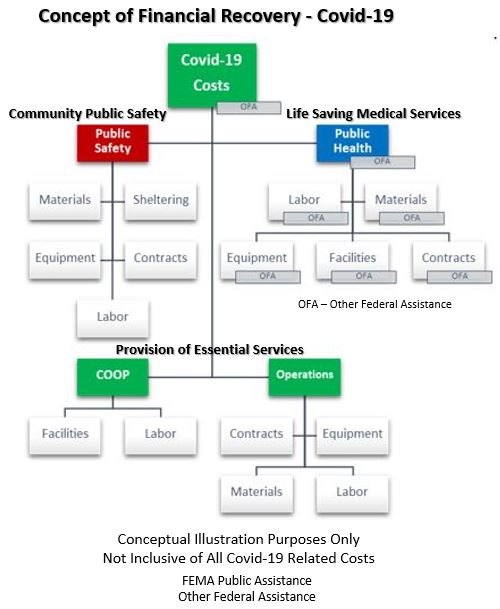
Waht are the Components of Facility Eligibility
Components of Facility Eligibility
The Federal Emergency Management Agency refers to these components as the building blocks of the Eligibility Pyramid. Generally, FEMA must determine whether each building block is eligible, starting at the foundation (Applicant) and working up to the top of the pyramid (cost).
The Applicant is responsible for demonstrating that each component of the pyramid is eligible by providing supporting documentation.
- FEMA accepts a variety of documentation to substantiate eligibility
- In some cases, FEMA requires specific documentation to support eligibility
There are two exceptions to the standard Eligibility Pyramid:
- Private nonprofits must own or operate an eligible facility in order for the Applicant to be eligible
- Evaluating facility eligibility is not a necessary step for most Emergency Work State, Territorial, Tribal, and Local Government Applicants
Facility Eligibility
A facility is a building, works, system, or equipment (built or manufactured), or an improved and maintained natural feature. A facility must be deemed eligible to qualify for the Public Assistance Grant Program.
- Components of a qualified facility include mechanical, electrical, plumbing, and other systems
- An example of a system that qualifies as a facility is a water distribution system
- A maintained natural feature may also be eligible. Unimproved property and land used for agricultural purposes are not eligible facilities. A natural feature is improved and maintained if it meets all of the following conditions. Only the section of the natural feature meeting the following criteria is eligible:
- The feature has designed and constructed improvements to its natural characteristics, such as a terraced slope or realigned channel
- The constructed improvement enhances the function of the unimproved natural feature
- The Applicant maintains the improvement on a regular schedule to ensure the improvement performs as designed
Facility Eligibility
For Private nonprofits, the facility must be eligible in order for the work to be eligible.
For State, Territorial, Tribal, and local governments, the facility must be eligible in order for Permanent Work, temporary repairs, or mold remediation to be eligible.
- Facility eligibility is not applicable to other types of Emergency Work
Public Facilities
An eligible public facility is one that a State, Territorial, Tribal, or Local government owns or has legal responsibility for maintaining, including any:
- Flood control
- Navigation
- Irrigation
- Reclamation
- Public power
- Sewage treatment and collection
- Water supply and distribution
- Watershed development
- Airport facility
- Non-Federal-aid street, road, or highway
- Other public building, structure, or system, including those used for educational, recreational, or cultural purposes
Private Nonprofit Facility
An eligible private nonprofit facility is one that provides educational, utility, emergency, medical, or custodial care, including for the aged or disabled, and other essential social services to the general public.
- If a private nonprofit operates multiple facilities, or a single facility composed of more than one building, FEMA will evaluate each building independently, even if all are located on the same grounds
- Buildings that are part of a complex that includes outdoor facilities (e.g., swimming pools, athletic fields, tennis courts) are not evaluated separately from the rest of the complex when determining eligibility of the building
Eligibility Requirements for Private Nonprofit Mixed-Use Facilities
A mixed-use facility is a private nonprofit facility that provides both eligible and ineligible services. Eligibility of mixed-use private nonprofit facilities depends on the primary use of the facility, which is determined by the amount of physical space dedicated to eligible and ineligible services and applies to both emergency and permanent work.
- Primary use: The use for which more than 50 percent of the physical space in the facility is dedicated
- FEMA evaluates the entire structure when determining primary use; it does not separately address individual areas, such as floors, basements, or wings
- Common space, such as bathrooms, hallways, lobbies, closets, stairways, and elevators, is not included when calculating mixed-use space
- If the facility is eligible, FEMA prorates funding based on the percentage of physical space dedicated to eligible services
- The Applicant is responsible for the balance of costs to restore the facility and must restore the entire facility to receive funding for repairs to the eligible-use portions of the facility
Eligibility Requirements for Private Nonprofit Mixed-Use Facilities
If space is available for use, but the Applicant cannot support that it is used for eligible services for more than 50 percent of operating time, then the Applicant may not be eligible for Public Assistance. When FEMA determines that 50 percent or more of physical space is dedicated to ineligible services, the entire facility is ineligible.
Eligibility Requirements for Private Nonprofit Mixed-Use Facilities
In cases where a private nonprofit Applicant shares use of a facility, the facility must be primarily owned by the private nonprofit Applicant and meet the primary use requirement, in order to be eligible. FEMA prorates funding for these facilities based on the percentage of physical space that the Applicant owns and dedicates to eligible services. The following guidelines are used to determine the eligibility of such facilities:
If the eligible private nonprofit owns the entire facility and leases a portion of it to another entity, the facility is eligible provided that the private nonprofit dedicates more than 50 percent of the facility for eligible services.
If the private nonprofit leases 50 percent or more of the facility to an ineligible Applicant, or for ineligible services, then the facility is ineligible.
If the eligible private nonprofit only owns a portion of the facility, it is eligible provided that the private nonprofit owns more than 50 percent of the facility and dedicates more than 50 percent of physical space for eligible services.
Alternate Use Facility
Alternate use facilities may be eligible for Public Assistance grant funding.
Alternate use facility: A facility that was serving an alternate function at the time of the incident but was not altered to provide that function.
- I.e., An Applicant designed and constructed an administrative building, but later used it as a school
FEMA provides Public Assistance funding to restore the facility either to the original pre-disaster function, or pre-disaster alternate function, whichever costs less.
Small Business Administration Loan Requirement
Following a Major Disaster Declaration, the U.S. Small Business Administration can provide loans to individuals and businesses for facility restoration.
For private nonprofits that provide non-critical, essential social services, FEMA only provides public assistance funding for eligible Permanent Work costs that a Small Business Administration loan won't cover.
- Non-critical private nonprofits must simultaneously apply for a disaster loan from the Small Business Administration.
Private nonprofits that provide critical services can apply to FEMA without having to apply to Small Business Administration.
- If the eligible portion of a mixed-use facility provides critical services (or is partially used to provide critical services), the Applicant may apply for public assistance funding without also applying to Small Business Administration for a loan.
- If the eligible portion of a mixed-use facility is used to provide services that are entirely non-critical, the Applicant must also apply to Small Business Administration for a loan.
Select this link for flowchart description.
Facility Under the Specific Authority of Other Federal Agencies
Other Federal agencies also have authority to provide assistance after disasters. If a facility is under the specific authority of another Federal agency, FEMA does not provide assistance to restore that facility even if that Federal agency does not provide funding to restore the facility.
- 72 Public Housing Authority facilities are eligible unless Congress appropriates funds to the U.S. Department of Housing and Urban Development for emergency capital needs for that facility
- Other Federal agencies have authority to conduct specific work that may overlap with FEMA's authority. FEMA does not provide assistance for that work except in certain, limited circumstances
Inactive or Partially Inactive Facility
To be eligible, a facility must have been in active use at the start of the incident period. Inactive facilities are not eligible, unless one of the following conditions is met:
- The facility was only temporarily inactive for repairs or remodeling (provided a contractor is not responsible for repair of disaster-related damage);
- The Applicant firmly established future active use in an approved budget; or
- The Applicant can clearly demonstrate its intent to begin use within a reasonable amount of time.
The above criteria also apply to facilities that are partially inactive at the start of the incident period. Inactive portions are not eligible unless one of the exceptions noted above applies.
Inactive or Partially Inactive Facility: Eligible Repairs
When eligible repairs benefit an area that was not in active use, FEMA prorates funding based on the percentage of the facility that was in active use.
- For example, if the roof of a partially used building is destroyed, FEMA limits the eligible cost to a prorated amount of the total cost to replace the roof based on the percentage of the building that was in active use.
For private nonprofit facilities, more than 50 percent of the facility had to be in active use for an eligible purpose at the time of the incident in order for the facility to be eligible.
Facility Scheduled for Repair or Replacement Including Deferred Maintenance
Facilities that are not yet under contract but scheduled for repair or replacement using non-Federal funds are eligible provided that the claimed damage did not exist prior to the incident (FEMA may review the bid and contract documents to validate).
- If damage existed prior to the incident, only the repair of damage caused by the incident is eligible.
- A facility scheduled for replacement within 12 months of the start of the incident period using Federal funds is not eligible.
- In such a case, the Applicant should coordinate with the agency funding the project to expedite replacement, if possible
Use of Disaster Recovery Consultants to assist with PA project work
FEMA's Public Assistance (PA) Program doesn't explicitly prohibit applicants from using Disaster Recovery Consultants to assist with PA project work. In fact, FEMA acknowledges the potential benefits consultants bring to the recovery process. Here's a breakdown of FEMA's position on Disaster Recovery Consultants:
FEMA Doesn't Endorse Specific Consultants:
- FEMA maintains a neutral stance on Disaster Recovery Consultants. They don't endorse or recommend specific firms.
Benefits of Using Consultants:
- FEMA recognizes that consultants can provide valuable expertise to applicants, particularly those with limited experience navigating the PA Program complexities.
- Consultants can assist with tasks like:
- Damage assessments
- Project scoping and development
- Grant application preparation
- Cost estimating
- Project management and compliance
Applicant Responsibility for Consultant Selection and Costs:
- The decision to use a Disaster Recovery Consultant rests entirely with the applicant (state, tribe, territory, or eligible non-profit).
- FEMA is not responsible for the fees or qualifications of any consultant an applicant hires.
FEMA's Role Regarding Consultants:
- FEMA focuses on ensuring applicants understand their responsibilities throughout the PA process, regardless of whether they use a consultant.
Recommendations for Working with Consultants:
- If you decide to use a consultant, FEMA recommends:
- Selecting a qualified consultant with experience in FEMA's PA Program.
- Establishing a clear contract outlining the consultant's scope of work, fees, and performance expectations.
- Maintaining clear communication and oversight of the consultant's work to ensure they are meeting your needs and complying with FEMA regulations.
Resources for Finding Qualified Consultants:
- FEMA doesn't provide a list of pre-approved consultants. However, some resources might be helpful in your search:
- National Emergency Management Association (NEMA): NEMA offers resources and directories related to disaster recovery, which might include consultant listings. (https://nemaweb.org/)
- State Emergency Management Agencies: Your state's emergency management agency might have information on qualified disaster recovery firms within your region.
Conclusion:
While FEMA doesn't endorse specific consultants, they acknowledge the potential benefits they offer. By carefully selecting a qualified consultant and maintaining clear communication throughout the process, applicants can leverage their expertise to expedite their recovery efforts and potentially strengthen their PA applications. Remember, the ultimate responsibility for project success rests with the applicant.
Under what conditions does FEMA fund removal of broken limbs on private property?
FEMA Funding for Broken Limb Removal on Private Property: Understanding the Exceptions
While FEMA generally doesn't fund debris removal on private property after disasters, there are specific exceptions for broken limbs under certain conditions:
- Imminent Threat: The broken limbs must pose a direct and serious danger to life, public health, or safety.
- SLTT Official Certification: A State, Local, or Tribal (SLTT) government official must certify the existence of the immediate threat.
- Legal Authority and Responsibility: The applicant (usually the property owner) must have the legal right and responsibility to remove the limbs.
- Documentation Required: Detailed records are necessary, documenting both the threat posed by the broken limbs and the removal process.
- Broken Limbs Extending Over Public Right-of-Way: FEMA may also consider funding removal if the broken limbs extend over public roads, sidewalks, or other public areas (right-of-way) and the minimum necessary portion is cut to eliminate the hazard from the public space.
Key Points to Remember:
- Meeting these conditions is essential for FEMA funding consideration.
- Broken limbs solely blocking access to a private property (e.g., driveway) typically wouldn't qualify.
- It's crucial to prioritize safety and consult with local authorities if you have concerns about broken limbs on your property.
For non-emergency situations, property owners are generally responsible for removing broken limbs from their own land.
Under what conditions can FEMA assist projects in Protected Areas?
FEMA can assist projects in ProtectedAreas under the following conditions:
- Projects must not require flood insurance after completion.
- Projects must be consistent with the purposes of the Coastal Barrier Resources Act.
- Projects must qualify as projects for the study, management, protection, and enhancement of fish and wildlife resources and habitats.
- Projects must meet one of the Coastal Barrier Resources Act exceptions if they occur in or adjacent to Coastal Barrier Resources System (CBRS) units.
- FEMA must consult with the appropriate U.S. Fish and Wildlife Service Ecological Services field office for projects in or adjacent to CBRS units.
- Proposed actions carried out within or adjacent to an otherwise protected area do not require consultation with the U.S. Fish and Wildlife Service.
- Projects intended to restore the facility back to pre-disaster condition using like materials.
- Projects with codes and standards upgrades.
- Projects involving replacement of contents, supplies, or equipment.
- Projects with minor repair, restoration, or construction on buildings or structures less than 45-50 years old or not listed or eligible for listing in the National Register of Historic Places.
These projects may qualify for streamlinedEnvironmental and Historic Preservation (EHP) review processes, enabling FEMAto make compliance determinations quickly without extensive consultations withmultiple parties or regulatory agencies.
Under what circumstances is debris removal in the public interest?
USE FOR INTRO
Top Line Messages:
• FEMA is simplifying the Public Assistance application and funding process to address the magnitude of this event and allow local officials to receive eligible funding more quickly.
• Public Assistance applicants are empowered to drive their own recovery and directly apply for reimbursement through a streamlined process designed to eliminate portions of the process that are unnecessary for the unique circumstances of, and types of assistance available for, response to COVID-19.
• While FEMA is making adjustments to streamline processes, we are keeping the adjustments as simple as possible and not deviating from the basic process with which experienced recipients and applicants are familiar.
• Funding is immediately available should local officials need expedited assistance.
• This is a dynamic environment. FEMA will be quick and clear in communicating changes. But the entire emergency management community should prepare for further adjustments in the delivery of Public Assistance for COVID-19 as we work together to assist the American people. Applicants are empowered to drive their own recovery and directly apply for reimbursement without an assigned Program Delivery Manager.
• The nature and scale of this national event are beyond anything the emergency management community has seen, with the most simultaneous FEMA PA applicants and project worksheets in the history of the program.
• Additionally, FEMA and recipient staff must alter work practices to follow CDC and local health official social distancing guidelines in order to slow the spread of COVID-19.
• To scale to an event of this size and maintain social distancing, it is not possible for FEMA or recipients to proactively work with every applicant to develop their subgrant project worksheets, as would be the case in a traditional disaster.
• Instead, FEMA is allowing applicants to directly apply for assistance in the PA Grants Portal at https://grantee.fema.gov.
• This prevents the need for applicants to wait on the availability of limited federal and recipient resources and provide applicants a transparent environment to request and quickly receive federal assistance.
Expedited funding is available to interested states, tribes and territories: o Expedited funding enables FEMA to provide 50 percent of the estimated project cost quickly based on limited information and provide the remainder of funding upon receipt of documentation. o Expedited projects can be processed in a timely manner, in most cases less than a week, when the recipient quickly provides information and responds to FEMA requests.
Troubleshoot viewing PDF files on the web
https://helpx.adobe.com/acrobat/kb/cant-view-pdf-web.html
Browser and browser-settings solutions
Use a different web browser
Certain conditions on your computer, such as security settings or browser cookies, can prevent you from viewing a PDF. Often, the fastest solution is to try to open the page using a different browser. Try any of the following browsers that you have not already tried:
Google Chrome
Mozilla Firefox
Microsoft Internet Explorer
Apple Safari
For a list of compatible browsers for Reader and Acrobat, see Compatible web browsers.
Switch to Compatibility View (Internet Explorer)
Some websites display better in the Compatibility View of Internet Explorer. The Compatibility View displays a page as if it were in an earlier version of the browser.
For instructions on how to switch to this view, see Fix site display problems with Compatibility View.
The current Simplified Acquisition Threshold (SAT) is $250,000. Is there a way for 2 CFR §300 procurement regulations to be waived or suspended for any purchase or acquisition that falls under the SAT during this event?
It has been determined that emergency and exigent circumstances exist based on the President’s Nationwide Emergency Declaration and the Secretary of the Health and Human Services’ (HHS) declaration of a Public Health Emergency for COVID-19. Therefore, non-state entities are permitted to non-competitively procure contracts pursuant to 2 CFR § 200.320(f)(2) for the duration of the COVID-19 Public Health Emergency as determined by HHS.
The Life of a PA Grant
The PA Program follows FEMA's common set of phases known as the Grants Management Life Cycle:
Pre-Award: Applicants work with the Recipient and FEMA to develop the award package for a grant.
Award: FEMA approves the award package and allocates funding.
Post-Award: Funds are released to the Recipients who must maintain, monitor, and report upon.
Closeout: FEMA administers performance evaluation, financial and appeal reconciliation, final reporting activities, appeal resolution and debt actions.
Post-Closeout: As necessary, FEMA performs debt collection actions, audit, and other adjustments may continue after grant closeout.
Special Considerations
Applicants may not duplicate benefits with insurance and must comply with Environmental, Historic Preservation, and Floodplain Management laws as part of the eligibility conditions. Procurement standards in the use of contracts for acquiring disaster-related goods and services must meet certain guidelines in order to receive funding.
Should I follow my local, state or federal procurement requirements?
Should I follow my local, state or federal procurement requirements?
Answer: It is recommended to utilize whatever is the most stringent between your local, state and federal procurement requirements. Insure you are documenting what method is being utilized for procurement and the reasoning in which it was chosen. Please see FEMA Public Assistance Program and Policy Guide (PAPPG) – Under Chapter 2: Public Assistance Policy, Section V. Costs Eligibility, Subpart G. Procurement and Contracting Requirements
Roles and Responsibilities
Multiple layers of government work in partnership to administer the PA Grant Program once a disaster has been declared. Each entity must work together to meet the overall objective of a quick, efficient, and effective program delivery.
FEMA's primary responsibilities are to determine the amount of funding, participate in educating the applicant on specific program issues and procedures, assist the applicant with the development of projects, and review the projects for compliance.
- FEMA: The federal awarding agency authorized to manage the program.
- Recipients: The State, Territorial, or Tribal government that receives funding under the disaster declaration and disburses funding to approved subrecipients.
- Applicants: Entities submitting a request for assistance under the recipient's federal award.
- Subrecipients: Applicants who have received a subaward from the Recipient and is then bound by the conditions of the award and subaward.
PA) Small Project threshold to $1 million has brought about some changes
The increase in FEMA's Public Assistance (PA) Small Project threshold to $1 million has brought about some changes for applicants, particularly regarding documentation and cost estimating. Here's a breakdown of the potential impact:
Potential Benefits:
- Reduced Documentation Burden: For projects under $1 million, the streamlined "Simplified Procedures" apply. This generally means less documentation is required compared to larger projects. This can expedite the application process and reduce administrative costs for applicants.
- Simplified Cost Estimating: For smaller projects, FEMA might allow for less detailed cost estimating methods compared to the FEMA Cost Estimating Format (CEF) typically used for larger projects. This can simplify the process for applicants with limited resources or experience in preparing construction cost estimates.
Potential Complications:
- Accuracy Concerns: While less detailed cost estimating methods might be allowed, there's a risk of underestimating project costs. This could lead to funding shortfalls later in the project if actual costs exceed initial estimates.
- Maintaining Audit Trail: Even with simplified procedures, applicants still need to maintain proper documentation to justify all claimed costs. This includes invoices, receipts, and time records.
- Varying Implementation: The specific documentation requirements and cost estimating methods might vary depending on your state or FEMA regional office. It's crucial to consult with your FEMA program specialist for the latest guidance.
Overall Impact:
The increased threshold offers potential benefits for applicants by streamlining the process for smaller projects. However, it's important to approach this change with caution:
- Don't Skimp on Documentation: While less documentation might be required, maintain a clear audit trail to avoid issues during project audits or reimbursement disputes.
- Consider Cost Estimating Expertise: Even for smaller projects, consider seeking professional cost estimating expertise to ensure your estimates are accurate and realistic.
- Stay Informed: Stay updated on FEMA's latest guidance and clarifications regarding documentation and cost estimating requirements for small projects under the $1 million threshold.
Additional Resources:
- FEMA PA Simplified Procedures Policy Webinar - Frequently Asked Questions: https://www.fema.gov/sites/default/files/documents/fema_pa-simplified-procedures-policy.pdf ([invalid URL removed])
- FEMA Public Assistance Grant Program Website: https://www.fema.gov/assistance/individual
By understanding these potential benefits and complications, applicants can leverage the increased small project threshold to expedite their recovery efforts while ensuring they meet all documentation and cost estimating requirements for successful FEMA PA Program participation.
PA Mandatory Flood Insurance Reduction rule
The FEMA PA Mandatory Flood Insurance Reduction rule applies a reduction to FEMA Public Assistance (PA) grant funding for certain facilities located in Special Flood Hazard Areas (SFHAs). Here's a breakdown of the key points:
What it is:
- This rule aims to incentivize communities to manage flood risks by requiring flood insurance for certain facilities.
- When a facility located in an SFHA is damaged by a disaster, and the facility owner doesn't have adequate flood insurance, FEMA reduces the amount of PA grant funding they receive.
How it applies:
- The reduction amount is typically equal to the maximum amount of insurance proceeds the facility could have received under a standard National Flood Insurance Program (NFIP) policy.
- This essentially means FEMA reimburses the applicant for the repairs minus the amount they could have recovered through flood insurance.
Justification:
- FEMA argues that communities that don't carry flood insurance on at-risk facilities are creating a burden on the federal government to repeatedly cover disaster recovery costs.
- The reduction is intended to encourage communities to take responsibility for flood risk mitigation by purchasing and maintaining flood insurance.
Exceptions:
- There might be exceptions to the Mandatory Flood Insurance Reduction rule in specific situations, such as:
- If the facility is not insurable under the NFIP program due to program limitations.
- If the applicant demonstrates they were actively pursuing flood insurance coverage at the time of the disaster.
Impact on Applicants:
- Applicants with facilities in SFHAs that lack flood insurance face a significant reduction in their PA grant funding if their project is deemed eligible for the reduction.
- This can create a financial burden for communities struggling to recover from disasters.
Important Considerations:
- FEMA regulations regarding the Mandatory Flood Insurance Reduction rule can be complex. It's crucial for applicants to understand their specific situation and potential impact on their PA grant funding.
- Applicants should consult with FEMA program specialists to determine if the reduction applies to their project and explore potential exceptions.
Resources:
- FEMA Public Assistance Policy Digest: Briefly mentions the Mandatory Flood Insurance Reduction ([invalid URL removed])
- FEMA Appeal Letters on NFIP Mandatory Reduction: These case studies illustrate how FEMA applies the reduction in specific situations. Search online using terms like "FEMA appeals NFIP mandatory reduction"
By understanding this rule and its implications, applicants can make informed decisions about flood insurance for their facilities and potentially minimize the impact of the reduction on their PA grant funding.
PA Insurance NON FLood
§ 206.253 Insurance requirements for facilities damaged by disasters other than flood.
(a) Prior to approval of a Federal grant for the restoration of a facility and its contents which were damaged by a disaster other than flood, the recipient shall notify the Regional Administrator of any entitlement to insurance settlement or recovery for such facility and its contents. The Regional Administrator shall reduce the eligible costs by the actual amount of insurance proceeds relating to the eligible costs.
(b)
(1) Assistance under section 406 of the Stafford Act will be approved only on the condition that the recipient obtain and maintain such types and amounts of insurance as are reasonable and necessary to protect against future loss to such property from the types of hazard which caused the major disaster. The extent of insurance to be required will be based on the eligible damage that was incurred to the damaged facility as a result of the major disaster. The Regional Administrator shall not require greater types and extent of insurance than are certified as reasonable by the State Insurance Commissioner.
(2) Due to the high cost of insurance, some applicants may request to insure the damaged facilities under a blanket insurance policy covering all their facilities, an insurance pool arrangement, or some combination of these options. Such an arrangement may be accepted for other than flood damages. However, if the same facility is damaged in a similar future disaster, eligible costs will be reduced by the amount of eligible damage sustained on the previous disaster.
(c) The Regional Administrator shall notify the recipient of the type and amount of insurance required. The recipient may request that the State Insurance Commissioner review the type and extent of insurance required to protect against future loss to a disaster-damaged facility, the Regional Administrator shall not require greater types and extent of insurance than are certified as reasonable by the State Insurance Commissioner.
(d) The requirements of section 311 of the Stafford Act are waived when eligible costs for an insurable facility do not exceed $5,000. The Regional Administrator may establish a higher waiver amount based on hazard mitigation initiatives which reduce the risk of future damages by a disaster similar to the one which resulted in the major disaster declaration which is the basis for the application for disaster assistance.
(e) The recipient shall provide assurances that the required insurance coverage will be maintained for the anticipated life of the restorative work or the insured facility, whichever is the lesser.
(f) No assistance shall be provided under section 406 of the Stafford Act for any facility for which assistance was provided as a result of a previous major disaster unless all insurance required by FEMA as a condition of the previous assistance has been obtained and maintained.
[56 FR 64560, Dec. 11, 1991, as amended at 82 FR 44, Jan. 3, 2017]
PA Insurance FLOOD
§ 206.252 Insurance requirements for facilities damaged by flood.
(a) Where an insurable building damaged by flooding is located in a special flood hazard area identified for more than one year by the Administrator, assistance pursuant to section 406 of the Stafford Act shall be reduced. The amount of the reduction shall be the maximum amount of the insurance proceeds which would have been received had the building and its contents been fully covered by a standard flood insurance policy.
(b) The reduction stated above shall not apply to a PNP facility which could not be insured because it was located in a community not participating in the NFIP. However, the provisions of the Flood Disaster Protection Act of 1973 prohibit approval of assistance for the PNP unless the community agrees to participate in the NFIP within six months after the major disaster declaration date, and the required flood insurance is purchased.
(c) Prior to approval of a Federal grant for the restoration of a facility and its contents which were damaged by a flood, the recipient shall notify the Regional Administrator of any entitlement to an insurance settlement or recovery. The Regional Administrator shall reduce the eligible costs by the amount of insurance proceeds which the recipient receives.
(d) The recipient or subrecipient is required to obtain and maintain flood insurance in the amount of eligible disaster assistance, as a condition of receiving Federal assistance that may be available. This requirement also applies to insurable flood damaged facilities located outside a special flood hazard area when it is reasonably available, adequate, and necessary. However, the Regional Administrator shall not require greater types and amounts of insurance than are certified as reasonable by the State Insurance Commissioner. The requirement to purchase flood insurance is waived when eligible costs for an insurable facility do not exceed $5,000.
[56 FR 64560, Dec. 11, 1991, as amended at 82 FR 44, Jan. 3, 2017]
Must the Centers for Disease Control and Prevention (CDC) or state/local public health officials direct the use of non-congregate sheltering?
Is it okay if another state/local official (e.g., emergency management office) directs the use?
The non-congregate sheltering must be at the direction of and documented through an official order signed by a state, local, tribal, or territorial public health official or be done in accordance with the direction or guidance of health officials by the appropriate state or local entities, in accordance with applicable state and local laws.
Legal Responsibility for FEMA Public Assistance Reimbursements
Legal Responsibility for FEMA Public Assistance Reimbursements: A Detailed Analysis
FEMA's Public Assistance (PA) Program reimburses eligible entities (states, tribes, territories, some private non-profits) for the costs of repairing or replacing essential infrastructure and facilities damaged by disasters. However, a critical aspect of receiving reimbursement is demonstrating legal responsibility for the work performed. Here's a deep dive into the legal responsibility requirement:
Basis for Legal Responsibility:
- The Stafford Act, the legal foundation for the PA Program, authorizes FEMA to reimburse costs associated with the "repair, restoration, reconstruction, or replacement" of facilities damaged by a declared disaster. (https://www.fema.gov/disaster/stafford-act)
- However, the Act emphasizes that FEMA can only reimburse for work that the applicant has legal responsibility to perform. This ensures funding is directed towards restoring essential public services and infrastructure, not for discretionary projects.
Determining Legal Responsibility:
FEMA reviews several factors to determine if an applicant has legal responsibility for a proposed project:
- Statutes and Ordinances: FEMA examines state, local, and tribal laws to see if the applicant has a legal mandate to own, operate, and maintain the damaged facility. Building codes, zoning regulations, and specific agency charters are often reviewed.
- Deed Restrictions or Ownership Documents: For certain facilities (e.g., privately owned bridges used by the public), ownership documents or deeds of transfer might specify maintenance or repair responsibilities.
- Past Practices: FEMA may consider past actions of the applicant regarding the facility. If the applicant has historically funded repairs or maintenance for the facility, it strengthens their claim of legal responsibility.
- Customary Practices: In some cases, established customs or practices within a jurisdiction might be considered. For instance, a local government that has always repaired a specific bridge, even if not explicitly mandated by law, might be considered legally responsible.
Case Studies and Appeals:
- FEMA's Public Assistance Policy Digest and PAPPG (Public Assistance Policy Guide) offer case studies and scenarios to illustrate how legal responsibility is determined in various situations. Unfortunately, there isn't a single online version of the latest PAPPG, but most chapters are available on FEMA's website. Search for "FEMA Public Assistance Policy Guide" + Chapter number (e.g., Chapter 3).
- Applicants who disagree with FEMA's determination on legal responsibility can file an appeal. The appeals process involves submitting additional documentation or arguments to support their claim.
Additional Considerations:
- Changes in Ownership: If a facility's ownership changes hands before or after a disaster, legal responsibility for repairs might shift depending on the terms of the ownership transfer.
- Partial Ownership/Responsibility: In some cases, multiple entities might share ownership or responsibility for a facility. FEMA might explore cost-sharing agreements between these entities for project funding.
- Private Non-Profit Organizations: For private non-profits to be eligible for PA funding, they must demonstrate legal responsibility for the specific facility or service they provide.
Conclusion:
Legal responsibility is a critical element for FEMA PA Program eligibility. By understanding the factors FEMA considers and having clear documentation to support their claim, applicants can increase their chances of receiving reimbursement for disaster recovery efforts. Consulting with FEMA beforehand to discuss specific situations is always recommended to ensure a smooth application process.
Legal Responsibility
Legal
Is there a way to get money fast?
YES, FEMA HAS AN EXPEDITED FUNDING PLAN FOR COVID-19 COSTS - GET 50% QUICKLY OF ACTUAL AND ESTIMATED COVID-19 COSTS - READ MORE HERE
Immediate Needs Funding (INF) is money earmarked for the most urgent work in the initial aftermath of a disaster. The funds may be provided to any eligible applicant for eligible emergency work that must be performed immediately and paid for within the first 60 days following declaration. Eligible work typically includes debris removal, emergency protective measures, and removal of health and safety hazards. Immediate needs funds can be used for expenses resulting from this eligible work, such as temporary labor costs, overtime payroll, equipment, and material fees.
During the PDA, immediate needs are noted for each area surveyed. If a disaster is declared, and the State thinks damage costs warrant the need for immediate cash flow, the State may INF on your behalf. Up to 50% of the Federal share estimate of emergency monies will then be placed in the State's account. Because this money can be made available in advance of normal procedures once a disaster has been declared, paperwork and processing times are reduced and you can receive emergency funds sooner. Even though your facilities may have been included in the PDA, INF will not be available unless your county/city has been included in the presidential declaration.
Is there a time when full and open competition is not required?
A procurement action that does not meet the requirement for full and open competition, such as a sole source contracts, constitutes a violation of regulation and is unauthorized unless the award of a contract is infeasible under small purchase procedures, sealed bids or competitive proposals AND one of the following circumstances applies:
• The item is available only from a single source;
• The public exigency or emergency for the requirement will not permit a delay resulting from competitive solicitation;
• FEMA authorizes noncompetitive proposals; or
• After solicitation of a number of sources, competition is determined inadequate.
If an applicant takes a noncompetitive procurement action, the applicant must complete a cost analysis and may be required to submit the proposed procurement to FEMA for pre-a ward review. 10
Is there a cost share related to Direct Federal Assistance (DFA) Mission Assignments? If so, is the cost share eligible under PA?
Mission Assignments have the same cost-share provisions applicable to the declaration (25% non-Federal share). The recipient of DRA will “provide reimbursement to FEMA for the nonFederal share of the cost of such work in accordance with the provisions of the FEMA-State Agreement.”
Is childcare for essential workers reimbursable?
Answer: Under current FEMA policy, no.
Is Hazard Pay Reimbursable?
Answer: Only if triggered by the applicant’s pre-disaster personnel policy and only for overtime while performing eligible emergency protective measures.
How long should records be retained for a Federal award?
Key points regarding record retention for Federal awards:
- General Rule: Three years is the standard retention period. This starts from the date you submit your final expenditure report (2 CFR Part 200.333).
- Exceptions Exist: The specific type of record and the regulations of the awarding agency may dictate a different retention period.
- Always Check Award Details: Review the specific terms and conditions of your grant agreement for any additional requirements from the awarding agency.
- State and Local Requirements Apply: State, local, tribal, and territorial governments may have their own record retention rules that you must comply with.
Following these guidelines ensures you properly manage grant-related records and avoid any potential issues during audits or inquiries.
How is repair cost percentage calculated?
The repair cost percentage iscalculated by comparing the estimated repair cost to the estimated replacementcost, as outlined in the document. Here is how the calculation is performed:
- Numerator:some text
- The estimated repair cost is used as the numerator in the calculation.
- The repair cost estimate includes expenses related to repairing disaster-related damage only, along with costs for compliance with applicable codes and standards that apply to the repair of the damaged elements.
- Denominator:some text
- The estimated replacement cost is used as the denominator in the calculation.
- The replacement cost estimate is based on replacing the facility according to its pre-disaster design (size and capacity) and function in compliance with relevant codes or standards.
- Calculation:some text
- The repair cost estimate is divided by the replacement cost estimate.
- This division results in a fraction that expresses the repair cost as a percentage of the replacement cost.
- FEMA refers to this percentage calculation as the "50% Rule."
By comparing these two cost estimates,FEMA determines whether the repair cost exceeds 50% of the replacement cost,which is a key factor in deciding whether a facility is eligible for repair orreplacement funding.
How does PAAP differ from Section 406 projects?
- PAAP allows for the use of excess funds for FEMA-approved eligible activities, while Section 406 projects require deobligation of excess funds.
- PAAP applicants are not required to track costs of specific work items or facilities, unlike Section 406 projects.
- PAAP cost estimates are based on restoring the facility to its pre-disaster design and function, but applicants do not have to rebuild facilities back as they existed prior to the disaster, offering more flexibility in design and construction.
- PAAP reduces the administrative burden on applicants by lessening cost tracking and reporting requirements, as well as allowing for more flexibility in rebuilding, potentially leading to cost savings.
- Under Section 406, final financial reconciliation is based on actual costs, while PAAP obligates funds based on the estimated cost to restore the facility, with any excess funds available for certain FEMA-approved activities.
- PAAP includes an independent expert panel to review cost estimates for projects with a Federal share estimate of $5 million or more, providing an additional layer of oversight not present in Section 406 projects.
- PAAP allows for flexibility in project design and implementation, while Section 406 projects have more rigid guidelines.
- PAAP offers the option to modify construction plans to enhance resiliency and improve facilities beyond their pre-disaster state, a feature not typically available in Section 406 projects.
- PAAP provides the opportunity to share funds across projects, including hazard mitigation, whereas Section 406 projects may not have this flexibility.
- PAAP allows for faster obligation of funds after a disaster declaration compared to Section 406 projects.
- PAAP aims to reduce administrative burden on applicants, offering streamlined processes for project approval and completion, which may differ from the procedures involved in Section 406 projects.
How does PAAP benefit applicants in disaster recovery?
PAAP benefits applicants in disaster recovery throughfinancial incentives, reduced administrative burden, flexibility in rebuilding,potential cost savings, improved recovery process, and positive feedback fromsurvey responses.
The program offers financial incentives for timely andcost-effective project completion, reduces administrative burden by notrequiring specific cost tracking, allows flexibility in rebuilding damagedfacilities, potentially results in cost savings, and enhances communityrecovery efforts.
How does FEMA handle fixed-cost offers for projects?
FEMA handles fixed-cost offers forprojects by engaging qualified professionals to develop or review costestimates, transmitting the offers to applicants for consideration, consideringthe fixed-cost offer as an Alternative Procedures Project if accepted,obligating the fixed-cost amount, not adjusting the fixed amount for hiddendamage, adjusting the fixed estimate for insurance proceeds before projectclosure, and adjusting funding based on actual eligible costs at closeout. During the Scoping and Costing phase,FEMA reviews applicant-provided information to develop or validate the Scope ofWork and cost estimate, ensuring compliance with requirements and determiningcost eligibility. Additionally, FEMA works with applicants to agree ondisaster-related damage descriptions, emergency protective measures, and debrisimpacts before finalizing the Scope of Work. If a project exceeds $1 million andfunds are not needed for more than 180 days, FEMA follows the Strategic FundsManagement process for fund obligation.
How does FEMA estimate project costs?
FEMA estimates project costs byengaging qualified professionals to develop or review cost estimates, reviewingapplicant-provided information during the Scoping and Costing phase, ensuringcompliance with program requirements, and determining cost eligibility. They develop or validate the Scope ofWork and cost estimate for each project, consider the percentage of workcompleted, and adjust funding based on actual eligible costs at projectcloseout. FEMA also transmits fixed-cost offers to applicants, obligates fixed-costamounts without adjusting for hidden damage, and adjusts for insurance proceedsbefore project closure. They follow specific procedures outlined in the ProgramDelivery Guide for accurate and fair determination of project costs under thePublic Assistance Program.
How does FEMA determine the reasonableness of claimed hours?
Examining Employee Hours: How FEMA Evaluates Reasonableness for Reimbursement
FEMA reimburses applicants for labor costs associated with disaster response and recovery efforts. However, to ensure efficient use of funds, FEMA determines the reasonableness of claimed employee hours based on several key factors:
1. Severity of the Incident
- FEMA's Perspective: The severity of the disaster and the level of response required are considered.
- Example: More severe disasters with widespread damage and urgent needs might justify longer work hours for response teams.
2. Necessity of Extended Hours
- Focus on Time-Sensitive Tasks: FEMA assesses whether extraordinary work hours were truly necessary due to the specific incident.
- Critical Operations: This includes evaluating the presence of time-sensitive tasks or critical operations that demanded extended work periods.
3. Employee Function
- Roles and Responsibilities: FEMA considers the employee's job function and its inherent demands during emergencies.
- Example: Certain roles like emergency responders or critical infrastructure personnel might inherently require longer hours during response and recovery.
4. Consecutive Hours Worked
- Employee Well-being and Quality Work: FEMA examines the number of consecutive hours worked to ensure employee well-being and avoid fatigue.
- Impact on Performance: Excessive consecutive hours without proper rest periods can negatively affect employee safety, effectiveness, and the quality of work performed.
Importance of Documentation
To support the claimed hours and demonstrate their justification, applicants should provide FEMA with the following documentation:
- Timesheets: Detailed employee timesheets recording actual work hours.
- Work Logs: Logs that document specific tasks performed and the time spent on each task.
- Activity Reports: Reports that outline the activities undertaken by employees and the associated timeframes.
By providing this documentation, applicants can help FEMA make a fair and informed decision regarding the reasonableness of claimed labor costs.
Key Takeaway:
Understanding how FEMA evaluates employee hours is crucial for applicants seeking reimbursement. Focusing on the severity of the incident, the necessity of extended hours, employee roles, and managing consecutive hours worked, all contribute to a successful application. Maintaining proper documentation further strengthens your case for reimbursement.
How does FEMA determine the eligibility of overtime and compensatory time costs?
Navigating Overtime and Compensatory Time Reimbursement with FEMA
FEMA reimburses applicants for eligible overtime and compensatory time costs incurred during disaster response and recovery efforts. Here's a breakdown of the key criteria for reimbursement based on your pre-disaster written labor policy:
Policy Requirements:
- No Funding Contingency: Your policy should not state that overtime or compensatory time is only paid if federal funding is available (after a Presidential declaration). These costs should be eligible regardless of FEMA funding.
- Uniform Application: The policy should apply consistently to all employees, ensuring everyone receives overtime or compensatory time based on the same established criteria.
- Clear Activation Criteria: The policy must have objective, pre-determined criteria for triggering overtime and compensatory time. This could involve specific work hour thresholds or emergency situations.
Meeting these requirements allows FEMA to consider your overtime and compensatory time costs for reimbursement.
Documentation and Evaluation:
- Pre-Disaster Policy Documentation: Provide FEMA with a copy of your pre-disaster written labor policy to demonstrate compliance with the above criteria.
- Reasonableness and Necessity: FEMA will evaluate the claimed overtime and compensatory time hours based on:
- Severity of the disaster event
- Specific circumstances of the work performed
- Employee's function and role in the response/recovery effort
Following these guidelines ensures your labor policy aligns with FEMA's requirements and strengthens your application for reimbursement of overtime and compensatory time costs.
How does FEMA calculate fringe benefit cost for force account labor?
FEMA calculates fringe benefit costs for force account labor by applying a predetermined percentage to the total direct labor costs, which includes wages, salaries, and any applicable payroll taxes. The specific percentage used may vary depending on the region and type of work being performed. The resulting amount is the fringe benefit cost for the force account labor.
How do contractors typically charge for debris removal?
Contractors typically charge for debris removal based on a unit price for volume (cubic yards) or weight (tons). The specific method of charging may vary depending on the contractor and the nature of the debris being removed. Here are some common approaches:
- Volume-based pricing: Contractors may charge based on the volume of debris being removed, typically measured in cubic yards. They may use equipment such as loaders or trucks to estimate the volume and determine the price accordingly.It is worth noting that FEMA encourages Applicants to procure branch or limb removal from trees on a one-time charge per tree basis, rather than a unit price per limb or branch. This approach is considered more cost-effective.
- Weight-based pricing: In some cases, contractors may charge based on the weight of the debris being removed, measured in tons. They may use scales or other weighing methods to determine the weight and calculate the price accordingly.
- Per tree or stump pricing: For hazardous limbs, trees, and stumps, contractors often charge a price per tree or stump based on its size. The size may be measured by diameter or other relevant factors.
How can the Applicant organize and label their documentation in Grants Portal?
Here are some tips for organizing and labeling your documentation in Grants Portal:
- Create Folders: The Applicant can create folders within Grants Portal to categorize and organize their documentation. These folders can be named based on the type of documentation or the specific project/task they relate to. For example, folders can be created for pre-disaster photos, damage assessment reports, invoices, permits, etc.
- Use Descriptive Labels: Within each folder, the Applicant should use descriptive labels for individual documents. These labels should clearly indicate the content or purpose of the document. For example, a label for a photo document could be "Pre-Disaster Condition - Building A" or "Damage Assessment - Road Repair."
- Follow a Consistent Naming Convention: It is helpful to establish a consistent naming convention for documents to ensure clarity and ease of navigation. The naming convention can include relevant information such as the date, location, and type of document. For example, a document related to a damage assessment conducted on January 1, 2022, in City X can be named "20220101_DamageAssessment_CityX."
- Use Subfolders if Necessary: If there are multiple subcategories within a folder, the Applicant can create subfolders to further organize the documentation. For example, within the "Invoices" folder, subfolders can be created for different vendors or types of expenses.
- Maintain a Logical Folder Structure: It is important to maintain a logical folder structure that is intuitive and easy to navigate. The Applicant should consider the needs of reviewers and auditors who may access the documentation and ensure that the folder structure aligns with the requirements and expectations of the Public Assistance program.
- Regularly Update and Review: The Applicant should regularly update the folders and labels as new documentation is added or changes occur. It is also important to review the organization periodically to ensure that it remains efficient and effective.
By following these steps, the Applicant can effectively organize and label their documentation in Grants Portal, making it easier to locate and review the necessary information during the Public Assistance grant process.
How can applicants facilitate the EHP project compliance review?
- Consider alternative locations and actions, consult with SHPO or THPO for historic properties, review for endangered species, identify environmental justice concerns, comply with floodplain and wetland regulations, obtain Clean Water Act certifications and permits, and coordinate with other federal agencies.
- Provide detailed information, submit supporting documentation, obtain necessary permits, share pre-existing permits, document correspondence, and adhere to permit conditions to expedite the EHP compliance review process.
How can Improved Project funds be used?
Improved Project funds can be used:
- Improved Project funds can be used to improve the damaged facility while ensuring it retains the same function it had immediately prior to the disaster.
- Examples of using Improved Project funds include: some text
- Laying asphalt on a gravel road.
- Replacing a firehouse with more bays than the original.
- Incorporating requirements from a code or standard that does not meet PA eligibility criteria.
- Relocating a facility when FEMA does not require the relocation.
- The funding available for PA hazard mitigation for an Improved Project is limited to the amount that would have been available if the facility had been restored to its pre-disaster design.
Improved Project funds can be combined withfunds from another federal agency to construct the project, but these externalfunds cannot be used towards the non-federal cost share of the PA-fundedproject, with few exceptions.
How are improved and alternate project different
The differences between ImprovedProjects and Alternate Projects, as explicitly mentioned in the document, areas follows:
Improved Projects:
- Definition: An Improved Project involves making improvements to a damaged facility while still restoring it to its pre-disaster function.
- Funding Limitations: FEMA limits Public Assistance (PA) funding for an Improved Project to the lesser of the federal share of the approved estimate to restore the facility to its pre-disaster design and function or the federal share of the actual costs of completing the Improved Project.
- Use of Funds: Improved Project funds can be used to improve the damaged facility, with examples including laying asphalt on a gravel road, replacing a firehouse with more bays, and relocating a facility.
- Eligibility: The facility must have the same function that existed immediately prior to the disaster.
- Mitigation: Funding for PA hazard mitigation for an Improved Project is limited to what would have been available if the facility had been restored to its pre-disaster design.
Alternate Projects:
- Definition: An Alternate Project is chosen when the applicant determines that restoring the pre-disaster function of a damaged facility is not in the public welfare's best interest.
- Funding Limitations: FEMA limits federal funding for an Alternate Project to the lesser of the federal share of the approved estimate to restore the facility to its pre-disaster design and function or the federal share of the actual cost of completing the Alternate Project.
- Use of Funds: Alternate Project funds can be used for various purposes, such as repairing, expanding, mitigating, or constructing a facility, demolishing facilities, purchasing capital equipment, funding project shortfalls, supplementing funds for an Improved Project, and conducting hazard mitigation measures.
- Restrictions: Alternate Project funds have restrictions on their use, such as not being able to fund budget shortfalls, create new community plans, or pay for operating expenses.
- Mitigation: Alternate Project funds can be used for hazard mitigation measures that reduce the risk of future damage, even if the facility was not damaged by the incident.
How are Reassigned Employees costs reimbursed
Reassigned employee costs are reimbursed by FEMA based on the employee's normal pay rate.
FEMA provides Public Assistance (PA) funding for these costs, considering the labor expenses incurred by the Applicant for the reassigned employees. When seeking reimbursement, the Applicant must submit documentation that supports the labor costs claimed for the reassigned employees.
This documentation should include: Summary of actual costs for completed work: The Applicant needs to provide a summary of the actual costs incurred for the work performed by the reassigned employees. How are reassigned employee costs reimbursed? FEMA reimburses these costs based on the employee's normal pay rate. The Applicant must provide documentation supporting the labor costs claimed for the reassigned employees. This documentation includes a summary of actual costs, individual details for each employee, fringe benefit calculations, and the pay policy.
FEMA evaluates the reasonableness and eligibility of the labor costs claimed and reimburses the Applicant if the costs meet the necessary criteria.Individual details: For each reassigned employee, the Applicant must provide the following information: NameJob title and function Type of employee (e.g., full-time exempt, full-time non-exempt, part-time, temporary) Days and hours worked Pay rates and fringe benefit rate Description of work performed, along with representative samples of daily logs or activity reports, if available Timesheets: The Applicant may be required to provide representative samples of timesheets when requested by FEMA.
Fringe benefit calculations: The Applicant needs to include calculations of fringe benefits, which are additional costs associated with the employee's compensation package, such as holiday leave, accrued vacation leave, sick leave, social security matching, Medicare matching, unemployment insurance, workers' compensation, retirement, health insurance, life and disability insurance, and administrative leave. Pay policy: The Applicant must provide the pay policy that outlines the compensation and benefits structure for the reassigned employees. Based on the documentation provided, FEMA evaluates the reasonableness and eligibility of the labor costs claimed for the reassigned employees. If the costs are deemed reasonable and meet the necessary criteria, FEMA will reimburse the Applicant for these costs as part of the Public Assistance program.
Grant Conditions - Procurement
Federal assistance comes with laws, rules and regulations that must be followed to maximize opportunities for eligible reimbursements. Following the laws, rules and meeting regulatory requirements help to expedite needed funding and speed the delivery of preparedness, prevention, response, recovery and mitigation initiatives and programs for emergency management professionals, citizens and communities. For this reason, GOHSEP created several informational tools to educate our subrecipients in the various laws, rules, regulations and policies that apply to them.
It is important that when procuring any materials, goods or services with Federal funding that the Code of Federal Regulations (CFR) be followed. This applies to all disaster and non disaster grants funded by FEMA – Preparedness, Hazard Mitigation (HM) and Public Assistance (PA) Grants. Failure to comply with Federal regulations when procuring with Federal funds has been the biggest reason the U.S. Department of Homeland Security Office of Inspector General (DHS – OIG) has recommendations for deobligation of funding.
General Rule
A Subrecipient (Applicant) is allowed to use its own procurement process as long as that process conforms to the Federal procurement requirements as stated above. When the Subrecipient’s (Applicant’s) process is not as stringent as the above, the Subrecipient (Applicant) must comply with the requirements of Federal regulations. Many times State law is more stringent than Federal regulations, in which case, the Subrecipient is required to apply State law to the procurement transaction.
FAQ Into
Federal Assistance Guidance for Emergency Managers
The information and resources on this page are available for Local Emergency Management Agencies in the State of Tennessee as guidance on the federal funding assistance available to local jurisdictions through the COVID-19 National Emergency Declaration.
The National Emergency Declaration authorizes FEMA is to provide Public Assistance (PA) funding to state and local jurisdictions (counties and municipalities) for Category B Emergency Protective measures, which are those actions a community undertakes before, during, and following a disaster to save lives, protect public health and safety, and eliminate the immediate threat.
On this page you will find links to federal guidance, FAQs, and forms to help Local Emergency Management Agencies understand the processes for capturing, reporting, and receiving reimbursement for proper Category B costs.
This information is only related to the FEMA Category B Assistance available under the Stafford Act for the COVID-19 National Emergency. Information for applicants and assistance for COVID-19 funding from the the U.S. Centers for Disease Control and Prevention is available at: https://www.cdc.gov/grants/public-health-emergencies/covid-19/index.html.
Essential Elements of Information: What is It?
Public Assistance Grants: Understanding Essential Elements of Information (EEI)
The Federal Emergency Management Agency (FEMA) requires applicants seeking Public Assistance Grants to submit Essential Elements of Information (EEI). This is a specific set of documents and details crucial for processing your grant application.
What is EEI?
Think of EEI as a checklist outlining the documentation needed to support your damage claims and project's eligibility for funding. It's developed based on the Recovery Scoping Meeting and a set of pre-determined questions.
How does the EEI process work?
- Request for Information: Following the Recovery Scoping Meeting, the Program Delivery Manager initiates an EEI request through the Grants Manager and Grants Portal.
- Applicant's Role: You, the applicant, will receive a notification detailing the requested documents and information. It's crucial to submit everything within the specified timeframe.
- FEMA's Review: The EEI helps FEMA assess the damage severity, project costs, and your eligibility for grant funding.
What type of information does EEI typically include?
The EEI may vary depending on your project, but commonly requested documents include:
- Photos and maps depicting the damage
- Technical reports detailing the repairs
- Permits required for the project
- Payroll policies and receipts for any completed work
- Environmental and historical impact assessments (if applicable)
- Insurance documentation
- Flood plain mapping (if applicable)
Why is EEI important?
By providing the requested EEI, you demonstrate compliance with FEMA's documentation requirements. This strengthens your application and increases your chances of securing Public Assistance funding to complete your project.
EMA develops the eligible scope of work for permanent work reimbursement:
FEMA's Public Assistance (PA) Program reimburses eligible entities for the costs of permanent work necessary to repair or replace facilities damaged by disasters. Here's a breakdown of how FEMA develops the eligible scope of work for permanent work reimbursement:
Collaboration and Documentation:
- The process starts with collaboration between the applicant (state, tribe, territory, or eligible non-profit) and FEMA.
- The applicant identifies damaged facilities and submits project descriptions outlining the scope of work needed for repairs or replacements. This scope of work should detail the specific activities and materials required to restore the facility to its pre-disaster condition.
Damage Assessment and Eligibility Review:
- FEMA reviews the proposed scope of work to ensure it aligns with eligible permanent work activities.
- This involves assessing the extent of damage and determining if repairs are necessary to restore the facility's functionality.
- FEMA might utilize engineers or other specialists to evaluate the damage and validate the proposed repairs.
FEMA Cost Estimating Format (CEF):
- For large construction projects, FEMA utilizes the Cost Estimating Format (CEF) to establish the eligible cost of permanent work.
- The CEF breaks down project costs into various categories like materials, labor, and equipment. Applicants might need to justify their cost estimates using the CEF format.
Compliance and Legal Considerations:
- FEMA ensures the proposed scope of work adheres to all applicable laws, regulations, and building codes.
- This includes considerations like environmental regulations, floodplain management standards, and accessibility requirements for public facilities.
Negotiation and Approval:
- Once FEMA has reviewed the scope of work, cost estimates, and compliance factors, they might negotiate specific details with the applicant.
- This could involve adjusting the scope of work to ensure it's truly necessary for permanent repairs while staying within eligible costs.
- Upon reaching an agreement, FEMA formally approves the final scope of work for permanent work reimbursement.
Resources:
- FEMA Public Assistance Alternative Procedures Pilot Program Guide for Permanent Work Version 3: https://www.fema.gov/sites/default/files/2020-07/fema_PAAP-perm-work-guide-V3_3-29-2016.pdf
- FEMA Public Assistance Policy Guide (PAPPG): While there isn't a single online version of the latest PAPPG, most chapters are available on FEMA's website. Search for "FEMA Public Assistance Policy Guide" + Chapter number (e.g., Chapter 3).
Additional Points:
- The specific process for developing the eligible scope of work might vary depending on the project size, complexity, and your state or FEMA regional office.
- It's crucial to maintain clear communication and collaboration with FEMA program specialists throughout the process to ensure your proposed scope of work is aligned with FEMA's eligibility criteria.
Do all contracts have to be competitively bid?
All contract procurement should be conducted in a manner providing full and open competition in compliance with State and local procurement regulations. Contracts will normally be competitively bid unless one of the following instances apply:
• The item is available only from a single source;
• The awarding agency authorizes noncompetitive proposals;
• After solicitation of a number of sources, competition is determined inadequate; or
• The contract will eliminate or reduce an immediate threat to life, public health or safety.
Do You Have A List of Procurement Resources
Below are various resources developed by various sources as guidance on the procurement under grants rules. These resources do not constitute legal advice or FEMA eligibility. Please consult your organization's servicing counsel on your local requirements. However, keep in mind that the most restrictive rules apply wherever State, local or Federal. Federal rules are the minimum.
- Top 10 Procurement Under Grants Mistakes Flyer
- Top 10 Procurement Under Grants Mistakes the Can Lead to Loss of FEMA Public Assistance Funding
- Key Points for Non-State Entities on How to Avoid the Top 10 Procurement Under Grants Mistakes
- Procurement Under Public Assistance Awards Brochure
DETAIL RESOURCES
- Supplement (Based on Procurement Standards in Effect for Disaster Declarations Issued ON or AFTER December 26, 2014)
- Cost and Pricing Guide
- Checklist for Non-Federal Entity Procurements Associated with Declarations Issued ON or AFTER December 26, 2014 (2 C.F.R. pt. 200)
- Checklist for Institutions of Higher Education, Hospitals, and Other Private Nonprofit Procurements Associated with Declarations Issued BEFORE December 26, 2014 (2 C.F.R. pt. 215)
- Contract Provisions Template
- Template for Comparison of Federal and State Procurement Requirements as Applicable Under FEMA’s Public Assistance Program
- PDAT Course Description
- Private Nonprofit Requirements (2 C.F.R. §§ 215.40-.48)
- OIG audit that led to creation of PDAT: OIG-14-46-D: FEMA’s Dissemination of Procurement Advice Early in Disaster Response Periods
Procurement Resources
- Current 2 C.F.R. pt. 200
- Online C.F.R. by year
- Federal Acquisition Regulation
- Federal Register Notices
- Grace Period Increased to Three Fiscal Years (82 Fed. Reg. 22,609 (codified at 2 C.F.R. § 200.110(a)) (May 17, 2017)
- Micro-Purchase Threshold Raised to $3,500 (80 Fed. Reg. 38,295 (codified at 48 C.F.R. § 2.101(b)(2)) (July 2, 2015))
- Final Rule: DHS/FEMA Adoption of Uniform Administrative Requirements, Cost Principles, and Audit Requirements for Federal Awards, 80 Fed. Reg 59,549 (Oct. 2, 2015)
- Joint Interim Final Rule: Federal Awarding Agency Regulatory Implementation of Office of Management and Budget's Uniform Administrative Requirements, Cost Principles, and Audit Requirements for Federal Awards (79 Fed. Reg. 75,871 (Dec. 19, 2014)
- Final Guidance: Uniform Administrative Requirements, Cost Principles, and Audit Requirements for Federal Awards (78 Fed. Reg. 78,590 (Dec. 26, 2013))
- Uniform Grant Crosswalk from Final Guidance to Prior OMB Circulars
- Uniform Guidance Crosswalk from Prior OMB Circulars to Final Guidance
- Uniform Guidance Administrative Requirements (Including Procurement Standards) Text Comparison to Prior Requirements
- Federal Agency Codification of Governmentwide Requirements and Guidance for Grants and Cooperative Agreements (June 2015)
- Other FEMA Resources
- FEMA Public Assistance Program
- Procurement-Related Public Assistance Second Appeals
- Socioeconomic Contracting Resources
- Small Business Administration (SBA)
- Search for SBA Offices
- List of State Procurement Agencies
- Procurement Technical Assistance Centers
- Dynamic Small Business Search
- Contracting Resources for Small Businesses
- Small Business Development Centers
- Women's Business Centers
- Minority-Owned Businesses
- Department of Commerce: Minority Business Development Agency (MBDA)
- MBDA Business Centers
- List of State and Local Sponsored Minority Business Enterprise and Disadvantaged Business Enterprise Programs
- List of State Offices for Minority and Women Business Enterprises
- Women’s Business Enterprise National Council
- Department of Labor: Labor Surplus Area
- System for Award Management: Search Records (Use "Advanced Search - Entity" function to search by socio-economic status)
- Additional Procurement Resources
- Association of Procurement Technical Assistance Centers
- National Association of State Procurement Officials
- North American Industry Classification System (NAICS)
- 2017 NAICS Manual
- NAICS Association
- NAICS Association: Code Identification Tools
- System for Award Management (SAM.gov)
- Disaster Response Registry
- Description: Database of contractors willing to provide debris removal, distribution of supplies, reconstruction, and other disaster or emergency relief supplies and/or services
- NOTE: Use of a contractor from this Registry does not relieve a recipient or subrecipient from the requirement to comply with applicable Federal procurement standards
- Available on SAM.gov (Use "Search Records" function and then select "Disaster Response Registry Search")
- Description of Disaster Response Registry of Contractors
- SAM.gov Quick Start Guide for Disaster Response Registry Search
- Procurement of Recovered Materials
- U.S. Environmental Protection Agency's Comprehensive Procurement Guideline Program
- Current 40 C.F.R. pt. 247: Comprehensive Procurement Guideline for Products Containing Recovered Materials
- General Services Administration (GSA) Resources for State & Local Governments
- Programs for State and Local Governments
- State and Local Government Customers
- Disaster Purchasing FAQs
- Cooperative Purchasing FAQs
- GSA Ordering Procedures
- For Supplies, and for Services Not Requiring a Statement of Work (48 C.F.R. § 8.405-1 (current))
- For Services Requiring a Statement of Work (48 C.F.R. § 8.405-2 (current))
- GSA eLibrary
- About GSA eLibrary
- Cooperative Purchasing - State & Local Governments
- Disaster Relief - State & Local Governments
- Disaster Purchasing - State & Local Governments
- GSA Advantage®
- About GSA Advantage®
- State & Local Governments
- Federal Surplus Personal Property Donation Program
- State Agencies for Surplus Property (SASP) Contacts
- GSAXcess.gov
- Justice Technology Information Center: Federal Excess Property
- Department of Homeland Security (DHS) Office of Inspector General (OIG)
- OIG Audits of FEMA
- OIG Hotline
Codes and Standards guidance for ensuring repairs and replacements funded through the program meet minimal quality and safety benchmarks
FEMA's Public Assistance Program and Policy Guide (PAPPG) outlines Codes and Standards guidance for ensuring repairs and replacements funded through the program meet minimal quality and safety benchmarks. Here's a breakdown of the key points:
Purpose:
- The Codes and Standards guidance aims to:
- Ensure repairs and replacements funded by FEMA are built to withstand future disasters.
- Promote consistency in applying building codes across different communities.
- Minimize the risk of injuries or property damage from future events.
Types of Codes and Standards:
- FEMA requires adherence to consensus-based codes, specifications, and standards (referred to as "codes" for simplicity). These encompass various aspects of construction and repairs, including:
- Building codes (e.g., International Building Code - IBC)
- Electrical codes (e. National Electrical Code - NEC)
- Plumbing codes (e.g., International Plumbing Code - IPC)
- Life safety codes (e.g., International Fire Code - IFC)
- Accessibility standards (e.g., Americans with Disabilities Act - ADA)
FEMA's Minimum Requirements:
- While some communities might have stricter building codes, FEMA generally requires adherence to the latest editions of nationally recognized codes at a minimum.
- For buildings, these typically include the International Building Code (IBC), International Residential Code (IRC), or equivalent standards.
Flexibility for Disaster-Resistant Features:
- FEMA allows exceeding the minimum codes if the project incorporates features that improve the structure's resilience to future disasters.
- This could involve stronger windstorm protection, flood mitigation measures, or earthquake-resistant construction techniques.
Finding the Applicable Codes:
- The specific codes applicable to your project will depend on the type of facility being repaired or replaced, its location, and the nature of the disaster damage.
- Appendix A of the PAPPG offers a table that links facility types to potentially applicable codes.
- Important Note: Refer to the most recent version of the PAPPG for the latest information on Appendix A.
Additional Considerations:
- State or local building code amendments: Some states or localities might have adopted stricter versions of national codes. FEMA requires adherence to these stricter amendments as well.
- Pre-disaster codes vs. current codes: In some cases, FEMA might allow repairs to follow the building codes in effect at the time of the disaster's construction (pre-disaster code). However, there might be limitations, and consulting with FEMA is recommended.
Resources for More Information:
- FEMA Public Assistance Policy Guide (PAPPG): Chapter 2: Public Assistance Policy, Section VII.B Permanent Work Eligibility: Codes and Standards ([invalid URL removed])
- International Code Council (ICC) - Building Safety Codes: https://www.iccsafe.org/ (Provides information on various building codes)
- National Fire Protection Association (NFPA): https://www.nfpa.org/en (Offers resources on life safety codes)
Remember: FEMA regulations can be intricate. It's always recommended to consult directly with FEMA for the most up-to-date information on Codes and Standards requirements applicable to your specific project.
Can you provide a template for non-congregate sheltering requests?
Yes, there is a template request letter that the Applicant can use. In addition, Template Project Worksheets are currently being developed. Please contact your Regional point of contact for additional information concerning the template.
Can the Request for Public Assistance (RPA) timeline be extended?
A: Yes, the deadline to submit the Request for Public Assistance (RPA) for the COVID-
19 the RPA deadline is nationally extended and will remain open for the duration of the
Public Health Emergency, as declared by the Secretary of Health and Human Services,
unless an earlier deadline is deemed appropriate by the FEMA Assistant Administrator,
Recovery Directorate.
Can local governments and other eligible entities hire vendors to provide advocacy and support for the PA reimbursement process? And are the vendor costs eligible for reimbursement?
Due to the strain on local government agencies and other eligible entities in dealing with a public health crisis of this magnitude and the extreme complexity of federal disaster reimbursement guidelines, FEMA subrecipients such as local governments can benefit from contracting with an experienced vendor to provide oversight and advocacy on their behalf through the PA reimbursement process. These vendor costs are eligible for reimbursement under this declaration and much of these costs can be offset by federal reimbursements.
Can a FEMA Regional Administrator approve non-congregate sheltering after it has already begun?
In limited circumstances where the nature of the emergency did not make a request feasible prior to beginning non-congregate sheltering, the Regional Administrator may approve non-congregate sheltering after it has already commenced.
Can a FEMA Regional Administrator allowed to delegate approval of non-congregate sheltering?
No, this delegation may not be re-delegated. The Regional Administrator should approve, partially approve, or deny the request in writing. This documentation should be uploaded to the project in FEMA Grants Manager.Public Assistance: Non-Congregate Sheltering Delegation of Authority
Under President Trump’s March 13, 2020, national emergency declaration for the coronavirus (COVID-19) pandemic, FEMA’s Regional Administrators have been delegated
authority to approve requests for non-congregate sheltering for the duration of the Secretary of Health and Human Services’ declaration of a Public Health Emergency for
COVID-19.
In accordance with section 502 of the Robert T. Stafford Disaster Relief and Emergency Assistance Act, eligible emergency protective measures taken to respond to the COVID-19 emergency at the direction or guidance of state,
local, tribal, and territorial public health officials may be reimbursed under Category B of FEMA’s Public Assistance program.
FEMA recognizes that non-congregate sheltering may be necessary in this Public Health Emergency to save lives, to protect property and public health, and to ensure public safety, as well as to lessen or avert the threat of a
catastrophe. States, tribes and territories should work with their regional administrators for approval of noncongregate sheltering and procure the necessary support services needed to meet the needs of the public health
emergency. The following criteria must be considered before setting up non-congregate sheltering and supportser vices:
- The non-congregate sheltering must be at the direction of and documented through an official order signed by a state, local, tribal, or territorial public health official.
- Any approval is limited to that which is reasonable and necessary to address the public health needs of the event and should not extend beyond the duration of the Public Health Emergency.
- Applicants must follow FEMA’s Procurement Under Grants Conducted Under Exigent or Emergency Circumstances guidance and include a termination for convenience clause in their contracts
- Prior to approval, the applicant must provide an analysis of the implementation options that were considered and a justification for the option selected.
- The funding for non-congregate sheltering to meet the needs of the Public Health Emergency cannot be duplicated by another federal agency, including the U.S. Department of Health and Human Services or Centers for Disease Control and Prevention.
- Applicable Environmental and Historic Preservation laws, regulations, and executive orders apply and must be adhered to as a condition of assistance.
###
Last Updated: March 19, 2020 - 14:05 XXXXXX
Can Applicants purchase their own personal protective equipment (PPE) if the costs are considered reasonable?
Yes, the costs to purchase or replace PPE is eligible. Per PAPPG Page 28 (PDF Page 39), the cost of such supplies is eligible if: “purchased and justifiably needed to effectively respond to and/or recover from the incident; or taken from the Applicant’s stock and used for the incident.” FEMA will provide funding for PPE based on either invoices or inventory records. Funding for items used from inventory will be priced according to the Applicant’s established method. If the Applicant does not have an established method, funding will be based on historical data or other prices from comparable vendors.
Based on the eligibility pyramid, could counties act as the Applicant on behalf of municipalities, special districts and private non-profits?
Typically, State statute does not allow for counties to be legally responsible for other entities such as schools, medical facilities, etc. However, there are instances where counties have been granted legal responsibility over townships. If the State believes statute currently exists to grant legal authority to the counties, the State should submit the applicable statute for FEMA legal review.
Are you an Eligible Applicant. what types of entities are eligible for FEMA Public Assistance?
State, Territorial, and Indian Tribal Governments and Local Governments
The following types of local governments are eligible Applicants
- Counties and parishes
- Municipalities, cities, towns, boroughs, and townships
- Local public authorities
- School districts
- Intrastate districts
- Councils of governments (regardless of whether incorporated as nonprofit corporations under State law)
- Regional and interstate government entities
- Agencies or instrumentalities of local governments
- State-recognized Tribes
- Special districts established under State law
- Community Development Districts are special districts that finance, plan, establish, acquire, construct or reconstruct, operate, and maintain systems, facilities, and basic infrastructure within their respective jurisdictions. To be eligible, a Community Development District must be legally responsible for ownership, maintenance, and operation of an eligible facility that is accessible to the general public.
The State or a political subdivision of the State may submit applications on behalf of rural communities, unincorporated towns or villages, and other public entities not listed above.
- Private Non-Profit Organizations - Fact Sheet for COVID-19 and Private Nonprofit Organizations
Only certain Private Non-Profit (PNP) Organizations are eligible Applicants. To be an eligible PNP Applicant, the PNP must show that it meets the tax-exempt status, own or operate an eligible facility. An eligible facility is one that provides an eligible service.
Tax-Exempt Status
- A current ruling letter from the U.S. Internal Revenue Service granting tax exemption under sections 501(c), (d), or (e) of the Internal Revenue Code of 1954;
- Documentation from the State substantiating it is a non-revenue producing, nonprofit entity organized or doing business under State law.
Eligible Services - click here for a chart of Critical, Non-Critical and Non-Eligible Services
- A facility that provides a critical service, which is defined as education, utility, emergency, or medical; or
- A facility that provides a non-critical, but essential social service AND provides those services to the general public. PNP facilities generally meet the requirement of serving the general public if ALL the following conditions are met:
Facility use is not limited to any of the following:
- A certain number of individuals;
- A defined group of individuals who have a financial interest in the facility, such as a condominium association;
- Certain classes of individuals; or
- An unreasonably restrictive geographical area, such as a neighborhood within a community;
Facility access is not prohibited with gates or other security systems; and
Any membership fees meet all the following criteria:
- Are nominal;
- Are waived when an individual can show inability to pay the fee;
- Are not of such magnitude to preclude use by a significant portion of the community; and
- Do not exceed what is appropriate based on other facilities used for similar services.
Certain types of facilities, such as senior centers, that restrict access in a manner clearly related to the nature of the facility, are still considered to provide essential social services to the general public.
In cases where the facility provides multiple services, such as a community center, FEMA reviews additional items to determine the primary service that facility provides, such as:
- U.S. Internal Revenue Service documentation
- Pre-disaster charter, bylaws, and amendments
- Evidence of longstanding, routine (day-to-day) use (e.g., a calendar of activities)
Facilities established or primarily used for political, athletic, recreational, vocational, or academic training, conferences, or similar activities are not eligible.
Are there any procurement actions that are prohibited by FEMA?
Noncompetitive contracts. Given the Federal contracting requirements or full and open competition, applicants must avoid awarding noncompetitive contracts unless the exceptions in FAQ #4 above apply.
Cost plus percentage of cost contracts. Cost plus percentage of cost contracts are strictly prohibited. Such contracts have four elements:
3. Payment is based on a pre-determined percentage rate;
4. Percentage rate is applied to actual performance costs;
5. Contractor entitlement is uncertain at the time of contracting, and;
6. Contractor entitlement increases commensurately with increased performance costs.17
Debarred or suspended contractors. Applicants must not employ disbarred or suspended contractors. In addition, applicants must report contractors who demonstrate a lack of integrity, ethical lapses, or perform inadequately. Applicants should check against the General Services Administration list of debarred and suspended contractors
at: https://www.epls.gov/.
Conflicts of interest. The procurement regulations forbid awarding contracts "if a conflict of interest, real or apparent, would be involved." 18Conflicts of interest arise when an applicant's employee, officer, or agent (or their immediate families or partners) has a financial or other interest in who receives the contract award. FEMA will also find a conflict of interest when an organization that employs (or is about to employ) any of the above parties has a financial or other interest in the award.
Duplicative costs. The Stafford Act and its implementing regulations forbid FEMA from reimbursing duplicative costs.
Contingency clauses. When procuring property and services under a grant, an applicant must follow the same policies and procedures it uses for procurements from its non-Federal funds. Therefore, while it is acceptable if the contract scope of work indicates that activities will be carried out consistent with FEMA laws, regulations, and eligibility guidelines, contracts may not be contingent upon the issuance of a Presidential declaration or FEMA's approval or obligation of funds.
Excessive Costs. To be eligible for reimbursement, costs incurred must be reasonable, allocable, and allowable.19Further, applicants must perform a cost or price analysis in connection with every procurement action including contract modifications.
17
Grantee or subgrantee profit. It is acceptable for applicants to pay reasonable fees or profit to cost- type contractors. However, no applicant can ever be in a position to receive a profit or fee itself for work procured pursuant to a Federal grant. FEMA will not fund any fee or profit to the applicant.
Are there any procurement actions that are discouraged by FEMA?
Time and materials contracts. Applicants should avoid using time and materials contracts in their procurement actions. This contract type creates the risk that costs could go beyond what the parties anticipated, so applicants should only use it when no other contract type is suitable. In light of this risk, time and materials contracts must include a ceiling amount on the price of the contract.13Including a ceiling shifts the risk to the contractor for any overages. For Public Assistance, such contracts should be limited for work that is necessary immediately after a disaster and should not exceed 70 hours.14
"Piggyback" contracts. "Piggybacking" occurs when an applicant has disaster-related work performed by another jurisdiction' s contractor.15 Because the competitive process for the existing contract could not have included the full scope of the new work, the new work has not been competitively bid. The resulting costs may therefore be higher than if the work had been bid out separately. FEMA therefore discourages such contracts and will use the reasonableness of eligible work as a basis to determine reimbursable costs.
Are there any other recommendations FEMA has for procurement actions?
Use sealed bids. For construction contracts, FEMA prefers sealed bids. After a public invitation and solicitation to bid, the applicant should award a firm-fixed-price contract, in writing, to the lowest responsible offeror. Applicants may also use the sealed bid method for non-construction contracts if appropriate.
When the sealed bid method is not appropriate, the applicant may use competitive proposals to award a fixed-price contract or a cost-reimbursement contract. With competitive proposals, awards are made in accordance with evaluation and award criteria set forth in the solicitation. The solicitation must set out all evaluation factors and their relative importance; solicit proposals from an adequate number of qualified sources; and have a method to conduct technical evaluations and select awardees. The competitive proposals method allows
9
applicants to make their decision on more factors than price alone. When an applicant procures professional architecture or engineering services, this method permits eliminating price as a selection factor entirely.11
Keep detailed records. Keep detailed records of any decision points in the procurement process, and document the rationale for the decision. A contemporary accounting of the decision will help the applicant in the event of an appeal or challenge at a later time.
Team up. To foster greater economy and efficiency, applicants are encouraged to enter into State and local intergovernmental agreements for procurement or use of common goods and services.
Lease vs. purchase. Applicants should compare the costs associated with leasing and those associated with purchasing over an applicable time frame to determine which option provides the greatest cost savings.
Use value engineering. Put value engineering clauses in sizeable construction contracts. Value engineering systematically reviews contract items and tasks to ensure that the "essential function is provided at the overall lower cost.
Are the costs associated with placing employees on administrative leave considered to be eligible costs?
No, administrative leave is not eligible under the PA program. PAPPG Page 25 (PDF Page 36) states “Administrative leave or similar labor costs incurred for employees sent home or told not to report due to emergency conditions are not eligible.”
Are non State governments allowed to totally self-insured their FEMA PA obtain and maintain insurance requirements
No, non-state governments are not allowed to totally self-insure to satisfy FEMA's Public Assistance (PA) program's "obtain and maintain insurance" requirements. Here's a breakdown of the policy:
Who Can Self-Insure:
- Only States can use a self-insurance plan to meet FEMA's insurance requirements for PA funding.
Non-State Entities:
- Local governments (cities, counties), Tribal governments, and eligible private non-profit organizations cannot utilize self-insurance to satisfy the insurance requirement.
Exceptions for Flood Insurance:
- An exception exists for flood insurance in some cases. Private non-profit organizations with buildings located in Special Flood Hazard Areas (SFHAs) can potentially meet the flood insurance requirement through self-insurance, but only after they have otherwise met the purchase requirements of the National Flood Insurance Program (NFIP). The Federal Insurance Administrator has the authority to approve such self-insurance plans for flood coverage.
Insurance Requirement Details:
- FEMA requires applicants to have certain types and amounts of insurance coverage in place to be eligible for PA funding. These requirements are typically based on the type and value of the facilities owned by the applicant.
- The purpose of this requirement is to encourage responsible risk management and lessen the burden on federal disaster recovery funds.
Alternatives for Non-State Entities:
- Local governments, Tribal governments, and eligible non-profits must obtain and maintain commercial property insurance to comply with FEMA's insurance requirements.
Resources:
- DAP9580.3 - FEMA: This document explicitly states that self-insurance is an option for States only. (https://www.fema.gov/assistance/individual)
- FEMA PA Policy Digest: Briefly mentions insurance requirements. ([invalid URL removed])
Important Note:
FEMA regulations can be subject to change. For the most up-to-date information on insurance requirements and self-insurance options, it's always recommended to consult directly with FEMA program specialists.
Are lost revenues eligible for reimbursement?
Answer: No.
Are legal fees covered?
Answer: No.
Are exempt employees eligible for reimbursement under category B work?
- Generally Not Eligible: Reimbursement for regular pay of exempt employees performing Category B work (emergency work) is typically not allowed.
- Internal Policy Check: You should refer to your organization's pay policy that existed before the disaster. This policy might have provisions for overtime pay or compensatory time for exempt employees in such situations.
- FEMA Reference: The FEMA Public Assistance Program and Policy Guide (PAPPG) provides specific guidance. Chapter 2, Section V. Costs Eligibility details eligibility criteria for applicant (force account) labor. Subpart A, Section 2 focuses on eligibility based on employee type and work performed, specifically for supervisors.
Here are some additional points to consider:
- Overtime for Exempt Employees: While regular pay might not be reimbursed, some FEMA programs might allow reimbursement for overtime pay of exempt employees engaged in Category B work, depending on your internal policy.
- Clarity on Supervisor Eligibility: The FEMA reference you provided (Chapter 2, Section V, Subpart A, Section 2) might offer specific details on supervisor eligibility, which could be relevant for some exempt employees with supervisory duties.
Overall, for a definitive answer on exempt employee reimbursement under Category B work, it's crucial to consult both your pre-disaster internal pay policy and the specific FEMA PAPPG guidelines relevant to your situation. There might be exceptions or specific circumstances that could affect eligibility.
Are cleaning services reimbursable?
Answer: An eligible applicant may seek reimbursement for reasonable and necessary costs for disinfecting its common areas to prevent spread of the virus. For example, a hospital may incur costs for more frequent disinfecting of areas where staff, patients and/or members of the public potentially exposed to the virus are meeting for purposes of diagnosis and treatment. This would include not only testing and treatment rooms, but also laboratories, waiting rooms,lobbies, cafeterias, hallways, elevators, stairwells and rest rooms, etc.
With regard to disinfecting a building that has been closed to the public for an extended period of time, be prepared to demonstrate the need for disinfection – what is the threat to public health and safety?
Are any costs associated with remote working capabilities, distance learning, or essential faceto-face services becoming remote (Zoom, WebEx, Telehealth, Chromebooks, etc.) eligible for reimbursement?
Answer: Under current FEMA policy, no.
Are Administration Costs or Management Costs reimbursable?
Answer: Yes, both direct and indirect administrative costs are eligible for reimbursement under a Category Z Management Costs Project.7a: Are costs added to contract, monitor, document, and account for projects and costs eligible for reimbursement?Answer: Contracting for and monitoring contracts would be a project cost, not a management cost. Documenting and accounting costs for the project would be management costs. D
What is Davis-Bacon Act and its applicability to FEMA's Public Assistance (PA) Program
The Davis-Bacon Act and its applicability to FEMA's Public Assistance (PA) Program can be a bit nuanced. Here's a breakdown of the key points:
Davis-Bacon Act Overview:
- This federal law requires the payment of prevailing wages to laborers and mechanics on certain federally funded or assisted construction projects.
- Prevailing wages are determined by the U.S. Department of Labor (DOL) and reflect local wage rates for various construction jobs.
Davis-Bacon Act and FEMA PA Program:
- Generally Not Applicable: The Davis-Bacon Act typically does not apply to Public Assistance grants for repairs to existing facilities under FEMA's PA Program.
- Exceptions: There might be exceptions in specific situations:
- FEMA Work Performed by Other Federal Agencies: If another federal agency (e.g., U.S. Army Corps of Engineers) is directly involved in construction using FEMA funds, Davis-Bacon Act compliance might be required for their contracts.
- State or Local Requirements: Some states or local governments might have their own prevailing wage laws that apply to repairs funded by FEMA grants. It's important to check with your state or local authorities for any such requirements.
Resources for More Information:
- FEMA M. Davis-Bacon and Related Acts: https://www.fema.gov/grants/mitigation/guide/part-8/m
- This FEMA webpage clarifies the applicability of Davis-Bacon Act to Mitigation grant programs (different from PA). It mentions that PA is generally not subject to Davis-Bacon, but highlights potential exceptions.
- U.S. Department of Labor (DOL) - Wage and Hour Division (WHD): https://www.dol.gov/agencies/whd/government-contracts/construction
- The DOL website offers resources and information on the Davis-Bacon Act and prevailing wages.
Important Note:
FEMA regulations can be complex. For the most accurate and up-to-date information on Davis-Bacon Act applicability to your specific situation under FEMA's PA Program, it's always recommended to consult directly with FEMA.
If the full scope of a project is not known at this time, can projects be revised after submission?
Answer: Large projects are routinely amended and are called versions. Small projects are not and should have a very clearly defined and limited scope of work and a solid cost estimate.
How long can an individual to stay in non-congregate sheltering? How long can a non-congregate sheltering mission last?
The length of non-congregate sheltering depends on the needs in each area and will be in accordance with the guidance and direction from appropriate health officials. Sheltering eligibility for sheltering activities may not extend beyond the state or local public health order or the HHS Public Health Emergency for COVID-19. Length of sheltering for individuals is based on health guidance and be limited to what is needed to address the immediate threat to public health and safety. The mission will depend on the level of community transmission in each area. Areas with high rates of community transmission, hospital admissions, and fatalities may need up to eight weeks. Reassessment at periodic intervals is necessary.
Regional Administrators should approve non-congregate sheltering in 30-day increments, or less if a re-assessment determines there is no longer a public health need, but not to exceed the duration of the order of the state or local public health officer. The state or local will need to provide a re-assessment of the continuing need for emergency non-congregate sheltering from a state public health official, as well as a detailed justification for the continuing need for emergency non-congregate sheltering. The non-congregate sheltering for an individual should be in accordance with the guidance and direction from appropriate health officials.
Does the non-congregate sheltering delegation apply to both emergency and major disaster declarations?
Yes, the delegation applies to all incidents declared as a result of COVID-19.
Damage Assesement Approach Used by FEMA considers various aspects of a building's repair or replacement
FEMA doesn't use specific construction divisions to estimate building damages. Instead, they employ a more comprehensive approach that considers various aspects of a building's repair or replacement. Here's a breakdown of how FEMA approaches building damage estimates:
Focus on Repair Scope:
- FEMA's primary concern is determining the repairs necessary to bring a damaged facility back to its pre-disaster condition (function and capacity).
- This involves assessing the extent of damage to various building elements like:
- Foundation
- Structural frame
- Exterior walls (including roof and cladding)
- Interior walls and finishes
- Mechanical, electrical, and plumbing (MEP) systems
- Life safety systems (fire suppression, sprinklers, etc.)
Cost Estimating Methodology:
- FEMA utilizes the Cost Estimating Format (CEF) for large construction projects (meeting a specific cost threshold).
- The CEF breaks down project costs into eight categories encompassing various aspects of repair or replacement, not limited to specific construction divisions. (Refer to previous response on FEMA PA Cost Estimating Format for details).
Expertise of Specialists:
- FEMA might involve specialists from various disciplines (structural engineers, architects, inspectors) to assess damage and determine the scope of repairs needed for different building elements.
- However, the final cost estimate considers the overall project scope, not individual construction divisions.
Additional Considerations:
- FEMA might utilize pre-disaster construction documents or industry standards to establish pre-disaster conditions for comparison.
- Local construction costs (labor, materials) are factored into the cost estimate.
Alternatives for Smaller Projects:
- For smaller projects, FEMA might use pre-determined unit costs for repairs to specific building elements.
- This simplifies the process but may not be as detailed as the CEF for larger projects.
Resources for More Information:
- FEMA Public Assistance Policy Guide (PAPPG): Chapter 3: Cost Eligibility, Section III Cost Estimating ([invalid URL removed])
- This section offers a more detailed explanation of FEMA's cost estimating procedures.
Remember: FEMA regulations can be intricate. Consulting directly with FEMA is always recommended to get the most up-to-date information on how they estimate building damages for your specific situation.
Cost Estimating Format (CEF) is a methodology used by FEMA to estimate the total cost of eligible permanent work
The FEMA Public Assistance (PA) Cost Estimating Format (CEF) is a methodology used by FEMA to estimate the total cost of eligible permanent work for large construction projects following a disaster. Here's a breakdown of the CEF and resources for further information:
What is the FEMA PA CEF?
- It's a forward-pricing model that considers all potential costs associated with repairing a damaged facility to its pre-disaster condition (function and capacity).
- FEMA specialists and grant applicants work together to develop detailed descriptions and scopes of work for eligible projects.
Structure of the CEF:
The CEF consists of eight parts that reflect the proposed costs of each project:
- Base Construction Cost: Covers labor, equipment, and materials needed for the eligible work.
- Work Execution Costs: Includes costs for temporary services/utilities, safety measures, field supervision, quality control, and administrative submissions.
- Construction Cost Contingencies: Accounts for project unknowns, complexities, and site access difficulties.
- Architectural/Engineering Services: Covers design and engineering fees associated with the project.
- Permitting and Inspection Fees: Includes costs for obtaining necessary permits and inspections.
- Other Direct Costs: Any other eligible costs directly related to the project that don't fit into the previous categories.
- Profit: A reasonable contractor profit is factored in.
- Bond and Insurance: Costs for project bonds and insurance are included.
Who Uses the CEF?
The CEF is typically used for large projects where the permanent restorative work (repair, replacement) costs meet or exceed a certain threshold established by FEMA.
Resources for More Information:
- FEMA Cost Estimating Tools: https://www.fema.gov/assistance/public/tools-resources/cost-estimating-tool
- This webpage provides an overview of the CEF, along with a downloadable fact sheet.
- FEMA Public Assistance Policy Guide (PAPPG): Chapter 3: Cost Eligibility, Section III Cost Estimating ([invalid URL removed])
- This section of the PAPPG offers a more detailed explanation of the CEF and cost estimating procedures.
- Cost Estimating Format Standard Operating Procedure (SOP): https://www.fema.gov/sites/default/files/documents/fema_pa-cef-sop.pdf
- This document provides a comprehensive overview of the CEF for Large Projects, including guidance for users and FEMA headquarters reporting requirements.
Important Note:
FEMA regulations can be subject to change. It's always recommended to consult directly with FEMA for the most up-to-date information on the CEF and its application to your specific project.
Can you provide additional clarity on avoiding duplication of benefits between FEMA and HHS?
FEMA cannot duplicate assistance provided by another Federal agency. In this case, HHS is providing funding for certain costs in response to the COVID-19 pandemic. Each Applicant will need to agree to the stipulation in the grant conditions of all FEMA awards that funding is not also being received from another funding source. FEMA is coordinating with HHS to share information about funding from each Agency to assist in the prevention of duplication of benefits.
Can approval be state-wide? Could a FEMA Regional Administrator approve a state-wide strategy rather than individual requests?
Requests should be submitted based on the state and/or local public health orders, along with relevant public health guidance that recommends sheltering be conducted in the manner that is being requested for reimbursement and must meet the criteria of the guidance issued by FEMA for COVID-19. In instances where the state is issuing the public health order along with relevant public health guidance for non-congregate sheltering for the state, it is possible for FEMA to approve a state-wide request.
A state-wide non-congregate sheltering request should outline the state’s non-congregate sheltering plan with options that will be utilized in the state by local governments. Upon pre-approval of non-congregate sheltering, the state can be the sub-recipient, or a county/local government can be a sub-recipient.
Tracking mechanisms must be in place to provide data and documentation to establish the eligibility of costs for which the Applicant is requesting Public Assistance funding (including the need for non-congregate sheltering of each individual, length of stay, and costs). As with any activity, lack of support documentation may result in FEMA determining that some or all of the costs are ineligible.
xxxxxx
(PA) Grant life cycle outlines the process
The FEMA Public Assistance (PA) Grant life cycle outlines the process by which applicants apply for, receive, and use grant funding to recover from disasters. Here's a breakdown of the key stages:
1. Applicant Collaboration:
- This initial stage involves activities that prepare the Applicant (state, tribe, territory, or eligible private non-profit) to apply for PA grants.
- Key activities include:
- Attending Applicant Briefings held by FEMA to understand the program and application process.
- Submitting a Request for Public Assistance (RPA) to FEMA, formally declaring their intent to apply for PA grants.
- Participating in an Exploratory Call with FEMA to discuss the disaster's impact and potential project needs.
- Attending a Recovery Scoping Meeting with FEMA to outline the overall recovery strategy and prioritize projects.
2. Project Formulation:
- During this stage, the Applicant identifies and documents specific eligible projects for which they seek funding. This involves:
- Identifying damaged facilities and infrastructure within their jurisdiction.
- Assessing the extent of damage to each facility.
- Determining if a facility is eligible for PA funding based on FEMA criteria (public facility, essential service provided by non-profit, etc.).
- Preparing detailed project descriptions outlining the scope of work needed to repair or replace each damaged facility.
- Estimating the eligible cost of repairs for each project, potentially using FEMA's Cost Estimating Format (CEF) for large construction projects.
3. Project Reviews:
- Once projects are formulated, several entities review and approve them before funding is obligated. Here's the flow:
- The Applicant submits project applications to FEMA.
- FEMA reviews project applications for eligibility and compliance with program requirements.
- The FEMA Consolidated Resource Center might review projects for environmental or historic preservation concerns.
- The Recipient (typically the state) reviews and approves projects on behalf of sub-recipients (localities or non-profits).
- FEMA conducts a final review to ensure all project approvals are in place.
4. Obligation and Recovery Transition:
- Upon successful project review, FEMA obligates funds to the Recipient based on the total eligible cost of approved projects.
- The Recipient then disburses funding to the Applicant.
- Once the Applicant signs all project agreements, FEMA coordinates with the Recipient to schedule a Recovery Transition Meeting (RTM).
- The RTM signifies the transition of the primary PA point-of-contact from FEMA field personnel to the Recipient, empowering the Recipient to manage ongoing project implementation.
5. Project Implementation and Closeout:
- The Applicant manages the awarded grant funds to complete the approved projects according to FEMA guidelines. This involves:
- Contracting with qualified firms to perform repairs or replacements.
- Managing project budgets and schedules.
- Keeping proper records of project expenditures.
- Submitting progress reports to FEMA and the Recipient.
- Upon project completion, the Applicant submits final documentation and invoices for FEMA and Recipient approval.
- After final reviews and audits, FEMA closes out the grant and any remaining funds are returned to FEMA.
Resources for More Information:
- FEMA Public Assistance Grant Program Website: https://www.fema.gov/assistance/public
- The Grant Life Cycle (FEMA): https://emilms.fema.gov/is_1009/groups/51.html
Remember: FEMA regulations can be intricate. Consulting directly with FEMA is always recommended to get the most up-to-date information on the PA Grant life cycle and its specific requirements for your situation.